Quick answer: To block hotel rooms for a sports team, gather your team details (headcount, ages, dates, budget), request group quotes from 3–5 hotels near the venue, negotiate a group rate with team-friendly perks, then sign a contract that spells out block size, cut-off date, attrition (usually ~80% pickup), deposit, and cancellation terms. Most hotels treat 10+ rooms per night as a group block. Book 4–6 months ahead for tournaments and a few weeks ahead for single-night away games.
Booking rooms for a team is not the same as booking a family vacation. You are juggling coaches, players, parents, budgets, and a hotel contract that can cost you money if the block is set up wrong. This guide walks through every step, with the numbers, scripts, and templates you actually need.
How many rooms count as a “room block”?
Most U.S. hotels and chains (Marriott, Hilton, Hyatt, IHG) treat 10 or more rooms per night as a contracted group block. Below that you can usually just book individually or ask for a courtesy hold. Above ~25 rooms you almost always have to go through the hotel’s group-sales team rather than the website.
For sports teams, the room block is usually tied directly to the tournament or game schedule. If you are also evaluating the venue where the team will compete, it helps to keep hotel costs separate from the broader event space costs and party venue pricing when building the trip budget.
How many rooms should you reserve, by team size?
Match the block to who is actually traveling. A rough starting point:
| Team size (people) | Rooms to block | Typical setup |
| Small (10–20) | 6–10 | 2 players per double + 1–2 coach singles; suites for families |
| Medium (21–50) | 15–25 | ~1 room per traveling family + 2–3 staff singles; add a meeting room for multi-day |
| Large (51–150) | 50+ (often 2 hotels) | Split by age group/team; master billing and payment guarantees expected |
Hold 10–20% more rooms than your current roster so late add-ons don’t get stuck paying rack rate.
Youth teams have extra rules
If minors are traveling, plan around SafeSport guidance: no adult shares a room or bed with a minor athlete, and aim for roughly one chaperone per 5–8 players. Get written parental consent, keep athlete–adult interactions in public spaces, and use two-adult checks for any room visit. Adult teams have far more flexibility on rooming and curfews.
Single-night vs. multi-night stays
- Single night (away games): smaller blocks, low attrition risk. You can often lock rooms just a few weeks out. Ask for late check-out in case the game runs long.
- Multi-night (tournaments): you’re blocking room-nights (rooms × nights), so attrition matters. Expect a 70–80% pickup requirement per night, book 4–6 months ahead, and negotiate daily breakfast and laundry access.
Choosing the hotel
- Proximity: onsite lodging first; otherwise aim for hotels within ~15 minutes of the venue with a shuttle or easy bus/coach parking.
- Room mix: 2 players per double to control cost, singles for coaches, suites for families. Ask for rooms on the same floor or wing.
- Amenities that matter for teams: free breakfast, Wi-Fi, on-site parking, laundry, a pool/hot tub for recovery, meeting space, and equipment storage.
Sample group rates by budget
| Hotel category | Low | Mid | High |
| Select-service (Hampton, Holiday Inn Express) | $99–$129 | $129–$169 | $169–$209 |
| Full-service (Courtyard, Hilton Garden Inn) | $129–$169 | $169–$229 | $229–$299 |
| Suite-style (Staybridge, Residence Inn) | $139–$179 | $179–$249 | $249–$329 |
| Resort/premium | $179–$249 | $249–$349 | $349–$499+ |
Lead time and a booking timeline
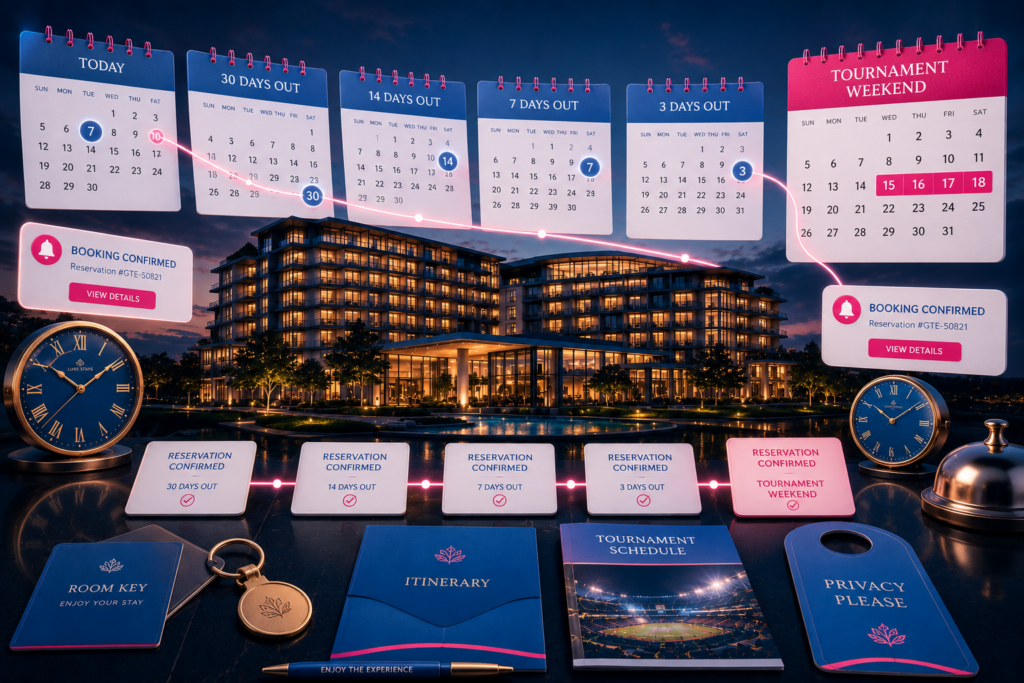
- Major national tournaments / high-demand cities: start 4–6 months out.
- Regional tournaments: 2–3 months.
- Local or single-game trips: 4–6 weeks is usually fine.
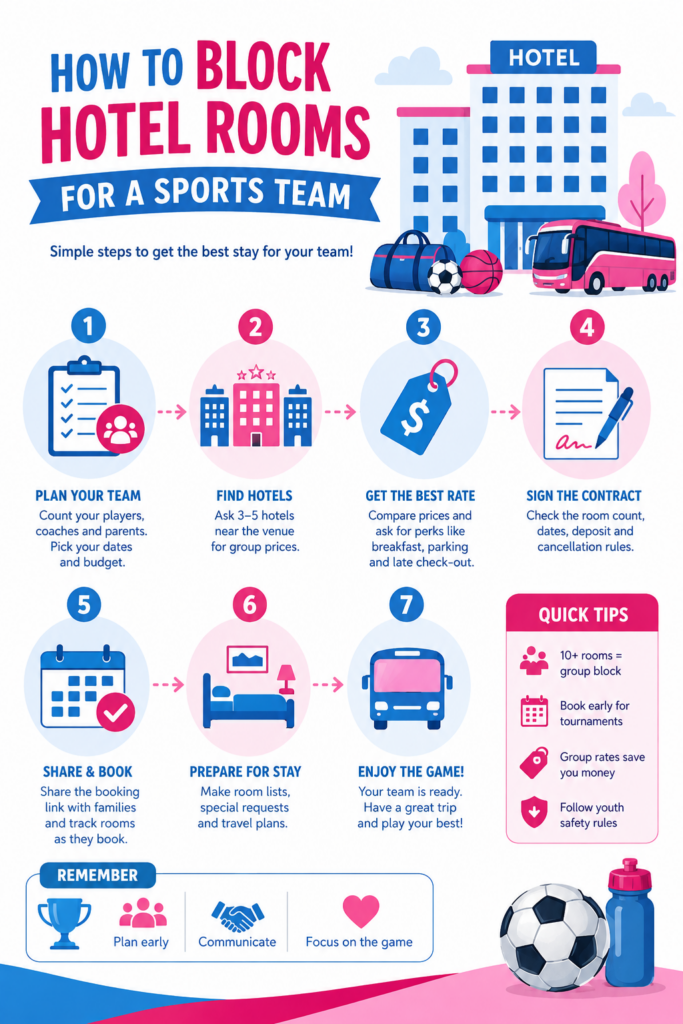
A simple 30-room timeline runs like this: set dates and budget, shortlist hotels, send RFPs to 3–5 of them, compare and negotiate, sign and pay the deposit (usually one night), share the booking link, monitor pickup, submit the final rooming list 7–14 days out, then release unused rooms at the cut-off.
Negotiating the group rate and perks
Group rates typically run 20–30% below standard rates, and hotels expect to give something to win the business. Lead with a clear, detailed request and let hotels compete.
Ask for:
- Complimentary breakfast and free/bus parking
- A comp meeting room for briefings
- Late check-out on game day, early check-in on arrival
- One comp room per ~15–20 booked rooms (great for the head coach)
- Waived resort/amenity fees; kids stay free in existing bedding
Tip: point to a competing quote. “Another property offered us free breakfast and parking” is the single most effective sentence in a group-rate call.
The contract: clauses that protect your team
Read every line before signing. The ones that cost teams money:
- Block details & cut-off date: exact room count/types by date, and when unused rooms are released.
- Attrition (~20%): you commit to filling ~80% of the block. Require the hotel to resell unused rooms and credit that revenue against your penalty. Negotiate on total room-nights, not per night.
- Deposit & payment: often one night’s revenue up front; balance by the cut-off.
- Cancellation: graduated by date (lighter far out, heavier inside 30 days). Push for a one-time rebook/credit option instead of 100% forfeiture.
- Force majeure: broad language (disasters, government orders, pandemics) with the right to move dates, not just refund.
- ADA: the hotel must reserve and describe accessible rooms; hold the number your team needs.
- Indemnification: make it mutual (each party covers its own negligence), not one-sided against the organizer.
Booking direct vs. a third-party service
| Channel | Best for | Trade-off |
| Direct with the hotel | Small teams, time to negotiate, loyalty perks | Time-consuming; less bargaining power on small blocks |
| Third-party block service (Engine, Groups360) | Tournaments, large teams, one RFP to many hotels | Possible fees; less direct control |
| Sports travel agent | Teams wanting airfare/tours bundled | ~10% commission, sometimes baked into the rate |
Copy-paste: initial hotel email
Subject: Hotel Room Block Inquiry: [Team], [Dates]
Hi [Sales Manager], I coach the [Team Name] [sport] team competing at [Venue] in [City] from [check-in] to [check-out]. We expect about [X] people and need roughly [Y] rooms (singles and doubles). Could you send your best group rate and terms, including breakfast, parking, and meeting space, plus a flexible release date and any team perks (game-day late check-out, a coach comp room)? We plan to decide by [deadline]. Thanks!
[Name, role, phone/email]
Pre-sign checklist
- Block dates, room mix, cut-off date
- Group rate locked through release (taxes/fees stated)
- Deposit amount and final-payment date
- Attrition ~20% with resale credit
- Cancellation penalties by date + rebook option
- Broad force majeure with date-change rights
- Perks in writing (breakfast, parking, comps)
- ADA rooms reserved; youth-supervision clause if minors
- Mutual indemnification / insurance certificate
Key takeaways
- 10+ rooms/night = a group block; hold 10–20% over roster.
- Tournaments: book 4–6 months out; single games: a few weeks.
- Group rates run 20–30% below standard; always get competing quotes.
- The attrition, cancellation, and force-majeure clauses are where money is won or lost.
- Youth teams: follow SafeSport (no adult–minor room sharing, ~1 chaperone per 5–8 players).
Frequently Asked Questions
How many hotel rooms is considered a group block? ▾
Generally 10 or more rooms per night. Chains let you book about 10–25 online; larger blocks go through group sales.
How far in advance should I book a team hotel block? ▾
4–6 months for major tournaments, 2–3 months for regional events, and 4–6 weeks for local or single-night trips.
What is attrition in a hotel contract? ▾
The share of your block you’re allowed to leave unsold without penalty, usually about 20% (an ~80% pickup commitment). Ask the hotel to resell unused rooms and credit you.
Do sports teams get discounted hotel rates? ▾
Yes. Group rates typically run 20–30% below standard rates, often with free breakfast, parking, and a comp room for the coach.
What deposit do hotels require for a room block? ▾
Commonly one night’s room revenue at signing, with the balance due by the cut-off date. Some hotels will take a smaller deposit if you ask.
What are the rules for booking youth team hotels? ▾
Follow SafeSport: no adult shares a room with a minor athlete, roughly one chaperone per 5–8 players, written parental consent, and two-adult room checks.
Should I book direct or use a group-booking service? ▾
Direct gives the most control and loyalty perks for smaller teams; a third-party service saves time and often unlocks better rates for tournaments and large groups.
Compare vendors for your next event
Search caterers, photographers, florists, planners, and rentals — then send one request to several vendors at once.