Quick answer: A rack rate is a hotel’s standard, pre-established rate for a room type, set before any discount. Attendees booking inside a contracted room block pay the group rate instead. To judge a group offer, compare it with the best available rate (BAR) for your exact dates, then compare total cost per room night: rate, taxes, and mandatory fees.
Example scenario (fictional): An agency has two proposals for a client’s 40-room, three-night block. Hotel A says its group rate is $110 a night off rack. Hotel B says $60 off rack. Hotel A looks better. Worked out on total cost below, Hotel B costs less. Every number in this scenario and in the worked example is invented to show the arithmetic.
This is for US professional planners and agencies comparing hotel room block proposals for client meetings, conferences, incentive groups, and team travel, and for the hotel and venue sales managers who write those proposals. It covers what each rate means and how to compare offers. Running a block across several hotels, with pickup reports and sub-blocks, is in our guide to managing conference room blocks. The fee rule discussed below is summarized for planning, not as legal advice.
What is a rack rate?
The Events Industry Council glossary defines rack rate as a “facility’s standard, pre-established guest room rates.” HSMAI’s glossary adds the hotel’s view: the rack rate is the standard price the hotel assigns to a room type for the year or season, and other rates are calculated from it, as discounts below it or premiums above it. Hoteliers treat it as the benchmark rate for that room type.
HSMAI’s entry for best available rate says BAR replaced rack rates as revenue management became more dynamic. A hotel can still have a rack rate on file, but the public price for your nights moves with demand. Peak nights can be priced above rack; HSMAI’s example is New Year’s Eve.
Rack rate vs. BAR vs. group rate vs. negotiated rate
These four rates come up in most room block proposals. Only the group rate is the offer you are judging; the other three are reference points.
| Rate | What it is | Who books at it | Does it change? | Use as a benchmark for a group offer |
|---|---|---|---|---|
| Rack rate | The hotel’s standard, pre-established rate for a room type (Events Industry Council). Set for the year or season (HSMAI). | In principle, anyone. It is often not the live public price. | Set for the year or season. Other rates are calculated from it. | Weak. A large discount off rack can still be close to what the public pays that week. |
| Best available rate (BAR) | The publicly available rate hotels use as a baseline for comparison (HSMAI). GBTA describes it as the lowest publicly available rate at a hotel on a given date. | Any guest booking on public channels, including attendees who book outside your block. | Yes. It moves with demand. | Strong, if you check it for your exact dates and room type. |
| Group rate | A confirmed rate extended to attendees booking their rooms as part of a group room block (Events Industry Council). | Attendees booking inside the block, or the planner by rooming list. | Confirmed in the group contract for the block dates. Read the wording. | This is the offer. Compare it with BAR and on total cost. |
| Corporate negotiated rate (local negotiated rate, or LNR) | A rate a company negotiates for its own business travelers. It can be a fixed rate or a discount off BAR, which GBTA calls a dynamic rate. | Individual travelers using the company’s rate code. | Fixed rates hold for the agreed term. Dynamic rates move with BAR. A non-last-room-availability rate can close when the hotel is nearly full (GBTA). | A useful reference. It is priced for individual trips, not for a block on set dates. |
Whether a corporate event should use the client’s negotiated rate or a group rate is a separate decision, covered in our guide to booking a hotel room block for a corporate event.
Why rack rate is a weak benchmark for a group offer
A discount off rack measures the gap between the group rate and the hotel’s list price. Your attendees will measure it against what they could pay on the same nights, and so should you.
- Rack is set by each hotel, for its own room types. Two hotels’ rack rates are not a common yardstick, so “$110 off rack” and “$60 off rack” cannot be compared directly.
- BAR for your dates can be far below rack on a slow week, or above it on a peak night. A group rate that looks generous against rack can be close to BAR, or even above it.
- Rack and BAR are room rates. Taxes and any mandatory resort, destination, or amenity fee sit on top, and they differ by hotel and city.
For budget ranges by hotel category, use the rack and group rate table in our guide on how to book a hotel room block. That table is for early budgeting. Once you have proposals, replace it with BAR for your dates and each hotel’s actual fees.
How to compare two group offers: a worked example (fictional)
This example is fictional. The rates, fee, and tax are invented to show the method. They are not quotes, and they are not US averages. Both hotels are offering the same room type for the same three nights, 40 rooms a night, which is 120 room nights. For this example only, a 15% tax applies to the room rate and to the mandatory fee. Check each hotel’s actual taxes, and whether they apply to fees, property by property.
| Line (fictional) | Hotel A | Hotel B |
|---|---|---|
| Rack rate | $329 | $289 |
| BAR for your dates, checked the same day | $249 | $259 |
| Group rate offered | $219 | $229 |
| Discount off rack, as advertised | $110 a night | $60 a night |
| Group rate below BAR | $30 a night | $30 a night |
| Mandatory fee per room night | $25 destination fee | None |
| Rate plus mandatory fee | $244 | $229 |
| Tax at 15% (fictional) | $36.60 | $34.35 |
| Total cost per room night | $280.60 | $263.35 |
| Total for 120 room nights | $33,672.00 | $31,602.00 |
Against rack, Hotel A looks $50 a night better. Against BAR, the two offers are identical: each is $30 below the public rate for those nights. On total cost, Hotel B is $17.25 less per room night ($280.60 minus $263.35), or $2,070 across the block ($33,672 minus $31,602), because of Hotel A’s destination fee and the tax charged on it.
Run the same math for an attendee who skips the block and books BAR. At Hotel A that is $249 plus the $25 fee, plus 15% tax, or $315.10 a night. At Hotel B it is $259 plus 15% tax, or $297.85. At both hotels the group rate saves that attendee $34.50 a night, so both offers are worth booking inside the block.
Then use the result in the negotiation. If Hotel A waived the destination fee for the group, its total would drop to $219 plus 15% tax, or $251.85 a night, which is $11.50 less than Hotel B. A fee waiver can be worth more than another $10 off the rate, so ask for both and compare the totals.

Room cost is one line of the meeting. To compare full proposals with meeting space, food and beverage, service charges, and taxes, use our hotel proposal comparison template.
When attendees find a lower rate online
BAR moves with demand after you sign. If the hotel’s public rate for your dates drops below the group rate, attendees who check online may book outside the block. They pay less that night, and your pickup falls short of the contract, which is where attrition exposure starts.
Ask for that risk to be handled in the contract. A rate protection clause, where the hotel agrees not to offer a lower public rate for the same room type over your dates while the block is open, is one of the hotel contract concessions worth requesting. Ask too whether the group rate will still apply to rooms booked after the cutoff if the hotel has rooms left, and whether it covers the shoulder nights before and after the meeting.
The Federal Trade Commission’s Rule on Unfair or Deceptive Fees took effect May 12, 2025. It requires any business that offers, displays, or advertises a price for short-term lodging, including hotels, to show the total price clearly, and more prominently than other pricing information. That total includes mandatory fees, but government charges such as taxes may be left out. In its Federal Register notice, the FTC said the rule covers business-to-business transactions as well as sales to consumers. For your comparison, this means a total price shown on a hotel’s public site will usually include mandatory fees but may exclude taxes. Add the taxes before you set it against your group total. Ask the hotel to list every mandatory fee in the proposal itself, and have counsel advise on how the rule applies to a specific contract.
Rate notes by segment
Every segment uses the same comparison. Who pays the folio changes which number the client watches.
Corporate meetings
The client may already have a negotiated rate at the property. That rate is built for individual trips, so ask the hotel to quote a group rate for the block as well, and compare both with BAR for your dates. When the company pays the rooms, the total cost per room night is the number finance will see.
Associations and conferences
Attendees usually book and pay for their own rooms, so they will compare your group rate with what they find online. BAR for the meeting dates, rate protection, and the cutoff carry the most weight here, because they decide whether attendees book inside the block.
Sports teams
Team blocks use the same comparison. Check BAR for the tournament dates themselves, not a typical weekend, because BAR moves with demand. Rooming lists, late additions, and team-specific block terms are covered in our guide to blocking hotel rooms for a sports team.
Incentive groups
The client usually pays for the whole stay, so every mandatory fee lands on the client’s bill. Total cost per room night, including any resort fee and the tax on it, is the figure to compare, and fee waivers are worth asking for alongside the rate.
The hotel side: why hotels still publish a rack rate
For the hotel, rack is the reference point for a room type. HSMAI’s example is a group of 20 rooms quoted at a discount off rack, and a peak night such as New Year’s Eve priced at a premium above it. Revenue managers set BAR day by day against demand, and group sales quotes a group rate for the block’s dates.
For hotel and venue sales managers, a proposal that leads with “off rack” invites the comparison problem above. Planners can compare offers faster when the proposal shows the group rate next to the current BAR for the same dates and room type, lists every mandatory fee per room night, and says which taxes apply to the rate and to each fee.

Checklist: rate questions for every room block proposal
Copy this into your request for proposal, or send it to each hotel with your dates and room pattern.
ROOM BLOCK RATE CHECKLIST
Client: ______________  Event: ______________  Dates: ______________
Hotel: ______________  Sales contact: ______________  Proposal date: ______

1. RATES
[ ] Group rate, by night and room type
[ ] BAR for the same dates and room type, checked on: ______
[ ] Rack rate (for reference only)
[ ] Rate for shoulder nights before and after the main nights

2. FEES AND TAXES
[ ] Every mandatory fee per room per night (resort, destination, amenity, other)
[ ] Which fees will be waived or reduced for the group, in writing
[ ] Each tax, its rate, and whether it applies to the fees as well as the room rate
[ ] Total cost per room night = rate + taxes + mandatory fees

3. RATE PROTECTION
[ ] Hotel will not offer a lower public rate for the same room type over our dates while the block is open
[ ] What happens if it does
[ ] Group rate after the cutoff, if rooms remain
[ ] Group rate honored for the shoulder nights

4. COMPARISON
[ ] Total for the block = total cost per room night x room nights
[ ] Attendee saving vs. booking BAR outside the block, including fees and tax
[ ] Same room type, same nights, and same date of BAR check for every hotel

5. SIGN-OFF
[ ] Client approved the rate comparison on: ______
[ ] Counsel reviewed rate protection and fee language on: ______
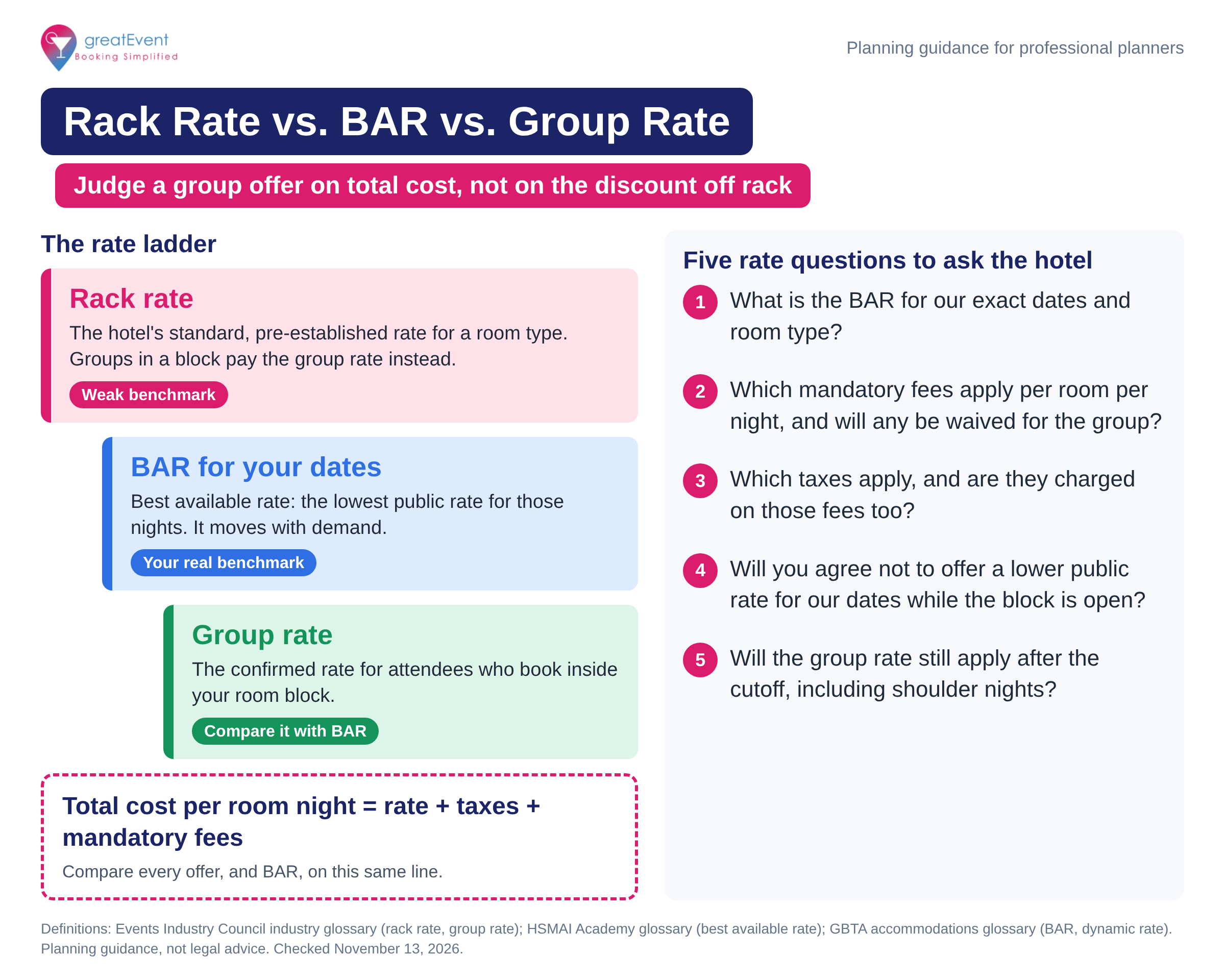
Text version of the infographic: Rack rate vs. BAR vs. group rate. Judge a group offer on total cost, not on the discount off rack. The rate ladder: rack rate is the hotel’s standard, pre-established rate for a room type, and groups in a block pay the group rate instead, so it is a weak benchmark. BAR for your dates is the best available rate, the lowest public rate for those nights, and it moves with demand, so it is your real benchmark. The group rate is the confirmed rate for attendees who book inside your room block; compare it with BAR. Total cost per room night = rate + taxes + mandatory fees; compare every offer, and BAR, on that same line. Five rate questions to ask the hotel: what is the BAR for our exact dates and room type; which mandatory fees apply per room per night, and will any be waived for the group; which taxes apply, and are they charged on those fees too; will you agree not to offer a lower public rate for our dates while the block is open; will the group rate still apply after the cutoff, including shoulder nights. Definitions from the Events Industry Council, HSMAI Academy, and GBTA glossaries.
Compare hotels, venues, and vendors on greatEvent
Start once you know your dates, room pattern, and meeting space needs, because those decide which hotels can quote at all.
On greatEvent, start a venue search with the meeting type, location, dates, and attendee count. You can compare hotels and venues side by side, check real-time availability, or send one inquiry to several venues and get quotes back. Ask each hotel for its group rate, BAR for your dates, and every mandatory fee on the same line, so the offers compare cleanly. You can also find your vendors and suppliers on greatEvent, from caterers for a welcome reception to transportation for arrival day.
There are no fees for planners. We pay you commission on any qualifying booking you make on greatEvent.
Register as a professional planner
Frequently asked questions
What is a rack rate in a hotel?
▾
A rack rate is a hotel’s standard, pre-established rate for a room type, usually set for the year or season. Hotels calculate their other rates from it, as discounts below it or premiums above it.
Does anyone actually pay the rack rate?
▾
Some guests do, but it is often not the live price. Public guests usually see the best available rate, which moves with demand and can be below or above rack. Attendees booking inside a contracted room block pay the group rate.
What is the difference between rack rate and BAR?
▾
Rack rate is the hotel’s standard list price for a room type. BAR, the best available rate, is the lowest public rate for a specific date and changes with demand. For a group offer, BAR on your dates is the better benchmark.
Is a group rate always lower than BAR?
▾
Not always. BAR can drop below the group rate after the contract is signed, and attendees may then book outside the block. Ask for a rate protection clause so the hotel does not offer a lower public rate for your dates while the block is open.
How do you compare two group rate offers?
▾
Compare total cost per room night: the group rate plus taxes plus every mandatory fee, for the same room type and nights. Then multiply by room nights. A bigger discount off rack can still cost more once fees and taxes are added.
Is a corporate negotiated rate the same as a group rate?
▾
No. A corporate negotiated rate is priced for a company’s individual business travelers. A group rate is quoted for one event, on set dates, for a block of rooms, and comes with contract terms such as a cutoff and attrition.
Research and sources
Sources were checked on November 13, 2026. The opening scenario and the worked example are fictional: the rates, fee, and 15% tax are invented to show the arithmetic and are not quotes or US averages. The rate table and checklist are planning guidance. The fee rule summary is not legal advice. No discount ranges or industry percentages are stated in this post.
- Events Industry Council, Industry glossary, “Rack Rate” and “Group Rate,” read November 13, 2026.
- HSMAI Academy, Glossary of Hospitality Terms, “Rack rate” and “Best Available Rate,” read November 13, 2026.
- Global Business Travel Association, Accommodations toolkit glossary (BAR, Dynamic Rate, LRA / NLRA), read November 13, 2026.
- Federal Trade Commission, Rule on Unfair or Deceptive Fees, 16 CFR Part 464 (eCFR, up to date as of November 10, 2026), read November 13, 2026.
- Federal Trade Commission, “Trade Regulation Rule on Unfair or Deceptive Fees,” Federal Register, 90 FR 2066, January 10, 2025, effective May 12, 2025, including the discussion of business-to-business transactions, read November 13, 2026.
Compare vendors for your next event
Search caterers, photographers, florists, planners, and rentals — then send one request to several vendors at once.