Quick answer: Hotel contract concessions are the extras a hotel gives your group in return for its business: comp rooms, upgrades and suites, reduced or waived meeting room rental, waived fees for Wi-Fi, parking, or resort charges, staff rates, a later cut-off date, and softer attrition, cancellation, and deposit terms. Ask for the ones your client would otherwise pay for, put a dollar value on each, and compare the full package with a simple rate cut. Then make sure every concession is written into the signed contract with its conditions, and check that it shows up on the final bill.
Example scenario (fictional): An agency planner is finishing a contract for a three-night sales meeting. The hotel’s proposal email promised two suite upgrades for the client’s executives, free Wi-Fi in the meeting rooms, and a “flexible” cut-off date. The contract draft that arrives a week later mentions the comp room ratio and the food and beverage minimum, and nothing else. The suites, the Wi-Fi, and the cut-off date are still only in an email from a sales manager who may not be there when the event happens. Getting them into the contract takes one more round of edits. Finding out at check-in that they were never there would cost the client real money.
This guide is for professional planners and agencies negotiating hotel group contracts for clients: corporate meetings, conferences, incentive trips, weddings, and sports team travel. It covers which concessions to ask for, how to put a dollar value on each one, a fictional worked example with the math shown, how to write concessions into the contract, how to handle commissions, rebates, and planner loyalty points openly, and how to check the final bill. It ends with a copyable concession request checklist. Contract points here are planning information, not legal advice. Have your client or counsel review any agreement before signing.
In this guide:
- What counts as a hotel concession
- Concessions to ask for, by category
- Contract terms that work as concessions
- How to put a dollar value on concessions
- Worked example (fictional)
- How to write concessions into the contract
- Commissions, rebates, and planner points
- What changes by client type
- Check the final bill against the contract
- Concession request checklist
What counts as a hotel concession?
The Events Industry Council’s APEX glossary defines concessions as a “contractual agreement where one party provides something of value to the other party in exchange for something else, pending certain conditions.” HSMAI’s sales glossary puts it from the hotel’s side: a concession is a “cost or consideration given by a seller to motivate the buyer to complete the purchase.”
Two words in those definitions matter for planners. “Exchange” means the hotel expects something back, usually room nights, catering spend, or dates it needs to fill. “Conditions” means most concessions depend on something your group has to deliver. A comp room ratio pays out only on rooms actually picked up. Waived meeting room rental often depends on hitting a food and beverage minimum. If the condition isn’t met, the concession can disappear, so know the condition before you count the value.

Concessions to ask for, by category
Not every group needs every item. Start from what your client would pay for anyway, then ask. The table groups the common asks and shows what to pin down for each.
| Concession | What to ask for | What to pin down in writing |
|---|---|---|
| Comp rooms | Complimentary room nights earned on paid room nights, written as a ratio such as 1/50 | Cumulative or per night, which rate the comp applies to, whether it can be taken as a credit, and whether comps count toward pickup |
| Upgrades and suites | Named suites or upgraded rooms for executives, speakers, or the couple, at the group rate or as comps | Room type, number, nights, and whether the hotel may substitute |
| Staff and speaker rooms | A reduced rate for working staff, or a set number of comp nights | How many, which nights, and whether they sit inside or outside the block |
| Rate extension | The group rate for a set number of days before and after the main dates | Number of days, subject to availability or guaranteed |
| Meeting room rental | Reduced or waived rental tied to room pickup or catering spend | The exact condition, and what rental you owe if pickup or spend falls short |
| Food and beverage | A minimum that fits your real menu, or credit toward it from other spend | Whether service charge and tax count toward the minimum (HSMAI defines the minimum without them) |
| Wi-Fi | Complimentary guest room Wi-Fi for attendees, and Wi-Fi in the meeting rooms | Speed tier, number of connections, and which rooms |
| Parking | Waived or reduced self-parking or valet for attendees | Daily or overnight, and how the discount is applied at checkout |
| Resort or amenity fees | Waived or reduced mandatory daily fees | That the waiver applies to every room in the block, without attendees having to ask |
| Early check-in and late checkout | Guaranteed times for VIPs or staff, or for the whole group on arrival and departure days | Which rooms and what time |
For a side-by-side look at how rental and catering minimums trade against each other, see our guide to the food and beverage minimum vs room rental.
Mandatory fees should be easier to spot in quotes now. Since May 12, 2025, the FTC’s rule on unfair or deceptive fees has required businesses that advertise short-term lodging to show the total price, including mandatory fees (government charges can be shown separately), and the final rule says it covers business-to-business sales too. The rule puts the fee in the quote, though you still have to negotiate to get it waived.
Contract terms that work as concessions
Some of the most valuable concessions are changes to the terms that decide what your client owes if things go differently than planned.
Attrition: cumulative vs daily
APEX defines attrition as the difference between the rooms (or food and beverage, or revenue) actually used and the amount agreed in the contract, noting that a shortfall limit, or “slippage,” is often allowed before damages apply. Ask for that allowance as a room-night number, and ask for it to be measured cumulatively across the whole stay rather than night by night. The worked example below shows why the difference matters. Our guide to room block attrition and shortfall covers damage formulas and resale credit in depth.
Cut-off date and review dates
The cut-off date is when the hotel releases unsold block rooms to the public. A later cut-off gives attendees more time to book at the group rate. Also ask for one or two review dates before cut-off, where you can release rooms you won’t need without counting them against attrition, and ask whether the hotel will honor the group rate after cut-off for rooms it still has available.
Rate protection
Ask the hotel to agree that it won’t offer a lower public rate for the same room type over your dates while your block is open, and to say what happens if it does. Without that, attendees may find a cheaper rate on their own, book outside the block, and leave your pickup short.
Resale and room audit
Ask that rooms the hotel resells after you fall short count toward reducing attrition damages. Ask for a room audit too, which APEX describes as a process to identify attendees who stay at the hotel outside the contracted block. Write in that attendees found this way are credited to your pickup. You’ll usually need to send a registration list for the hotel to check against.
Early departure fees
An early out is a guest who checks out one or more days before the scheduled departure. A hotel may charge a fee for this, and Hilton’s Honors terms note that early departure fees “may apply and vary by hotel.” Ask for the fee to be waived for your group, or at least disclosed at check-in, so an attendee who leaves a day early isn’t surprised.
Deposits, cancellation, and force majeure
A smaller first deposit and a later payment schedule help your client’s cash flow. A cancellation clause outlines damages owed if one side cancels; ask for a sliding scale tied to how far out the cancellation happens, and for a credit toward a future booking as an alternative to cash damages. The APEX entry for a force majeure clause describes it as excusing performance when an event beyond either party’s control makes performance “impracticable or impossible.” Read the list of covered events, the notice steps, and what happens to deposits. If your client wants to reduce or cancel a block before signing anything else, see how to cancel or reduce a hotel room block. This is planning information, not legal advice. Have counsel review these clauses.
Accessible rooms
The ADA regulation at 28 CFR 36.302(e) already requires hotels to describe the accessible features of their rooms and to hold accessible rooms for guests with disabilities until other rooms of that type are rented. It also requires hotels to reserve, upon request, accessible guest rooms and make sure they are “blocked and removed from all reservations systems.” You don’t have to trade for these rooms, but you do have to ask in time: list the number and type of accessible rooms your group needs in the block, and confirm in writing how they will be held for your attendees.
How to put a dollar value on concessions
A list of concessions is hard to compare across hotels. A dollar figure is easier. Use the formulas below on the room nights you expect to pick up, not on the full block, and only count items your client would have paid for.
| Concession | How to value it |
|---|---|
| Comp room nights | Number of comp nights earned on expected pickup, times the group rate |
| Waived daily fee | Fee per room night, times expected paid room nights |
| Parking discount | Discount per car per night, times expected car nights |
| Waived meeting room rental | The rental amount, only if you expect to meet the condition |
| Suite or upgrade | Difference between the suite rate and the group rate, times nights, times rooms |
| Staff rate | Difference between the staff rate and the group rate, times staff room nights |
| Rate cut (for comparison) | Dollars off per night, times expected paid room nights |
Two habits keep the numbers honest. Count each concession once, in one place, so a waived fee doesn’t also show up as a lower total rate. And value risk terms separately. A softer attrition clause has no dollar value if pickup goes to plan, but it can be worth more than everything else on the list if it doesn’t.
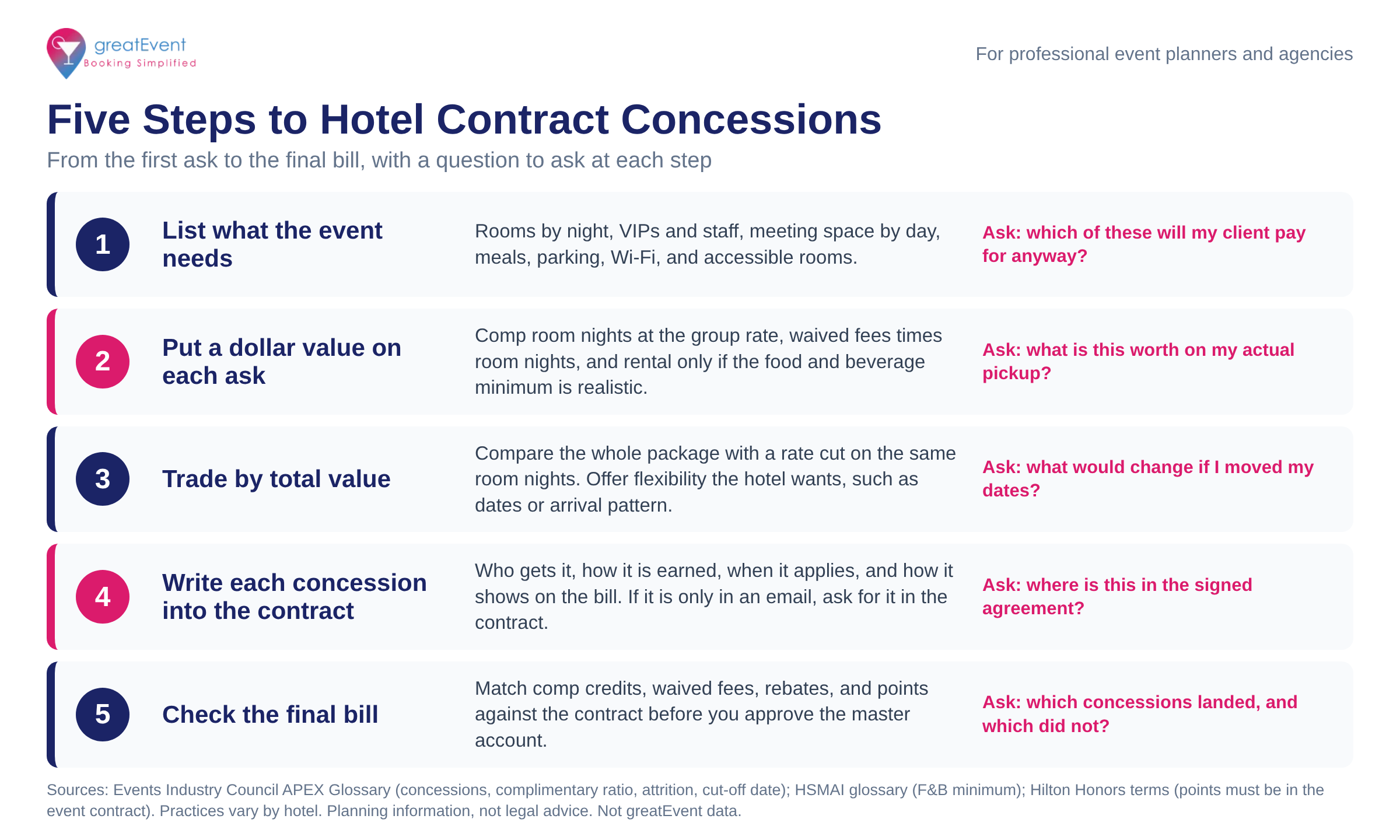
Text version of the infographic:
- List what the event needs: rooms by night, VIPs and staff, meeting space by day, meals, parking, Wi-Fi, and accessible rooms. Ask which of these your client will pay for anyway.
- Put a dollar value on each ask: comp room nights at the group rate, waived fees times room nights, and rental only if the food and beverage minimum is realistic.
- Trade by total value: compare the whole package with a rate cut on the same room nights, and offer flexibility the hotel wants, such as dates or arrival pattern.
- Write each concession into the contract: who gets it, how it is earned, when it applies, and how it shows on the bill.
- Check the final bill: match comp credits, waived fees, rebates, and points against the contract before you approve the master account.
Worked example (fictional)
All names and numbers here are invented to show the math. They are not market averages or greatEvent data.
A corporate client holds a three-night block: 60 rooms on night one and 120 rooms on nights two and three, for 300 contracted room nights. The group rate is $219. The planner expects 280 paid room nights. The hotel’s offer includes:
- One comp room night for every 40 paid room nights, counted cumulatively
- The $20 daily amenity fee waived for every room in the block
- Self-parking reduced by $20 a night, with about 60 car nights expected
- $6,000 meeting room rental waived if catering spend reaches a $30,000 minimum before service charge and tax, which the planned menus already exceed
- Two suites at the group rate for all three nights, where the suite rate would be $180 a night higher
- Four staff rooms for three nights at $159 instead of $219
| Concession | Math | Value |
|---|---|---|
| Comp room nights | 280 / 40 = 7 nights; 7 x $219 | $1,533 |
| Amenity fee waived | 280 x $20 | $5,600 |
| Parking discount | 60 x $20 | $1,200 |
| Meeting room rental waived | Condition expected to be met | $6,000 |
| Two suites at group rate | $180 x 2 suites x 3 nights | $1,080 |
| Staff rate | $60 x 4 rooms x 3 nights | $720 |
| Total package | $16,133 |
Now compare that with a competing hotel that offers $10 off the rate and no other concessions. On 280 paid room nights, that is $2,800. The fee waiver alone is worth twice as much. A lower headline rate looks better in a proposal summary, but in this case it would cost the client more.
The same block shows why the attrition basis matters. Say the contract lets pickup fall to 240 room nights in total before damages apply, set as 48, 96, and 96 rooms on the three nights. Actual pickup is 45, 118, and 117 rooms, or 280 room nights.
- Measured cumulatively: 280 is above 240, so no damages.
- Measured night by night: night one is 3 rooms below its floor of 48, so damages may apply to 3 room nights even though the total is fine. If the contract charged the group rate for each short room night, that would be 3 x $219 = $657 before tax. The actual formula depends on the contract.
Run the same check on your own contract before you sign, using the pickup you expect.
How to write concessions into the contract
If a concession only lives in a proposal or an email, treat it as unconfirmed. Brand programs work the same way. Hilton’s Group & Event Bonus terms say bonus points “must be included in the event contract” to be awarded. Hilton’s terms also say group reservations are not eligible for elite suite upgrades and may not get complimentary elite upgrades at all, so if your executives expect suites, get them named in the contract rather than relying on their loyalty status.
For each concession, the contract should answer five questions:
- What exactly is given: room type, number, nights, fee, or dollar amount.
- How it is earned: the ratio, minimum, or pickup level that triggers it, and how it is measured.
- When it applies: dates, and whether it survives a change to the block or dates.
- Who receives it: the client, named attendees, staff, or the master account.
- How it shows on the bill: a credit on the master account, a zero-rate room, or a fee removed from each folio.
Also ask what happens to each concession if the block is reduced: whether they shrink with the block or drop away entirely. Our hotel RFP guide for group bookings shows how to ask for concessions up front so the proposals you compare are built the same way.
Commissions, rebates, and planner points: keep them visible
Concessions that benefit the planner or agency rather than the client need to be handled in the open. Three are common:
- Commission: APEX defines a commission as a payment to a person or organization for bringing business to another. A net rate is a non-commissionable rate. Confirm in the contract whether the group rate is commissionable and to whom. Our guide to hotel group commission for planners covers how it is paid.
- Rebates: a dollar amount per room night returned to the client, the group, or the agency. Write down who receives it and when it is paid.
- Planner loyalty points: Marriott Bonvoy says members can earn points for eligible meetings and events they plan, with a cap per event. Hilton’s Group & Event Bonus awards points only to the person named in the event contract, excludes rebates and commissions from eligible spend, and says recipients booking for an employer must tell the hotel first if the points would break the employer’s policy.
Tell your client in writing about every commission, rebate, and point award tied to their event, and get their agreement before you sign. Some clients’ policies don’t allow it, which is why Hilton asks employees to tell the hotel first, so ask early.
What changes by client type
- Corporate meetings: suites for executives, staff rooms, Wi-Fi in meeting rooms, and a realistic food and beverage minimum usually matter most. Check the client’s travel policy on loyalty points and rebates before you ask for them.
- Conferences: attendees book their own rooms, so cut-off date, review dates, rate protection, and room audit carry the most weight. They protect pickup you don’t control.
- Incentive trips: the client usually pays for everything, so waived resort fees, parking, and upgrades add up fast. Value them on every room night.
- Weddings: guests pay for their own rooms, so ask whether the block can be set up with little or no attrition, a later cut-off, and a suite for the couple. Ask how the hotel handles guests who book outside the block.
- Sports teams: blocks follow the game schedule and can change late. Ask for early check-in, late checkout, a team meal room, and terms that let you release rooms if a team is eliminated. For team travel, the greatEvent sports booking site lets you search sports facilities and team hotels and hold a team room block with the rate and terms in front of you.
For how concessions fit into the full room block process, from the first estimate to the final pickup report, see our hub guide to managing conference room blocks.
Check the final bill against the contract
A concession you won is only worth something if it reaches the bill. Before you approve the master account, go line by line:
- Comp room nights: does the credit match the ratio applied to actual pickup?
- Waived fees: are amenity, resort, parking, and Wi-Fi charges removed from every attendee folio, not only the ones who asked?
- Meeting room rental: if it was waived on a condition, was the condition met, and is the rental at zero?
- Suites, staff rooms, and upgrades: billed at the contracted rate?
- Attrition: was pickup measured the way the contract says, with room audit and resale credits applied?
- Rebates and points: requested, with the amount and posting date confirmed? Hilton says bonus points can take 6 to 8 weeks after the event is paid in full to post.
Keep the contract, the final pickup report, and the bill together. They are also your best evidence when you negotiate the next contract with the same hotel.

Concession request checklist (copy and edit)
Paste this into your RFP or your contract redline notes. Delete what doesn’t apply.
HOTEL CONCESSION REQUEST - [Event name], [Dates]
Client: [Client]   Planner/agency: [Name]   Peak night: [Rooms]

ROOMS
[ ] Comp room nights: 1 per [__] paid room nights, cumulative,
    at the group rate, usable as a credit on the master account
[ ] Suites/upgrades: [number] x [room type], nights [__], rate [__]
[ ] Staff/speaker rooms: [number] at $[__], inside/outside block
[ ] Group rate [__] days before and after, guaranteed
[ ] Early check-in / late checkout for [rooms], times [__]
[ ] Accessible rooms: [number and type], held for our attendees

MEETING SPACE AND FOOD
[ ] Meeting room rental: $[__] or waived if [condition]
[ ] F&B minimum: $[__], before service charge and tax
[ ] Wi-Fi in meeting rooms: [speed], [connections]

FEES
[ ] Guest room Wi-Fi included for all attendees
[ ] Resort/amenity fee waived for every room in the block
[ ] Parking: $[__] per night, self/valet
[ ] Early departure fee waived or disclosed at check-in

TERMS
[ ] Attrition: pickup may fall to [__] room nights, measured
    cumulatively, with resale and room audit credit
[ ] Cut-off date: [date]; review dates: [dates]
[ ] Group rate honored after cut-off, space available
[ ] No lower public rate for the same room type over our dates
[ ] Deposits: [schedule]
[ ] Cancellation: sliding scale; future-booking credit option
[ ] Force majeure: covered events, notice, deposit handling
[ ] What happens to each concession if the block is reduced

MONEY FLOWS (disclosed to client in writing)
[ ] Commissionable to: [__]   Rebate: $[__] per room night to [__]
[ ] Loyalty points to: [name], approved by client: yes/no
Book hotel room blocks and venues on greatEvent
Concessions are easier to compare when every hotel quotes against the same brief. On greatEvent, planners can book venues, meeting space, and hotel room blocks for their clients’ events, and find event vendors such as caterers, photographers, and entertainment. You can send one detailed inquiry to multiple venues and get quotes back, then add services and a hotel room block and finalize the details with your event specialist, so your vendors and suppliers all work from the same facts.
There are no fees for planners. We pay you commission on any qualifying booking you make on greatEvent.
Register as a professional planner
Frequently asked questions
What concessions should I ask for in a hotel contract?
▾
Start with what your client would pay for anyway: comp rooms, suites or upgrades, staff rates, meeting room rental, Wi-Fi, parking, and resort fees. Then ask for softer terms on attrition, cut-off date, deposits, and cancellation.
What is a typical comp room ratio?
▾
It varies by hotel, dates, and how much the hotel wants your business, so there is no single standard. It is written as one comp room night per a set number of paid room nights, such as 1/50. Ask for it to be counted cumulatively.
Is cumulative attrition better than daily attrition?
▾
Usually, for the planner. Cumulative attrition measures pickup over the whole stay, so a weak night can be offset by a strong one. Daily attrition can trigger damages on a single short night even when the total is fine.
Can a hotel take back a concession?
▾
It can if the condition attached to it is not met, such as a pickup level or a food and beverage minimum. Read what happens to each concession if the block is reduced, and get every concession into the signed contract.
Should I tell my client about rebates and loyalty points?
▾
Yes. Disclose every commission, rebate, and point award tied to the event in writing and get the client’s agreement before signing. Some clients’ policies do not allow them.
Research and sources
Sources were checked on October 29, 2026. The opening scenario and the worked example are fictional, and their numbers are not market averages or greatEvent data. Hotel practices and brand program terms vary and change. Contract points are planning information, not legal advice.
- Events Industry Council, APEX Industry Glossary, insights.eventscouncil.org: concessions, complimentary ratio, attrition, cut-off date, reservation review date, room audit, early out, cancellation clause, force majeure clause, commission, net rate, master account.
- HSMAI, “Build Your Business Acumen: 108 Terms” (PDF). Concession and F&B minimum.
- U.S. Department of Justice ADA regulations, 28 CFR 36.302(e), reservations made by places of lodging, ecfr.gov.
- Federal Trade Commission, Rule on Unfair or Deceptive Fees, 16 CFR Part 464, ecfr.gov, and the final rule in the Federal Register (January 10, 2025; effective May 12, 2025).
- Hilton, Hilton Honors Terms and Conditions (effective July 15, 2026), Group & Event Bonus and elite upgrade sections.
- Marriott, Marriott Bonvoy Events, marriott.com.
Compare vendors for your next event
Search caterers, photographers, florists, planners, and rentals — then send one request to several vendors at once.