Quick answer: A hotel group commission is a percentage of the group’s room revenue that the hotel pays to a qualified third-party agency after the event. The major brands pay it only on rooms guests actually use, at a commissionable rate, inside the contracted block. Food and beverage, meeting room rental, and attrition or cancellation fees usually don’t count. Rates vary by brand: Hilton publishes 7% for US and Canada hotels, and Wyndham’s brand document shows 10% of actualized room revenue. So write the rate and terms into the group contract, tell your client how you’re paid, and invoice on time.
Your agency signs a 120-room-night block for a client’s sales kickoff. The contract looks clean. Six weeks after checkout you’re still waiting on the commission, and when it arrives it’s smaller than you expected. Only 100 room nights picked up, and the hotel paid on those, not on the block you signed.
This is for US event agencies, third-party meeting planners, and independent planners who place hotel room blocks for clients. It covers how group commissions work in practice and what three major brands publish about them. It’s planning information, not legal or tax advice. Have your attorney and accountant review contract language and how you report commission income.
Commission vs. rebate vs. net rate
Proposals often mix up these three terms, and the mix-up costs money. A commission pays the intermediary for placing the business. A rebate returns money to the client or its event, often a flat amount per room night. A net rate is a non-commissionable rate. The agency earns nothing from the hotel and charges the client a service fee instead.
| Model | Who receives the money | How it’s usually figured | What to confirm |
|---|---|---|---|
| Commission | The agency (intermediary) | A percentage of consumed room revenue | Rate, eligible rooms, and payment process in the group contract |
| Rebate | The client or event, sometimes collected by the agency for the client | A percentage of room revenue or a flat amount per room night | Whether the brand allows it alongside commission |
| Net rate | No one. The room rate is simply lower | Not applicable | Your fee agreement with the client covers your work |
Brands draw hard lines here. Hilton’s FastPay page says Hilton won’t process a 7% commission plus a rebate when the combined payment goes to the intermediary as total compensation. Its invoice guide allows rebates through FastPay only when the contract says the intermediary is collecting the rebate on behalf of the end-user client to offset the event’s cost. Marriott processes commission on eligible rooms “less any rebates to the end-user or housing bureau/association.”
What three major brands publish today
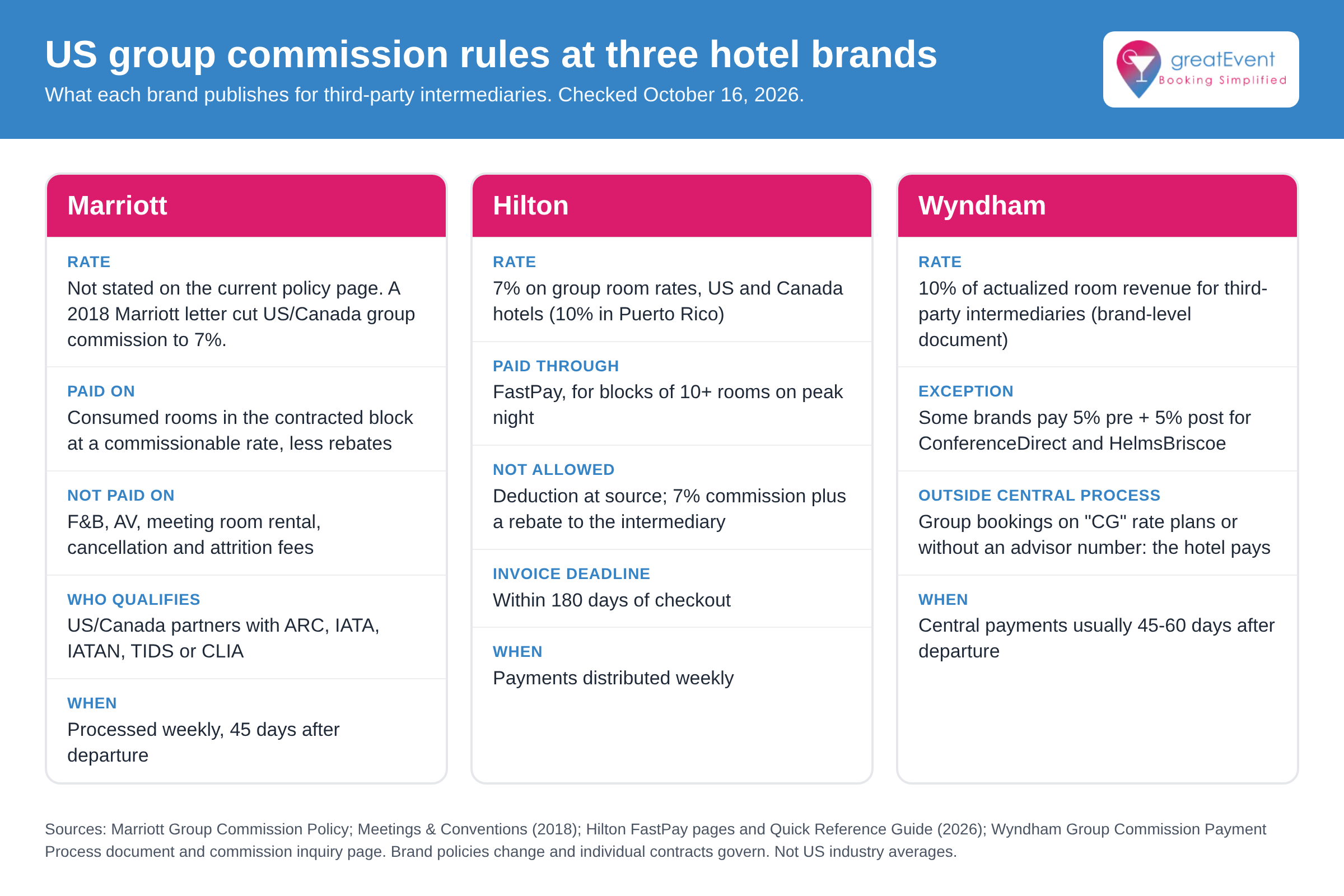
We checked each brand’s own pages on October 16, 2026, and this is what they said. Treat them as brand policies rather than US industry averages. The signed group contract always governs.
| Brand | Rate published | Paid on | Payment timing |
|---|---|---|---|
| Marriott | Not stated on the current policy page. Marriott’s 2018 letter cut US and Canada group commission from 10% to 7% for contracts signed from March 31, 2018. Confirm current terms with the property. | Consumed reservations in the contracted block at a commissionable rate, less rebates | Processed weekly, 45 days after group departure, for US and Canada intermediaries |
| Hilton | 7% on group room rates for US and Canada hotels; 10% in Puerto Rico | Group blocks of 10 or more rooms on peak night, through FastPay | Invoice within 180 days of checkout; payments go out weekly |
| Wyndham | 10% of actualized room revenue for third-party intermediaries, per a brand payment-process document; some brands pay 5% before and 5% after the event for ConferenceDirect and HelmsBriscoe | Actualized room revenue | Central commissions usually paid 45-60 days after departure |
Eligibility matters as much as the rate. Marriott’s central process pays US and Canada partners with an active ARC, IATA, IATAN, TIDS, or CLIA accreditation, and it doesn’t pay end-user accounts booking for themselves, even with an accreditation number. Wyndham says group reservations made directly with a hotel on a rate plan starting with “CG,” or without a travel advisor number, fall outside its central process, so the hotel itself owes that payment.
What is and isn’t commissionable
Assume rooms only unless the contract says otherwise. Marriott’s policy is explicit: for US and Canada intermediaries, no commission on food and beverage, audio/visual, meeting room rental, cancellation fees, attrition fees, or any other non-room item. Wyndham’s document notes that for events held in EMEA, the commission base can include food and beverage and rental. That’s an EMEA exception and doesn’t apply to US events.
Your commission follows pickup. Every brand above pays on rooms guests actually used, so attrition hits you twice. The client may owe an attrition fee, and your commission shrinks with the pickup. If attrition is new territory, read how room block attrition shortfalls are calculated before you set the block size.
Take a hypothetical block (not a quote from any hotel) of 120 room nights at $200, with commission set at 7% in the contract.
| Hypothetical scenario | Room nights | Room revenue | Commission at 7% |
|---|---|---|---|
| Full pickup | 120 | $24,000 | $1,680 |
| Actual pickup | 100 | $20,000 | $1,400 |
| Difference | 20 | $4,000 | $280 |
Rooms booked outside the block, at a lower public rate or through another channel, won’t earn group commission under Marriott’s policy either, since it pays only on reservations inside the contracted block. That’s one more reason to track pickup weekly.
Putting the commission in the group contract
Marriott says commissions must be disclosed in the Group Sales Agreement. Even where a brand doesn’t say it that plainly, a verbal promise from a sales manager won’t help you six months later. Bring up commission at the RFP stage. Our guide to what a hotel RFP should include for group bookings shows where it fits, and the hotel proposal comparison template lets you compare commissionable and net offers side by side.
Copy this checklist into your contract review notes. It lists points to confirm and isn’t meant as contract language.
GROUP COMMISSION CONTRACT CHECK
[ ] Agency legal name, address, and EIN
[ ] Accreditation number (ARC / IATA / IATAN / TIDS / CLIA / other)
[ ] Commission rate stated as a percentage
[ ] Basis: consumed room revenue only? Taxes and fees excluded?
[ ] Rooms covered: in-block, at the group rate, including shoulder nights?
[ ] Any rebate: amount, who receives it, and that the brand allows it
[ ] Payment route: brand central program (e.g., FastPay) or the hotel
[ ] Invoice deadline and what the invoice must show
[ ] Expected payment timing after departure
[ ] What happens if the block is renegotiated or the event is canceled
[ ] Client acknowledgment of the commission (see disclosure)
Book the block through the right channel too. Our walkthrough on how to book a hotel room block covers the steps from shortlist to signature.
Disclosing commission to your client
None of the brand pages above sets client disclosure rules for you. That’s between you and your client, and it may raise legal questions in your state, so get advice. As a practice, I’d put it in writing anyway. Name the hotel, the rate, and the basis in your client agreement, and get a signature before you sign the hotel contract.
It also heads off an awkward question. Some planners have argued commission creates a conflict when you’re negotiating the lowest rate for the client, since a lower rate means a smaller payment. Clients who see the terms up front rarely push back. Clients who find them later often do. If you’re deciding between commission and a flat fee, compare how event planners structure their fees.
When commissions get paid
Payment takes weeks. Marriott processes 45 days after departure. Wyndham’s central commissions usually arrive 45-60 days after departure, and it asks you not to open an inquiry before 60 days or after 180. Hilton wants your invoice within 180 days of checkout. After that, you have to go to the hotel directly. Hilton also notes it facilitates payment but isn’t a guarantor, and hotels remain responsible for amounts due.
Build a simple tracker for every block: hotel, contract date, departure date, final pickup, expected commission, invoice date, and payment date. Then chase anything that’s overdue. Pickup reports and the rooming list are your evidence. Keeping them current is part of managing conference room blocks from contract to checkout.
Plan your next room block on greatEvent
Register as a professional planner on greatEvent to search hotels and venues for client events and send booking requests. Share the block size, dates, and how you’re compensated so properties can respond with the right rate type. greatEvent doesn’t set or pay hotel commissions, and terms come from each property.
Register as a professional planner
Research and sources
Research reviewed October 16, 2026. Brand policies change, and the signed group contract governs. No rate here is presented as a US industry average. The hypothetical example, clause checklist, and tracker are editorial practice, not contract language, legal advice, or tax advice.
Marriott International, Group Commission Policy (grouppartners.marriott.com). Eligibility, commissionable rooms, exclusions, disclosure in the Group Sales Agreement, and 45-day processing.
Hilton, FastPay Information and FastPay pages (hilton.com travel agent portal). 7% US and Canada, 10% Puerto Rico, 10+ room blocks, no deduction at source, no commission plus rebate to the intermediary.
Hilton, FastPay Quick Reference Guide and FastPay Invoice Best Practice Guide (2026). 180-day invoice deadline, rebate clause wording, and non-guarantor note.
Meetings & Conventions, “Marriott Cuts Third-Party Commissions” (2018). Reduction from 10% to 7% for US and Canada hotels, effective March 31, 2018.
Wyndham Hotels & Resorts, Group Commission Payment Process for Global Sales Managed Third Party (community.wyndham.com document, undated). 10% of actualized room revenue; 5% pre and 5% post for ConferenceDirect and HelmsBriscoe; EMEA basis note.
Wyndham Hotels & Resorts, travel professionals commission inquiry page. 45-60 day payment timing, inquiry windows, and “CG” rate plan note.
MPI, “Third-Party Planners Discuss the Negative Implications of Marriott’s Commissions Cut.” Planner views on commission and rate negotiation.
Frequently Asked Questions
Do hotels pay commission on food and beverage for groups?
▾
Usually not in the US. Marriott’s policy excludes food and beverage, AV, meeting room rental, and cancellation and attrition fees for US and Canada intermediaries. Wyndham’s document says EMEA events can include F&B and rental. Check your contract.
Is 10% the standard hotel group commission?
▾
There’s no single standard. Hilton publishes 7% for US and Canada hotels, Marriott cut US and Canada group commission to 7% in 2018, and Wyndham’s brand document shows 10% of actualized room revenue. Confirm the rate in each group contract.
Do I get commission on the full block or only rooms used?
▾
Only rooms used, under all three brand policies covered here. They pay on consumed or actualized room revenue, so low pickup lowers your commission.
Can I take both a commission and a rebate?
▾
Not to yourself at Hilton. It won’t process a 7% commission plus a rebate paid to the intermediary as total compensation. A rebate can go through FastPay when the contract says you’re collecting it for the client. Marriott pays commission less any rebates to the end user.
How long does it take to get paid?
▾
Plan on 45-60 days. Marriott processes 45 days after departure, Wyndham usually pays 45-60 days after, and Hilton requires your invoice within 180 days of checkout.
Do I need an IATA number to earn group commission?
▾
For Marriott’s central process, US and Canada partners need an active ARC, IATA, IATAN, TIDS, or CLIA accreditation. Other brands set their own rules, so ask the hotel before you sign.
Compare vendors for your next event
Search caterers, photographers, florists, planners, and rentals — then send one request to several vendors at once.