How Much Do Event Planners Charge?
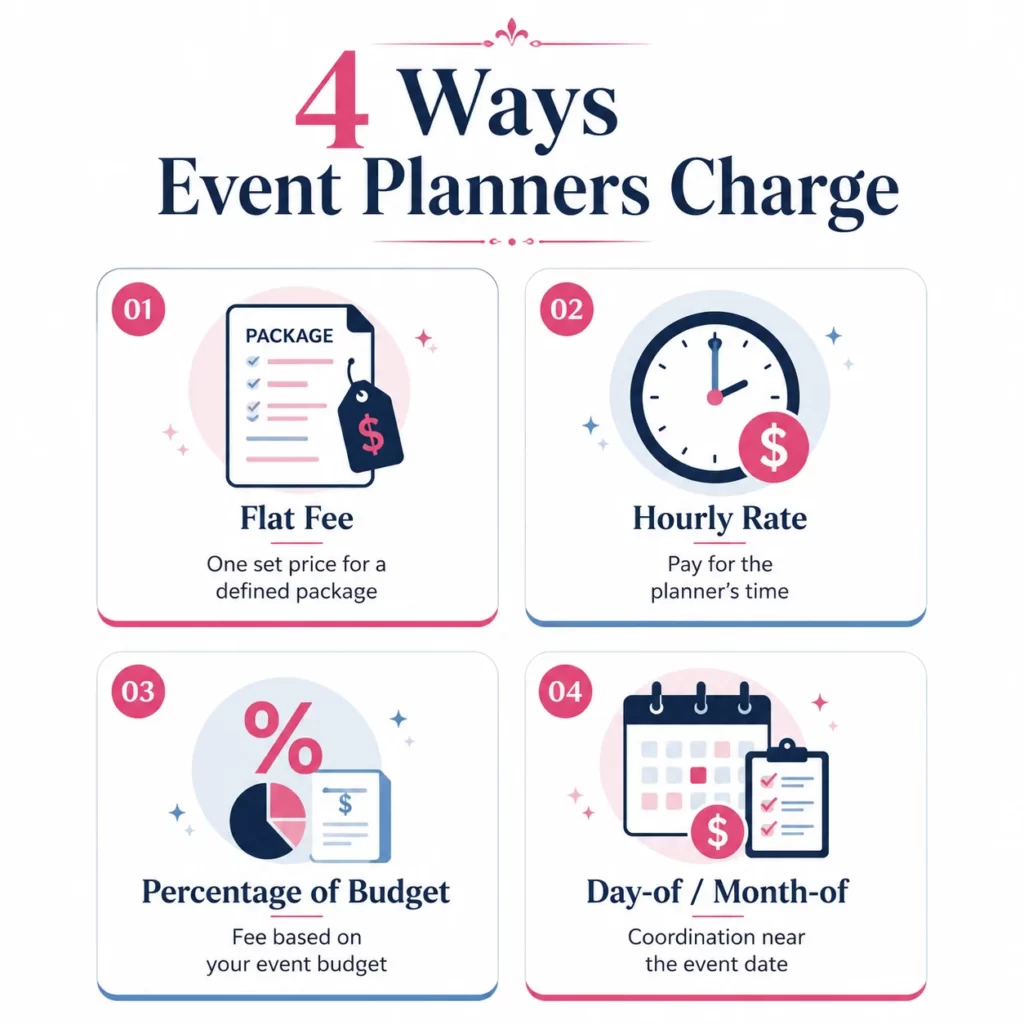
Let’s cut to the chase. Event planners get paid in one of four ways: a flat fee, an hourly rate, a percentage of your event budget, or a day-of/month-of coordination package. Which one you end up with depends on the kind of event you’re hosting, how many guests are coming, where it takes place, how much experience your planner brings, and how much of the work they actually do.
If you want a ballpark: couples spend about $2,100 on a wedding planner on average, according to The Knot’s Real Weddings Study, while Thumbtack puts party-planner fees in the $871–$1,947 range nationally. Treat those as starting points, not invoices — your quote will move up or down based on your event and your market.
Before you hire anyone, put proposals side by side. Make sure each one spells out the pricing model, what’s included, what costs extra, how many hours of work you’re buying, the payment schedule, and what happens if you cancel.
How Event Planners Charge
There’s no single answer to “how much does a planner cost?” — but there is a simple way to make sense of it. Nearly every planner works under one of four models, and once you know how each one behaves, quotes that looked all over the place start making sense.
Flat Fee
This is the model most couples and hosts end up with, and for good reason: you agree on one number up front, and that number is what you pay. Planners usually offer flat fees in tiers — day-of coordination, partial planning, and full service — so you can pick the level of support that matches your budget. The price stays fixed unless the scope grows, so if you want the ceremony relocated or five extra hours of on-site management, expect that conversation to revisit the number.
One thing worth knowing before you sign: many planners ask for a 30–50% non-refundable deposit at signing, with the balance due before the event. Ask about the deposit schedule early — it matters for your cash flow.
Percentage of the Event Budget
Here the planner takes a cut of your total spend — most commonly 15–20% — which means their fee scales right along with the event itself. It’s a popular fit for weddings and bigger corporate events, where budgets are large and the work grows with them.
The catch is transparency. Before you agree, pin down exactly which expenses get counted in the “budget” their percentage is calculated from. Decor, entertainment, and catering are usually in; your planner’s own fee usually isn’t, but you shouldn’t have to guess.
Hourly Rate
Hourly billing charges for the planner’s time, plain and simple. It’s the right fit when you don’t need a full-service handover — you’re doing most of the planning yourself and just want consulting, vendor sourcing, or a second set of eyes on a few tasks.
Nationally, party planners average about $50–$75 per hour (Thumbtack, January 2026), with the broader industry range running $25–$100+ depending on experience and market. One question to ask before work starts: how many hours do you expect this to take? It turns an open-ended hourly rate into something you can actually budget around.
Day-of and Month-of Coordination
Sometimes you’ve done the heavy lifting and just want someone to make sure the day itself doesn’t fall apart. That’s what day-of and month-of coordinators are for — they confirm vendors, run the timeline, and manage event-day execution while you enjoy your own party.
Expect roughly 8–10 hours on the day itself plus 10–20 hours of prep work, billed as a smaller flat fee. It’s the most affordable way to get professional oversight, and a lot of couples underestimate how much calmer a wedding day feels with someone else holding the clipboard.
Vendor Commissions
A handful of planners take their cut from the vendors — venues, caterers, florists — rather than from you. It happens, it’s legal, and it’s increasingly rare, mostly because it raises obvious questions about whether the planner is recommending vendors for your sake or their commission check. If a planner works this way, they should tell you upfront and in writing. Ask about it either way.
Pricing Models at a Glance
| Pricing Model | How It Works | Best For | Typical Range |
|---|---|---|---|
| Flat fee | One set price for a defined package | Day-of, partial, or full planning | Roughly $800–$10,000+ depending on tier |
| Percentage of budget | 15–20% of total event costs | Large weddings and corporate events | 15–20% of budget |
| Hourly rate | Pay for the planner’s time | Consulting and partial planning | $50–$75/hr national average |
| Day-of / month-of | Fixed coordination fee plus preparation | Hosts who handle most planning | About $800–$3,000 |
These ranges are planning estimates, not guaranteed quotes. Location, event complexity, planner experience, and what’s actually in the package all shift the final number.
What Affects an Event Planner’s Cost?
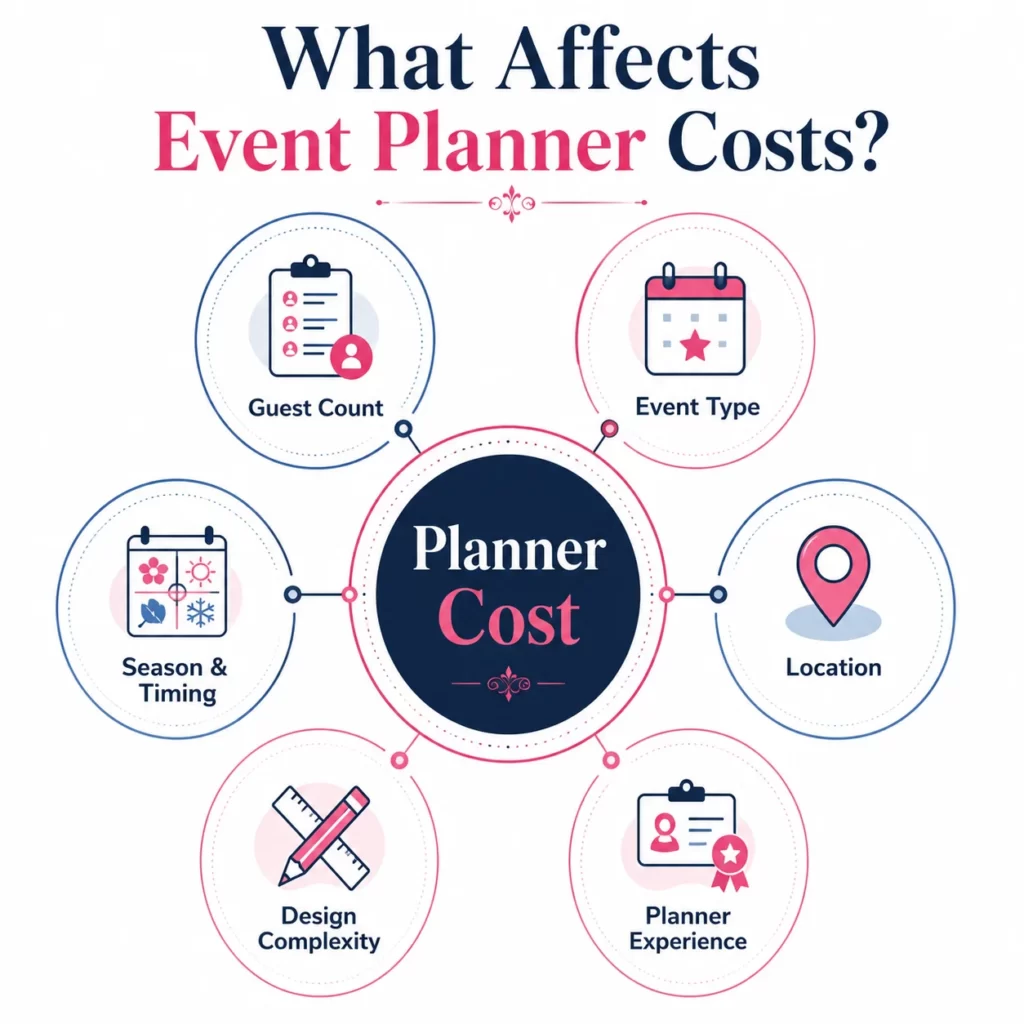
Two planners can quote the same event at wildly different prices — and often, the difference isn’t padding or greed. It’s scope. These are the factors that move the number.
Event Size and Guest Count
More guests mean more moving parts: more vendor coordination, more tables, more logistics, more day-of management. The Knot’s data shows the pattern clearly — planner costs average about $1,700 for 1–50 guests, $1,900 for 51–100, and $2,300 for 101+. It’s not a step change, but it’s consistent, and it adds up over a long guest list.
Type of Planner Involvement
This is the biggest lever you control. A day-of coordinator works a fraction of the hours a month-of coordinator does, and a full-service planner can spend 150–250 hours on a single wedding. Less involvement, lower fee. If budget is tight, trimming involvement — rather than shopping for a cheaper planner — is usually the smarter move.
Location
Metro planners carry higher operating costs and price accordingly; smaller markets run cheaper for comparable work. Rather than trusting a national average, pull a few local quotes — the local spread will tell you more than any headline figure.
Planner Experience and Team Size
A planner with a decade of weddings behind them charges more than someone building a portfolio, and a planner who brings assistants and an on-site team bakes those staffing costs into the proposal. You’re usually paying for a real difference in day-of execution — but make sure the proposal actually names who shows up on your event day.
Design Complexity, Vendors, and Staffing
Custom décor, multiple venues, VIP logistics, a long vendor list, intricate timelines — all of it adds planner hours. This is also where the exclusions hide. Check whether your proposal charges separately for travel, assistants, rentals, design work, or vendor commissions before you sign.
Season and Timing
Peak wedding season (late spring through early fall) means fuller calendars and firmer pricing. Weekday and off-peak dates? Planners are hungrier and rates soften. If your date has any flexibility, this is the easiest discount to win.
Typical Event Planner Costs by Event Type
The numbers below come from two named, dated sources — The Knot’s Real Weddings Study (May 2026) and Thumbtack’s national cost data (January 2026). They’re U.S. averages and estimates, not quotes.
| Event Type | Typical Planner Cost | Source |
|---|---|---|
| Wedding — all service levels | $2,100 average | The Knot, May 2026 |
| Wedding — full service | ~$3,800 average | The Knot, May 2026 |
| Wedding — month-of coordination | ~$2,400 average | The Knot, May 2026 |
| Wedding — day-of coordination | ~$1,600 average | The Knot, May 2026 |
| Destination wedding planner | $2,700 domestic / $3,000 international | The Knot, May 2026 |
| Private party | $871–$1,947 | Thumbtack, Jan. 2026 |
| Corporate event | $986–$2,166 | Thumbtack, Jan. 2026 |
| Nonprofit / fundraiser | Often 10–15% of budget | eventplanning.com |
For specific party types, Thumbtack’s data puts anniversary parties at $853–$2,012, graduation parties at $775–$1,836, bridal showers at $701–$1,494, and fundraisers at $933–$2,317.
One caveat before these numbers shape your budget: location, event size, services, planner experience, and scope all move the final quote. If you’re budgeting for both planning services and a venue, understanding event space costs can help you estimate your total event budget.
Questions to Ask Before Hiring an Event Planner
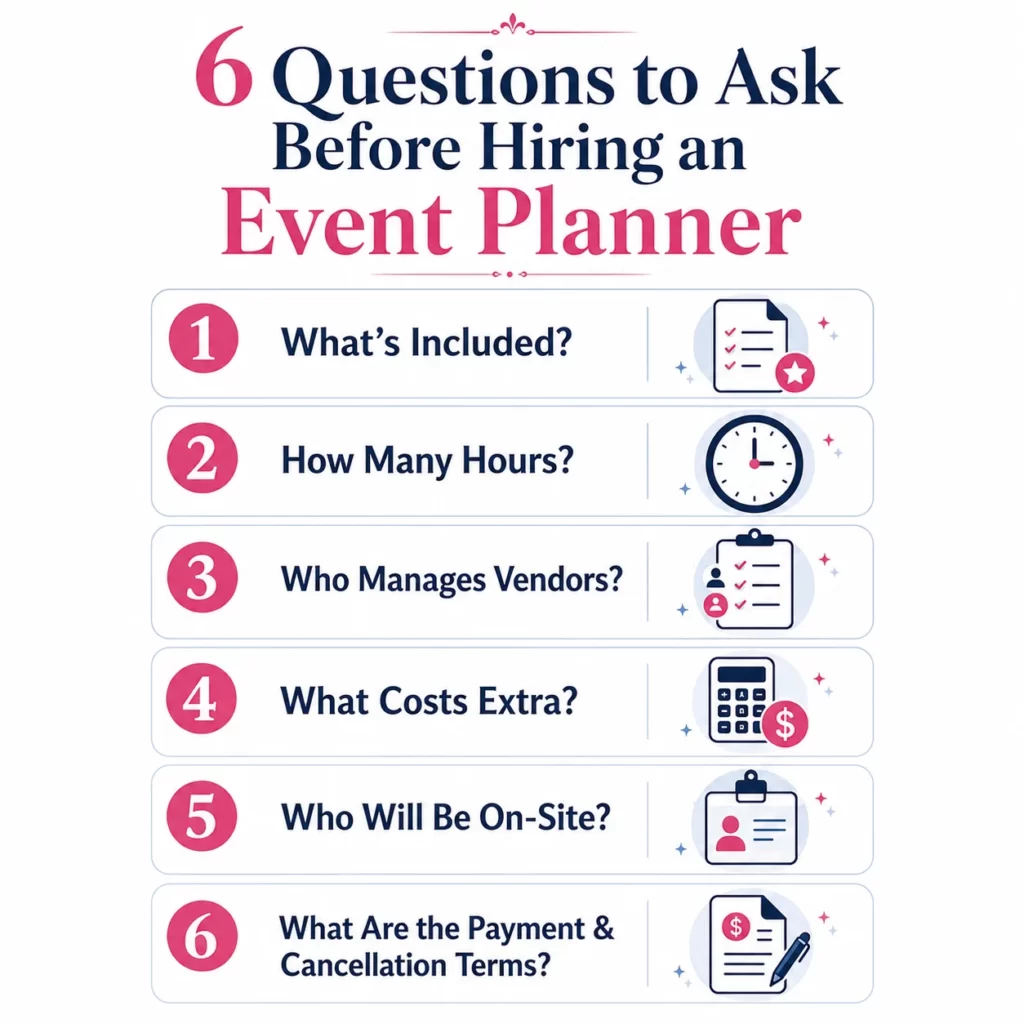
Before you sign anything, ask every planner the same six questions. It’s the only way to compare proposals fairly — and it usually exposes differences that were hiding in fine print.
1.What services are included in this package, and what costs extra?
2.How many planning meetings, venue visits, and event-day hours are included?
3.Will you manage vendor communication, contracts, timelines, and payments?
4.Are travel fees, assistant fees, rentals, design costs, or vendor commissions excluded?
5.Who will be on-site during the event, and what happens if the lead planner is unavailable?
6.What is the payment schedule, cancellation policy, and rescheduling policy?
Give questions four and six extra weight. Travel, overtime, walkthrough fees, and design work are the most common budget surprises — get all potential additional costs in writing before you sign.
How to Compare Event Planner Proposals
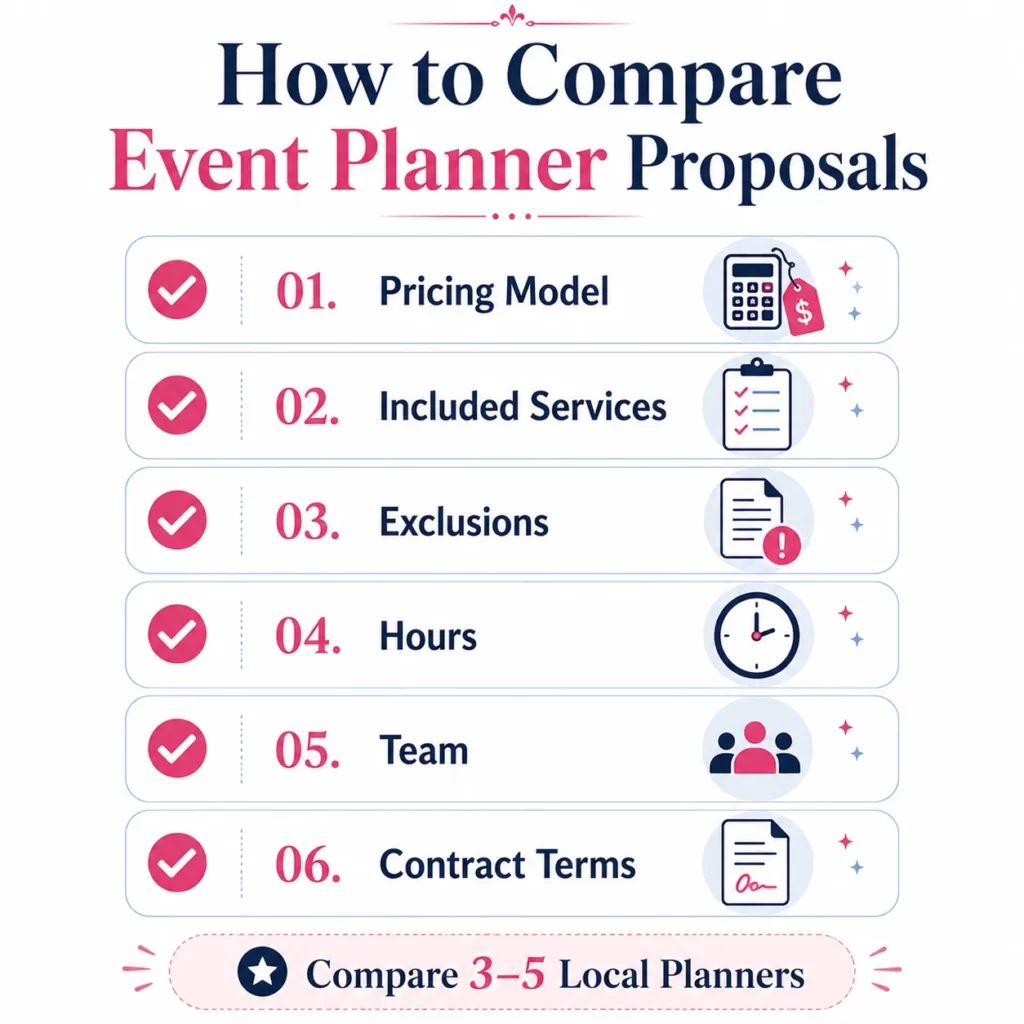
A higher quote doesn’t automatically mean you’re paying more. Two proposals can differ because one includes services the other bills separately, or because they’re built on different pricing models entirely. The goal is to put every quote on the same footing before comparing a single number.
| Compare | What to Look For |
| Pricing model | Flat fee vs. hourly vs. percentage |
| Included services | Vendor sourcing, contract review, design, on-site management |
| Exclusions | Travel, assistants, rentals, décor, commissions |
| Hours | Planning meetings, walkthroughs, event-day hours, preparation |
| People | Lead planner vs. team members |
| Terms | Deposit, payment schedule, cancellation, rescheduling, overtime |
How Many Planners Should You Compare?
Three to five is the sweet spot. Fewer than three and you can’t see the local market; more than five and quote-comparison becomes a part-time job.
And don’t compare price alone. Look at experience with events like yours, portfolio quality, reviews and references, communication style, what’s actually included, and contract terms. A slightly higher fee often buys better vendor relationships, tighter coordination, and a more complete scope — and a planner you actually enjoy talking to for the next six months matters more than it sounds like it should.
If budget is tight, day-of or partial planning delivers professional oversight without the full-service price tag, and weekday or off-peak dates frequently come with better rates.
Find an Event Planner Near You
Need help comparing planners? greatEvent connects you with event-planning professionals — you can request details on services, availability, and pricing in one place. When you reach out, share your event date, city, guest count, event type, and approximate budget. The more specifics you lead with, the sharper the proposal you’ll get back.
If you’re planning a wedding, you can also compare planner fees against the average wedding cost in the U.S. to see how the planning fee fits your overall budget.
Ready to plan your event? Explore event professionals and find options that fit your needs and budget.
Frequently Asked Questions
How much do event planners charge on average? ▾
Most planners charge a flat fee, an hourly rate, or a percentage of the total event budget. The Knot puts the national average wedding planner cost at about $[amount], while Thumbtack puts party-planner fees at $[amount]–$[amount] nationally. Your actual cost depends on location, event type, and scope.
How much do event planners charge per hour? ▾
National-average hourly rates run about $[amount]–$[amount], with a broader industry range of $[amount]–$[amount]+ depending on experience and location. Metro planners tend toward the top of the range, while smaller markets tend toward the bottom. Ask for an estimated total-hour range before work begins.
What percentage of my budget should go to a planner? ▾
If your planner charges a percentage, [percentage]% of the total event budget is the standard range. For example, a $[amount] event points to roughly $[amount]–$[amount]. Ask the planner to spell out in writing which expenses the percentage is calculated on.
How much do day-of coordinators charge? ▾
Day-of coordination averages about $[amount] for weddings, with the typical range running $[amount]–$[amount]. Month-of coordination averages around $[amount]. Both assume you’ve completed most of the planning yourself.
What is the difference between a full-service planner and a day-of coordinator? ▾
A full-service planner is involved from the start, including budgeting, design, vendor selection, contracts, planning, and day-of execution, and averages around $[amount] for weddings. A day-of coordinator joins late in the process and focuses on vendor coordination, timeline management, and running the day itself, at a fraction of the cost.
What is included in event planning fees? ▾
Depending on the package, services may include timeline creation, vendor sourcing, contract reviews, budgeting support, vendor communication, design, floor plans, venue walkthroughs, transportation coordination, staffing, and day-of execution. Full-service packages cover most of the list, while day-of packages cover the tail end of it. Always request a written scope of work.
Are there hidden fees I should watch for? ▾
Yes. Travel, assistant fees, overtime, venue walkthroughs, design mockups, décor sourcing, and vendor commissions are common additional charges. Ask the planner to list every possible additional charge before you sign. A reputable planner should be willing to explain these costs clearly.
How can I compare local event planner rates? ▾
Pull itemized proposals from three to five planners in your area and compare them using the same scope and pricing model. Look beyond price at experience, services, reviews, and contract terms. Expect metro rates to be above the national average and smaller-market rates to be below it.
When should I hire an event planner? ▾
For weddings and larger events, three to six months out generally gives you the widest planner and vendor availability. For simpler events using day-of coordination, one to two months is usually enough.
Do event planners actually save money? ▾
Often, yes. Planners can negotiate vendor rates, prevent costly mistakes, keep the budget on track, and use vendor relationships to potentially unlock better pricing. However, savings vary by event, so judge a planner on overall value rather than assuming the fee will always pay for itself.
Compare vendors for your next event
Search caterers, photographers, florists, planners, and rentals — then send one request to several vendors at once.