Quick answer: An event logistics checklist covers the operational side of a corporate event: when the venue lets you load in and when you must be out, the floor plan and room sets, guest rooms and the rooming list, shuttles, food and beverage orders (BEOs), AV and power, signage, registration, staffing, vendor arrival times, accessibility, and backup plans. Give every item one owner and a written confirmation. Send your full event specifications to the venue and vendors at least four weeks out, get the BEOs and production schedules back at least two weeks out, and run the event day from one run of show.
It’s 6:10 AM on the first day of a 300-person sales conference. The AV crew is at the loading dock, but the dock was promised to the florist until 7:00. The shuttle from the overflow hotel leaves at 7:15, and nobody has told the driver that two attendees need a lift-equipped bus. Registration opens at 7:30, and the badge printer still isn’t on power. All four were settled by phone weeks earlier, and none of them made it into writing. (This scenario is illustrative.)
This guide is for corporate meeting and conference planners and agency planners who run events on site. It covers the operational logistics, from load-in to load-out. It picks up once the venue is signed and the agenda is mostly set. If you need a broader list that also covers the early planning phases, use our general event planner checklist. Fire safety and accessibility points below are planning information, not legal advice. The venue, your local fire official, and your own counsel have the final word on what applies to your event.
What event logistics covers
Event logistics is the work of getting people, equipment, food, and information to the right place at the right time, and back out again. On a corporate meeting it usually includes:
- Venue access: load-in and load-out windows, the loading dock, and freight elevators
- The floor plan, room sets, and room flips between sessions
- Guest rooms: the room block, the rooming list, and the arrival flow at the hotel
- Ground transportation and shuttles
- Food and beverage, written up as banquet event orders (BEOs)
- AV, power, and internet
- Signage, wayfinding, and registration
- Staffing, the run of show, and vendor arrival times
- Accessibility, contingency plans, and the post-event breakdown
The documents that hold your logistics together
The Events Industry Council’s APEX Event Specifications Guide (ESG) template is the industry format for sending event requirements to venues and suppliers. It has a narrative that gives an overview of the event, a function schedule that lists every function with its date, times, room, and setup, and a set-up order for each function. The template says every facility and vendor should get a complete copy of the final ESG. Its suggested minimum timing is to send the ESG at least four weeks before the event and to get completed orders, such as BEOs and production schedules, back no later than two weeks before. Your contracts can set different dates, and they take priority.
The same template asks you to date every revision and mark what changed. It saves an argument on the day about which floor plan is the current one.
| Document | What it holds | When it goes out |
|---|---|---|
| Event specifications (ESG) | Event overview, contacts, attendee profile, housing, F&B, transport, shipping, billing instructions, and authorized signatories | At least 4 weeks before the event (APEX minimum) |
| Function schedule | Every function with date, start and end times, room, setup, and whether the room is held 24 hours | With the ESG; revise and re-date on every change |
| Function set-up orders and room diagrams | Room set, headcount, AV placement, power needs, and set-by and dismantle-by times | With the ESG |
| BEOs and production schedules | What the venue and AV team will set, serve, and run for each function | Back to you at least 2 weeks before (APEX minimum) |
| Rooming list | Guest names, arrival and departure dates, room types, and special requests | By the hotel contract’s deadline |
| Transportation manifest | Pickup points, times, passenger counts, and accessible-vehicle needs | As soon as numbers firm up; accessibility requests well before the operator’s notice deadline |
| Run of show | Minute-by-minute cues across rooms, people, and vendors | Final version before the pre-event meeting |
Venue load-in, floor plan, and room sets
Load-in and load-out
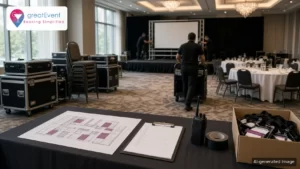
Get the move-in and move-out windows in writing, by date and time, along with which entrance, dock, and freight elevator each vendor uses. The APEX set-up order has fields for “set up by” and “dismantle no later than” for each function. Fill both in, because the second one often decides your load-out plan. Ask the venue about anything that limits access, such as a dock shared with another group, union or house labor rules, or rigging restrictions, and whether outside vendors need to send insurance certificates before they arrive.
Floor plan and room capacity
Room capacity depends on how the room is set. Fire codes set occupant loads by use. Minnesota’s state fire code, for example, uses 15 square feet per person (net) for table-and-chair seating, 7 square feet for chairs only or standing, and 5 square feet for waiting and queuing areas. Your local code and fire official may differ, so ask the venue for the approved capacity of each room in the setup you plan to use. Our guide to how much meeting space you need works through the math, and the room capacity chart by layout gives quick numbers for each setup.
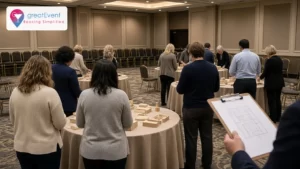
Put the diagram on paper with exits, aisles, the registration area, the stage, AV positions, power drops, and the catering line. The APEX template says each room diagram should show AV placement and electrical needs. Then plan the room flips. If the general session turns into a lunch room, write down who flips it, how long it takes, and where attendees wait in the meantime.
Crowd managers and the venue’s emergency plan
NFPA 101, the Life Safety Code, requires assembly occupancies to have at least one trained crowd manager. Once the occupant load passes 250, it calls for additional crowd managers at a ratio of one for every 250 occupants in most facilities, and the local authority can reduce that ratio in some sprinklered buildings. Assembly occupancies also need an emergency action plan. Ask the venue how it meets the crowd manager requirement for your headcount, get a copy of the evacuation procedures that apply to your rooms, and brief your staff on them.
Room blocks, rooming lists, and arrival flow
Track pickup against the block every week until the cutoff, and agree on the rooming list deadline separately from the block’s cutoff date. Our guide on what to put on a rooming list covers the fields hotels need and what to keep off the list.
Collect accessibility needs for guest rooms at registration and pass them to the hotel. Under the ADA rules for places of lodging (28 CFR 36.302(e)), hotels must hold accessible guest rooms for people with disabilities until every other room of that type has been rented. When an accessible room is reserved, the hotel must block that specific room and remove it from its reservation systems. Ask the hotel how your block handles accessible rooms, and name the attendees who need them on the rooming list.
Then plan the arrival. If most of the group lands on the same afternoon, ask the hotel about extra front-desk staff, early check-in, and luggage storage for people who arrive before their rooms are ready. Make sure the hotel knows the time of your welcome function. Keep a short arrival sheet at your hospitality desk with Wi-Fi details, shuttle times, and the day-one schedule.
Transportation and shuttles
Build a manifest for every movement: pickup point, departure time, headcount, and destination. For airport transfers, group arrivals into waves by flight time. For shuttles between hotels and the venue, set loop times you can actually hit in morning traffic, and keep a staff member with a radio or phone at each pickup point.
Check the bus company before you sign. The Federal Motor Carrier Safety Administration (FMCSA) asks planners to “Look Before You Book.” Get the company’s USDOT number and look it up in FMCSA’s Bus Safety Search to see its safety rating, its out-of-service status, and its record in five safety categories. FMCSA says an interstate, for-hire motorcoach carrier generally must have a USDOT number and operating authority, at least $5 million in insurance coverage, and accessible service under the ADA. Drivers need a commercial driver’s license with a passenger endorsement.
Plan long days around driver hours. Under FMCSA rules, a bus driver may drive up to 10 hours after 8 consecutive hours off duty and can’t drive after being on duty for 15 hours. If you have a 6:00 AM first pickup and a late return from an evening dinner, ask the operator whether you need a second driver or a second bus.
For accessible transport, DOT rules allow charter bus operators to require up to 48 hours’ advance notice for a lift-equipped bus. If notice comes later, the operator still has to provide one when it can with reasonable effort. Ask about accessibility needs at registration so you can give the operator far more notice than that. Check the drop-off point as well. The ADA National Network’s guide to temporary events says an accessible passenger loading zone needs at least 114 inches of vertical clearance for buses and raised-roof vans, a pull-up space 20 feet long and 8 feet wide, and a 5-foot access aisle beside it. Our coach parking and drop-off checklist covers the rest of the curbside questions.
Food and beverage: BEOs and counts
Every catered function should have its own BEO. Before you sign, check each one against the run of show: times, room, setup, menu, counts, dietary and allergy needs, and break refresh times. Our guide to what goes on a BEO has a review checklist and explains how guarantees and minimums work. On the logistics side, decide where the food line goes on the floor plan so it doesn’t block an exit or the registration queue. Confirm when the catering team needs the room and when it clears it, and label dietary meals clearly.
AV, power, and internet
Write the AV list session by session: microphones, screens, confidence monitors, recording, and any streaming. Then confirm power separately. The APEX set-up order asks for each function’s electrical connections and gives “120 volt (10 amp) service or power strip” as examples of what to specify. Send the venue a list of everything that needs power, such as registration printers, laptops, charging stations, catering equipment, and exhibitor booths. Ask what the venue includes, what it charges for, and whether outside AV crews can tie into house power.
Schedule the crew call, the tech check, and the speaker rehearsal in the run of show. Tape down or cover cables that cross walkways, and keep them out of the accessible route. If the general session uses live polling or a demo, test the internet from the stage at the time of day it will be used.
Signage, wayfinding, and registration
Walk the route an attendee takes from the curb or garage to registration, then to each room, the restrooms, and the exits, and put a sign at every point where someone could take a wrong turn. The ADA National Network guide recommends high contrast, a non-glare finish, a simple typeface, and letter sizes matched to how far away people will read the sign. If the accessible route differs from the main one, sign it. Check that signs and easels don’t narrow a walkway below 36 inches, the guide’s minimum width for an accessible route.
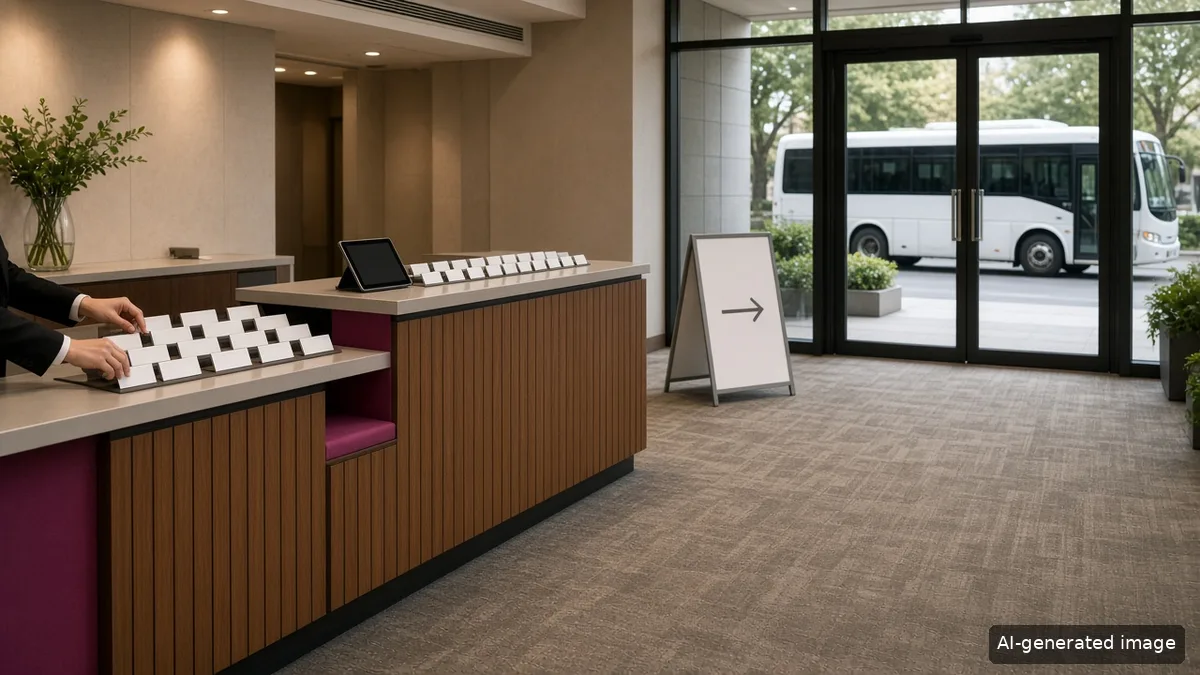
Size registration lanes for your peak arrival time. Separate badge pickup from problem solving, so one attendee with a missing registration doesn’t hold up the line. Apply the ADA guide’s advice for information and ticketing areas to your registration desk: keep a section of the counter no higher than 36 inches and at least 36 inches long, and make sure front-line staff know where the accessible features are, such as accessible restrooms and ramps.
Staffing and the run of show
The run of show is the minute-by-minute script for the event: what happens, where, who does it, and what triggers the next step. It sits above the BEOs and the AV schedule and ties them together. A workable format has one row per cue, with columns for time, location, action, owner, and the vendor involved.
Give each staff member a written assignment for each block of time, and share one contact sheet with names, roles, cell phone numbers, and radio channels for your team, the venue, AV, catering, transport, and security. The APEX template makes the pre-event meeting (date, time, location, and attendees) a required field. Hold it with the venue and your vendors, walk the run of show and every BEO at that meeting, and confirm each department’s on-site contact.
Vendor arrival schedule
A vendor arrival schedule keeps the dock and the freight elevator from turning into a bottleneck. Build it backward from doors open. Here’s an example for a one-day meeting with doors at 7:30 AM, with illustrative times.
| Vendor | Arrives | Access point | Needs on arrival | Done by |
|---|---|---|---|---|
| AV and staging | Day before, 2:00 PM | Dock A, freight elevator 1 | Power drops at stage and tech table | Tech check, day before, 6:00 PM |
| Signage and décor | Day before, 4:00 PM | Dock A after AV | Floor plan with sign locations | Day before, 8:00 PM |
| Venue catering | Event day, 5:30 AM | House back-of-house | Signed BEOs and final counts | Breakfast set by 7:00 AM |
| Registration team | Event day, 6:00 AM | Main lobby | Power and internet at the counter | Lanes open 7:30 AM |
| Shuttle operator | Event day, 6:45 AM | Hotel A curb, loading zone | Manifest and an on-site contact | First loop 7:00 AM |
| Photographer | Event day, 7:45 AM | Main entrance | Shot list and run of show | After the reception |
Send each vendor its row, plus the venue’s rules for parking, check-in, and badges. Ask each one to confirm its arrival time in writing.
Accessibility across the event
The ADA National Network guide recommends naming one accessibility coordinator to oversee access from planning through the event. In practice, that person makes sure the details above are handled consistently:
- Registration asks about access needs and gives a contact and a reasonable deadline for requests such as sign language interpreters or real-time captioning.
- The accessible route connects arrival points, registration, every session room, catering, and restrooms, and it’s signed where it differs from the main route.
- Stages used by speakers have a ramp or lift. The guide says it’s generally not acceptable or safe to carry a person up steps.
- Assistive listening devices are available for sessions, and staff know where to get them.
- Shuttles are accessible. The guide says that if you provide a shuttle service, the shuttle must be accessible.
- Staff know the event’s service animal policy.
Contingency plans
Write a one-page contingency sheet for the problems most likely to hit your event, and give it to every lead. For each one, note the trigger, the decision maker, and the first three actions. Common entries for corporate meetings:
- Weather that affects outdoor functions or travel, with the indoor backup room already on the BEO
- A late or missing shuttle, with the operator’s dispatch number and a backup ride option
- Power or AV failure in the general session, with a spare microphone, a backup laptop, and a plan for the next 15 minutes
- A medical emergency, with the venue’s emergency procedure and the nearest hospital address
- A speaker no-show, with a named backup or a planned schedule shift
- A large headcount change after the guarantee deadline
Ask the venue how its emergency action plan works for your rooms, where the assembly points are, and how announcements are made, and brief your staff on the answers.
Post-event breakdown and load-out
Load-out needs its own schedule, often tighter than load-in because the next group is waiting. Use the “dismantle no later than” times from your set-up orders, sequence vendors at the dock in reverse order of arrival where you can, and assign someone to walk each room for lost items and your organization’s property. Arrange outbound shipping before the event: the APEX template includes expected outbound shipping in the ESG.
Within a week or two, match the final bill line by line against the signed BEOs and change orders, reconcile room block pickup against the contract, and write up what happened. The Events Industry Council publishes a Post-Event Report template for recording event history in a standard format. A short debrief with the venue while the details are fresh also helps.
Day-of logistics timeline
This sample timeline is for a one-day, 300-person conference at a hotel, with a reception. The times are illustrative. Build yours from your own run of show.
| Time | What happens | Check | Owner |
|---|---|---|---|
| Day before, 2:00 PM | Load-in: AV, staging, signage | Dock and elevator schedule held; power drops live | Planner and AV lead |
| Day before, 5:00 PM | Pre-event meeting with venue and vendors | Every BEO and the run of show walked through | Planner |
| Day before, 6:00 PM | Room sets checked against diagrams | Exits and aisles clear; approved capacity confirmed | Planner and venue |
| 5:30 AM | AV crew call | Mics, screens, and stage power tested | AV lead |
| 6:00 AM | Staff call and briefing | Radios, contact sheet, contingency sheet handed out | Planner |
| 6:45 AM | Shuttle check-in at Hotel A | Manifest matched; accessible bus confirmed | Transport lead |
| 7:30 AM | Registration and breakfast open | Lanes staffed; dietary meals labeled | Registration lead |
| 8:30 AM | General session starts | Speaker in place; recording running | Stage manager |
| 12:00 PM | Lunch and room flip | Flip finished before breakouts start | Venue banquet captain |
| 5:00 PM | Sessions end; shuttle return loops | Shuttles staged at the venue | Transport lead |
| 5:30 PM | Reception | Counts match the BEO; bar times followed | Planner |
| 8:00 PM | Load-out begins | Rooms clear by the dismantle-by time; lost items logged | Planner and vendors |
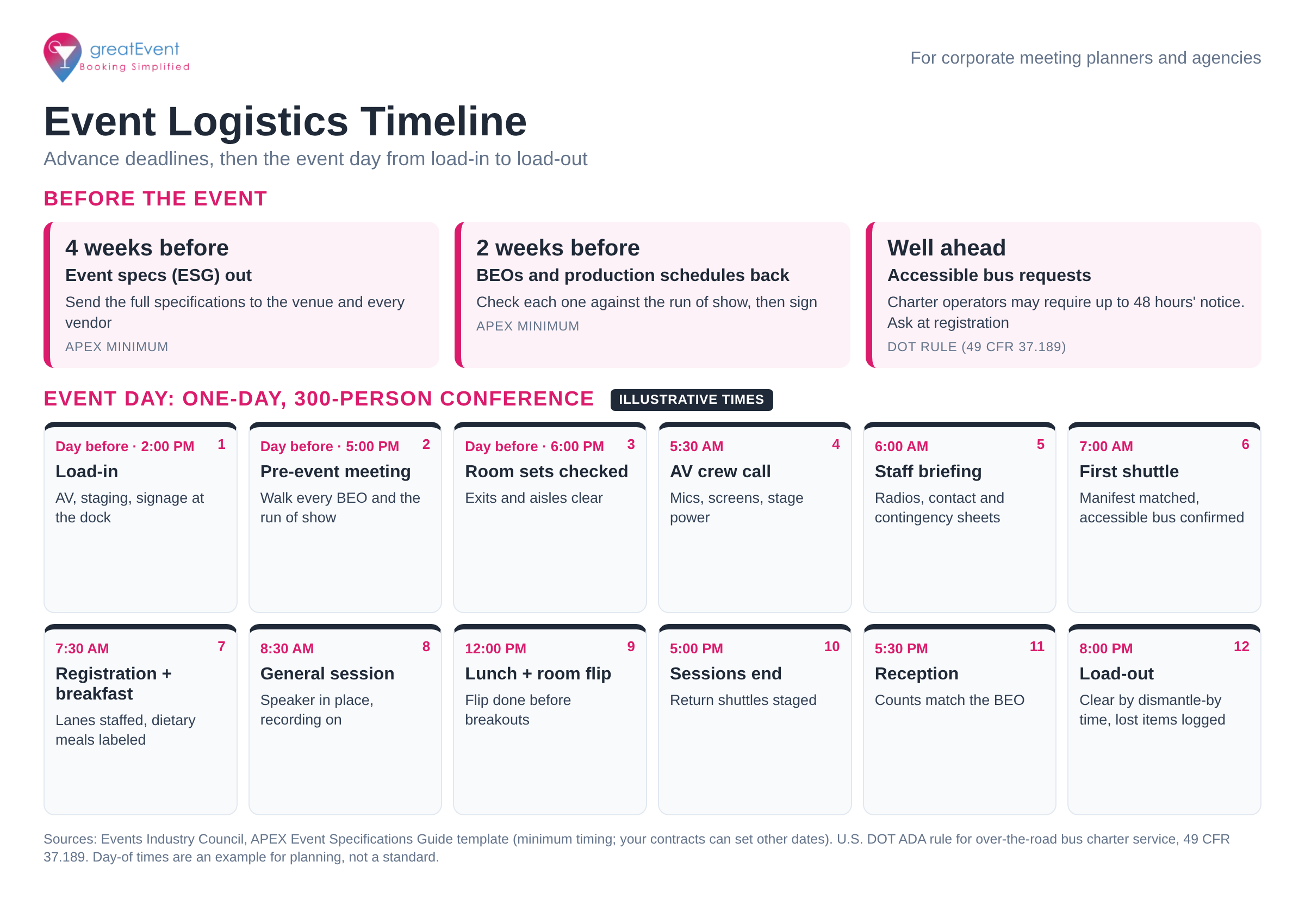
Text version of the infographic: Advance deadlines: send event specifications to the venue and vendors at least 4 weeks before the event; get BEOs and production schedules back at least 2 weeks before (APEX minimums; contracts can set other dates); request accessible charter buses well ahead, because operators may require up to 48 hours’ notice. Illustrative day-of sequence: load-in the day before at 2:00 PM; pre-event meeting at 5:00 PM; room sets checked at 6:00 PM; AV crew call at 5:30 AM; staff briefing at 6:00 AM; first shuttle at 7:00 AM; registration and breakfast at 7:30 AM; general session at 8:30 AM; lunch and room flip at noon; sessions end and shuttles return at 5:00 PM; reception at 5:30 PM; load-out at 8:00 PM.
Copyable event logistics checklist template
Copy this into a document or spreadsheet, add an owner and a due date to every line, and mark each item done only when you have the confirmation in writing.
EVENT LOGISTICS CHECKLIST
Event: ____________  Dates: ________  Venue: ____________  Headcount: ____
Version date: ________  (date every revision and mark the changes)

DOCUMENTS                                             Owner      Due     Done
[ ] Event specifications (ESG) sent to venue and all vendors   ______  ______  [ ]
[ ] Function schedule final, revision dated              ______  ______  [ ]
[ ] Room diagrams with AV, power, exits, and aisles      ______  ______  [ ]
[ ] BEOs and production schedules received and signed    ______  ______  [ ]
[ ] Run of show final; contact sheet and radio channels  ______  ______  [ ]

VENUE ACCESS AND ROOM SETS
[ ] Move-in and move-out dates and times in writing      ______  ______  [ ]
[ ] Dock, entrance, and freight elevator per vendor      ______  ______  [ ]
[ ] Vendor insurance certificates sent (if required)     ______  ______  [ ]
[ ] Approved capacity for each room in its planned set   ______  ______  [ ]
[ ] Room flips: who, how long, where attendees wait      ______  ______  [ ]
[ ] Crowd managers and evacuation procedures confirmed   ______  ______  [ ]

GUEST ROOMS AND ARRIVALS
[ ] Weekly pickup report vs. block until cutoff          ______  ______  [ ]
[ ] Rooming list sent by the contract deadline           ______  ______  [ ]
[ ] Accessible rooms requested by name                   ______  ______  [ ]
[ ] Arrival wave plan: front desk, early check-in, bags  ______  ______  [ ]

TRANSPORTATION
[ ] Carrier USDOT number checked in Bus Safety Search    ______  ______  [ ]
[ ] Manifest: pickup points, times, counts               ______  ______  [ ]
[ ] Driver hours checked for long days                   ______  ______  [ ]
[ ] Accessible vehicles requested well ahead             ______  ______  [ ]
[ ] Loading zone and curb plan at each stop              ______  ______  [ ]

FOOD AND BEVERAGE
[ ] One BEO per function, checked against run of show    ______  ______  [ ]
[ ] Dietary and allergy counts and labels                ______  ______  [ ]
[ ] Guarantee deadlines in calendar (venue time zone)    ______  ______  [ ]
[ ] Food lines clear of exits and registration queue     ______  ______  [ ]

AV, POWER, AND INTERNET
[ ] AV list per session                                  ______  ______  [ ]
[ ] Power list per room (registration, catering, AV)     ______  ______  [ ]
[ ] Crew call, tech check, and rehearsal in run of show  ______  ______  [ ]
[ ] Cables covered and off the accessible route          ______  ______  [ ]

SIGNAGE AND REGISTRATION
[ ] Sign plan walked from curb to every room and exit    ______  ______  [ ]
[ ] Accessible route signed where it differs             ______  ______  [ ]
[ ] Registration lanes sized for peak arrival            ______  ______  [ ]
[ ] Lowered counter section; help desk separate          ______  ______  [ ]

STAFFING AND VENDORS
[ ] Staff assignments by time block                      ______  ______  [ ]
[ ] Vendor arrival schedule sent and confirmed           ______  ______  [ ]
[ ] Pre-event meeting with venue and vendors held        ______  ______  [ ]

ACCESSIBILITY
[ ] Accessibility coordinator named                      ______  ______  [ ]
[ ] Requests collected with a deadline (interpreters, captioning)  ______  ______  [ ]
[ ] Stage ramp or lift; assistive listening devices      ______  ______  [ ]

CONTINGENCIES
[ ] One-page contingency sheet handed to every lead      ______  ______  [ ]
[ ] Backup room, backup transport, spare AV              ______  ______  [ ]
[ ] Venue emergency plan and assembly points briefed     ______  ______  [ ]

BREAKDOWN AND CLOSE-OUT
[ ] Load-out schedule and dismantle-by times             ______  ______  [ ]
[ ] Room sweeps for lost items and company property      ______  ______  [ ]
[ ] Outbound shipping booked                             ______  ______  [ ]
[ ] Final bill matched to BEOs and change orders         ______  ______  [ ]
[ ] Post-event report and debrief                        ______  ______  [ ]
Find the venue for your next event on greatEvent
If you’re still choosing the venue for your next event, register as a professional planner on greatEvent to search meeting and event venues as well as event vendors, and book instantly where available.
Register as a professional planner
Research and sources
Sources reviewed October 22, 2026. Fire safety and accessibility rules vary by location and venue, so treat the points in this article as planning information and confirm what applies with the venue, your local fire official, and your counsel. All times and vendor schedules in the examples are illustrative.
- Events Industry Council (formerly the Convention Industry Council), “The APEX Event Specifications Guide Template,” approved September 30, 2004, updated June 2005, and the council’s templates page, which lists it and the Post-Event Report template as under review (eventscouncil.org). ESG parts, the four-week and two-week minimum timing, revision tracking, pre-event meeting, set-up order fields, electrical connections, and outbound shipping.
- National Fire Protection Association, “Strategies for Crowd Management Safety,” by Kristin Bigda, November 1, 2022 (nfpa.org). NFPA 101 crowd manager requirement and ratio, and emergency action plans for assembly occupancies.
- Minnesota Department of Public Safety, State Fire Marshal Division, “Occupant loads for assembly buildings” (dps.mn.gov). Occupant load factors from the 2020 Minnesota State Fire Code, used here as an example.
- ADA National Network, “A Planning Guide for Making Temporary Events Accessible to People with Disabilities,” 2015 (adata.org). Accessibility coordinator, accessible routes, loading zones, accessible shuttles, signage, registration counters, communication access, and stages.
- U.S. Department of Justice ADA regulations, 28 CFR 36.302(e), reservations made by places of lodging (ecfr.gov). Holding and blocking accessible guest rooms.
- Federal Motor Carrier Safety Administration, “Look Before You Book,” Bus Safety Search, and “Top 3 Things to Know When Planning Your Next Bus Trip” (fmcsa.dot.gov). USDOT number, safety ratings, insurance, accessible service, and driver licensing.
- Federal Motor Carrier Safety Administration, “Summary of Hours of Service Regulations,” and 49 CFR 395.5 (fmcsa.dot.gov, ecfr.gov). Driving and on-duty limits for passenger-carrying drivers.
- Federal Motor Carrier Safety Administration, “ADA Requirements for Over-the-Road Bus Companies,” and 49 CFR 37.189 (fmcsa.dot.gov, ecfr.gov). Accessible charter service with up to 48 hours’ advance notice.
Frequently Asked Questions
What is event logistics?
▾
It’s the operational side of an event: getting people, equipment, food, and information to the right place at the right time. For a corporate meeting, that includes load-in and load-out, room sets, guest rooms, transportation, F&B, AV, signage, registration, staffing, and accessibility.
What should an event logistics checklist include?
▾
Venue access times, the floor plan and room sets, the room block and rooming list, transportation, BEOs, AV and power, signage, registration, staffing, vendor arrival times, accessibility, contingency plans, and load-out. Give each item an owner and a due date.
When should I send event specs to the venue and vendors?
▾
Industry guidance suggests at least four weeks before the event, with BEOs and production schedules back at least two weeks before. Your contracts may set other dates, and those take priority.
How many crowd managers does an event need?
▾
NFPA 101 calls for at least one trained crowd manager in an assembly occupancy, plus one for every 250 occupants once the occupant load passes 250 in most facilities. Ask the venue how it meets this for your headcount.
How much notice do bus companies need for an accessible bus?
▾
Charter operators may require up to 48 hours’ notice for an accessible bus. Collect needs at registration and tell the operator well before that.
What’s the difference between a run of show and a BEO?
▾
A BEO tells the venue what to set and serve for one function. A run of show is your minute-by-minute script for the whole event, with cues, owners, and vendors across every room.
Compare vendors for your next event
Search caterers, photographers, florists, planners, and rentals — then send one request to several vendors at once.