TL;DR
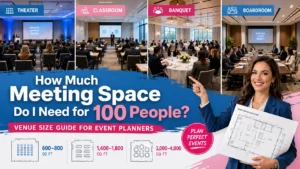
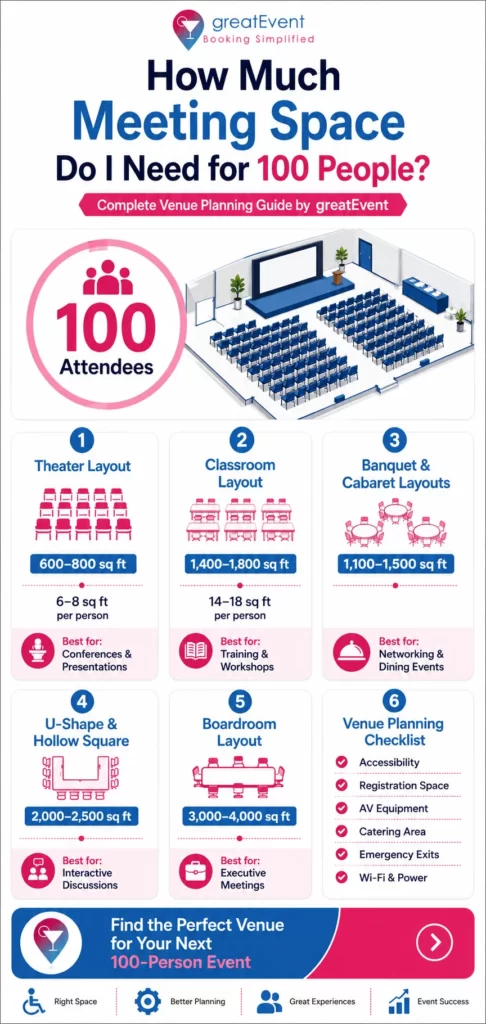
If you’re asking How much meeting space do I need for 100 people?, the answer depends entirely on your room layout. A theater setup may require only 600–800 square feet, while classroom seating typically needs 1,400–1,800 square feet. Banquet-style events fall somewhere in between, while U-shape and boardroom configurations require substantially more space. In addition to seating, planners should account for staging, accessibility, AV equipment, registration areas, and attendee circulation before booking a venue.
Introduction
Choosing the right meeting venue can make the difference between an engaging event and a frustrating attendee experience. A room that’s too small feels crowded and uncomfortable, while an oversized venue can waste budget and reduce energy in the room.
If you’ve been searching How much meeting space do I need for 100 people?, you’re not alone. Corporate planners, association organizers, training coordinators, and event managers ask this question every day because venue capacity isn’t as simple as matching guest count to room size.
The reality is that 100 attendees can fit comfortably into 700 square feet—or require more than 3,000 square feet—depending on how the room is arranged. Theater seating, classroom layouts, banquet tables, and collaborative boardroom setups all have dramatically different space requirements.
Many organizers begin their venue search through greatEvent because it allows them to compare capacities, layouts, amenities, and event services in one place. Before selecting a venue, it’s also worth learning more about greatEvent and how the platform helps connect planners with curated venues and trusted event professionals.
If you’re building a meeting budget, understanding how much do event planners charge can also help you estimate total event costs beyond venue rental.
In this guide, we’ll break down the space requirements for every major room layout and help you determine exactly how much space your next 100-person event needs.
How Meeting Layouts Impact Space Requirements
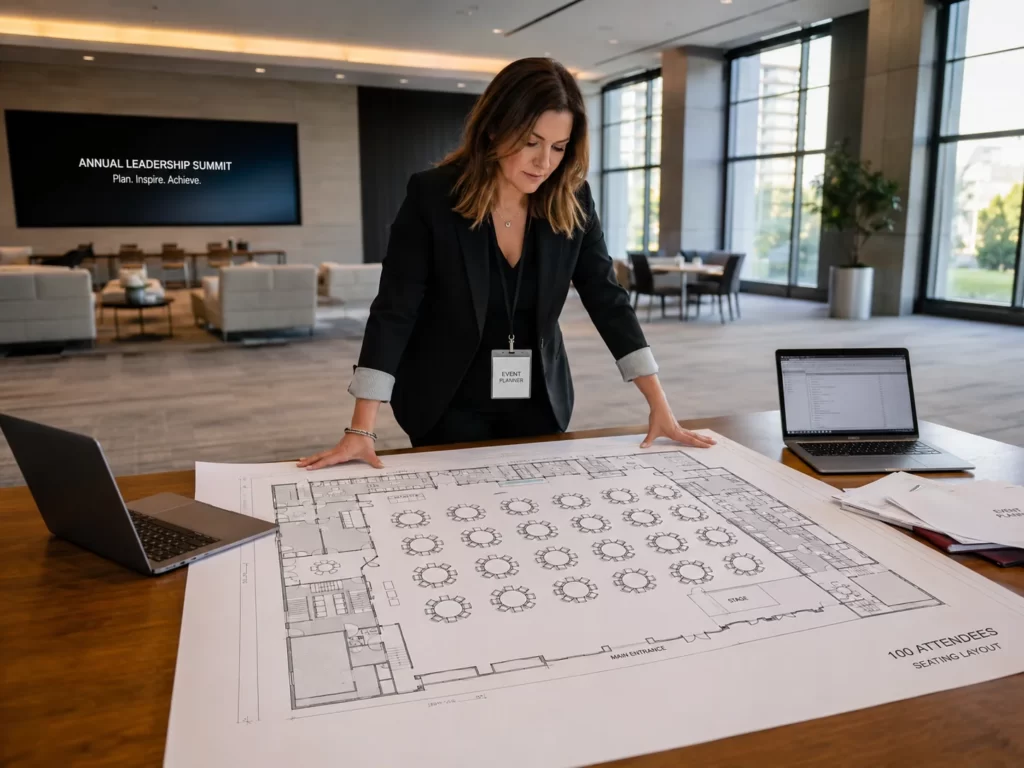
The biggest mistake planners make is assuming venue capacity numbers tell the whole story.
A room advertised as accommodating 100 people may only fit that number in a theater-style setup. The moment tables, staging, catering stations, networking areas, or breakout spaces are introduced, the required square footage increases dramatically.
Organizations planning larger meetings often compare different event planning price packages before deciding whether to hire professional support. Understanding typical event planner fees can help determine whether additional planning assistance or a larger venue budget will provide the best return on investment.
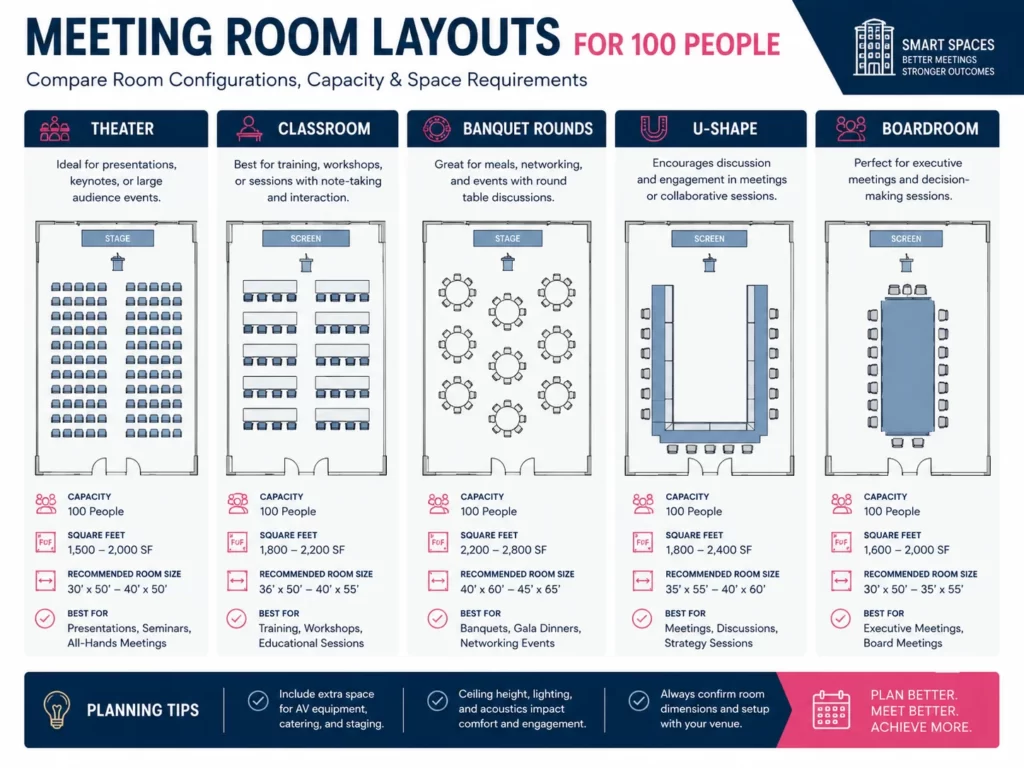
The table below provides a quick comparison of the most common room layouts for 100 attendees.
| Layout | Space Per Person | Total Space Needed |
|---|---|---|
| Theater | 6–8 sq ft | 600–800 sq ft |
| Reception | 6–8 sq ft | 600–800 sq ft |
| Banquet | 11–12 sq ft | 1,100–1,200 sq ft |
| Cabaret | 11–15 sq ft | 1,100–1,500 sq ft |
| Classroom | 14–18 sq ft | 1,400–1,800 sq ft |
| U-Shape | 20–25 sq ft | 2,000–2,500 sq ft |
| Hollow Square | 20–25 sq ft | 2,000–2,500 sq ft |
| Boardroom | 30–40 sq ft | 3,000–4,000 sq ft |
A useful rule of thumb is to book slightly more space than the minimum calculation suggests. Registration tables, AV equipment, sponsor displays, and attendee circulation all consume floor space that venue capacity charts often ignore.
Pro Tip
Add at least 10–15% more square footage than your seating calculation whenever presentations, networking, catering, or exhibit displays are part of the event.
Theater Seating: The Most Space-Efficient Option
If your primary goal is maximizing attendance while minimizing venue costs, theater seating is usually the most efficient choice.
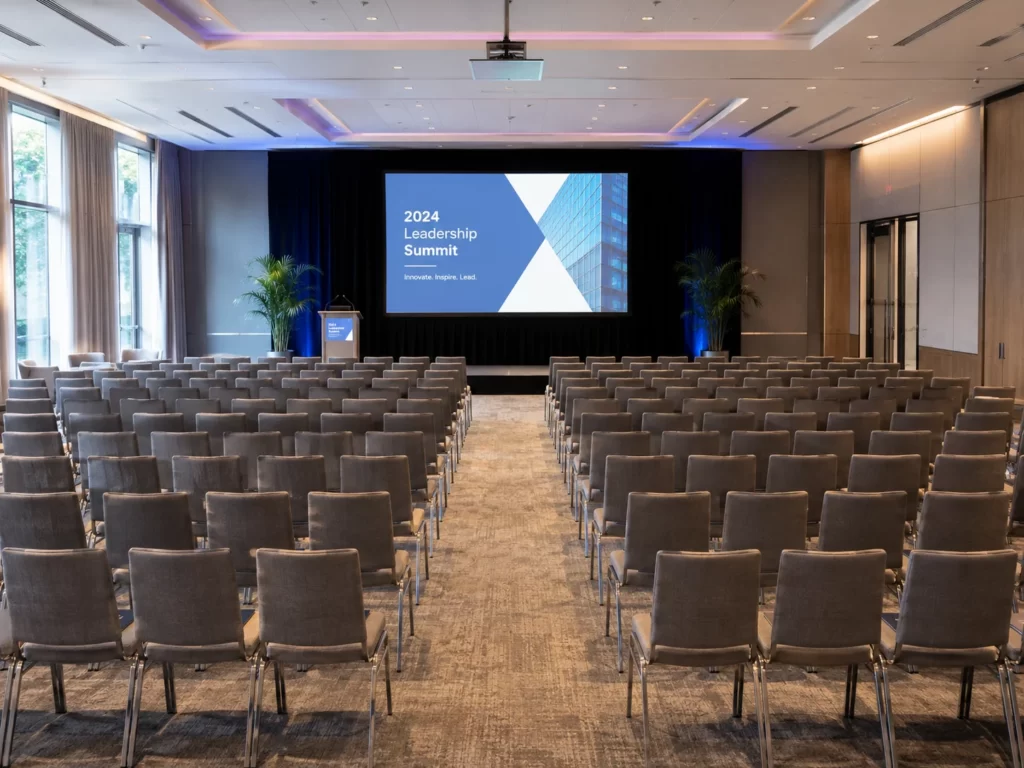
In a theater layout, attendees sit in rows of chairs facing a stage, podium, or presentation screen. Since no tables are used, this arrangement requires significantly less space than most other meeting formats.
For 100 attendees, you’ll typically need:
- 600–800 square feet
- One center aisle or multiple side aisles
- A designated presentation area
- Accessible seating locations
This setup is commonly used for:
- Corporate conferences
- Product launches
- Company town halls
- Industry seminars
- Guest speaker events
A theater configuration allows planners to fit more people into smaller spaces, making it one of the most cost-effective venue options available.
Organizations comparing venue expenses often research a club house rental near me or compare pricing against rental halls near me to determine which venue category offers the best value.
Example Room Dimensions
| Capacity | Approximate Room Size |
|---|---|
| 100 People | 20′ × 40′ |
| 100 People | 25′ × 32′ |
| 100 People | 28′ × 25′ |
Advantages of Theater Seating
✔ Highest seating capacity
✔ Lowest square footage requirement
✔ Excellent speaker visibility
✔ Lower venue rental costs
Limitations
✘ Limited participant interaction
✘ No workspace for laptops
✘ Not ideal for training sessions
✘ Networking opportunities are reduced
Pro Tip
If you’re hosting presentations lasting longer than two hours, consider increasing row spacing slightly. The extra comfort can significantly improve attendee satisfaction and engagement.
Classroom Layout: Best for Training Sessions and Workshops
While theater seating maximizes capacity, classroom layouts prioritize productivity.
A classroom setup places tables and chairs in rows facing the front of the room, giving attendees space for laptops, notebooks, handouts, and training materials.
For 100 attendees, plan for:
- 1,400–1,800 square feet
- Multiple aisle pathways
- Power access for devices
- Additional room depth
Companies hosting recurring educational programs often rely on private event planning services to coordinate venue sourcing, registration, speaker logistics, and attendee management.
This format works particularly well for:
- Employee training programs
- Certification courses
- Continuing education workshops
- Software demonstrations
- Leadership development sessions
Typical Classroom Dimensions
| Capacity | Approximate Room Size |
|---|---|
| 100 People | 30′ × 50′ |
| 100 People | 24′ × 50′ |
| 100 People | 30′ × 60′ |
One major advantage of classroom layouts is attendee engagement. Participants can take notes, work on exercises, and actively participate in discussions without feeling cramped.
For planners comparing venues, understanding how much to rent a hall for party versus corporate meeting spaces can provide useful budgeting insights, especially when evaluating multi-purpose venues.
Advantages of Classroom Layouts
✔ Supports note-taking
✔ Laptop-friendly
✔ Better learning environment
✔ Works well for longer sessions
Limitations
✘ Requires substantially more space
✘ Lower capacity than theater seating
✘ More complex room setup
Classroom Layouts with Laptops and Technology
Modern meetings often require attendees to use laptops throughout the event.
When technology is involved, planners should increase space allocation slightly to accommodate:
- Charging stations
- Power strips
- Extension cables
- Wider tables
- AV equipment
A classroom layout with laptops may require 1,500–2,000 square feet for 100 attendees.
Organizations evaluating overall event budgets frequently compare event planning price packages alongside venue costs to determine the most efficient allocation of resources.
Insider Tip
Never assume a venue has enough power outlets for 100 devices. Confirm electrical capacity and charging availability before signing a contract.
Banquet Seating: Ideal for Networking and Dining Events
Banquet seating is one of the most common formats for galas, awards ceremonies, fundraising events, and corporate dinners.
This arrangement uses round tables, typically seating eight guests per table.
For 100 attendees, banquet layouts generally require:
- 1,100–1,200 square feet
- Approximately 12 round tables
- Space for servers and circulation
- Access to food service areas
Example Room Dimensions
| Capacity | Approximate Room Size |
|---|---|
| 100 People | 30′ × 40′ |
| 100 People | 24′ × 50′ |
| 100 People | 33′ × 36′ |
Banquet layouts create a social atmosphere and encourage conversation among attendees.
Many event planners discover that venue costs become easier to understand after researching how much do venues charge for concerts because entertainment-focused venues often use different pricing structures than corporate meeting facilities.
Advantages
✔ Excellent for networking
✔ Comfortable dining experience
✔ Encourages conversation
✔ Ideal for awards and celebrations
Limitations
✘ Reduced sightlines to the stage
✘ More setup complexity
✘ Higher space requirements than theater seating
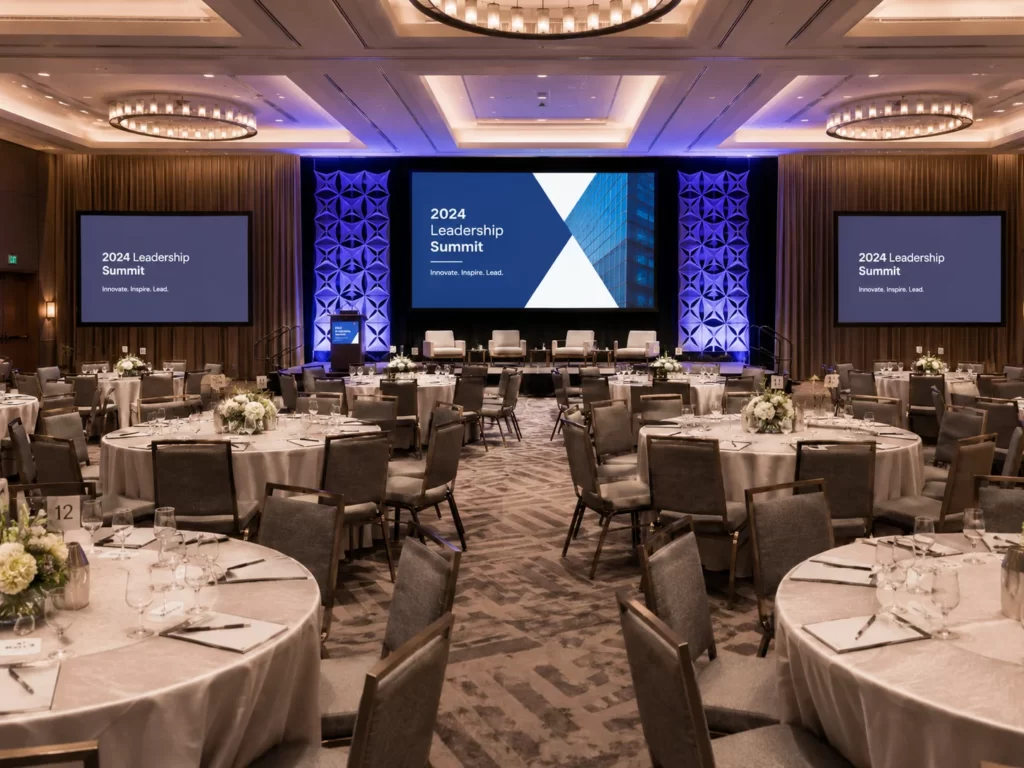
Cabaret Layout: Combining Presentations and Interaction
Cabaret seating combines the best elements of banquet and classroom layouts.
Guests sit at round tables, but one side of each table remains open toward the stage. This provides better visibility while maintaining group interaction.
For 100 attendees, expect to need:
- 1,100–1,500 square feet
- 10–12 tables
- Additional aisle spacing
- Clear sightlines to the presentation area
Cabaret seating works particularly well for:
- Leadership summits
- Training conferences
- Fundraising galas
- Awards banquets
- Interactive workshops
Planners who are comparing venue styles often discover similarities between corporate event spaces and venues commonly used for weddings. Researching the average wedding cost 2026 or the average cost of a wedding in the US can provide useful context for understanding venue pricing trends across the hospitality industry.
Advantages
✔ Strong audience engagement
✔ Better stage visibility
✔ Supports networking
✔ Comfortable for longer events
Limitations
✘ Lower seating density
✘ More floor space required
✘ More expensive setup requirements
U-Shape Layout: Best for Interactive Discussions and Workshops
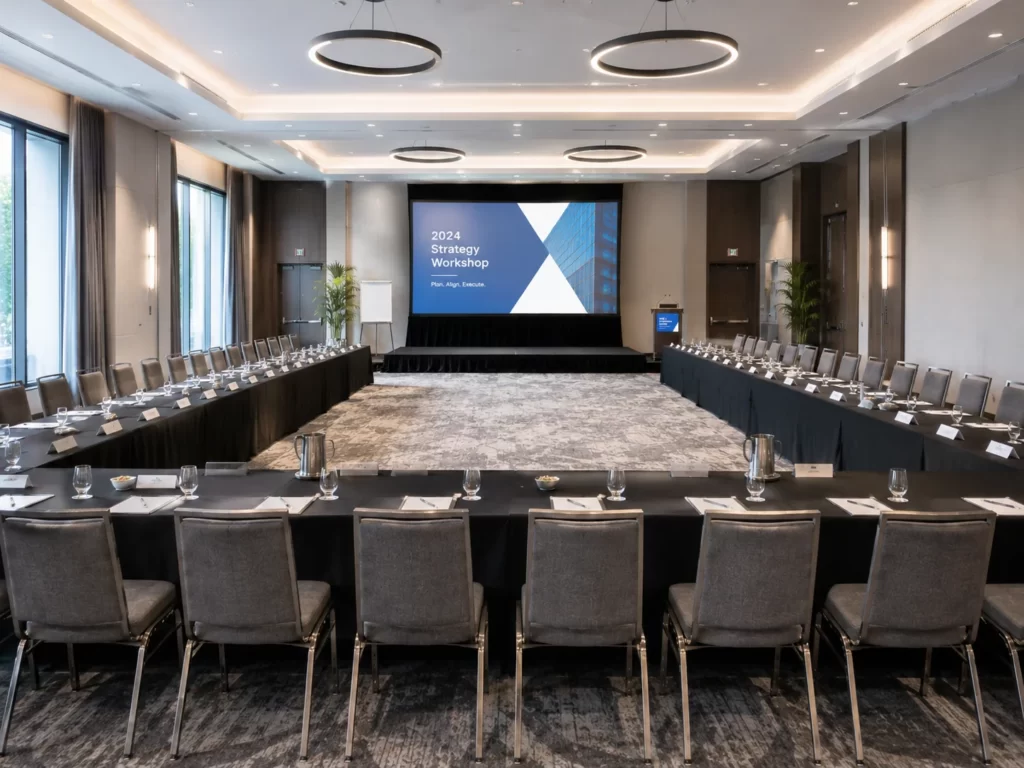
When attendee participation matters more than maximizing capacity, a U-shape layout can be one of the most effective room configurations.
In this setup, tables are arranged in the shape of a “U,” with attendees seated around the outside edges while the center remains open. The open end typically faces a presenter, screen, or facilitator.
For 100 attendees, you’ll generally need:
- 2,000–2,500 square feet
- Large open center space
- Wide circulation paths
- Clear presentation sightlines
This layout is particularly effective for:
- Leadership retreats
- Strategic planning sessions
- Executive workshops
- Training programs
- Collaborative meetings
Unlike theater seating, U-shape layouts encourage discussion and make it easier for participants to engage directly with one another.
Example Room Dimensions
| Capacity | Approximate Room Size |
|---|---|
| 100 People | 40′ × 50′ |
| 100 People | 34′ × 60′ |
| 100 People | 25′ × 80′ |
Advantages
✔ Excellent participant engagement
✔ Strong presenter visibility
✔ Supports collaboration
✔ Ideal for facilitated discussions
Limitations
✘ High square footage requirement
✘ Reduced seating efficiency
✘ More expensive venue costs
Pro Tip
Once your attendee count approaches 100, consider whether multiple breakout rooms may deliver better engagement than a single oversized U-shape setup.
Hollow Square Layout: Maximizing Group Discussion
A hollow square layout resembles a U-shape arrangement but closes the open end, creating a complete square of tables with an open center.
Because every attendee faces inward, this format promotes equal participation and visibility among participants.
For 100 attendees, planners should allocate:
- 2,000–2,500 square feet
- Significant circulation space
- Large central open area
This setup works best for:
- Advisory board meetings
- Industry roundtables
- Committee discussions
- Collaborative planning sessions
However, hollow square layouts become increasingly difficult to manage as attendance grows. At 100 participants, the room footprint becomes substantial.
Advantages
✔ Strong discussion environment
✔ Equal visibility for participants
✔ Encourages collaboration
Limitations
✘ Inefficient use of space
✘ Poor format for presentations
✘ Limited audience focus
For organizations evaluating multiple venue types, comparing dedicated meeting facilities with spaces commonly used for renting a place for a party can reveal major differences in layout flexibility and furniture availability.
Boardroom Layout: The Least Efficient Option for 100 People
Boardroom seating is one of the most recognizable meeting formats.
It typically consists of a large central table with attendees seated around all sides.
While this arrangement works exceptionally well for executive teams and board meetings, it becomes highly inefficient at larger scales.
For 100 attendees, a boardroom setup may require:
- 3,000–4,000 square feet
- Oversized furniture configurations
- Extended sightlines
- Significant circulation areas
Example Room Dimensions
| Capacity | Approximate Room Size |
|---|---|
| 100 People | 50′ × 60′ |
| 100 People | 35′ × 90′ |
| 100 People | 25′ × 120′ |
Advantages
✔ Supports executive discussion
✔ Creates equal participation
✔ Professional atmosphere
Limitations
✘ Largest space requirement
✘ Expensive setup
✘ Poor presentation visibility
✘ Rarely practical for 100 attendees
Most event professionals recommend alternative layouts when attendance exceeds 30–40 participants.
How Much Extra Space Should You Add Beyond Seating?
One of the biggest venue-planning mistakes is focusing exclusively on attendee seating.
Even when you’ve accurately calculated room capacity, operational requirements can dramatically increase your total space needs.
If you’re asking How much meeting space do I need for 100 people?, remember that the seating layout is only the starting point.
Registration and Check-In Areas
For 100 attendees, allocate:
- 100–300 additional square feet
- Registration tables
- Badge pickup stations
- Queueing space
Many organizations streamline attendee management using GE Invite, which helps reduce check-in congestion and improves event communication.
Staging and Presentation Space
Presentations require more than just a projector.
Most events need space for:
- Speaker movement
- Podiums
- Screens
- Confidence monitors
- Audio equipment
A modest stage may require:
- 100–200 additional square feet
Larger conferences may require considerably more.
Insider Tip
Always ask venues whether stage space is included in published room capacities. Many venues advertise maximum seating without accounting for presentation areas.
Catering and Refreshment Areas
Food service significantly increases space requirements.
If you’re planning:
- Coffee breaks
- Buffet lunches
- Networking receptions
- Cocktail hours
You’ll typically need:
- 200–500 additional square feet
Depending on the event format, planners often compare costs associated with how much to rent a hall for party events and corporate gatherings to better understand food-service-related venue pricing.
Accessibility Requirements Matter
Venue capacity should never come at the expense of accessibility.
For a 100-person meeting, planners should ensure:
- Accessible entrances
- Wheelchair seating locations
- Companion seating
- Accessible restrooms
- Clear circulation pathways
ADA standards generally require:
- Four wheelchair spaces for a 100-seat assembly area
- Accessible routes throughout the venue
- Minimum 36-inch aisle widths
Accessibility planning should be incorporated into venue selection from the beginning rather than added later.
Ventilation, Comfort, and HVAC Considerations
Room capacity calculations often overlook environmental comfort.
A room that technically accommodates 100 people may feel uncomfortable if ventilation is inadequate.
When evaluating venues, confirm:
- HVAC capacity
- Fresh air circulation
- Temperature control
- Air distribution
Comfortable attendees stay engaged longer and are more likely to view the event positively.
Organizations planning recurring conferences frequently include HVAC evaluations as part of their private event planning process to ensure attendee satisfaction.

Space Planning Formula for 100-Person Events
Before signing a venue contract, use this simple formula:
Required Venue Space = Seating Area + Stage Area + Registration Area + Catering Space + Circulation Space
For example:
Classroom Layout:
- Seating: 1,500 sq ft
- Stage: 150 sq ft
- Registration: 150 sq ft
- Catering: 300 sq ft
- Circulation Buffer: 200 sq ft
Recommended Venue Size: 2,300+ sq ft
This approach provides a far more accurate estimate than relying on capacity numbers alone.
Accessibility, Safety, and Compliance Requirements
When calculating venue size, many planners focus entirely on seating capacity and forget that safety and accessibility requirements can significantly affect room layouts.
A venue may technically fit 100 attendees, but if it lacks adequate aisle widths, accessible seating, emergency exits, or proper circulation paths, it may not be suitable for your event.
If you’re still evaluating How much meeting space do I need for 100 people?, remember that compliance requirements should be factored into your calculations from the beginning.
Accessibility Considerations for 100 Attendees
For a meeting of this size, planners should ensure:
- Accessible venue entrance
- Wheelchair-accessible routes throughout the facility
- Accessible restrooms
- Companion seating
- Clear signage
- Accessible parking
Many venues advertise capacity numbers without explaining how accessibility accommodations impact actual seating layouts.
ADA-Friendly Space Guidelines
| Requirement | Recommendation |
|---|---|
| Wheelchair Spaces | Minimum 4 |
| Accessible Aisles | 36 inches minimum |
| Turning Radius | 60 inches |
| Accessible Door Clearance | 32 inches minimum |
| Companion Seating | Adjacent to accessible seats |
Why Accessibility Impacts Room Size
When wheelchair seating, accessible pathways, and circulation areas are properly included, usable seating capacity can decrease slightly.
This is one reason experienced planners rarely book venues based solely on maximum published occupancy.
Pro Tip
Request a floor plan rather than relying on venue capacity sheets. A floor plan reveals how much usable space actually remains once accessibility requirements are incorporated.
Emergency Egress and Occupant Safety
Every event venue must provide safe evacuation routes.
For meetings with 100 attendees, planners should verify:
- At least two accessible exits
- Visible exit signage
- Emergency lighting
- Fire alarm systems
- Unobstructed evacuation routes
Many corporate planners include these evaluations as part of their venue selection process, particularly when hosting executive meetings, conferences, or public-facing events.
Questions to Ask Before Booking
- Are all exits accessible?
- Are emergency routes clearly marked?
- Does the venue comply with local fire code requirements?
- Are evacuation procedures documented?
- Can staff provide emergency support if needed?
The answers to these questions can be just as important as room size itself.
Venue Selection Checklist for 100-Person Meetings
Choosing the right venue involves much more than finding enough square footage.
Use the checklist below before signing a contract.
Venue Capacity and Layout
- Room comfortably accommodates your chosen layout
- Space includes registration area
- Stage and presentation area available
- Adequate networking space
- Flexibility for future adjustments
Organizations comparing venue options often review dedicated event venues in Washington DC because many properties provide multiple room configurations under one roof.
Technology and AV Requirements
- Projector and screen availability
- Sound system support
- High-speed Wi-Fi
- Sufficient power outlets
- Presentation lighting controls
For training events, workshops, and hybrid meetings, technology infrastructure can be just as important as room size.
Catering and Hospitality
- Coffee station location
- Buffet space
- Catering prep areas
- Water stations
- Staff service routes
If your event includes meals or receptions, these requirements should be included in your venue calculations from the start.
Guest Experience
- Comfortable seating
- Easy navigation
- Clear signage
- Nearby restrooms
- Comfortable temperature control
A well-designed attendee experience often determines whether guests remember your event positively.
Common Mistakes When Booking Meeting Space
Even experienced event organizers occasionally underestimate how much room a 100-person event truly requires.
Avoid these common mistakes.
Mistake #1: Choosing Capacity Based on Theater Seating
Many venues advertise their highest possible capacity using theater-style seating.
If your event requires tables, networking areas, catering stations, or workshops, the actual capacity may be significantly lower.
Always ask for capacities based on your intended layout.
Mistake #2: Ignoring Registration Space
Check-in areas often create bottlenecks.
Without adequate registration space, attendees may experience long lines before the event even begins.
Tools such as GE Invite can streamline registration and attendee communication while reducing congestion at arrival.
Mistake #3: Forgetting About Venue Costs Beyond Rental
Room rental is only one component of the total event budget.
Additional expenses may include:
- Catering
- AV equipment
- Staffing
- Decor
- Furniture upgrades
Some planners compare venue costs against resources discussing how much do venues charge for concerts because entertainment venues often use very different pricing structures.
Others research event planner fees before deciding whether to outsource planning responsibilities.
Mistake #4: Not Considering Alternative Venue Types
Traditional conference centers aren’t your only option.
Depending on the event, alternatives such as a club house rental near me or rental halls near me may offer more flexibility and better value.
For networking events and social gatherings, planners may also compare options for renting a place for a party before making a final decision.
Mistake #5: Waiting Too Long to Book
Popular venues often book months in advance.
This is especially true in major metropolitan markets where venue demand remains high throughout the year.
In Washington, DC, for example, planners frequently evaluate both traditional meeting spaces and unique wedding venues DC because many historic venues can successfully host corporate functions.
For smaller networking events or workshops, small party venues in DC may provide more affordable alternatives.
Insider Tip
Start venue research at least three to six months before your preferred event date whenever possible.
Earlier bookings generally provide better availability, more room choices, and stronger negotiating power.
How Different Event Types Affect Space Requirements
Although this guide focuses on meetings, many of the same venue planning principles apply to:
- Corporate galas
- Awards ceremonies
- Fundraisers
- Networking receptions
- Engagement parties
- Wedding-related events
For example, families often research who pays for an engagement party while determining guest counts and venue budgets.
Similarly, couples frequently compare the average wedding cost 2026 and how much does an average wedding cost before selecting a venue size.
The key lesson remains the same: venue selection should be driven by attendee experience rather than capacity alone.

Conclusion
By now, the answer to How much meeting space do I need for 100 people? should be much clearer.
While attendee count is an important starting point, the right venue size depends on far more than simply fitting 100 people into a room. Theater seating may require only 600–800 square feet, while classroom layouts can need up to 1,800 square feet. Collaborative setups such as U-shape, hollow square, and boardroom configurations often demand 2,000–4,000 square feet or more.
Beyond seating, planners must account for registration areas, presentation stages, accessibility requirements, catering stations, networking zones, and attendee circulation. These factors can significantly increase the amount of space required and directly impact the success of the event.
The most successful meetings are rarely those that maximize capacity. They’re the events that create comfortable environments where attendees can learn, collaborate, network, and engage without feeling crowded.
Whether you’re planning a leadership summit, training session, annual conference, or networking event, investing time in accurate space planning can improve attendee satisfaction while helping you avoid unnecessary venue costs.
Ready to Find the Right Venue?
A room that fits 100 attendees on paper isn’t always the right fit in practice. The best venues balance capacity, comfort, accessibility, technology, and attendee experience to create an event environment where people can truly engage.
At greatEvent, you can compare venue capacities, layouts, amenities, and event services in one place, making it easier to identify spaces that match your specific meeting goals. Whether you’re hosting a conference, workshop, executive retreat, or networking reception, early planning can help secure the best options before prime dates become unavailable.
Start exploring venues today through greatEvent and find the perfect space for your next 100-person event.
If you’d like personalized recommendations or help narrowing your options, contact us and our team can help guide your venue search.
Frequently Asked Questions
What is the minimum room size needed for 100 people? ▾
The minimum room size depends on the seating layout. A theater-style setup typically requires 600–800 square feet, while layouts that include tables, such as classroom or banquet seating, require significantly more space.
How much space does a classroom setup need for 100 attendees? ▾
A classroom layout generally requires between 1,400 and 1,800 square feet. The extra space accommodates tables, chairs, aisles, and room for attendees to work comfortably.
Is theater seating the most space-efficient layout? ▾
Yes. Theater seating is one of the most space-efficient configurations because it uses rows of chairs without tables. This allows 100 attendees to fit comfortably within approximately 600–800 square feet.
How much extra space should I add for registration and catering? ▾
It’s a good idea to add 10–20% beyond your seating calculation to account for registration desks, catering stations, networking areas, AV equipment, and attendee circulation.
What is the best layout for a 100-person training session? ▾
A classroom layout is usually the best choice for training sessions because it provides attendees with workspace for laptops, notes, and learning materials while maintaining clear sightlines to the presenter.
How much space is needed for a banquet event with 100 guests? ▾
A banquet setup typically requires 1,100–1,200 square feet, depending on table size, spacing, and service requirements. Additional space may be needed for buffets, bars, or entertainment.
Do accessibility requirements affect room capacity? ▾
Yes. Accessible seating locations, wider aisles, wheelchair turning spaces, and accessible routes can reduce usable seating capacity, which is why planners should consider accessibility during venue selection.
When should I book a venue for a 100-person event? ▾
For the best availability and pricing, it’s recommended to book a venue at least three to six months in advance, especially during peak event seasons.
Can one room layout work for every type of meeting? ▾
Not usually. Theater seating works well for presentations, classroom layouts support training sessions, banquet seating is ideal for networking and dining events, and U-shape configurations are best for collaborative discussions.
How do I calculate meeting space requirements accurately? ▾
Start by choosing your seating layout, then multiply the attendee count by the recommended square footage per person. Finally, add space for staging, registration, catering, accessibility, and attendee movement to determine the total room size needed.
Compare vendors for your next event
Search caterers, photographers, florists, planners, and rentals — then send one request to several vendors at once.