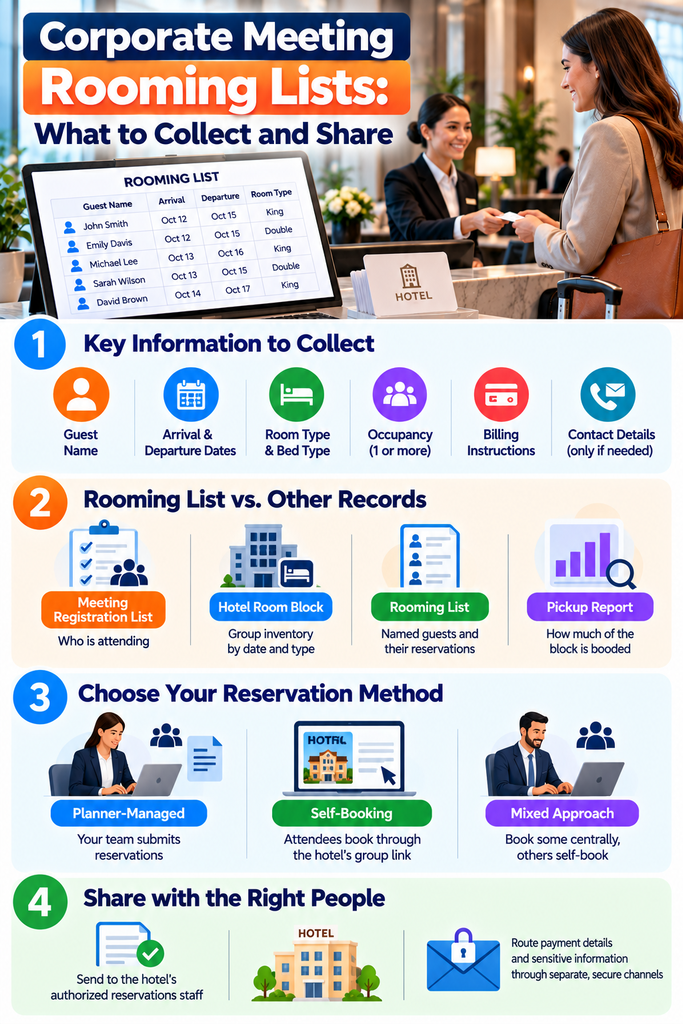
Quick answer: A rooming list should identify each reservation: guest name, arrival and departure dates, room type, occupancy and the agreed billing instructions. Add contact details only where the reservation process needs them. Send the hotel-specific list to authorized reservations staff, and route payment credentials and sensitive accommodation details through separate approved channels.
Collect too little and reservations go missing. Collect too much and you end up maintaining a spreadsheet full of other people’s personal data that nobody needed in the first place.
The checklist below is a starting point. Map it onto the hotel’s own template, because required fields, deadlines, payment arrangements and update procedures all depend on the property and what you signed.
What a rooming list is
A rooming list is the reservation-level record used to arrange or reconcile guest rooms for a group. It connects named travelers to their stay dates, room requirements and reservation status. Here “room” means an overnight guest room, not a meeting room.
| Record | What it tells the planner |
|---|---|
| Meeting registration list | Who is attending, local attendees who need no lodging included |
| Hotel room block | The group inventory by date and room type, subject to agreed terms |
| Rooming list | Which named guests need which reservations, dates and billing treatment |
| Pickup report | How much of the block is booked at that moment. Confirm how it treats cancellations and shared rooms |
Those four get conflated constantly, and the confusion is expensive. You can have a complete, accurate registration list and a half-empty block at the same time.
Choose the reservation method before collecting names
In a planner-managed process your team submits reservations. In a self-booking process attendees reserve through the hotel’s group link and your team watches the reports. A mixed approach books staff and speakers centrally and leaves everyone else to book themselves.
Marriott publicly describes both a group booking link, ResLink, and a portal for submitting and tracking rooming lists. Those are two examples of how it can work, not evidence that every property offers either.
Agree one owner per reservation. The failure mode is an attendee booking themselves and also appearing in your upload, which produces two rooms and one very annoying conversation at checkout.
If you are still arranging the block itself, how to book a hotel room block covers that stage, and managing room blocks for a conference covers the ongoing side.
What data a hotel rooming list should include
Ask for the hotel’s import template and field definitions before you build the registration form. Confirm whether it wants one row per reservation or one row per occupant. Shared rooms need an explicit link between occupants, or two people arrive as two rooms.
| Field | Recommended handling |
|---|---|
| Event and hotel identifiers | Event name, property and hotel-issued group code in the agreed header. One export per hotel |
| Guest first and last name | The confirmed reservation name, matching the identification they will present. Let guests correct spelling directly |
| Arrival and departure dates | Actual check-in and checkout, approved extensions included, in the hotel’s date format |
| Room category and bed type | Hotel-recognized labels or codes. Distinguish a requested bed type from a confirmed one |
| Occupancy and shared-room link | Occupant count and additional names where required. Link roommates using the hotel’s method |
| Billing instructions | Which approved charges go to the master account and which to the guest. Credentials stay out |
| Guest email or phone | Only the contact fields the agreed workflow needs for confirmations or operational contact |
| Reservation identifier | A stable internal reference. Add the hotel confirmation number once the hotel creates or matches it |
| Status and change action | Pending, confirmed, changed, canceled. For updates, name the action explicitly |
| Operational requests | An actionable request, its owner, and whether the hotel confirmed it. Sensitive details route separately |
These are planning fields rather than a universal specification. roommaster’s published template shows the common ones: guest names, room and bed types, occupancy, billing arrangements. What you submit is whatever the hotel’s current format says.
A property-specific requirement, verified
Madden’s on Gull Lake’s 2026 Meetings and Events Planning Guide tells groups to collect attendee names and email addresses under their signed contract and submit them to the Rooms Coordinator by the contractual deadline. That is a reason to ask each property what it wants. It does not establish a standard deadline or a mandatory email field anywhere else.
Keep internal control fields out of the export
Your working record probably needs an approver, department, cost center, last-updated time and issue owner. Export those only if the hotel needs them.
A front-desk room number and a reservation confirmation number are different things, and the hotel issues both. Do not invent room assignments before it does.
What should stay off the list
Keep the export to its operational purpose. The FTC advises businesses to collect and retain sensitive information only where there is a legitimate need, and to dispose of it when the need ends. That principle decides your field list. [4]
| Information | Where it should go instead |
|---|---|
| Full card number and CVV | The hotel’s approved payment or authorization process. Never the spreadsheet |
| Passport or ID scan, Social Security number | Not collected for an ordinary rooming list. If identification is required, have the hotel explain its own collection process |
| Medical diagnosis or treatment history | Out of rooming-list notes entirely. Coordinate the accommodation through a restricted process |
| Dietary requirements | To the catering contact, separately. Not duplicated into a lodging export |
| Flight itinerary and emergency contact | A separate travel or emergency process. Share an arrival time with the hotel only if operationally needed |
| Loyalty number | Optional, when the guest wants it applied and the hotel accepts it. Collect through the hotel where practical |
| Salary, HR notes, personal explanations | Excluded. None of it helps anyone create a reservation |
Share the accommodation, not the diagnosis
“Accessible requested” is usually too vague to resolve anything. Arrange a private conversation between the guest and the hotel about the actual features: a roll-in shower, visual notification equipment. Record the reservation outcome in the general workflow and keep the detailed request with the people arranging it.
The US Department of Justice’s lodging reservation provisions address describing accessible features in enough detail for guests to judge suitability. Confirm the specific features and the reservation with the property, because a checkbox on a registration form confirms nothing. This is a planning application of that guidance, not a complete accessibility assessment.
Separate billing instructions from payment credentials
A useful instruction reads: “Room and tax to the approved master account for November 10 to 13; guest pays incidentals and approved personal extensions.” Confirm the treatment of mandatory fees, parking, early departure and no-shows separately.
Writing that in a spreadsheet does not establish credit approval or payment authorization. Those are separate processes with separate approvers.
Provide credentials through a hotel-approved channel. PCI Security Standards Council guidance states card verification codes cannot be stored after authorization, and password-protecting a spreadsheet is not a reason to keep them. [6]
Who should receive what
Build purpose-specific exports rather than sending one file to everyone. This is a recommended workflow; adjust it to your organization’s privacy requirements and the hotel’s process.
| Recipient | What they need |
|---|---|
| Hotel reservations team | That property’s guest reservation fields, agreed billing routing, changes, necessary requests |
| Housing lead or coordinator | Working reservation records, confirmations, issue status, ability to reconcile changes |
| Finance or procurement | Approved charges, dates, room-nights, reservation references, cost allocation. Accommodation details excluded unless genuinely needed |
| Guest | Their own hotel, dates, confirmation, payment responsibilities and change instructions |
| Transportation coordinator | Pickup time and location, relevant contact details, transport requirements, via a separate transfer manifest |
| Meeting leadership | Aggregate pickup, cost and exception summaries, unless a named record is needed for a decision |
How to send it
Verify the hotel contact and the agreed submission channel. Prefer an organization-approved portal or a restricted file exchange with named access. Avoid public links and broad distribution lists, use access controls, and revoke access when someone no longer needs it. That follows the FTC’s guidance on limiting access and protecting data in transmission. [7]
If the hotel wants an attachment, use a method your organization approves for the data involved.
Hiding a column is not the same as removing it. Build a clean export containing only the fields you intend to send, then inspect every tab, comment and hidden row before the file leaves your machine.
Tell attendees how their information will be used
Explain what you need to arrange the stay, which hotel or housing provider receives it, and how they can correct it. Offer a private route for accommodation details. Use your organization’s approved privacy notice and any required consent process, because a generic registration checkbox does not resolve every obligation.
Use tools without losing the confirmation step
Marriott offers a rooming-list portal; Cvent describes Passkey functionality that maps reservation data into hotel-required formats. Before choosing a workflow, ask whether it handles shared rooms, rejected-row reports, confirmations, updates and access restrictions. [1][8]
A successful upload tells you the file parsed. Whether the hotel then created every reservation correctly is a separate question, and nobody checks that one for you.
Reconcile people, rooms and room-nights
An attendee count will not tell you whether the rooming list matches the block. Count distinct reservations for each occupied night, treating checkout as the departure day rather than another occupied night. Shared occupants count as one room when they share a reservation.
Say 100 people attend and 80 of them need lodging. Sixty stay alone, 20 share across 10 pairs. All need three nights, and 10 of the solo travelers arrive a night early.
| Measure | Calculation | Result |
|---|---|---|
| Attendees needing lodging | 60 solo + 20 sharing | 80 people |
| Rooms on each main night | 60 single + 10 shared | 70 rooms |
| Main-stay room-nights | 70 rooms x 3 nights | 210 room-nights |
| Early-arrival room-nights | 10 solo rooms x 1 extra night | 10 room-nights |
| Total room-nights | 210 + 10 | 220 room-nights |
| Peak nightly demand | Largest nightly count | 70 rooms |
So 100 attendees produce 70 peak rooms and 220 room-nights. People use those three numbers interchangeably in conversation, and your contract commits you against exactly one of them. How many rooms a group block needs works through the sizing, and room block attrition covers what happens when the booked number comes in under the committed one.
The example assumes no cancellations, late departures, room moves or changes in sharing. Compare the nightly totals and room types against the hotel’s confirmed inventory, and expect your forecast and the hotel’s pickup to disagree while reservations are pending.
Deadlines and changes
Agree the deadlines separately
Record the rooming-list submission date, the group booking cutoff, the permitted name-change window, cancellation terms and any block adjustment deadlines. They are rarely the same date and nothing warns you when you assume they are. Ask for the hotel’s time zone and the procedure for late changes.
Send changes the hotel can identify
Include the stable reference, the hotel confirmation number where you have it, the change action, the old value, the new value and the submission time. For example: reservation R014, change departure from November 13 to November 14, subject to hotel confirmation.
Ask whether the hotel wants a complete replacement file or only changed records, and do not send both without saying which is which.
Deleting a row from your workbook does not cancel a hotel reservation. Request cancellation through the agreed channel and keep the confirmation, and if you are cutting the block itself rather than one reservation, canceling or reducing a hotel room block covers the penalties that apply. A name substitution also needs hotel acknowledgment under the applicable terms.
Confirm what the hotel created
Work through the rejected rows. Compare confirmed dates and room types against what you sent, and check the nightly totals again. Then send each guest their own confirmed details.
After the meeting, reconcile stays and billing, then delete unnecessary working copies under your retention schedule, keeping required financial records and anything under legal hold.
Plan the hotel workflow while you are still choosing the venue
Start your corporate venue search on greatEvent. If you are still at the sourcing stage, what a hotel RFP should include for group bookings is the step before this one. When you evaluate a hotel, ask how it handles group reservations, rooming-list submissions, confirmations and changes. Confirm the chosen property’s process before you collect guest information, because the fields you need depend on it.
Research and sources
Sources checked October 6, 2026. Hotel and vendor sources support the specific examples attributed to them. The field checklist, sharing matrix, change process and numerical scenario are editorial planning recommendations, not a universal hotel standard or measured greatEvent customer results.
[1] Marriott, Innovative Tools and Resources. Describes ResLink group booking links and a portal for submitting and tracking rooming lists.
[2] roommaster, Rooming List Template. Vendor-published example of guest, room, occupancy and billing fields. Its generic submission timing is not adopted here.
[3] Madden’s on Gull Lake, 2026 Meetings and Events Planning Guide, page 32. Attendee names and email addresses and the deadline are linked to the signed contract. A property-specific example.
[4] FTC, Protecting Personal Information: A Guide for Business. Supports data minimization and a written retention and secure-disposal policy.
[5] US Department of Justice, ADA Title III Regulations. Section 36.302(e) addresses lodging reservations, including descriptions of accessible features.
[6] PCI Security Standards Council, FAQ 1280. Explains the prohibition on retaining card verification codes after authorization.
[7] FTC, Start with Security: A Guide for Business. Supports appropriate access restrictions and protection of sensitive data in transmission.
[8] Cvent, Passkey for Hotels. Describes mapping rooming-list reservation data to the hotel’s required format.
[9] greatEvent, How It Works. Supports the venue-search connection. This article makes no claim that greatEvent provides a secure rooming-list vault or any particular housing integration.
Frequently Asked Questions
What is the minimum information on a hotel rooming list? ▾
Guest names, arrival and departure dates, room type, occupancy and billing instructions. The property may want more, such as email addresses or shared-room links. Get its current template before you collect anything from attendees.
Does every attendee need a row? ▾
Follow the hotel’s import format. Some workflows represent a reservation with additional occupant fields, others use linked guest records. The thing to avoid is two separate bookings for two people who are sharing one room.
Should I include credit card information? ▾
No. Billing instructions belong on the list; payment credentials go through the hotel’s approved process. Card verification codes cannot be retained after authorization under PCI DSS guidance. [6]
How should accessible room requests be handled? ▾
Arrange a private discussion about the features the guest needs, get hotel confirmation, and give the guest a chance to verify suitability. Restrict the details to the people fulfilling the request, and keep medical histories out of the general file.
When should I send the final rooming list? ▾
On the date in your agreement or the hotel’s confirmed instructions. There is no deadline that applies to every meeting. Set an earlier internal collection deadline so you have time to chase missing information.
Is a rooming list the same as a pickup report? ▾
No. A rooming list describes individual reservation requirements. A pickup report shows booked use of the block at a point in time. Reconcile them by date and room type, accounting for pending, changed, shared and canceled reservations.
Can attendees book their own rooms instead? ▾
Yes, where the hotel supports a group booking link or equivalent. Establish what reporting you receive, how bookings are attributed to the block, and who handles changes. Then do not duplicate those reservations in a planner-submitted list.
How long should I keep the rooming list? ▾
Use your organization’s retention schedule. Keep required billing or dispute records, strip unnecessary personal details, and securely dispose of obsolete exports. There is no universal retention period. [4]
Compare vendors for your next event
Search caterers, photographers, florists, planners, and rentals — then send one request to several vendors at once.