Quick answer: If you don’t fill your hotel room block, you owe attrition damages on the shortfall between your contracted room nights and your actual pickup, usually the missed room nights multiplied by your group rate plus tax. Sample clauses commonly forgive 10 to 20 percent. Rooms the hotel resells, and attendees who booked outside your block, should reduce that bill.
The contract is signed. Registration is open. And the pickup report says you are sitting at 60 percent of your block with five weeks to go.
This post is about that situation and what follows it: the arithmetic the hotel will run, the damages number it produces, which parts of that number you can legitimately argue down, and what you can still do before and after the cut-off date. If you have not signed yet, the clause negotiation itself belongs in a different conversation, and the hotel RFP and group booking guide covers what to ask for and how hard to push..
What does a room block shortfall actually cost you?
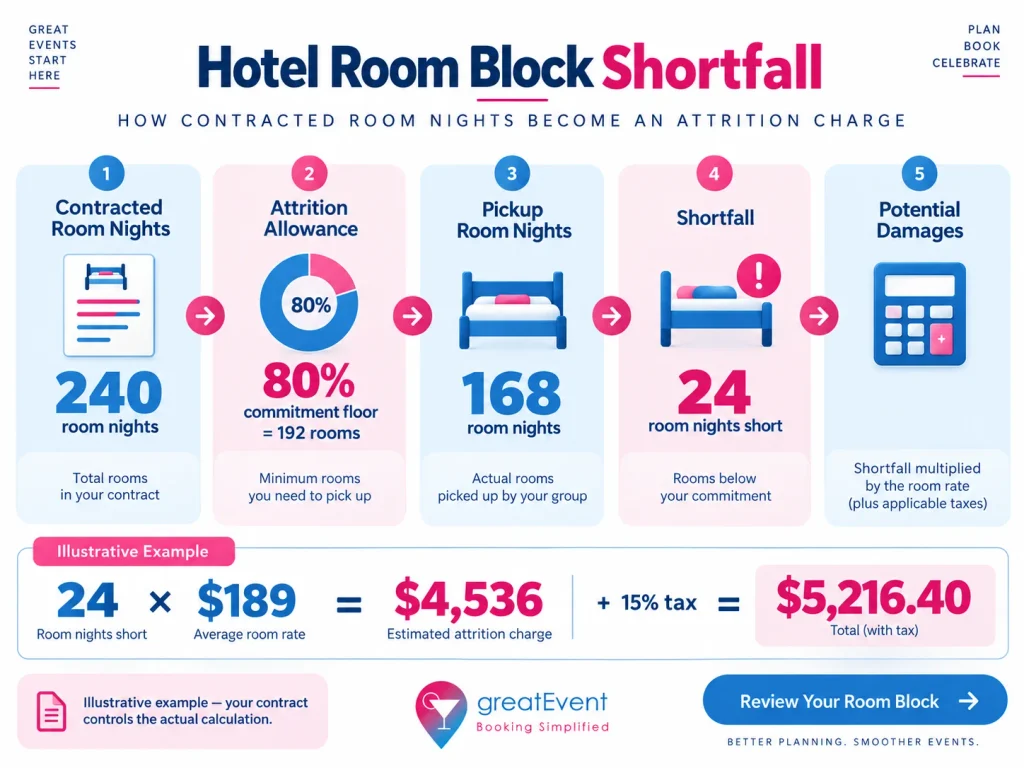
Something between nothing and a five-figure invoice, depending on four things: your allowance percentage, how the shortfall is measured, what the damages formula multiplies by, and whether the hotel resold the rooms.
Published guidance on the allowance clusters in a fairly narrow band, though the sources do not agree on a single number. Law Insider’s sample rooms attrition clauses run from 70 to 90 percent required pickup, with 80 percent appearing most often. HopSkip describes standard contracts as requiring 80 to 90 percent. EventPipe puts typical allowances at 10 to 15 percent, so 85 to 90 percent pickup. Lighthouse calls 10 to 20 percent a healthy allowance range for hotels. Groups360 describes 10 to 30 percent depending on the agreement. Treat any of these as an opening position that moves with season, market and how much of the hotel you are filling, rather than a standard you can rely on.
The other half of the exposure is the multiplier. HopSkip states that penalties typically run between 50 and 80 percent of the room rate for each unoccupied room below the threshold. Law Insider’s samples more often apply the full average group rate plus taxes, and one sample charges a flat stated amount per unused room night instead. Those are very different bills for the same shortfall, which is why reading your own clause beats reading any article about clauses.
One point worth knowing before you call the hotel. Joshua L. Grimes, quoted by Meetings Today, notes that a hotel can charge attrition even when it is fully booked, unless the contract requires it to credit resold rooms. He also notes the reverse: without an attrition clause at all, a sold-out property cannot charge you. The credit language is doing the work, not the occupancy.
How is attrition calculated, per night or cumulatively?
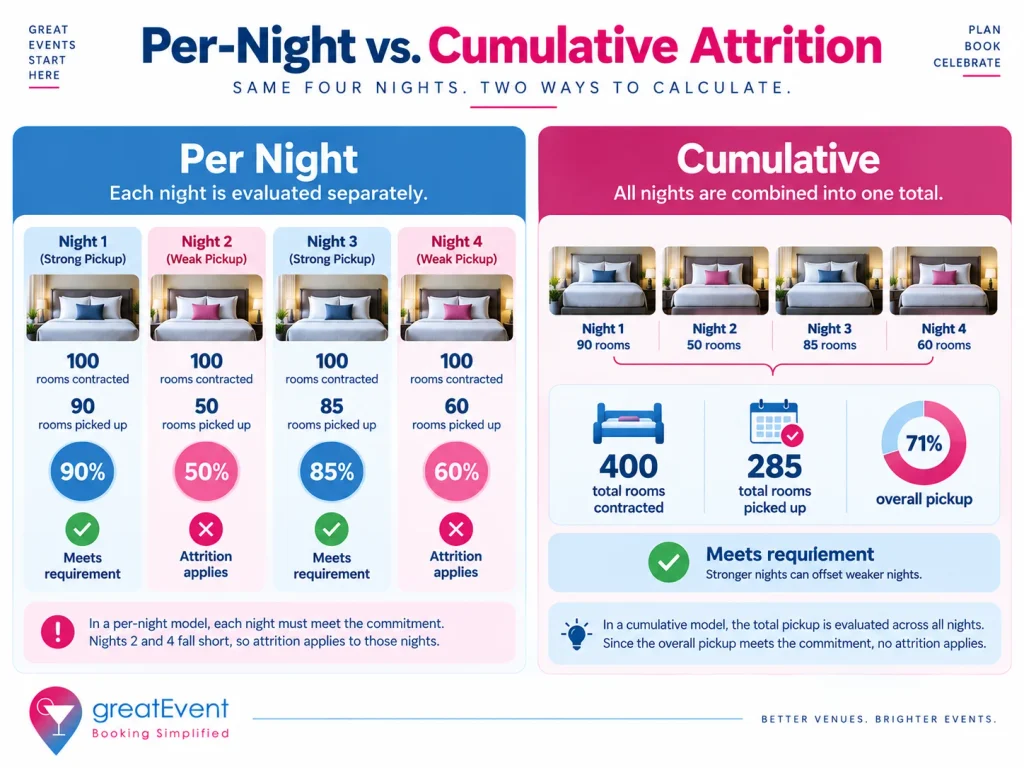
This single choice moves more money than the percentage does, and it was decided when you signed.
| Measurement method | How the hotel runs it | What sources say |
| Per night | Each date is judged on its own against that night’s contracted count. Miss the floor on one night and you pay for that night | ProStay’s example: a 50-room block with an 80 percent nightly clause obliges you to pay for at least 40 rooms every night. EventPipe quotes Patricia Driscoll: per night clauses punish you for every room short on every night |
| Cumulative | Total picked-up room nights across the whole pattern are compared to total contracted room nights, so a strong peak night offsets a soft shoulder night | Law Insider reports most sample clauses apply the threshold to total room nights, though at least one sample measures individually by day. ProStay calls cumulative the most common and preferred method |
| Revenue based | Measured against contracted rooms revenue rather than room count | Event Garde’s example: $50,000 contracted, $40,000 picked up, damages assessed on the $10,000 gap. Lighthouse describes revenue-based clauses often allowing 15 percent, so 85 percent of anticipated revenue |
| Stepped or scheduled | Different thresholds at different dates, with releases along the way | HopSkip describes attrition schedules with thresholds at set points. ProStay gives a phased release of 20 percent at 90 days, 15 percent at 60 and 10 percent at 30. Event Garde describes 10 percent at two months out plus another 5 percent one month before arrival |
Two practical notes. If your clause is revenue based, Brightspot Incentives and Events points out a lever room-count clauses do not give you: upgrading some attendees into higher rate categories raises revenue toward the minimum without adding bodies. And if your clause is per night, your real exposure sits on the shoulder nights, so that is where your remaining effort should go.
For broader planning, it also helps to understand how room blocks are structured before the contract becomes a problem. Our guide to managing room blocks for a conference covers the operational side of tracking inventory, pickup and attendee reservations.
What does a shortfall calculation look like in practice?
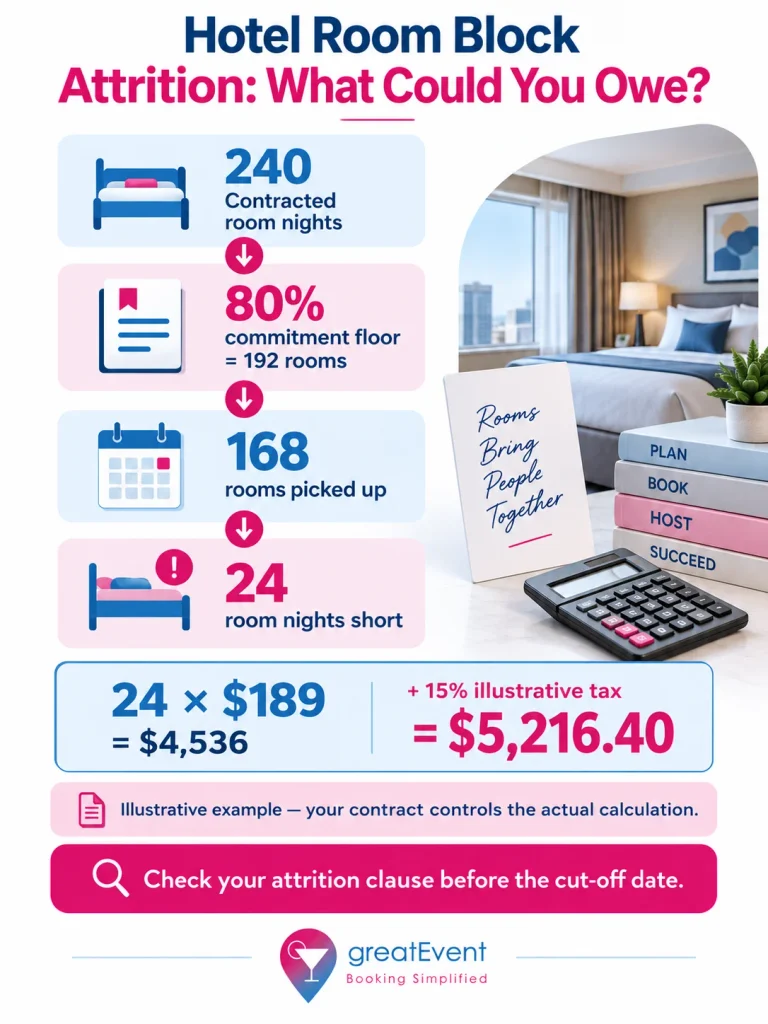
Below is one worked example. Every input is a stated assumption chosen to show the arithmetic, not a benchmark or a typical figure. Your own numbers come off your contract and your pickup report.
| Assumption | Value |
| Contracted block | 60 rooms per night, Monday to Thursday, 4 nights |
| Total contracted room nights | 240 |
| Group rate | $189 per room per night |
| Attrition allowance | 20 percent, measured cumulatively on total room nights |
| Pickup on the hotel’s report | 168 room nights |
| Attendees found in house but outside the block, post-event audit | 9 room nights |
| Room nights the hotel confirms it resold | 12 room nights |
| Occupancy and sales tax used for illustration | 15 percent |
| Damages basis, hotel starting position | 100 percent of group rate |
Now the same shortfall priced four ways, working from the hotel’s opening number down to what a well-drafted clause would actually support.
| Step | Calculation | Amount owed |
| 1. Your commitment floor | 240 contracted room nights x 80 percent | 192 room nights |
| 2. Shortfall on the hotel’s report | 192 floor minus 168 picked up | 24 room nights |
| 3. Hotel’s opening invoice | 24 x $189, plus 15 percent tax | $5,216.40 |
| 4. Credit the out-of-block stays | Pickup restated at 177, so shortfall is 15. 15 x $189, plus tax | $3,260.25 |
| 5. Credit the resold room nights | Shortfall net of 12 resold is 3. 3 x $189, plus tax | $652.05 |
| 6. If damages are set at 50 percent of rate | 3 x $189 x 50 percent, before tax | $283.50 |
The gap between line 3 and line 5 is the whole argument. Nothing changed about how many people came. What changed is whether the bill reflects rooms the hotel actually lost money on. Law Insider notes that sample clauses commonly frame these charges as liquidated damages and not as a penalty, and that framing is not decoration: it is what keeps the charge enforceable, and it also gives you the principle to argue from.
Whether tax rides on top is contract-specific. Law Insider’s samples frequently add taxes to the shortfall calculation. Ask which line your hotel intends to tax before you accept the figure, because on line 3 above the tax alone is $680.40.
How are attrition damages supposed to be measured?
On the hotel’s loss, not on your rate card. That is the position published legal guidance takes, and it is the single most useful thing to know when an invoice arrives.
Tenenbaum Law Group PLLC and Venable LLP both publish guidance that the damages formula should be premised on lost profits and not on lost gross revenue, meaning room rates. The same guidance explains why the wording matters: an attrition clause stated in terms of estimated lost profits is enforceable, while one stated in terms of a penalty is not, and enforceability does not depend on the hotel proving what it actually lost, because a reasonable predetermined estimate is enough.
HopSkip’s sourcing material carries a caution worth keeping. It lists three elements behind an enforceable liquidated damages provision: one party is injured if the other does not perform, the actual loss would be difficult to determine, and the parties agree in advance on an amount or a formula. It then adds that damages do not have to be based on profit, on the reasoning that if lost profit were easy to calculate there would be no need for liquidated damages at all. So the lost-profit argument is a strong negotiating principle and a drafting recommendation, not a rule you can assume a court will read into a clause that says something else.
Grimes, in Meetings Today, adds two boundaries on scope. Liquidated damages should cover only what you were contractually obligated to use, such as guest rooms and contracted banquet food and beverage, and should not reach optional spending like golf or spa unless you agreed to that in advance. And a group should not be made to give up its concessions and pay attrition damages, since the damages already compensate the hotel for the same loss.
Does the hotel have to try to resell your rooms?
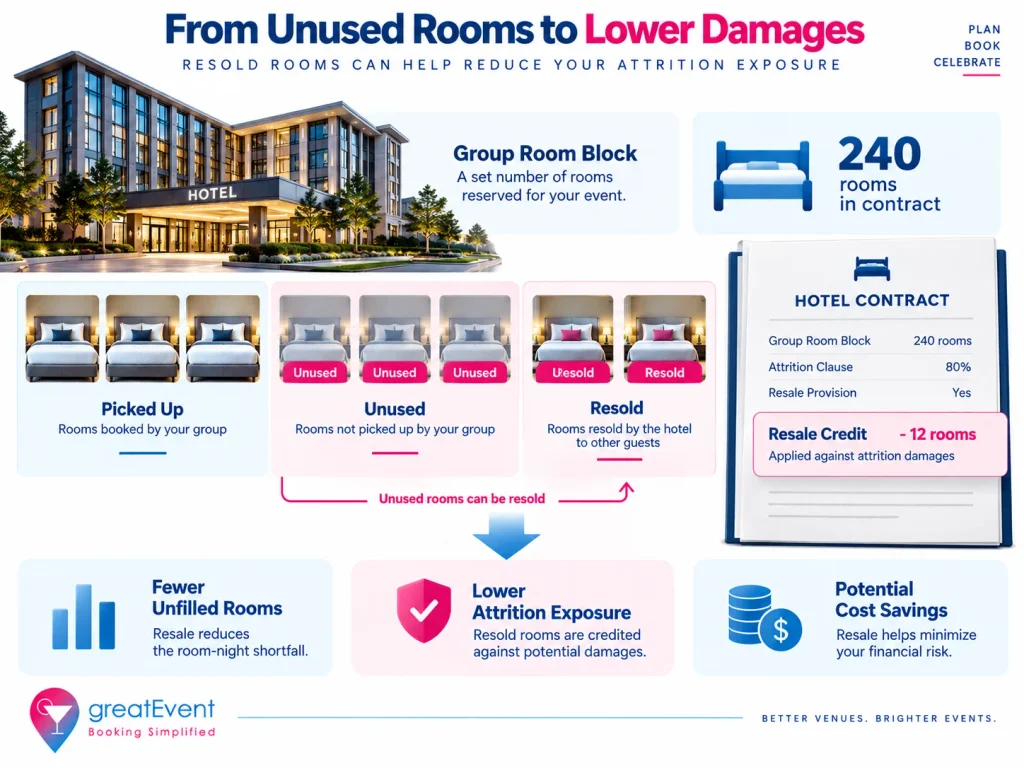
Only if your contract says so, and this is where you should look first.
Law Insider’s samples show the range. Multiple clauses require the hotel to attempt to sell the unused portion of the room block and to credit the group for rooms resold, in some samples up to the rate for that room, with a good faith effort to mitigate. Other samples are considerably weaker, and at least one adds that group rooms shall be the last in the hotel’s inventory to be sold, which makes the resale promise close to worthless in a busy week.
The stronger version is what Tenenbaum and Venable recommend asking for: an affirmative duty to resell rooms not reserved by the stated date, with any damages owed reduced by the rooms resold. Both also describe a further protection worth knowing about, that the group owes no liquidated damages if the property meets or exceeds its average occupancy level for the week of the meeting.
Practical asks when you are already in a shortfall:
- Ask, in writing, what the hotel did to resell the released inventory and what the property’s occupancy was on each of your nights.
- Ask for the resale credit to be shown as a line on the settlement, not folded into a single lump figure.
- ProStay’s guidance on stronger contracts sets the standard to hold to: documented resale attempts, and your unused rooms sold before walk-in business.
- If the property ran at or near full occupancy across your pattern, say so plainly and ask what loss the damages are estimating.
Why does your pickup report understate your real pickup?

Because it only counts reservations booked against your rate codes. Anyone who used a loyalty account, a corporate rate, a public rate or a discount site is physically sleeping in the hotel and invisible to your report. Groups360 notes it is common for more than a third of group attendees to reserve outside the block.
That produces a shortfall that is partly fictional. And the fix is not automatic. Grimes is blunt about it: absent a contract provision covering the subject, a hotel has no duty to apply rooms reserved by group guests booking outside the block to the group block. His recommended language requires all guest rooms of your attendees to count toward the block regardless of how they booked or what rate they paid.
If you do not have that language, you can still ask, and it works often enough to be worth the effort. Event Garde and ProStay both describe post-event housing audits, where the hotel compares your registration or attendee list against its in-house guest list and applies the matches. Expect friction: this is a manual name-by-name comparison that hotels are not eager to run. Brightspot recommends doing the cross-check about a week before arrival instead, while the reservations still exist and can be moved.
Two more sources of found room nights. Lighthouse recommends negotiating credit for pre-event and post-event bookings, and Brightspot suggests asking for shoulder nights to be counted into your totals. Neither is guaranteed. Both are free to ask for.
What can you do while pickup is still tracking short?
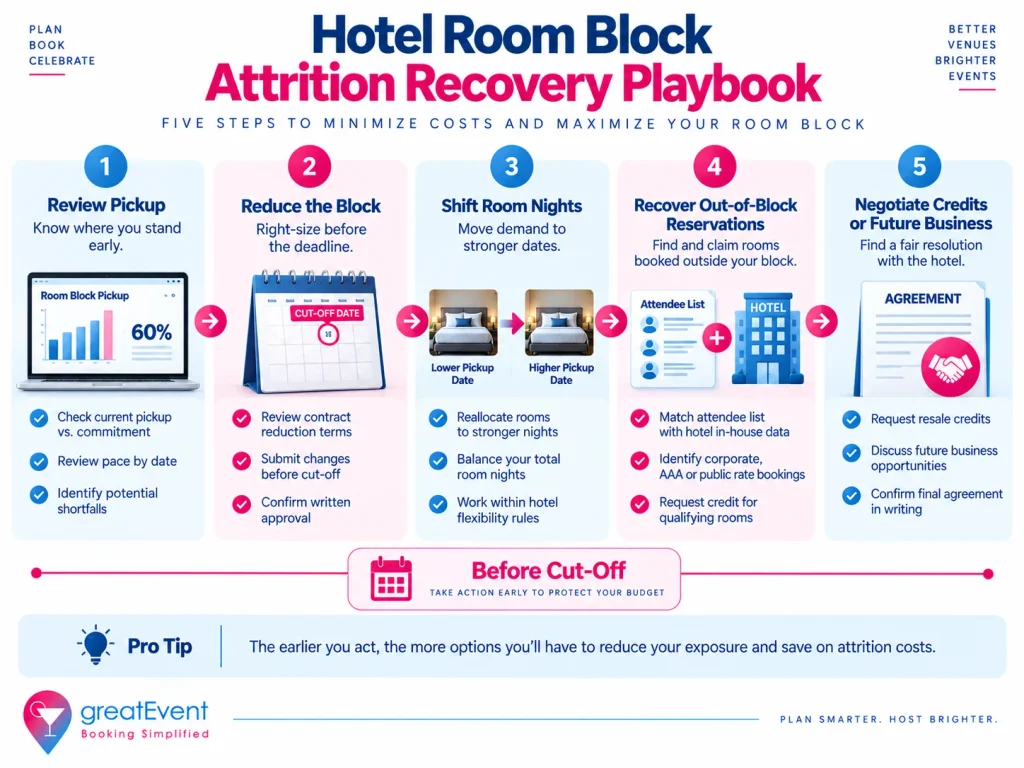
Almost everything useful happens before the cut-off date, and Brightspot’s advice is the one line to remember: if you are confident you will not pick up the block, tell the hotel immediately, because early notice is what gives the property time to resell.
| Timing | What is still available | Source basis |
| 90 to 60 days out | Reduce the block under any stepped release you already contracted for | ProStay describes phased releases at 90, 60 and 30 days; Event Garde describes 10 percent at two months plus 5 percent at one month |
| About one month before cut-off | Formal block review with the hotel using pickup reports by rate code, then release or add rooms | Groups360 recommends scheduling this review, and notes hotels may accept a reduced block with the attrition calculation adjusted if both sides agree |
| Before cut-off | Shift room nights off soft dates, and extend the rooming list deadline | Brightspot lists rooming list extensions and written pickup guarantees as things to request |
| Before cut-off | Cross-check registration against the hotel’s in-house list and move out-of-block reservations into the block | Brightspot recommends this about a week out; Groups360 notes out-of-block booking runs above a third of attendees |
| Any time | Offer replacement business: a small meeting inside the next 60 to 90 days, or a rebook of the same program next year | Brightspot lists both; Event Garde lists a future booking commitment as a settlement route |
| Any time | Convert the exposure rather than pay it: meeting space credit, or applying value to a future program | HopSkip lists converting unused rooms to meeting space credit or applying them to a future program, plus negotiating a reduced settlement |
| After the event | Post-event housing audit, then check the settlement line by line | Event Garde and ProStay both describe post-event audits recovering room nights |
A note on the ask itself. Event Garde is realistic that a full waiver is rare and depends on the relationship, and lists reduced percentages, food and beverage offset and future business as the more achievable outcomes. Go in asking for the waiver, plan to land on one of the others.
How does the food and beverage minimum interact with room attrition?
They are separate commitments that can help or compound each other, and the direction depends on your contract.
The compounding case first. Lighthouse notes that a group failing to meet a contracted minimum food and beverage spend may be liable for penalties on that too, so a thin meeting can generate two shortfalls at once. Law Insider’s sample food and beverage minimum clauses compute the shortfall as the difference between the agreed food and beverage revenue and the actual revenue received, payable as liquidated damages, commonly within 30 days. Those samples also state the minimum exclusive of taxes and service charge or gratuity, which matters: if tax and service charge do not count toward the minimum, your real spend has to run meaningfully higher than the headline number to clear it. On the useful side, one sample has the hotel agree not to seek further damages for the guaranteed functions once the shortfall is paid.
The helpful case is the offset. Event Garde lists increased food and beverage spending as a way to offset room attrition, and Brightspot lists crediting excess food and beverage spend toward the room revenue obligation. ProStay notes that revenue managers often bundle revenue-based attrition with food and beverage minimums in the first place. Whether an overage on one line can be applied against a shortfall on the other is a contract question, so read your clause and ask the hotel directly before you plan a spend around it.
If the shortfall is unavoidable, spending your way out can still be the better deal. Money spent on a reception your attendees enjoy is worth more to your organization than the same money paid as damages for rooms nobody slept in.
For example, if your event is also carrying a meaningful catering commitment, understanding your broader event catering options and costs can help when evaluating whether additional food and beverage spending makes financial sense. The specific caterer is only an example; your contract and event location should determine the appropriate vendor.
The recovery playbook
- Pull your own clause and read three things. Whether measurement is per night, cumulative or revenue based; what the damages formula multiplies by, and whether tax is added; and whether the hotel owes you a resale duty with credit.
- Rebuild the pickup number yourself. Hotel pickup by rate code and by night, against your registration list, so you know your real position before the hotel tells you what it is.
- Tell the hotel early and reduce the block. Use any stepped release you contracted for, call a formal block review about a month before cut-off, and put a revised commitment in writing.
- Shift room nights off the soft dates. Move inventory toward the nights that will fill, ask for shoulder nights and pre-event or post-event stays to count, and ask for a later rooming list deadline.
- Recover your out-of-block stays. Cross-check attendee names against the hotel’s in-house list roughly a week before arrival, move what you can into the block, and request a post-event housing audit for the rest.
- Bring something to trade. A small meeting within the next 60 to 90 days, a rebook of the program, added food and beverage spend, or a meeting space credit instead of cash damages.
If you are planning another corporate program, a dedicated corporate event hotel room block guide can also help you structure the next room block before you get back into the same situation.
For sports organizations, tournaments and similar group travel, the hotel strategy can be different. The hotel booking guide for sports tournament organizers covers another use case where room inventory, dates and pickup can have a major impact on the final hotel commitment.
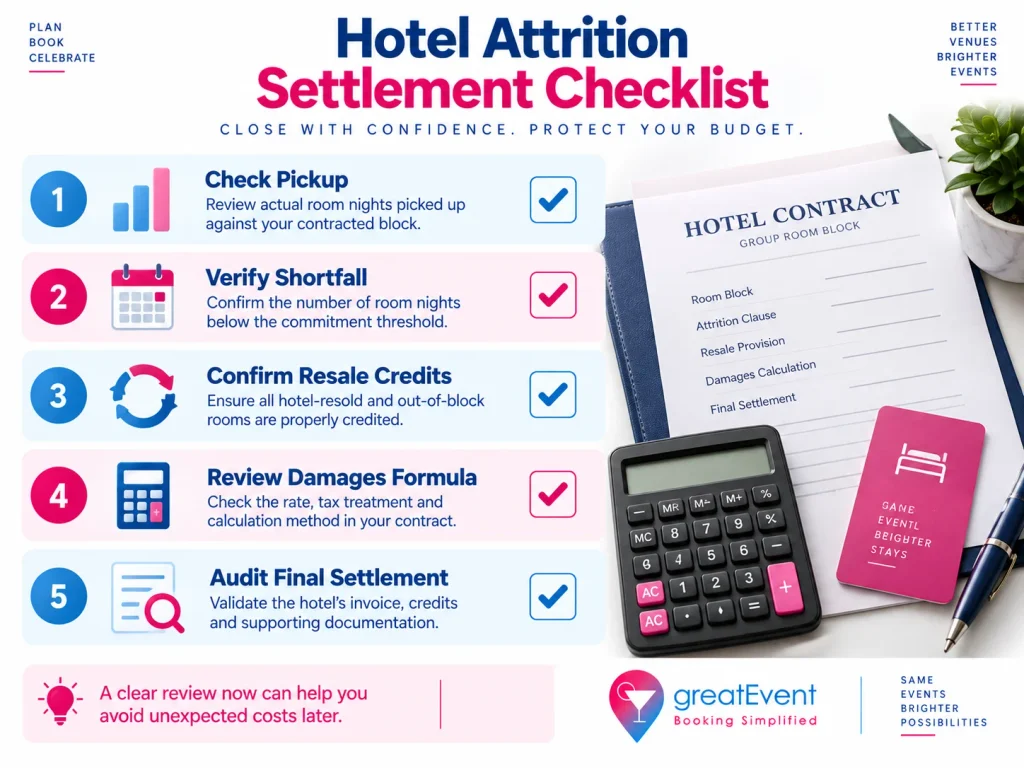
- Audit the settlement before you approve it. Check the shortfall arithmetic, the resale credits shown as separate lines, the property’s occupancy on your nights, the damages basis, and that no ancillary spending you never contracted for has been pulled into the calculation.
If the hotel is proposing additional venue or meeting-space charges as part of the settlement, compare them against the broader economics of your event rather than treating the number in isolation. Published event pricing can vary significantly by venue type, market and booking structure; the event space cost guide provides useful context for evaluating those costs.
You can also compare hourly venue pricing through this event venue cost per hour guide when deciding whether converting some of the hotel exposure into meeting-space value is commercially reasonable.
Key takeaways
- Attrition damages are billed on the shortfall between your commitment floor and your pickup, usually shortfall multiplied by group rate. HopSkip reports penalty bases commonly running 50 to 80 percent of rate, while Law Insider’s samples more often apply the full rate plus tax.
- Cumulative measurement across the whole pattern is materially safer than per night, because strong nights offset soft ones. Sources put the allowance anywhere from 10 to 30 percent, so treat published figures as opening positions.
- Tenenbaum Law Group and Venable both advise that damages be premised on lost profits rather than lost gross revenue, and framed as an estimate of loss rather than a penalty so the clause holds up.
- The resale credit is the clause that decides your real exposure. Grimes notes a hotel can bill attrition even when sold out unless the contract requires resold rooms to be credited.
- Out-of-block bookings create shortfalls that are partly fictional. Groups360 notes more than a third of group attendees book outside the block, and Grimes notes hotels have no duty to count those rooms without contract language saying so.
- Act before the cut-off. Reducing the block, shifting room nights, offering replacement business or converting exposure into meeting space credit all become harder once the date passes.
Frequently Asked Questions
What happens if you don’t fill your hotel room block? ▾
You owe attrition damages on the shortfall between your contracted commitment and your actual pickup. Published sample clauses commonly require 70 to 90 percent pickup and charge the missed room nights at the group rate, sometimes plus tax. Rooms the hotel resells should reduce that bill if your contract requires the credit.
How is a room block shortfall calculated? ▾
Take your contracted room nights, multiply by the required pickup percentage to get your commitment floor, then subtract your actual pickup. The remainder is billed at your group rate, or at a stated percentage of it. ProStay states the common formula as contracted rooms minus actual rooms used, multiplied by the group rate and the number of nights.
Is cumulative or per night attrition better for the planner? ▾
Cumulative attrition is generally more favorable to planners because it compares total picked-up room nights to total contracted room nights across the whole pattern, so a full peak night can offset a soft shoulder night. Per-night attrition judges every date separately. EventPipe quotes Patricia Driscoll saying per-night clauses can result in charges for every room short on each individual night.
Does the hotel have to resell my unused rooms? ▾
Only if your contract says so. Tenenbaum Law Group and Venable both recommend an affirmative duty to resell, with damages reduced by rooms resold. Law Insider’s samples vary widely, and one even places group rooms last in the hotel’s inventory to be sold. Ask for documented resale attempts and a credit line on the settlement.
Can attendees who booked outside the block count toward my pickup? ▾
Not automatically. Joshua L. Grimes, quoted by Meetings Today, states that absent a contract provision, a hotel has no duty to apply rooms booked outside the block to your block. You can still ask for a post-event housing audit matching your attendee list against the in-house guest list, although hotels may be reluctant to run it.
Can I reduce my room block before the cut-off date? ▾
Yes, to the extent your contract allows, and it is often the cheapest fix available. ProStay describes phased releases at 90, 60 and 30 days out, while Event Garde describes reductions at two months and one month before arrival. Groups360 recommends a formal block review about a month before the cut-off.
Can food and beverage spending offset room attrition? ▾
Sometimes, and only if your contract permits it. Event Garde lists increased food and beverage spend as an offset route, and Brightspot Incentives and Events lists crediting excess food and beverage toward the room revenue obligation. Confirm it with the hotel in writing first, because sample clauses may treat the two minimums separately.
Can a hotel charge attrition if it sold out anyway? ▾
Yes, according to Grimes in Meetings Today, unless your contract requires resold rooms to be credited against what you owe. He also notes the reverse: with no attrition clause at all, a sold-out property cannot charge you. Ask for the property’s occupancy on each of your nights before approving the settlement.
Compare vendors for your next event
Search caterers, photographers, florists, planners, and rentals — then send one request to several vendors at once.