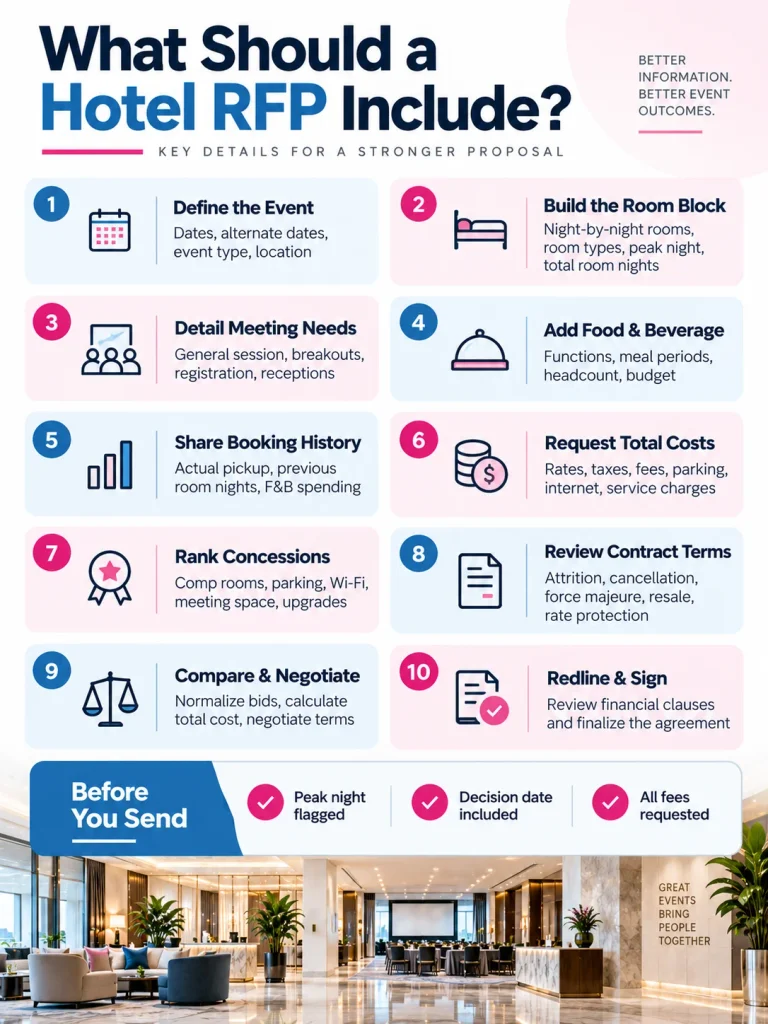
Quick answer: What should a hotel RFP include for group bookings? Exact dates plus two alternates, a night by night room block pattern with the peak night flagged, meeting space and food and beverage needs, honest pickup history from prior events, your decision date, and the criteria you will score on. Then require every hotel to quote total cost including every fee and tax.
Two hotels quote the same nightly rate. One of them costs your organization noticeably more by the time the group checks out. The gap sits in the fees your RFP never asked about and the clauses nobody redlined.
This post assumes you already know how a room block works. If not, start with the pillar guide on how to book a hotel room block, then come back. What follows is the document you send and the negotiation that comes after it: what to write, how to line up responses so they are genuinely comparable, and which clauses to push on and how far.
Why does a vague RFP cost you money?
Because the hotel prices your uncertainty. Mews, writing for hotel sales teams, puts it bluntly: a total room block number without a nightly pattern is close to useless to a revenue manager. When a hotel cannot see what you actually need, it quotes defensively, which means a higher rate and tighter terms.
The same source lists what makes a hotel deprioritize a bid: no decision timeline, missing arrival and departure detail, and unranked concession wish lists. Mews notes that more than 60 percent of planners expect a response within four days, and that an incomplete RFP delays the reply, which hands the advantage to whichever property got a cleaner brief.
There is a credibility cost too. HopSkip warns that hotel revenue managers can spot inflated pickup estimates, and that padding your numbers damages your standing for the next cycle. Overstating the block also raises your attrition exposure, so you pay twice for the same lie.
What goes in the RFP document, section by section?
Engine’s published hotel RFP template runs in ten sections, and the structure is a reasonable spine for almost any group program. Below is that spine with what each section needs to contain.
| Section | What to include | Why the hotel needs it |
| Who you are | Organization, event name, event type, planner contact, whether you are corporate, association, nonprofit or government | Sets the tax and rate profile and tells sales who they are dealing with |
| Dates and flexibility | Preferred pattern plus two named alternates, and whether you can shift to shoulder dates | HopSkip notes hotels often return better rates on shoulder dates when you give them the option |
| Room block pattern | Every night, every room type, count per night, peak night flagged, total room nights | The rate is built off this, not off your total |
| Rate request | Target rate, hard ceiling, net or commissionable, comp room ratio expected | Filters properties out of your range before either side spends time |
| Meeting space | General session, breakouts, registration, office, receptions, with set style, headcount and hold times | Space is often the constraint that decides yes or no |
| Food and beverage | Function by function, with meal periods, headcount and your overall budget or minimum | Prevents a quote built on an F and B assumption you never made |
| History | Actual picked-up room nights from your last two or three events, by property and by night | This is your bargaining position, and it is verifiable |
| Concessions requested | Ranked, not listed flat | Ranking tells the hotel where to spend its give |
| Terms and billing | Attrition, cut-off, deposits, billing method, cancellation expectations | Surfaces deal breakers before the contract stage |
| Process | Response deadline with a time and time zone, site visit window, decision date, and your scoring criteria | Mews reports that no timeline reads as early-stage tire kicking |
The room block pattern is the part hotels actually price
Write it as a grid, not a sentence. Date down the side, room type across the top, count in the cell. Engine’s template flags the peak night explicitly and totals room nights at the bottom, which is the format a revenue manager can drop straight into a forecast.
Two habits worth keeping. State arrival and departure days, because a Sunday arrival and a Wednesday departure is a completely different piece of business from Thursday to Sunday. And separate staff and speaker rooms from the attendee pool, so you can negotiate those terms independently later.
What history should you disclose?
Picked-up room nights, not contracted room nights. Corporate and Incentive Travel quotes Genny Castleberry of Brightspot Incentives and Events on using meeting history as your position in the negotiation: a group with demonstrated performance can offer a higher food and beverage minimum or a firmer commitment and get paid for it in concessions.
If you have no history, say so plainly and explain your forecast method. A first-year event with an honest range beats a fictional 400-room block that you miss by a third.
If catering is being sourced separately, reviewing an event catering service can also help planners understand what information should be included when requesting food-and-beverage pricing.
How long should the process take, and how many hotels should get it?
HopSkip recommends five to eight well-chosen properties and warns against blanket sending. Easy RFP’s published timeline runs six to twelve weeks for a medium to large program, and 14 to 20 weeks for major conferences of 1,000 or more attendees, organizations with heavy legal review, or multi-stakeholder international events.
| Phase | Typical window | What happens |
| Brief and history file | Week 0 to 1 | Internal alignment on dates, budget, deal breakers |
| RFP out | Week 1 | Five to eight properties, receipt confirmed inside 48 hours |
| Response window | Week 1 to 3 | HopSkip suggests 5 to 7 business days minimum, 2 weeks or more for complex programs; Easy RFP allows 2 to 3 weeks |
| Evaluation | Week 3 to 4 | Normalize bids, shortlist 3 to 5 |
| Site visits | Week 4 to 6 | Finalists only |
| Negotiation | Week 7 to 9 | Rates, concessions and clauses together |
| Contract and legal | Week 10 to 12 | Easy RFP flags legal review as a 2 to 4 week extension risk |
Easy RFP names negotiation as the phase that slips most often. Build slack there rather than in the response window, because compressing the response window is what produces thin bids.
When evaluating finalists, consider the entire property rather than the room rate alone. A hotel that combines guest rooms and event facilities can sometimes simplify logistics, making it useful to compare options such as a hotel event venue.
A short RFP cover email that works
The full RFP goes in an attachment or a sourcing platform. The email is what gets it opened.
Subject: RFP: [Event name], [City], [Dates], [X] peak rooms, decision [Date] Hi [Sales Manager], attaching an RFP for [Organization]’s [event type], [dates] in [city], with [alternate dates] as our second and third options. Headlines: [X] total room nights across [N] nights, peak of [X] rooms on [day]. We need [square footage or capacity] for general session plus [N] breakouts, and we are budgeting [amount or range] for food and beverage across [N] functions. Last year at [property or city] we picked up [X] room nights against a [X]-room block, and I have that report if it helps you price. Proposals due [day, date] by [time, time zone]. We will shortlist by [date], visit finalists the week of [date], and award by [date]. We will score on total cost per attendee per night, meeting space fit, walk time to [venue], and contract flexibility on attrition and cancellation, in that order. Please quote all fees and taxes separately: occupancy and sales tax, resort or destination fee, self and valet parking, guest room and meeting space internet, and your food and beverage service charge with its tax treatment. Our top three concession priorities are [1], [2], [3]. [Name, title, phone, email]
Naming the decision date and the scoring order does two things. It tells sales this is live business, and it tells them where to concentrate the give.
For meeting-focused programs, understanding company meeting room rental costs can also help establish a realistic meeting-space budget before sending the RFP.
How do you compare hotel bids on total cost?
Never on the headline rate. Rebuild every bid into the same columns before you look at any of them, and add the lines hotels quote separately.
| Line to normalize | What to watch | Ask in the RFP |
| Group room rate | Net or commissionable, single or double occupancy | Both, stated separately |
| Occupancy and sales tax | Percentage and whether it applies to fees as well as rate | Full percentage and what it attaches to |
| Resort, destination or amenity fee | Groups360 lists these as negotiable, often waived or reduced for groups | Amount per room per night, and whether it is waivable |
| Parking | Self and valet differ sharply, and Groups360 flags parking as a standard concession target | Both rates, plus in and out privileges |
| Internet | Guest room and meeting space are usually priced separately | Both, with bandwidth for general session |
| Food and beverage service charge | Commonly quoted in the high teens to low twenties as a percentage of the F and B bill | The percentage, and whether gratuity sits inside or on top |
| Tax on the service charge | Varies by state. The Texas Hotel and Lodging Association explains that in Texas a banquet service charge over 20 percent is usually taxable in full, while at 20 percent or less only the portion not distributed to tipped employees is generally taxed | Confirm treatment in writing for your state |
| Meeting space rental | GoGather notes rental is commonly waived once the F and B minimum is met | Rental, set-up, breakdown and room flip charges |
| Audio visual, rigging, electrical | GoGather cites 10 to 15 percent discounts with the in-house provider as a common ask | Rate card, plus whether outside AV is permitted |
| Concession value | A comp room ratio and waived fees have real dollar value | Convert to dollars and subtract |
| Rebate or commission | Changes what the attendee pays and what you receive | Stated explicitly, with the order of calculation |
For another benchmark, review event space costs and party venue pricing when determining whether a hotel’s meeting-space quote fits within your overall venue budget.
Then reduce everything to one number: total program cost, plus cost per attendee per night. Do the arithmetic in the order the folio will follow, fees first and tax on top, because tax applied after a resort fee is not the same as tax applied to the rate alone.
One warning on service charges. Because a mandatory service charge is not discretionary, it is hotel revenue rather than a tip, which is why it can attract sales tax. Get the treatment confirmed for your specific state before you sign a food and beverage minimum, since the tax sits on top of a number you have already committed to.
Which concessions are realistic to ask for?
Package them and rank them. Groups360’s guidance is to quote space, parking and breakfast together rather than one at a time, because bundled asks pull harder than isolated ones.
| Concession | Common ask | How realistic |
| Comp rooms | GoGather cites 1 per 30 to 40; HopSkip cites 1 per 40 to 50 | Widely granted. Treat 1 per 40 as the floor and push on volume |
| Waived or reduced resort or destination fee | Full waiver for the block | Often granted for groups, per Groups360 |
| Parking | Comp or discounted self-parking | Commonly negotiable |
| Internet | Comp in guest rooms and meeting space | GoGather lists comp meeting space WiFi as standard |
| Meeting room rental | Waived once the F and B minimum is met | Standard practice per GoGather |
| Suite upgrades and VIP early check-in or late checkout | Named list, fixed count | Usually available, numbers negotiable |
| Rate extension | GoGather cites three days pre and post at the contracted rate | Frequently granted |
| Staff and planner rooms | Reduced staff rate, one comp planner room on site | Commonly negotiable |
| AV discount | 10 to 15 percent with in-house | Frequently granted per GoGather |
| Block review dates without penalty | Scheduled chances to reduce the block | Negotiable, and worth more than most rate concessions |
| Weekly pickup reporting from a named contact | Written into the contract | Cheap to grant, so ask |
| Chef’s choice amenities, welcome notes, airport transfers | VIP touches | Groups360 lists these as standard asks |
Corporate and Incentive Travel quotes Tyra Hilliard, CMP, on the mistake that costs planners the most: walking into a negotiation having already decided the meeting will be at that hotel. Keep a live alternate until you sign.
Realism cuts the other way too. All of the above depends on season, demand and how much of the hotel you are filling. A soft January date buys concessions that a citywide peak week will not.
For events that include milestone celebrations, some planners may also need to account for secondary event expenses, such as 10-year anniversary gift ideas, when building the wider event budget.
Which contract clauses actually carry money?
These are the provisions where a single sentence moves thousands of dollars. The middle column reflects what published sample clauses and legal commentary describe as common hotel starting positions, and the right column reflects what practitioners and counsel recommend asking for.
| Clause | Typical hotel starting position | What to ask for |
| Attrition | Law Insider’s sample rooms attrition clauses cluster around 80 percent of total room nights, with damages framed as liquidated damages and not a penalty. ContractNerds describes 75 percent as a common allowance and 85 percent in higher-demand cities | Corporate and Incentive Travel reports typical allowances of 10 to 15 percent; Groups360 suggests asking for 20 percent for unpredictable groups. Measure cumulatively across the whole pattern rather than per night |
| Attrition damages formula | Shortfall multiplied by average group rate, plus tax | Tenenbaum Law Group advises damages premised on lost profits rather than lost gross revenue, and framed as estimated damages rather than a penalty so they stay enforceable |
| Resell and mitigation duty | Some sample clauses promise only to attempt resale, and add that group rooms are last in inventory to be sold | Tenenbaum recommends an affirmative duty to resell, with damages reduced by rooms resold. ContractNerds adds that attrition fees should be the exclusive remedy |
| Cancellation | ContractNerds describes tiered scales rising as the date approaches, for example 50 percent beyond 90 days, 70 percent at 30 to 90 days, and 90 percent inside 30 days | Lower percentages, credit for resold rooms, and a rebooking substitution. Tenenbaum also suggests no damages if the hotel meets or exceeds its average occupancy for that week |
| Force majeure | ContractNerds notes most agreements restrict relief to performance being illegal or impossible | PCMA, quoting attorney Joshua L. Grimes, recommends “commercially impracticable or inadvisable” language, explicit reference to disease, epidemic and pandemic, and notice worded as promptly rather than a hard deadline |
| Go or no-go date | Usually absent | Grimes advocates a decision deadline around 90 days out so you can cancel when attendance clearly will not support the meeting and the hotel still has time to rebook |
| Rate guarantee | The quoted rate, with no protection against lower public rates | Tenenbaum recommends a clause that the group receives the lowest rates in the hotel at the time of the meeting, and for bookings more than a year out, a formula such as current-year rate plus a set percentage, or the lesser of several stated methods |
| Cut-off and block release | Around 30 days out, with release of unreserved rooms and no change to your commitment | Tenenbaum recommends a date before which no rooms are released, and confirmation that attendees still get the contracted rate after cut-off on a space available basis |
| ADA | Silent, or the obligation pushed onto the group | Tenenbaum recommends the hotel warrant its own compliance, including wheelchair access provisions, and indemnify you for its failures. Split the remaining responsibilities item by item in writing |
| Indemnification | HopSkip notes hotels prefer one-sided clauses in their own favor, since injury claims almost always name the hotel | Reciprocal indemnity covering hotel negligence and willful misconduct, plus defense costs. HopSkip’s point is that insurance funds the promise, so name the coverage |
| Construction and renovation | Silent | Tenenbaum recommends a warranty that the property will be in the same or better condition, notice of any work, and a remedy including comparable nearby space and transportation if work interferes |
Two further points from Corporate and Incentive Travel worth carrying into your redline. Tyra Hilliard warns that hotels increasingly pull ancillary spending such as bar, golf and gift shop revenue into damages calculations, and her position is that anything not contracted for should stay out of the damages math. And Joan Eisenstodt of Eisenstodt Associates argues for dual rather than mutual cancellation clauses, because the two parties do not have identical responsibilities or identical damages.
On indemnification, HopSkip makes a practical observation: hotels resist mutual clauses partly because when both sides demand indemnity the provisions cancel out, and in practice each side ends up defending itself anyway. That is an argument for tying the clause to named insurance, not for dropping the ask.
A working process
- Build the history file before you write anything. Picked-up room nights by property and by night for your last two or three events, plus what you actually spent on food and beverage.
- Write the room block as a night by night grid. Flag the peak night, total the room nights, and split staff and speaker rooms out from the attendee pool.
- Set the process dates and the scoring order. Response deadline with a time zone, site visit window, award date, and the criteria you will score on, ranked.
- Send to five to eight properties with two alternate date patterns and your top three ranked concession priorities.
- Normalize every bid to total cost. Rate, tax, mandatory fees, parking, internet, service charge and its tax treatment, space rental and AV, then reduce to cost per attendee per night.
- Negotiate rate, concessions and clauses in one conversation. Trade a firmer commitment or a higher food and beverage minimum for attrition relief, resale credit and review dates. Keep a live alternate property.
- Redline before you sign, and get counsel on the money clauses. Attrition measurement and formula, cancellation scale, force majeure standard, resell duty, rate guarantee, cut-off, ADA and indemnification.
Key takeaways
- The room block pattern is what hotels price. A total without a nightly grid and a flagged peak night invites a defensive quote.
- Disclose picked-up history, not contracted history. HopSkip notes revenue managers spot inflated estimates, and padding the block raises your own attrition exposure.
- Put the decision date and your ranked scoring criteria in the RFP. Mews reports that a missing timeline reads as early-stage evaluation rather than live business.
- Compare bids only after normalizing tax, resort or destination fees, parking, internet, service charge and space rental into cost per attendee per night.
- Cumulative attrition measurement, damages on lost profit, and an affirmative resell duty with credit are the three clause changes that move the most money.
- Force majeure limited to illegal or impossible performance gives you very little. PCMA’s guidance points to commercially impracticable or inadvisable language plus a go or no-go date around 90 days.
When planning the broader event budget, it can also be useful to understand how much event planners charge so planning fees can be accounted for alongside hotel, venue and service costs.
Frequently Asked Questions
What should a hotel RFP include for group bookings? ▾
Your organization and event type, preferred dates with two alternates, a night-by-night room block grid with the peak night flagged, meeting space and food and beverage requirements function by function, verified pickup history, ranked concession priorities, billing and terms expectations, and a process section naming the response deadline, site visit window, award date, and scoring criteria.
How many hotels should you send a hotel RFP to? ▾
HopSkip recommends five to eight well-chosen properties and warns against blanket sending. A tight list also lets you respond properly to every bid, which matters if you plan to source in that city again.
How long should you give hotels to respond? ▾
HopSkip suggests at least 5 to 7 business days for a standard event and 2 weeks or more for larger programs, while Easy RFP allows 2 to 3 weeks in its standard timeline. One-week windows tend to produce thin proposals. Easy RFP puts the full process at 6 to 12 weeks, or 14 to 20 weeks for major conferences.
How do you compare hotel bids fairly? ▾
Rebuild every bid into identical columns before you judge any of them. Add occupancy and sales tax, resort or destination fees, self and valet parking, guest room and meeting space internet, the food and beverage service charge and its tax treatment, space rental and AV, then divide by attendees and nights. The lowest headline rate frequently loses on that math.
What attrition percentage should you negotiate? ▾
Sample clauses commonly sit near 80 percent of total room nights. Corporate and Incentive Travel reports typical allowances of 10 to 15 percent, and Groups360 suggests asking for 20 percent when your pickup is unpredictable. The measurement method matters more than the number: cumulative room nights across the whole pattern is far safer than per-night measurement.
What concessions can you actually get in a group hotel contract? ▾
Comp rooms at roughly 1 per 40 room nights, waived or reduced resort fees, discounted parking, comp internet in guest rooms and meeting space, waived meeting room rental once the food and beverage minimum is met, VIP upgrades, a rate extension of about three days either side, and an AV discount near 10 to 15 percent. All of it depends on season and demand.
What should a force majeure clause say? ▾
Ask for relief when performance becomes commercially impracticable or inadvisable rather than only illegal or impossible. PCMA, quoting attorney Joshua L. Grimes, recommends naming disease, epidemic, and pandemic explicitly, wording notice as promptly rather than a fixed deadline, and adding a go-or-no-go decision date around 90 days before the event.
Should you put your budget in the RFP? ▾
Yes, as a target rate with a hard ceiling and a food and beverage range. HopSkip’s reasoning is that it filters out properties outside your range before either side invests time. It also stops a hotel from building a proposal around an assumption you never made, which is where most renegotiations start.
Compare vendors for your next event
Search caterers, photographers, florists, planners, and rentals — then send one request to several vendors at once.