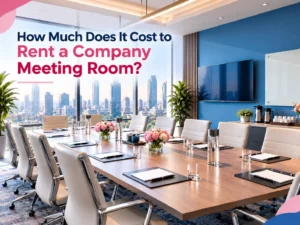
Quick answer: Expect $25 to $75 an hour for a standard company meeting room in the US. Small rooms for two to six people sit at the bottom of that range. Downtown boardrooms in major metros pass $120 an hour. A four hour half day runs $150 to $300, and a full eight hour day starts around $300.
That is the room. The number on your final invoice is usually higher, and the gap is where most budgets go wrong.
What you actually pay per hour

Three things move the price more than anything else: how many people the room seats, what city it is in, and whether the building has a downtown address.
| Room size | Small city | Mid-sized city | Major metro |
| 2 to 6 people | $25-$35/hr | $35-$50/hr | $50-$75/hr |
| 6 to 12 people | $35-$50/hr | $50-$65/hr | $65-$90/hr |
| 12 or more | $50-$70/hr | $70-$85/hr | $85-$120+/hr |
Alliance Virtual Offices puts small rooms at $25 to $40 an hour, medium at $40 to $60, and large at $60 to $75, with major city boardrooms crossing $120. Venture X quotes a similar shape: $20 to $50 for a small room, upwards of $100 for a large boardroom.
A Class A downtown address carries a premium on its own. You are booking the location as much as the table.
For smaller meetings and flexible hourly rentals, pop-up party venues in DC with hourly rentals can also provide a useful comparison point when evaluating how different event spaces structure short-term pricing.
Book blocks, not hours
Hourly is the most expensive way to buy meeting space. Providers price half days and full days below the sum of their parts because a single long booking is cheaper for them to service than four short ones.
A four hour half day comes in at $150 to $300. Budget rooms land at $150 to $180. A properly equipped boardroom runs $240 to $300 or more. That works out roughly 20 to 30 percent cheaper per hour than booking the same four hours separately.
Full days start at $300. Mid range sits at $400 to $500, and premium all inclusive rooms reach $500 to $600 and beyond.
Regus publishes the discount rather than burying it: 20 percent off a morning or afternoon half day, 30 percent off a full day. If your agenda runs past three hours, price the block before you price the hours.
When comparing spaces, it also helps to look at what the venue itself offers beyond the meeting room. For example, a full-service property such as The Ritz-Carlton Half Moon Bay illustrates how location, property type, and available event services can influence the overall cost of hosting a gathering.
The fees that arrive after the quote

What is normally in the rate
Most rooms include Wi-Fi, a screen or projector, a whiteboard, and water or coffee. WeWork On Demand states Wi-Fi, coffee and tea, and on site support in the base rate.
What is not
Then there is everything else.
| Add-on | Typical cost |
| Receptionist or host | $50-$150 per day |
| Catering and coffee service | $15-$50 per person |
| Printing and office supplies | $10-$30 flat |
| Dedicated parking | $10-$20 per vehicle per day |
| Overtime | often 1.5x the hourly rate |
| Cancellation | 10% to 100% of the booking |
Boxed lunch and coffee for 20 people adds $300 to $1,000. That can exceed the room itself.
If catering is part of your meeting budget, compare the Blin Catering and Running Wild Catering options available for different event needs. The catering cost can materially change the final meeting budget even when the room rate looks reasonable.
Hotels price differently again
Hotels are a different pricing animal. Hotel meeting rooms average $70 to $160 an hour, with mid range properties around $250 to $300 for a full day. EventPipe breaks a full day hotel package into parts worth knowing before you ask for a quote: room rental $400 to $1,200, basic AV $0 to $300, food and beverage $40 to $120 per person, service charges of 20 to 35 percent, and setup or cleaning $0 to $200. Many hotels also set a food and beverage minimum before they will release the space at all.
Booking a meeting room outside a hotel typically costs 30 to 50 percent less. You give up the catering and the on site staff.
For example, The Westin New Orleans Canal Place represents the type of hotel venue to consider when meeting space, guest rooms, food service, and a central location all need to be evaluated together.
Booking a meeting room outside a hotel typically costs 30 to 50 percent less. You give up the catering and the on-site staff.
For a broader comparison of event-space pricing, see this event space cost guide, which covers how venue pricing can vary by space type, location, and event requirements.
Cheapest is not always cheapest
A $50 room with reliable AV and someone on site beats a $30 room where you spend the first fifteen minutes fighting a projector in front of a client. Fifteen minutes of six people’s time costs more than the twenty dollar saving.
Ask what the rate includes before comparing two rates. Some providers advertise a low hourly figure and then charge for internet, screen access, or setup.
When you book changes what you pay
Timing works in two directions.
Time of day: mid morning and early afternoon slots are cheaper than prime late afternoon at providers who price off peak at all.
Day of week: Peerspace data shows Monday and Wednesday in Los Angeles running about 14 percent below Saturday, and Friday and Sunday in New York about 9 percent below the midweek peak. New York’s busiest day is Wednesday. Los Angeles peaks on Saturday. If your meeting can move, moving it is free money.
Lead time: booking one to two weeks ahead gets you better rates and a real choice of rooms. Last minute requests get whatever is left, at whatever it costs.
Most spaces also set a minimum booking of one to three hours. A 45 minute meeting still costs you the minimum.
If you book often, stop paying retail
Memberships change the arithmetic. WeWork’s All Access plan starts around $187 a month and bundles meeting room credits, working out roughly 15 percent below on demand hourly rates. Regus offers discounted blocks to members. LiquidSpace and Deskpass sell hourly credits that beat ad hoc booking.
There is also the option nobody uses enough: ask. Recurring bookings, multi day sessions, and larger groups all have room in them. Grouping several sessions into one conversation often surfaces a rate that never appears on the website.
What a real booking costs
Four examples, tax and gratuity excluded.
A two hour huddle for three people in a mid sized city, at roughly $45 to $50 an hour, comes to $90 to $100.
A four hour workshop for twelve in Boston or Chicago at $75 an hour is $300 at list. Taken as a half day block it drops to about $240.
A full day seminar for 40 people in New York or San Francisco, at $125 an hour for a large room, is $1,000. Add tech and catering and $1,200 is realistic.
A week of training for 20 people in a Tier 1 city, at a $500 day rate, runs $2,500 or more, though five consecutive days is exactly the booking where a package rate exists.
If you’re comparing meeting costs with other event types, the average wedding cost in 2026 provides additional context on how venue, food, service, and other event expenses can add up.
Six ways to pay less for the same room
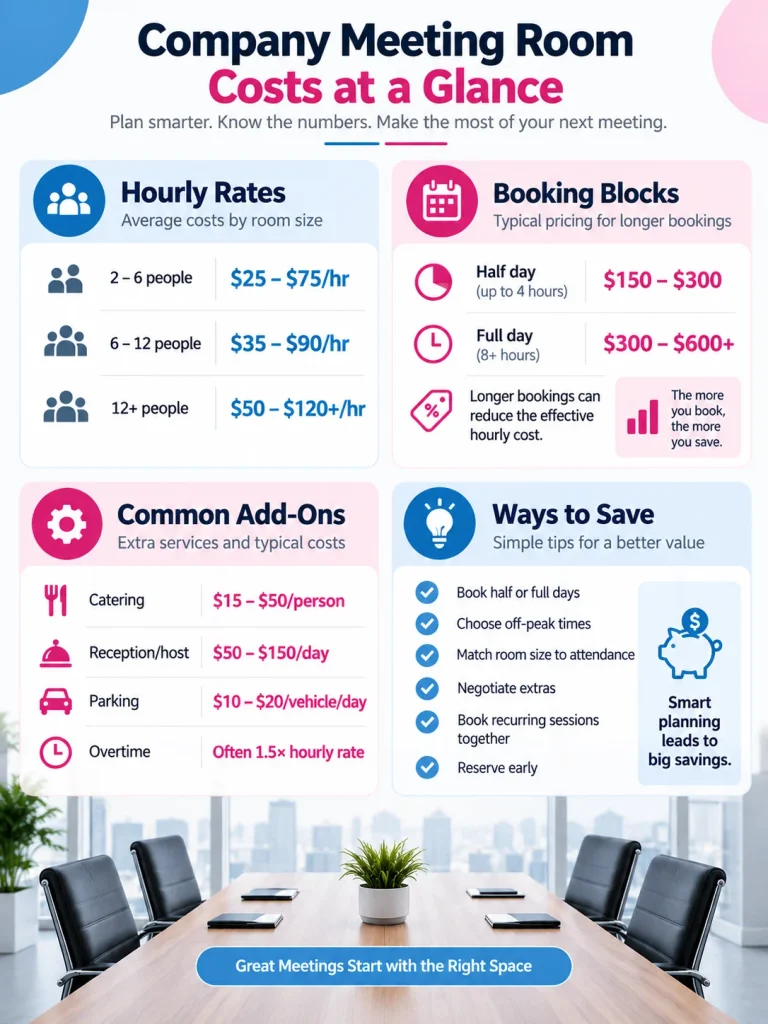
Consolidate into half or full day blocks. An eight hour booking often carries a 30 percent discount against eight separate hours.
Move the meeting off peak. Before 11am, or onto a quieter weekday, wherever the provider prices it that way.
Match the room to the group. A two person call in a twenty person boardroom is money set on fire.
Negotiate the extras rather than the rate. Wi-Fi, AV cables, parking validation, and a modest lunch are easier to win than a lower hourly figure.
Bundle with something you already buy. Several providers attach meeting credits to a virtual office or coworking plan.
Book early. It secures the room and the price, and it avoids the rush premium.
Key takeaways
- A standard company meeting room costs $25 to $75 an hour. Downtown boardrooms in major metros pass $120.
- A four hour half day is $150 to $300, roughly 20 to 30 percent cheaper per hour than four separate hours.
- Full days start at $300 and reach $600 for premium all inclusive space.
- Hotel meeting rooms average $70 to $160 an hour. Booking outside a hotel costs 30 to 50 percent less.
- Catering at $15 to $50 a head and service charges of 20 to 35 percent are where quotes turn into invoices.
Most providers set a one to three hour minimum, so a 45 minute meeting still pays for the minimum.
Frequently Asked Questions
How much does it cost to rent a company meeting room? ▾
$25 to $75 an hour in most US markets. Small rooms for two to six people start around $25. Downtown boardrooms in major metros exceed $120 an hour.
Is a half day cheaper than booking by the hour? ▾
Yes. A four hour half day runs $150 to $300, roughly 20 to 30 percent less per hour than four separate hours. Regus discounts half days 20 percent and full days 30 percent.
How much is a meeting room for a full day? ▾
Full days start at $300. Mid range is $400 to $500. Premium all inclusive rooms reach $500 to $600 or more.
Why are hotel meeting rooms more expensive? ▾
Hotel rooms average $70 to $160 an hour and usually carry a food and beverage minimum plus service charges of 20 to 35 percent. Booking outside a hotel typically costs 30 to 50 percent less, without the catering and on site staff.
What is usually included in the rate? ▾
Wi-Fi, a screen or projector, a whiteboard, and water or coffee. Catering, a receptionist, parking, and premium AV are charged separately.
Is there a minimum booking time? ▾
Most providers set a minimum of one to three hours. A 45 minute meeting still pays for the full minimum, so if you have two short sessions on the same day it is usually cheaper to book them as one block than as two separate minimums.
How far ahead should I book? ▾
One to two weeks for a standard meeting gets better rates and a real choice of rooms. Last minute bookings pay a premium when they are available at all.
Does a membership save money? ▾
If you book monthly, yes. WeWork All Access from about $187 a month includes meeting credits at roughly 15 percent below on demand rates. Below that frequency, one off booking is usually fine.
Compare vendors for your next event
Search caterers, photographers, florists, planners, and rentals — then send one request to several vendors at once.