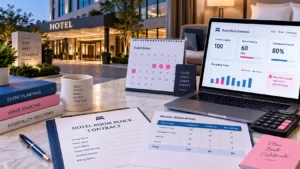
Quick answer: Yes. A hotel can provide room blocks if the wedding isn’t there, and properties near barns, churches, gardens and private estates do it constantly. The hotel is selling sleeping rooms, not your ceremony. Call the group sales desk at 2 to 3 hotels within roughly 15 minutes of your venue, ask for a courtesy block first, and lock it in 9 to 12 months out.
Plenty of couples assume a room block is something only the wedding venue can arrange. It is not. Hotels earn money on occupancy, and 30 guaranteed guests on a Saturday night is good business whether the vows happen in the ballroom downstairs or at a farm twenty minutes away.
What does change when your wedding is off-site is your negotiating position. You are not bringing the hotel a catering contract or ballroom rental, so you have less to trade. That affects which block type you get and which perks are realistic. Here is how to work with that instead of against it.
Why hotels say yes to off-site weddings
Group sales teams have room-night targets. A block fills rooms on dates they might otherwise discount, with near-zero marketing cost, and the guests often add restaurant and bar spend. None of that depends on where the ceremony happens.
Two practical consequences:
- You do not need permission from your venue. Some venue coordinators will make an introduction or already have a preferred hotel, which is worth asking about, but you can approach hotels directly.
- You will be treated as a rooms-only group. Expect the conversation to focus on room count, dates and rate, not on food and beverage minimums.
If you are still comparing the cost of different event spaces, understanding typical event space costs can help you separate your venue budget from your accommodation budget.
Courtesy block or contracted block?
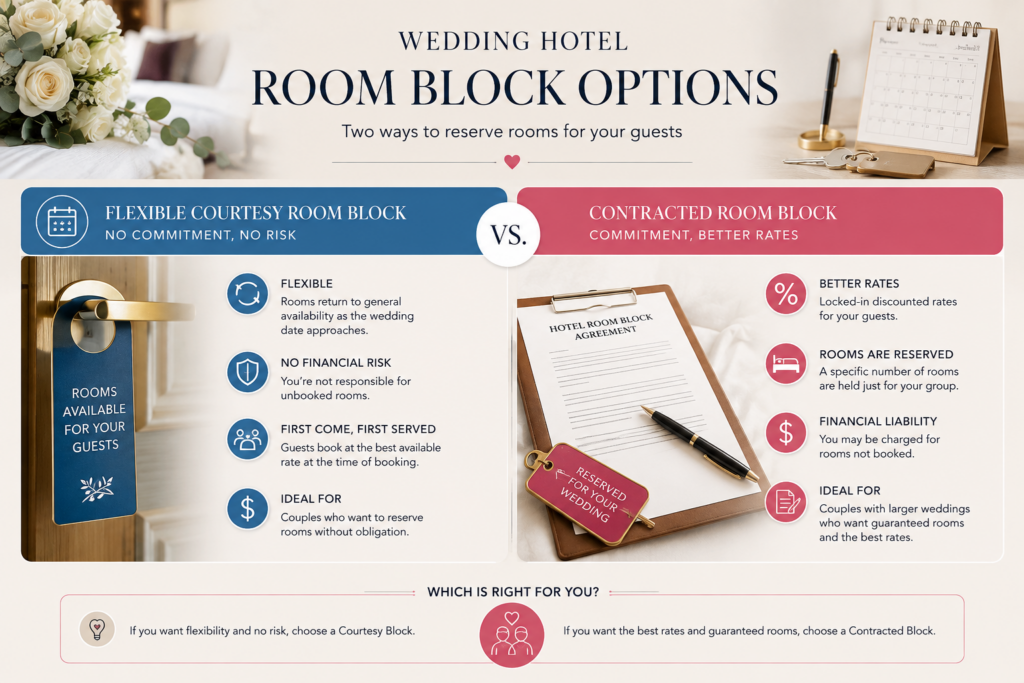
This is the single decision that matters most, because it decides whether you can lose money.
| Courtesy block | Contracted block | |
|---|---|---|
| Financial risk if rooms go unbooked | None | You pay for the shortfall |
| Attrition clause | No | Yes, commonly 80% pickup (range 70% to 90%) |
| Typical size cap | Around 10 rooms per night, sometimes up to 30 | As many as you can justify |
| Rate discount | Smaller | Better |
| Perks (comp room, upgrades) | Rare | Negotiable |
| Deposit | Usually none | Often required |
| Best for | Most off-site weddings | Large, predictable guest lists |
With a courtesy block, unbooked rooms simply return to the hotel’s inventory at the cut-off date and you owe nothing. That is the right default for an off-site wedding, where you have less bargaining power for perks anyway and your guest count is rarely certain a year out.
A contracted block earns you a better rate, but the attrition clause is real money. Reserve 25 rooms with 80% pickup and you have committed to filling 20. If guests book only 15, you owe the hotel for the 5-room gap at the group rate. Couples under roughly 75 guests can usually negotiate a courtesy block instead, and should.
Ask for a review date
Whichever you sign, ask for a review date 60 to 90 days before the wedding that lets you adjust the block size up or down without penalty. Many hotels will agree, particularly on courtesy blocks. It is the cheapest insurance in the whole process.
Your overall wedding budget should also account for expenses beyond the venue and hotel rooms. A current breakdown of average wedding costs can help you see where accommodation fits into the larger budget.
How many rooms can you actually block?
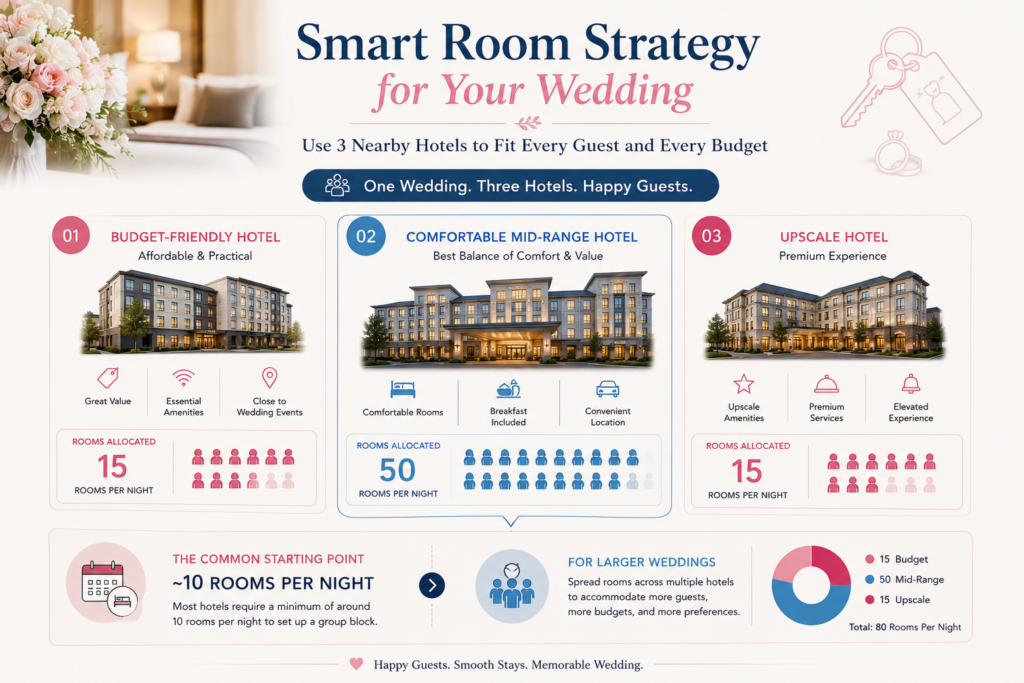
Most hotels treat 10 rooms per night as the threshold for a group block. Below that you can often just ask for a small courtesy hold or let guests book individually.
The awkward part for off-site weddings: courtesy blocks are frequently capped at about 10 rooms per night, while anything larger pushes you toward a contract. Two ways around it:
- Split across 2 to 3 hotels. This is the standard play and it solves several problems at once.
- Stagger by night. Hold fewer rooms on the shoulder nights and concentrate them on the wedding night itself.
Why 2 to 3 hotels beats one
Two to three properties is the right range for most weddings. Vary the price points, roughly $50 apart, so guests can self-select:
| Tier | Role in the mix | Notes |
|---|---|---|
| Budget / select-service | Cost-conscious guests, larger families | Free breakfast and parking matter more here |
| Mid-range | The default most guests pick | Put your largest block here |
| Upscale | Immediate family, wedding party, guests who want it | Smallest block, often where you stay |
Spreading the block also lowers your risk. If one property underfills on a courtesy block, nothing happens to you. On a contract, splitting means no single attrition clause covers your whole guest list.
If you are still deciding where the wedding itself should take place, a detailed wedding planning checklist can help you organize venue, guest, accommodation, transportation, and other booking decisions in the right order.
When to lock it in
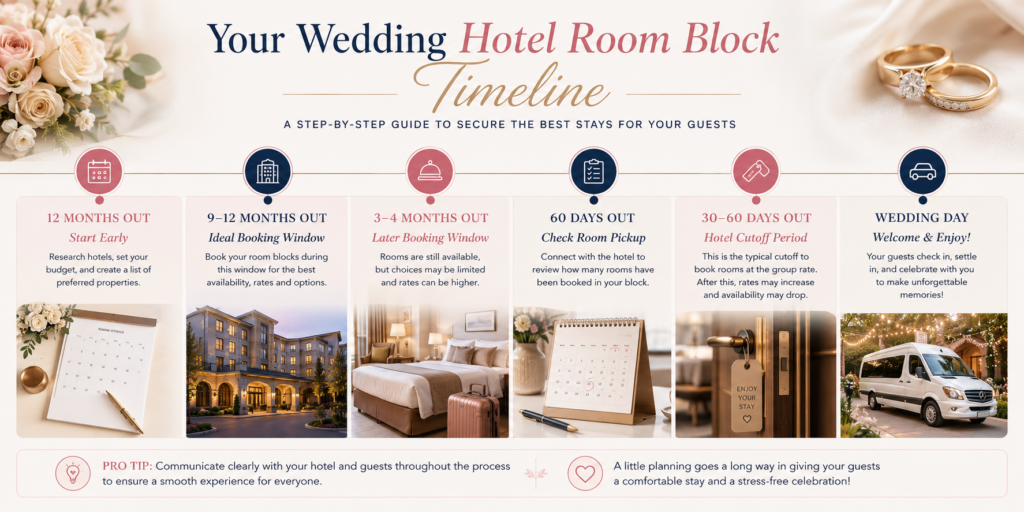
| Timing before the wedding | What to do |
|---|---|
| 12 months and out | Best rates and full availability, especially peak season or a popular city |
| 9 to 12 months | The sweet spot for most weddings |
| 3 to 4 months | Possible, but expect limited availability and higher rates |
| 30 to 60 days | Typical cut-off window, when unbooked rooms get released |
Cut-off dates commonly land 30 days before check-in, though the range runs from 30 to 90 days, and some chain contracts set it as tight as 14 days. Confirm your specific date in writing, then tell guests to book 3 to 6 weeks before it, not on the deadline.
Setting it up, step by step

- Fix your dates and rough headcount. Count how many guests are travelling, not how many are invited. Roughly one room per couple, plus singles.
- Shortlist hotels near the venue. Aim for properties within about 15 minutes. Walking distance is ideal if your venue is in a town centre.
- Send a short RFP to 3 to 5 of them. Same details to each so the quotes are comparable. Ask explicitly for a courtesy block.
- Compare rate and terms together. A slightly higher rate with no attrition beats a bargain rate that exposes you to a penalty.
- Get the booking method in writing. Hotels give you a unique booking link or a group code. Test the link yourself before it goes out.
- Share it on your wedding website. Include hotel name, rate, the code or link, the cut-off date, and travel time to the venue.
- Check pickup at 60 days. If a block is filling slowly, use your review date to trim it. If one is nearly full, ask to add rooms.
A short email that works
Subject: Wedding room block enquiry for [Date], [Number] rooms
Hi [Sales Manager], we are getting married at [Venue] in [City] on [Date] and looking for a room block for guests. The venue does not have accommodation, so we need rooms only, no event space. We expect about [X] rooms on [night(s)]. Could you send your group rate and terms, including whether a courtesy block is available, the cut-off date, and whether you run a shuttle? We plan to decide by [Deadline]. Thanks!
[Names, phone, email]
Naming the off-site venue up front saves a round trip. It tells group sales immediately that this is a rooms-only enquiry.
Choosing hotels around an off-site venue
Distance is the thing guests actually complain about, so weigh it first.
- Travel time over mileage. Fifteen minutes on a country road beats eight miles through city traffic.
- Parking. For a rural venue most guests will drive. Free self-parking is worth more than a slightly lower rate.
- Late-night return. Check whether the front desk is staffed 24 hours if your reception runs past midnight.
- Breakfast. Guests who have been out late appreciate it, and it is a cheap ask on any block.
- A block of rooms together. Ask for the same floor or wing so your guests can find each other.
If the wedding venue is outdoors or at a property where guest travel is more complicated, it is also worth considering the venue’s layout and accessibility when planning transportation. An outdoor event venue guide for 100 guests can be useful when comparing venue setups and logistics.
Getting guests from the hotel to the venue
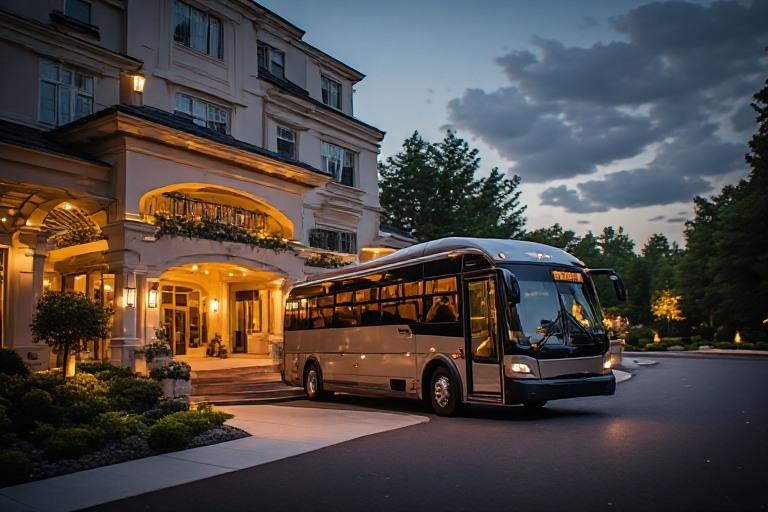
This is the part off-site couples underestimate. Sort it while you are still negotiating, because it affects which hotel you choose.
Many hotels run a shuttle and will include it for a group, so ask directly. If you are hiring transport yourself, run it to one or two hotels only, publish those as the shuttle hotels, and let guests choose accordingly. Trying to collect people from four properties turns into a timing problem on the day.
Whatever you arrange, put departure and return times on your wedding website next to the hotel details. Guests planning to drink need to know the return time before they book.
What to check in the paperwork
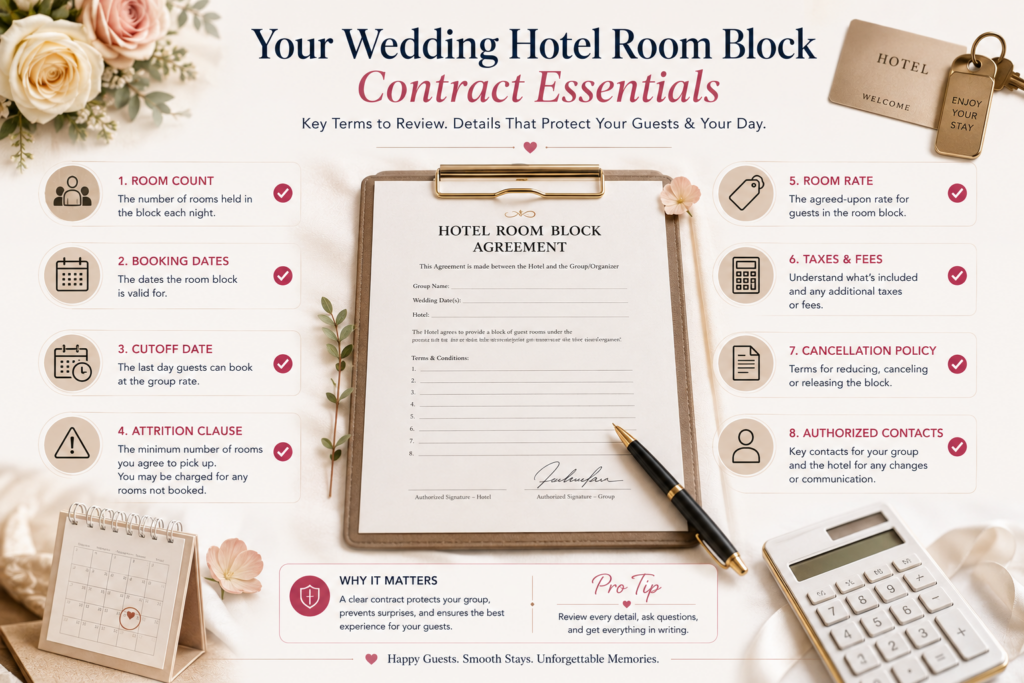
Even a courtesy block usually comes with a written confirmation. Read it for these:
- Block size and dates: exact room counts per night, in writing.
- Cut-off date: the day unbooked rooms are released.
- Attrition: on a courtesy block this should say none. If it names a percentage, you are looking at a contract.
- Rate and what sits on top: taxes, resort or amenity fees, parking. Ask for the total a guest will actually pay.
- Rate honoured through the cut-off: so guests booking later are not quoted more.
- Cancellation terms for individual guests: typically 24 to 72 hours, and worth knowing.
- Who can change the block: name yourselves, and a planner if you have one.
Key takeaways
- Hotels block rooms for off-site weddings routinely. You do not need the wedding at the property.
- Ask for a courtesy block first. No attrition means no financial risk, which is the right trade for most couples.
- 10 rooms per night is the usual group threshold, and courtesy blocks are often capped near that number.
- Split across 2 to 3 hotels at different price points. It widens choice and lowers risk.
- Book 9 to 12 months out, confirm the cut-off date in writing, and tell guests to reserve 3 to 6 weeks before it.
- Settle the shuttle question while choosing hotels, not after.
Frequently Asked Questions
Can a hotel provide blocks of rooms if the wedding is not hosted there? ▾
Yes, and it is routine. Hotels sell sleeping rooms independently of event space, so a block for a wedding at a barn, church, garden or private estate is normal business for a group sales team. You approach the hotel directly and ask for a rooms-only block.
Do you get a worse rate if the wedding is at another venue? ▾
Sometimes, slightly. You are not bringing catering or ballroom revenue, so you have less to trade and fewer perks are realistic. The group rate itself is usually still below the hotel’s standard rate, and competing quotes from 3 to 5 nearby hotels remain your best tool.
What is the difference between a courtesy block and a contracted block? ▾
A courtesy block holds rooms with no financial liability. Unbooked rooms return to inventory at the cut-off date and you owe nothing. A contracted block gives a better rate and negotiable perks, but adds an attrition clause committing you to fill a percentage of rooms, commonly 80%, with a penalty if you fall short.
How many rooms can you block for a wedding? ▾
Most hotels treat 10 rooms per night as the minimum for a group block. Courtesy blocks are often capped around 10 rooms, sometimes up to 30. For larger guest lists, split the block across 2 to 3 hotels rather than signing one big contract.
How far in advance should you reserve the block? ▾
Aim for 9 to 12 months before the wedding, and further out for peak season or a high-demand city. Booking 3 to 4 months out is possible but you risk limited availability and higher rates.
When do unbooked rooms get released? ▾
At the cut-off date, commonly 30 days before check-in, with a usual range of 30 to 90 days. Some chain contracts set it as tight as 14 days. Get your exact date in writing and ask guests to book 3 to 6 weeks ahead of it.
Should you block rooms at more than one hotel? ▾
For most weddings, yes. Two to three hotels at price points about $50 apart lets guests match their budget, raises total pickup, and means no single block carries your whole guest list. Run the shuttle to just one or two of them.
Will the hotel provide a shuttle to an off-site venue? ▾
Many will, and some include it for groups that book a block, so ask during negotiation rather than after signing. If you hire transport separately, publish which hotels it serves, along with departure and return times, so guests can choose where to stay accordingly.
Compare vendors for your next event
Search caterers, photographers, florists, planners, and rentals — then send one request to several vendors at once.