Quick answer: To book a hotel room block for a corporate event, settle who pays before you source: company master account, or attendees on their own cards. Then send an RFP to 3 to 5 hotels, apply for direct bill early, and negotiate attrition, cut-off and concessions in writing. Get procurement approval before signing, not after.
Most room block guidance answers the question a guest would ask. A corporate block raises a different one: whose money is this, and who is allowed to commit it? Before you compare a single rate, you need to know whether the company is paying for rooms, whether an attendee’s personal card ever touches the folio, and who inside your organisation can sign an agreement that carries an attrition penalty.
The mechanics of holding rooms are the same as any group booking, so if you have never run one, start with the pillar guide on how to book hotels for a sports tournament and come back. This post skips the basics and covers the company side: billing routes, direct bill approval, expense policy, tax, invoicing and the annual repeat.
What makes a corporate block different from any other block?

Five things, and they are all internal rather than hospitality-side.
- The payer is often not the guest. That single fact changes the contract, the reservation method and the check-in process.
- Somebody else signs. Procurement or legal will have views on payment terms, indemnification and insurance limits, and those views arrive late if you do not go looking for them.
- There is already a rate cap. Travel policy or a per diem ceiling was set before you started sourcing, and it does not care that the hotel is sold out that week.
- The invoice needs a home. A cost centre, a purchase order number, an accrual in the right quarter.
- It usually happens again. Sales kickoffs, board meetings, training cohorts and customer advisory boards come back every year, which gives you a negotiating asset most one-off groups do not have.
Corporate negotiated rate or group rate: which one applies?
This is the first place corporate planners lose money, usually by assuming the company’s existing hotel program covers the event. It generally does not.
A local negotiated rate, commonly shortened to LNR, is the arrangement Event Temple describes between a hotel and a company that wants better pricing over a period of time, priced for individual business travellers rather than for the public. A group rate is quoted for one event, on specific dates, for a defined number of rooms. Different products, different desks inside the hotel, different paperwork.
| Best available or transient rate | Corporate negotiated rate (LNR) | Group rate | |
| How it is set | Moves daily with demand | Fixed or dynamic discount, agreed annually | Quoted per event, per date range |
| Who books | Anyone | Individual travellers on the company code | Attendees on a block link, or you by rooming list |
| Typical trigger | None | Company room-night volume at that property | Around 10 rooms per night, higher at full-service hotels |
| Availability for 30 rooms on one night | No | Rarely, even with last room availability | Yes, that is the point |
| Your liability if rooms go unused | None | None | Attrition damages under the contract |
| Concessions | None | Occasional amenities | Comp rooms, upgrades, WiFi, parking, space |
Two practical consequences. First, your company’s negotiated rate is a useful reference point and a bad benchmark. Hospitality Net’s coverage of GBTA research from April and May 2026, based on 258 travel managers mostly in the US, Canada and Europe, found 49 percent of programs expanded dynamic discounts in the past year against 17 percent that increased fixed rates. A percentage off a moving number tells you very little about whether a fixed group rate quoted ten months out is fair.
Second, ask the hotel to compare the two anyway. If your company already has volume at the property, say so in the RFP. It is the cheapest credibility you will ever buy with a group sales manager.
Who pays the hotel: your company or each attendee?
Decide this before you send the RFP, because it changes the reservation method, the credit paperwork and the tax question. There are four common routes.
| Billing route | What the hotel needs from you | What lands on your invoice | What the attendee pays |
| Full master account | Approved direct bill, signed authorisation, rooming list | Room, tax, and any authorised charges you route there | Nothing, unless they add something outside the routing |
| Room and tax to master (RTM) | Approved direct bill, rooming list, incidental policy in writing | Room and tax only | Incidentals on their own card |
| Individual guest pays own | Booking link or group code, nothing else | Nothing, apart from attrition or concession settlement | Everything, then claims it on expenses |
| Split by attendee type | Sub-lists showing who is master-billed and who is not | Only the named group, for example staff and speakers | Everyone else pays their own folio |
EventPipe’s glossary uses RTM for exactly the middle case, a group where the master account covers rooms and the guest covers incidentals. It is the most common corporate arrangement and the one that generates the fewest arguments at checkout.
Individual payment is not a lesser option. For a large internal event where every attendee already has a corporate card and an expense workflow, pushing folios to the individual removes a credit application, a master folio audit and a reconciliation cycle from your job. What it does not remove is your attrition liability. You still signed for the rooms.
How do you get direct bill approved?

Direct bill is a credit facility, so treat it like one. Engine’s guidance on hotel direct billing describes setup taking roughly 3 to 5 business days after submission, with hotels asking for a federal tax ID and registration details, 3 to 4 trade references from suppliers or other hotels, bank references and financial statements. Payment terms after approval are commonly Net 30 or Net 60, settled by ACH, check or virtual card.
Three things planners get wrong here:
- Starting too late. Approval sits with a credit department, not with your sales manager, and large chains route it through a central team. Begin as soon as the contract is signed.
- Assuming approval travels. Direct bill approved at one property in a brand does not automatically apply at another, particularly across franchised hotels.
- Not asking what happens without it. If credit is declined or you are a new entity, hotels usually ask for advance payment or a card guarantee instead. Deposit and prepayment structures vary widely by property and by market, so get yours quoted in the proposal rather than discovered in the contract.
What sits on the master account and what does not?
Write the routing into the contract in plain language, then repeat it to attendees in the confirmation email. Engine notes that incidentals such as room service, minibar and parking normally stay on the guest’s own card through a split folio, and that hotels commonly hold an incidental authorisation in the range of $50 to $100 per night at check-in.
The routing list worth agreeing in advance:
- Room and tax to master, named explicitly.
- Parking, WiFi and resort or amenity fees, each stated as master or guest. These are the three that surprise people.
- Group meals and any hospitality suite charges, with a named person authorised to sign.
- Early departure or late checkout fees, and who absorbs them.
- Anything else: guest folio by default.
Then review the master folio on site, daily if the event runs several nights. Catching a misrouted charge while the guest is still in the building costs you a conversation. Catching it on a Net 30 invoice costs you a credit memo request and a month.
How do per diem and expense policy limit the rate you can sign?

If your organisation follows federal per diem, the ceiling is published and not negotiable by you. GSA sets lodging and meals rates that federal agencies use to reimburse employees for official travel in the continental US, with a standard rate plus roughly 300 non-standard areas built around a key city and its surrounding county, and rates for the coming fiscal year usually announced in mid-August. GSA also notes that taxes are not part of the lodging per diem, which matters when you compare a group rate to a cap.
Private-sector policy works the same way with different labels: a nightly rate cap by city, sometimes tiered, sometimes with an exception path. Two rules that save you a painful conversation later:
- Compare like with like. If your cap is room-only and the hotel quoted room plus a mandatory amenity fee, you are over the cap even though the rate looks compliant.
- Get the exception before you sign. When the only viable hotel sits above policy, document the market rate evidence and secure written approval as part of the contract approval, not as a surprise in month nine.
For broader event budgeting, planners can also compare the event venue cost per hour alongside hotel room, meeting-space and service costs rather than looking at the room rate in isolation.
Do you owe hotel occupancy tax on a corporate block?

Usually yes, in full. Exemptions exist, but they are narrower than most planners assume, and they turn on who pays rather than on who stays.
| Payer | Realistic tax position |
| For-profit company, any billing route | Fully taxable. No exemption for being a business |
| Federal centrally billed account | Exempt in every state, since the charge is paid directly by the federal government |
| Federal traveller on an individually billed account | Depends on the state. GSA publishes the rules state by state, and treatment differs |
| State or local government body | Varies by state and often by the state the traveller is from. Verify in the destination |
| Qualified nonprofit educational, religious or charitable organisation | Sometimes exempt from the state portion only |
The nonprofit case is worth spelling out because it is the one that gets over-claimed. The Texas Comptroller of Public Accounts states that a qualified nonprofit educational organisation is exempt from the 6 percent state hotel occupancy tax but still owes local hotel taxes, with some exceptions, and must present Form 12-302 to the hotel. So the exemption is real, partial, and paperwork-dependent. Other states draw the line differently.
Three habits that keep this clean:
- Send the exemption certificate to the hotel with the signed contract, not on arrival day.
- Ask the hotel to confirm in writing which taxes it will and will not charge on the master account.
- If attendees pay their own rooms, exemption on a master account does not help them. Tell them the room is taxable so nobody argues with a front desk agent.
How many rooms do you need, and what are you liable for?
Offsite puts the usual group threshold at 10 or more room-nights, while noting that many full-service hotels want 25 to 30 room-nights before they will negotiate group pricing at all. Below that, you are often better off with your corporate rate and no contract.
When researching suitable properties, it can help to review actual hotel options alongside your RFP list. Examples include Hilton University of Florida, OYO Hotel in Texas, Spring House Hotel and Royal Mansions Resort. The purpose is not to treat individual properties as substitutes for an RFP, but to understand the kinds of hotel inventory available in different markets.
On liability, published guidance varies and you should treat any single figure as an opening position rather than a standard. Offsite describes typical clauses requiring 80 to 90 percent pickup, while Stova’s concessions guidance frames a 20 percent cumulative attrition allowance as a reasonable thing to ask for. Offsite also puts the corporate cut-off date commonly at two to four weeks before arrival, which is tighter than the windows social groups get.
Three asks that matter more than the headline percentage:
- Cumulative measurement across the stay pattern, so a strong Tuesday offsets a soft Sunday.
- All attributable rooms counted, including staff, pre and post nights, and rooms booked on your corporate code during the event dates.
- Rate honoured above the block. Donna Wikstrand of Conference Hotels Unlimited, quoted in Insurance & Financial Meetings Management, asks routinely for the group rate to continue if the block is exceeded before the cut-off. That clause is free and it prevents the awkward case where success costs you money.
If your event spans several hotels, or attendees book over a long window and you need pickup reports to see it happening, that is a different management problem. The conference housing guide covers multi-hotel inventory and pickup tracking in detail.
What concessions can you realistically win?
Concessions are where a corporate block gets its real value, because they land in budget lines your finance team can see. Published ranges have moved, so ask rather than assume.
| Concession | What sources describe | How to ask |
| Comp room nights | Commonly 1 per 40 to 50 room-nights. Stova uses 1 per 50 cumulative. Nancy Ryan of Aon, quoted in Insurance & Financial Meetings Management, has said 1 per 40 was the norm and she now sees 1 per 45 and 1 per 50 | Ask for the ratio, cumulative, and the right to take it as credit instead of a room |
| Suite or category upgrades | Stova suggests at least one upgrade at 10 or more rooms per night, with more as the block grows | Name the executives by role, not by name, so the list survives staff changes |
| WiFi in guest rooms and meeting space | Frequently included for groups. Planners quoted in Insurance & Financial Meetings Management single out meeting-room WiFi and AV pricing as the sorest point | Get guest-room WiFi comped in writing, then price meeting space bandwidth separately |
| Parking | Discount or waiver, commonly negotiable | Worth more than a rate cut at a suburban or airport hotel where everyone drives |
| Meeting space rental | Often waived when food and beverage spend clears the hotel’s threshold | Ask what the threshold is before you agree to an F&B minimum |
| Rebate to the master account | Groups360 gives the example of a $275 rate written at $285 with $10 per room-night credited back | Useful for funding shuttles or offsetting AV. Be careful, see below |
| Loyalty points to the planner | Groups360 lists this among common asks | Check your own gift and ethics policy first. Some employers prohibit it |
When the event includes a substantial meeting component, review how much meeting space you need for 100 people before negotiating meeting-room rental or food-and-beverage minimums. Understanding the space requirement gives you a better basis for evaluating whether a hotel is actually offering useful concessions.
Two cautions on rebates. They inflate the visible rate, which pushes cost-conscious attendees out of the block and straight into your attrition exposure. And in a corporate setting, a rebate is company money returning to the company, so tell finance where it will land before you sign. Groups360 also points out the plain timing tactic worth using: hotel sales teams close quotas at quarter and year end, and multi-year commitments buy bigger concession packages.
How does procurement approval usually work?
The pattern is consistent across mid-size and large companies, even when the tooling differs.
| Stage | Who owns it | Realistic timing |
| Meeting request and budget approval | Business sponsor, then finance | Before sourcing. If you source first, you will resource later |
| Sourcing against preferred suppliers | You, sometimes with procurement or a third party | 9 to 12 months out for peak dates |
| Contract review | Legal or procurement | Allow two to three weeks, longer for a new supplier |
| Supplier onboarding and PO issue | Procurement and accounts payable | Runs in parallel with contract review, and often lags it |
| Direct bill credit application | You, with finance supplying references | Start at signature |
| Post-event reconciliation | You, then accounts payable | Within the invoice terms, Net 30 or Net 60 |
Stova’s guidance on strategic meetings management describes the shape of a mature program: an online meeting request form, approval workflows aligned to travel and meetings policy, preferred vendor lists, consolidated spend visibility and an audit trail. Stova estimates savings of 10 to 25 percent for mature programs and cites materially higher policy compliance, and while those are a vendor’s figures, the direction is uncontroversial: the savings sit in sourcing and in not signing things twice.
Two structural points. Confirm early who actually holds signature authority for the value of your contract, because in many companies it is not the planner and not the sponsor. And expect procurement to push on payment terms, insurance certificates and indemnification language rather than on the rate. That is normal. It is also why the contract needs to reach them with weeks to spare, not days.
Where sourcing is outsourced, you are in good company. The GBTA research reported by Hospitality Net found 54 percent of organisations partially or fully outsourcing RFP activity to travel management companies or consultants.
What should the contract say about cancellation and force majeure?

Cancellation damages in group agreements are normally a sliding scale tied to how close to arrival you cancel, calculated against anticipated room revenue. Read the schedule, then read what counts as anticipated revenue, because that definition does more work than the percentages.
Force majeure deserves more attention than it usually gets. Writing in PCMA, attorney Joshua L. Grimes of Grimes Law Offices recommends naming disease, epidemic and pandemic among the triggering events rather than relying on a general catch-all, and using standards such as commercially impracticable or inadvisable so the clause can operate before a legal prohibition exists. He also suggests specifying which authorities govern the decision, for example federal, state and local law together with CDC guidance, and building in a go/no-go point when it becomes reasonably apparent the meeting cannot proceed, which he puts at around 90 days out.
Three more clauses to raise:
- Mutuality. A force majeure clause that only the hotel can invoke is not a shared risk provision.
- Rebooking rights. Stova notes rebooking language reduces cancellation exposure when a meeting has to move rather than disappear. Pin down the window and whether the rate holds.
- Construction and change of brand. For a recurring annual event contracted years out, you want the right to walk if the hotel is renovating or reflags.
How do you handle a recurring annual event?
Recurrence is your strongest card, so play it deliberately rather than mentioning it in passing.
- Keep a history file by property and by night. Rooms actually picked up, not rooms contracted. It is the only number that wins a rate argument.
- Contract multiple years where the destination rotates predictably. Groups360 notes multi-year arrangements attract larger concession packages.
- Time the negotiation to the hotel’s calendar, not yours. Quarter and year end close differently.
- Reconcile every year and file the result. Attrition calculation checked line by line, master folio audited, rebate accounted for, concessions confirmed as delivered. Concessions promised and not delivered are worth raising while there is still a next year to trade against.
A working process
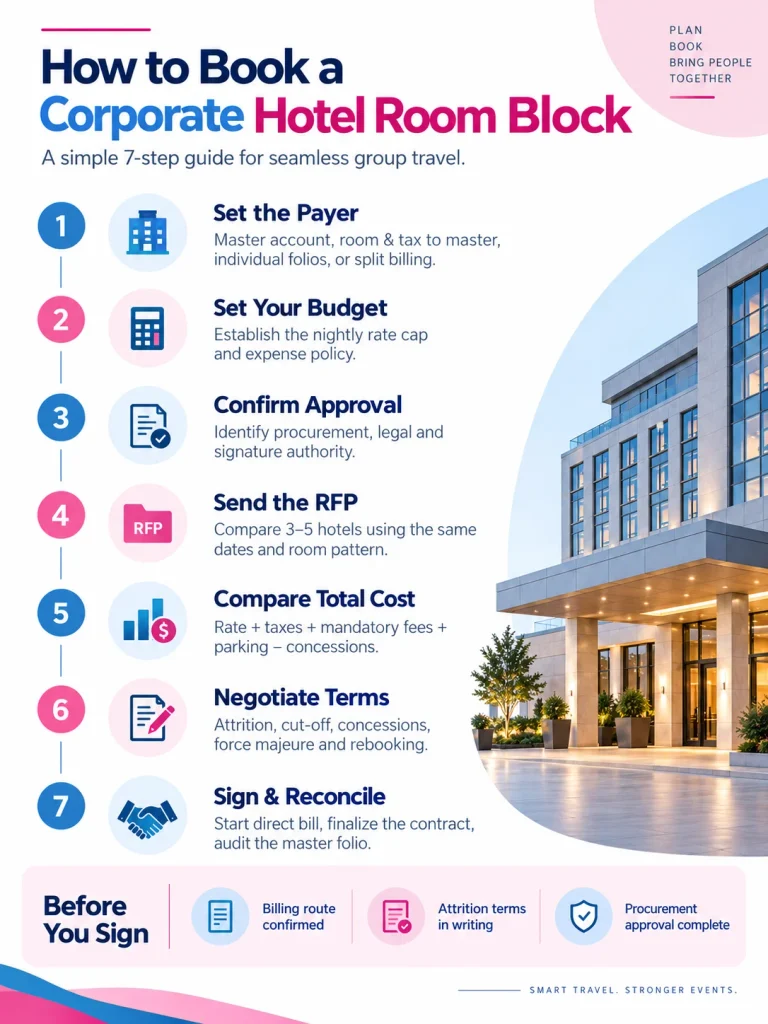
- Fix the payer and the budget first. Master account, individual folios or a split, and the nightly cap you have to live inside. Everything else depends on this answer.
- Confirm who signs and get on their calendar. Signature authority, legal review time, insurance and indemnification requirements, preferred supplier list.
- Send one RFP to 3 to 5 hotels. Same dates, same room-night pattern by night, same questions. State your billing route, your existing corporate volume at the brand, and your decision date.
- Compare total cost, not rate. Rate plus taxes plus mandatory fees plus parking, minus the value of concessions, against your policy cap.
- Negotiate terms alongside price. Cumulative attrition, all attributable rooms counted, rate honoured above the block, a later cut-off, mutual force majeure, rebooking rights.
- Start the credit application at signature. In parallel, raise the PO, set up the supplier and confirm which taxes apply.
- Publish, then reconcile. Send attendees the booking link or code, the cut-off date and a plain statement of what the company pays. After the event, audit the master folio and the attrition calculation before the invoice is approved.
A short enquiry email that works
Subject: Corporate room block RFP, [Company], [Dates], [X] room-nights Hi [Sales Manager], I am sourcing sleeping rooms for [Company]’s [event type] in [City]. Pattern is [X] rooms on [night 1], [Y] on [night 2], arriving [date] and departing [date], roughly [total] room-nights. Rooms will be billed [room and tax to a company master account, with incidentals to the guest / to each attendee individually]. We hold a negotiated rate with [brand] at [property or market], so please quote your group rate alongside it. Could you send the group rate excluding and including taxes and mandatory fees, cut-off date, attrition allowance and how it is measured, comp room ratio, deposit or direct bill requirements, and what is included for WiFi, parking and meeting space. Our internal cap is [$X] room-only. Decision by [date], contract to legal review after that. Thanks. [Name, title, phone, email]
Naming the billing route and the cap in the first email saves two rounds of proposals. A group sales manager who knows you are master-billing and capped at a number will either quote inside it or tell you quickly that they cannot.
Key takeaways
- Decide who pays before you source. Master account, room and tax to master, individual folios or a split changes the contract, the credit paperwork and the tax answer.
- Your company’s negotiated corporate rate is not a group rate and rarely delivers 30 rooms on one night. Ask the hotel to quote both.
- Direct bill is a credit approval, not a booking preference. Engine describes 3 to 5 business days after submission plus references and financials, so start at signature and expect Net 30 or Net 60.
- Being a business does not exempt you from hotel occupancy tax. Exemptions turn on who pays, and nonprofit exemptions are often state-portion only, as the Texas Comptroller sets out.
- Published attrition and cut-off norms differ by source. Negotiate cumulative measurement, all attributable rooms counted, and rate honoured above the block, rather than fixating on a percentage.
- Get legal and procurement the contract weeks early, and get any above-policy rate approved in writing before you sign.
Frequently Asked Questions
How do you book a hotel room block for a corporate event? ▾
Decide who pays first, then send one RFP with identical details to 3 to 5 hotels stating your billing route, room-night pattern and internal rate cap. Compare total cost including taxes and mandatory fees, negotiate attrition and cut-off terms, route the contract through legal and procurement, and start the direct bill credit application at signature.
What is the difference between a corporate negotiated rate and a group rate? ▾
A corporate negotiated rate, or LNR, is agreed annually for individual business travellers at a property and carries no block and no liability. A group rate is quoted for one event on set dates for a defined number of rooms, comes with concessions, and comes with attrition exposure. They are separate products handled by different desks inside the hotel.
Should the company pay for rooms or should attendees pay their own? ▾
It depends on who owns the budget. A master account gives you one invoice, control of the rate and no expense claims, at the cost of a credit approval and a folio audit. Individual payment removes that admin but not your attrition liability, since the company still signed for the rooms.
How do you set up direct bill with a hotel? ▾
Apply through the hotel or brand credit department. Engine describes setup taking roughly 3 to 5 business days after submission, with a federal tax ID, 3 to 4 trade references, bank references and financial statements requested, and terms commonly Net 30 or Net 60. Approval at one property does not automatically carry to another.
What goes on the master account and what does the guest pay? ▾
The common corporate arrangement is room and tax to the master account with incidentals on the guest’s own card, which EventPipe’s glossary calls RTM. Name parking, WiFi and amenity fees explicitly, since those three are where disputes start. Engine notes hotels commonly hold an incidental authorisation of roughly $50 to $100 per night at check-in.
Is a corporate room block exempt from hotel occupancy tax? ▾
Rarely. A for-profit company pays lodging tax in full regardless of billing route. Exemptions turn on the payer: federal centrally billed charges are exempt in every state, individually billed federal travel depends on the state, and qualified nonprofits are often exempt from only the state portion. Texas, for example, exempts qualified nonprofit educational organisations from the 6 percent state tax but not local tax.
How many rooms does a corporate room block need? ▾
Offsite puts the usual threshold at 10 or more room-nights, and notes many full-service hotels want 25 to 30 room-nights before negotiating group pricing. Below that, booking on your corporate rate without a contract is often cheaper, because you avoid attrition liability entirely for a discount you were unlikely to get anyway.
What happens if the company cancels the event? ▾
Cancellation damages usually follow a sliding scale tied to how close to arrival you cancel, measured against anticipated room revenue, so check how that revenue is defined. Force majeure is a separate route out. Writing in PCMA, attorney Joshua L. Grimes recommends naming disease and pandemic explicitly, using standards like impracticable or inadvisable, and setting a go/no-go point around 90 days out.
Compare vendors for your next event
Search caterers, photographers, florists, planners, and rentals — then send one request to several vendors at once.