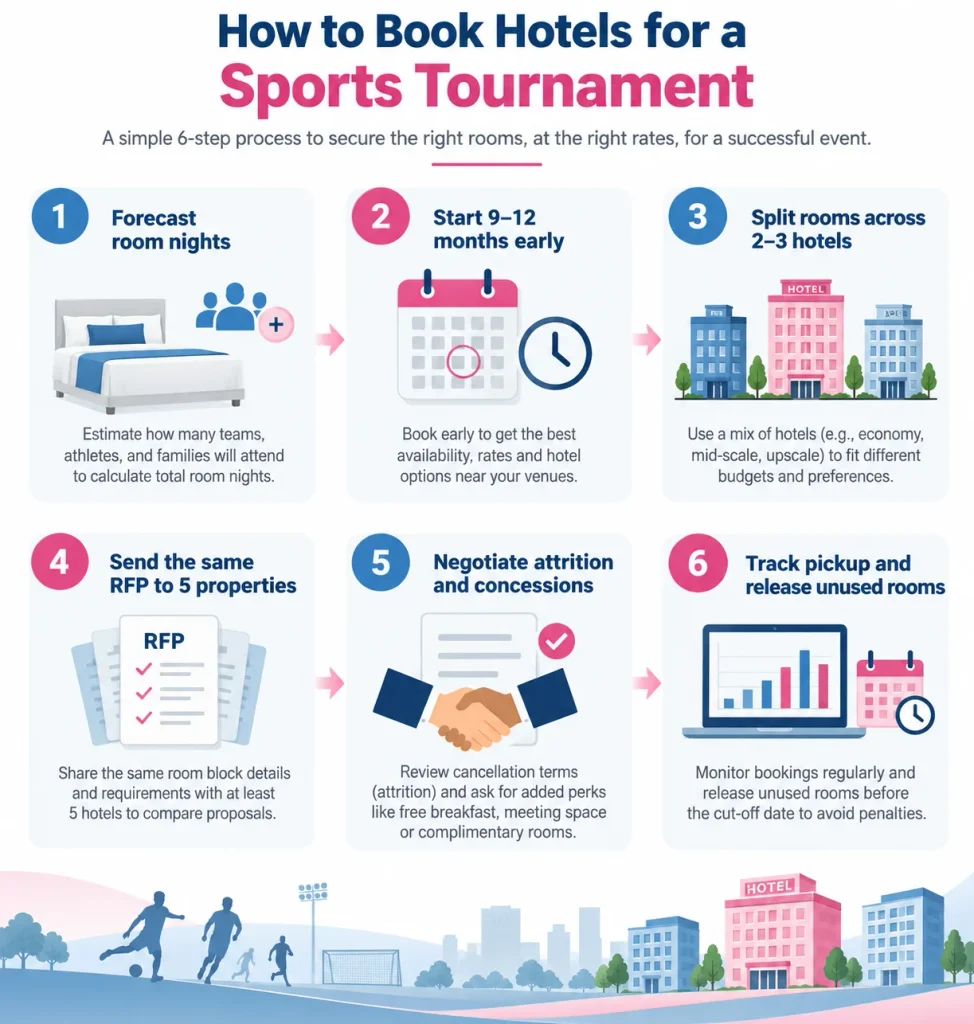
Quick answer: If you are hosting, forecast total room nights across every visiting team, then split the block across two or three hotels rather than one. Send the same RFP to five properties, cap attrition at 20 percent of room nights rather than per night, and expect a group rate 20 to 30 percent below rack. Start nine to twelve months out if you can, and ask the local sports commission what room-night target unlocks a rebate before you sign anything.
This is written for the organizer running the event. If you are one team traveling to a tournament, the team side of this is covered in how to block hotel rooms for a sports team.
When to start
Lead time is the cheapest thing you will ever negotiate with, and most organizers give it away by starting late.
| Stage | Ideal | Compressed |
| Initial RFPs out | 9 to 12 months before | Month 1 |
| Contracts signed | 6 to 8 months before | Month 2 |
| Booking link open to teams | 4 to 6 months before | Month 3 |
The compressed column is for an event you have already committed to on short notice. It works, but every week you lose comes out of your negotiating position rather than out of the schedule: a hotel with three months of unsold inventory is a very different conversation from one with eleven.
Forecast room nights, not rooms

The number that matters is room nights: rooms multiplied by nights. A 20 team event where each team needs 12 rooms for three nights is 720 room nights, and that is the figure hotels price against.
Build it from the bottom up. Take your expected team count, the roster size per team, whether families travel, and the number of competition days. A rough first pass:
Rooms per peak night ≈ total participants ÷ 2, plus 5 to 10 percent for staff and exceptions.
So a 16 team event with 12 players, coaches and some parents might run to 300 people, which is about 150 rooms on the peak night before the buffer. A 64 team, week-long event is a different animal: 800 to 1,000 visitors across six or seven nights.
Then hold 10 to 20 percent above the forecast, because a block that runs out sends teams to hotels you have no relationship with and no rate at.
Two cautions on the divide-by-two rule. Youth events often allow three or four to a room, which changes the answer a lot. And governing bodies restrict who may share a room by age, so check your own sanctioning rules before you plan on four to a room.
Ten rooms per night is where US hotels start treating a booking as group business. At tournament scale you are far past that, which is what gives you room to negotiate.
Expect the block to fill partway
Blocks do not fill completely, and a plan that assumes they will is a plan to pay attrition. Published guidance puts typical pickup at 60 to 80 percent of the contracted block.
That number is the reason every other decision in this article exists: the block size you commit to, the attrition percentage you negotiate, and the review date you insist on are all ways of managing the gap between what you reserve and what teams actually book.
Split the block across hotels
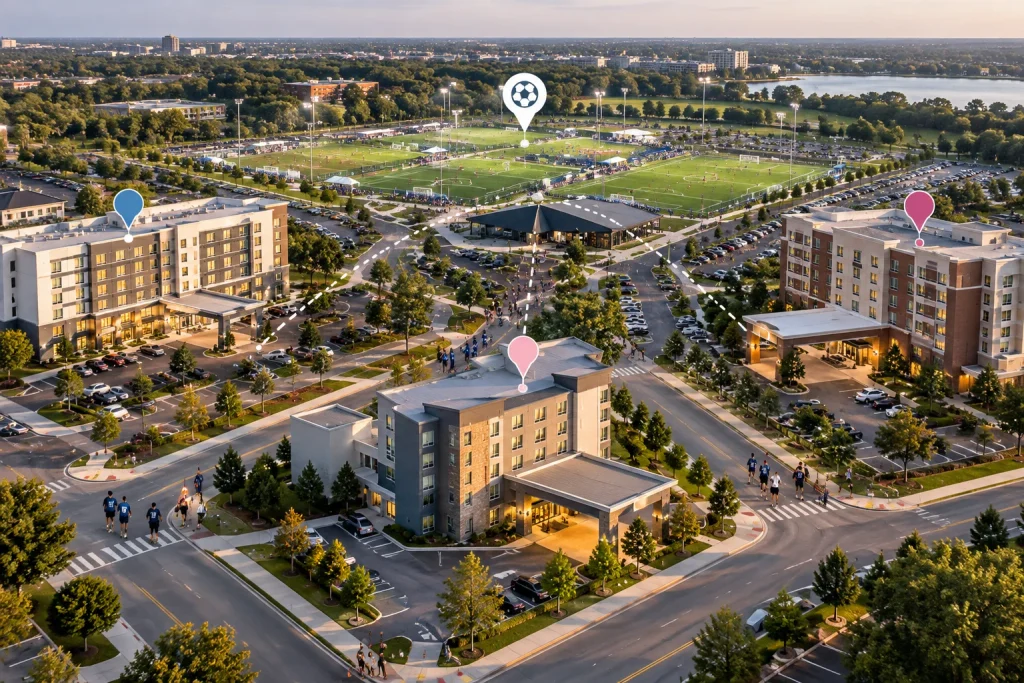
One hotel for a whole tournament is usually the wrong answer, for three separate reasons.
Capacity
Capacity is the obvious one. Few properties can absorb 700 room nights in a weekend alongside their normal business.
Price choice
Price is the second. Teams travel on very different budgets. Two or three properties at price points roughly $50 apart lets a family choose, and raises total pickup rather than splitting it.
If the tournament also includes receptions, award ceremonies, or other hosted events, you can coordinate the hotel stay with a hotel venue for tournament events.
Attrition risk
Risk is the third and least obvious. A single block carrying your whole event means a single attrition exposure. Three smaller blocks spread that, and each hotel knows it is competing with the other two for pickup.
If your fields are spread across a metro area, cluster the hotels the same way: two or three near each venue rather than all of them near one.
The RFP, sent five times

Send the same document to five properties in the same week. Dates, forecast room nights by night, room mix, and the concessions you want. Identical wording matters: quotes you can lay side by side are worth more than five quotes you have to normalize first.
Ask for, in the RFP itself rather than later:
- The group rate, and whether taxes and resort fees sit on top
- Attrition as a percentage of total room nights, not per night
- Cut-off date, and whether it can move
- Complimentary rooms, and at what ratio
- Breakfast, parking and Wi-Fi for every guest in the block
- Bedding mix, because a team needs double-doubles and a coach needs a king
- A meeting room for organizer briefings
- A named contact for the weekend itself
If your event includes hosted meals or team functions, it is also worth planning catering for tournament events alongside your hotel requirements.
An RFP email you can send today
Subject: [Tournament Name] — hotel block inquiry, [dates], [city] Dear [Sales Manager], I am organizing the [Tournament Name] in [city] on [date range]. We expect [#] teams, around [#] people, and need approximately [X] rooms per night. Peak nights are [dates] and shoulder nights are [dates]. Please send your best group rate and contract terms, including: nightly rate with tax, deposit requirement, cut-off date, attrition policy measured on total room nights, and any complimentary room or amenity offers. We also need meeting space for [briefings], and would welcome information on shuttle service and equipment storage. We plan to select our hotel partners by [decision date] and would appreciate a proposal by [proposal date]. Best regards, [Name, title, organization, contact]
Send that to five properties on the same morning. The replies that come back inside 48 hours tell you which sales teams actually want the business.
What attrition should you accept?
Attrition is the share of the block you pay for whether it fills or not. Contracts commonly allow 10 to 30 percent, which is the same thing as an 80 to 90 percent pickup commitment.
The arithmetic is usually written as: unfilled rooms × the average room rate. Two things are worth pushing on in that formula. Cap the charge at the hotel’s actual net loss rather than the full rate, and require that a room resold to someone else credits against your liability.
Three things to negotiate, in order of how much they are worth.
Measure it on total room nights, not per night. An 80 percent commitment across 720 room nights gives you room to be short on a quiet Thursday and strong on Saturday. The same commitment applied night by night means Thursday’s shortfall is a penalty even if Saturday oversells.
Require the hotel to resell. If a room you paid attrition on gets sold to someone else, that revenue should credit against your penalty. Hotels agree to this more often than they offer it.
Ask for a block review about a month before cut-off. That is a scheduled conversation to reduce the block without penalty if pickup is behind. It costs the hotel nothing and it is the single most useful clause you can add.
Contract terms at a glance
| Term | What to expect |
| Cut-off date | Published ranges disagree: some guidance says 7 to 30 days before arrival, other sources say 30 to 60. Treat it as negotiable and get it in writing |
| Attrition | 10 to 30 percent allowed, so 70 to 90 percent pickup required |
| Deposit | Commonly quoted two ways: one night’s revenue at signing, or 10 to 30 percent of expected room revenue. Ask which basis the hotel is using |
| Group rate | 20 to 30 percent below rack, fixed across all block dates |
| Complimentary rooms | Ratios vary widely, from one per 15 rooms to one per 50 room nights |
| Cancellation | Often tiered by timing. A published example runs 50 percent inside 90 days, 70 percent between 30 and 90, and 90 percent inside 30 |
| Force majeure | Should cover weather, travel bans, government orders and facility closure, with a right to reschedule |
| ADA access | The contract should state the hotel’s obligation to provide accessible rooms and spaces, not leave it implied |
| Insurance | Both parties carrying liability cover, commonly $1M to $2M per occurrence, with the hotel named as additional insured |
| Pickup reporting | Final room-night pickup confirmed by the hotel in writing, with a defined window to reconcile disagreements |
On complimentary rooms, the ratio is where the published guidance disagrees most: some sources quote one free room per 15 to 20 booked, others one room night per 50 room nights picked up. That spread is real, which means it is negotiable. Ask for the better end and see what comes back.
Two clauses deserve more attention than they usually get.
Force majeure wording decides whether it protects you. A clause that only releases you when the event becomes illegal or impossible will not help when a public health advisory makes travel unwise but not unlawful. Push for language that triggers on an event becoming inadvisable, or on an official advisory, and for notice given without undue delay rather than by a fixed deadline.
The pickup report is how you find out you were overcharged. Ask for it in writing, and for a reconciliation window after the event. Your own rooming lists and the hotel’s report disagree more often than you would expect.
Negotiate the concessions, not just the rate
A lower rate is the obvious ask and usually the least productive one. Hotels protect published rate more than almost anything else, because it affects every other piece of business on the books.
Three tactics that work better.
Ask for a rebate instead of a discount. Set the rate $10 higher than the hotel’s number and have that $10 per room night credited to your master account. The hotel keeps its rate integrity, you get a fund that covers catering, briefing space or transport. Both sides can sign that.
The same approach can help when coordinating other event suppliers, from event catering services to transportation and guest amenities.
Be open about the budget. Telling a sales manager the number you have to hit turns a negotiation into a problem you are both solving. It also gets you a straight answer faster, which matters when you are sending five RFPs and reading them side by side.
Bring the data. Last year’s pickup, growth in team count, a returning event. Multi-year commitments buy concessions that a single weekend cannot.
Ask the city what your room nights are worth
This is the part most organizers never ask about, and it can be worth more than every other negotiation combined.
Many US cities, convention and visitors bureaus and sports commissions run event grant programs tied to hotel room-night targets. Hit an agreed number of room nights and the destination may offer a cash rebate, free venue time, complimentary staff rooms, or direct support with housing administration.
The conversation to have, before you sign a hotel contract:
- What is the room-night target for a grant or rebate at this event size?
- Is the rebate per room night, or a flat grant at the threshold?
- What proof do you need, and by when?
- Is there support for shuttles, signage or welcome services on top?
Ask this early, because the answer may change which city you host in, and it will certainly change which hotels you want in the block.
Once the destination is selected, organizers can also compare event venue booking in New Jersey and other local venue options when planning the tournament’s wider event program.
Should you use a housing company?
At a certain scale the answer becomes yes, and the trade is worth understanding.
A tournament housing company negotiates and contracts on your behalf, which moves the attrition liability off you. That is the main reason organizers use one. It is also how stay-to-play requirements get administered.
Stay-to-play means teams must book inside the official block through the designated portal. It is less common than it was: the Sports Events and Tourism Association reported nearly 40 percent of tournament destinations requiring hotel stays in 2023, down from 60 percent in 2021.
If you go that route, be deliberate about enforcement, because the penalties in circulation are steep. Published examples include an Alternative Lodging Surcharge of $750 to $1,300 for teams missing their minimum room nights, prorated for partial compliance, and Palmetto Region Volleyball fining $25 per room night short with non-payment meaning removal from the tournament. Some governing bodies go the other way entirely: USA Volleyball states it will not agree to attrition in any form, and its Florida Region confirms clubs are not required to sign attrition clauses.
Decide which of those worlds your event lives in before you write the policy.
Whatever you choose, run one booking channel and only one. A single link, a housing bureau, or your own registration system. Two channels is how a block gets undercounted, and an undercounted block is an attrition charge you did not need to pay.
A four night budget, worked
For a mid-sized event with 25 rooms held for organizer and staff use, plus catering and transport.
| Item | Unit | Quantity | Total |
| Hotel rooms at group rate | $150 per night | 25 rooms x 4 nights | $15,000 |
| Group breakfast | $10 per person per day | 50 people x 4 days | $2,000 |
| Team dinner | $12 per person | 50 people x 4 days | $2,400 |
| Meeting room for briefings | $200 per half day | 2 | $400 |
| Bus transport | $500 per day | 4 days | $2,000 |
| Contingency at 10 percent | $2,600 | ||
| Total | $24,400 |
For a mid-sized event with 25 rooms held for organizer and staff use, plus catering, transport, décor, and other event services such as event florists.
Two notes on using it
Confirm whether tax sits on top of the group rate, because it usually does, and 15 percent on the room line alone is another $2,250.
Keep the contingency at 10 percent rather than trimming it. Late additions at rack rate are the single most common overrun on a budget like this.

The weeks before cut-off
Pickup is the number to watch, weekly, from the moment the booking link goes out.
Publish the link and the cut-off date together, and repeat both. Most teams book late, and most organizers discover that too close to the deadline to act.
Collect rooming lists rather than trusting the hotel’s report alone. The two disagree more often than you would expect, usually because a family booked outside the block.
At about a month out, use the block review clause. If pickup is behind, reduce. If one hotel is full and another is empty, ask whether rooms can move between them.
Then release unused rooms by the cut-off. That single action is what avoids the attrition charge.
Four numbers to track
| Metric | What it tells you |
| Pickup percentage | Rooms actually booked against rooms blocked. The one that decides whether you pay attrition |
| Average daily rate | What teams really paid, including anyone who booked outside the block |
| No-show rate | Rooms booked and not used. Worth knowing before you size next year’s block |
| Team satisfaction | Whether the hotels were close enough, fed people early enough, and had somewhere to park a bus |
Keep them year on year. The second time you run the event, your own pickup history is the strongest negotiating document you have.
Key takeaways
- Start nine to twelve months out if you can. Lead time is the cheapest negotiating leverage there is.
- Forecast room nights, not rooms. Rooms times nights is what hotels price against.
- Expect 60 to 80 percent of the block to fill, and plan the contract around that gap.
- Split the block across two or three hotels for capacity, price choice, and to spread attrition risk.
- Negotiate attrition on total room nights rather than per night. It is the most valuable change you can make.
- Ask for a block review a month before cut-off so you can reduce without penalty.
- Ask for a rebate to the master account instead of a lower rate. Hotels protect rate, not concessions.
- Ask the local sports commission what room-night target unlocks a grant or rebate, before you sign.
- Check the force majeure wording releases you on advisory, not only on illegality.
- A four night event with 25 rooms, catering and transport lands near $24,400 before tax.
Frequently Asked Questions
How do you book hotels for a sports tournament? ▾
Forecast total room nights across all visiting teams, split the block across two or three hotels, send the same RFP to five properties, then contract with attrition capped at 20 percent of total room nights and a cut-off you can move.
How far in advance should you book tournament hotels? ▾
Send RFPs nine to twelve months out, sign contracts six to eight months out, and open booking to teams four to six months out. On short notice the same sequence compresses into three months, at the cost of your negotiating position.
How many rooms will a tournament actually need? ▾
Start at total participants divided by two, add 5 to 10 percent for staff and exceptions, then hold 10 to 20 percent above that. Youth events often allow three or four to a room, which changes the answer, so check your sanctioning body’s rules first.
How much of a room block usually fills? ▾
Published guidance puts typical pickup at 60 to 80 percent of the contracted block. Plan the contract around that gap rather than around a full block.
How many hotels should a tournament block cover? ▾
Two or three for most events. It covers capacity, gives families a choice of price point roughly $50 apart, and spreads attrition across separate contracts instead of one.
What attrition should a tournament organizer accept? ▾
Ten to 30 percent is the normal range, meaning a 70 to 90 percent pickup commitment. Insist it is measured on total room nights rather than night by night, and that resold rooms credit against your liability.
What is a block review clause? ▾
A scheduled conversation about a month before cut-off that lets you reduce the block without penalty if pickup is behind. It costs the hotel nothing and is worth asking for every time.
How many complimentary rooms can you ask for? ▾
Published ratios range from one free room per 15 to 20 booked to one room night per 50 room nights picked up. The spread means it is negotiable, so ask for the better end.
Should you negotiate the rate or the concessions? ▾
The concessions. Hotels protect published rate because it affects all their other business. Setting the rate slightly higher and having the difference rebated to your master account is usually an easier yes than a discount.
Can a city pay you to bring a tournament there? ▾
Often, in effect. Many convention and visitors bureaus and sports commissions run grant or rebate programs tied to hotel room-night targets. Ask what the target is and what proof they need before you sign a hotel contract.
What should a force majeure clause say? ▾
It should release you when the event becomes inadvisable or an official advisory is issued, not only when it becomes illegal or impossible, and it should allow notice without undue delay rather than by a fixed date.
Do tournaments still require stay-to-play? ▾
Less than they did. The Sports Events and Tourism Association reported nearly 40 percent of tournament destinations requiring hotel stays in 2023, down from 60 percent in 2021.
What happens to teams that book outside the block? ▾
It depends on the policy. Published penalties include an Alternative Lodging Surcharge of $750 to $1,300 prorated for partial compliance, and one region fining $25 per room night short with removal from the tournament for non-payment.
How much does a tournament hotel program cost? ▾
For a four night event with 25 rooms at $150, group breakfast, a team dinner, briefing space and four days of transport, roughly $24,400 including a 10 percent contingency and before tax.
Compare vendors for your next event
Search caterers, photographers, florists, planners, and rentals — then send one request to several vendors at once.