Quick answer: A stay-to-play requirement for tournaments is a rule that traveling teams must book lodging through the event’s designated housing block to compete. Organizers use it to guarantee hotel room nights, which underwrites venue costs and secures dates. Compliance is checked against the housing company’s booking report, and teams outside the mileage radius that skip it can face fees, unassigned schedules or removal.
Few lines in a tournament application generate more email than the housing rule. Organizers see a room-night guarantee that pays for fields, officials and a place on the city’s calendar. Club administrators see a mandate they have to explain to forty parents who already priced a cheaper hotel across the street. Both readings are accurate, which is why this topic has stayed contested for two decades and has recently drawn lawyers.
This post covers the mechanism itself: what the requirement obligates, how it is enforced, where the money goes, who gets waived, what the criticism actually alleges, and how each side should handle it. If you need the mechanics of building and negotiating the block itself, read how to block hotel rooms for a sports team
What Does a Stay-to-Play Requirement Actually Require?
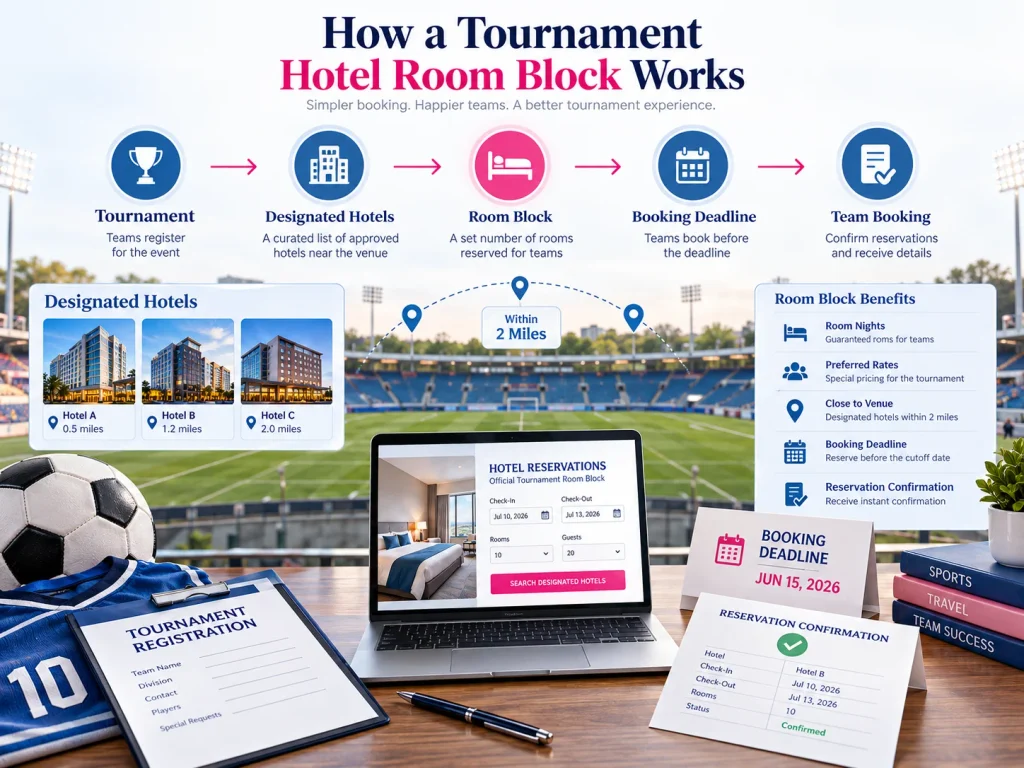
EventPipe, which sells event housing software, defines it as a rule that participating teams and athletes stay only at designated hotels inside the official tournament housing block. The important word is “designated.” The requirement is rarely about spending a minimum amount. It is about routing the reservation through one channel so the room night can be counted.
Team Travel Source, a Louisville-based tournament housing firm, puts the counting rule plainly in its published FAQ: any reservation made outside the designated booking site will not satisfy the stay-to-play requirement. Calling the hotel directly and getting the same rate at the same property still fails the test, because the event never sees the booking on its report.
In practice, a housing rule usually bundles four separate obligations:
- Channel: Book through the named housing company or portal, not through the hotel, and not through Expedia, Hotels.com or a similar site.
- Volume: A minimum number of rooms per team, or a minimum number of nights per room. Oklahoma Watch reported that Premier Girls Fastpitch Nationals required at least eight rooms per team, and that Dallas Stars tournaments required at least three nights at designated Hilton properties.
- Radius: The rule applies to teams traveling from beyond a stated distance.
- Proof: Names on a rooming list by a stated deadline.
Sports Destination Management notes the hotel side of the same deal: the event or rights holder negotiates a rate the hotel agrees not to undercut during the contract period, and the hotel agrees not to accept direct reservations from athletes, coaches or officials. Rate parity and channel exclusivity are what make the count reliable.
How Is Stay-to-Play Enforced?
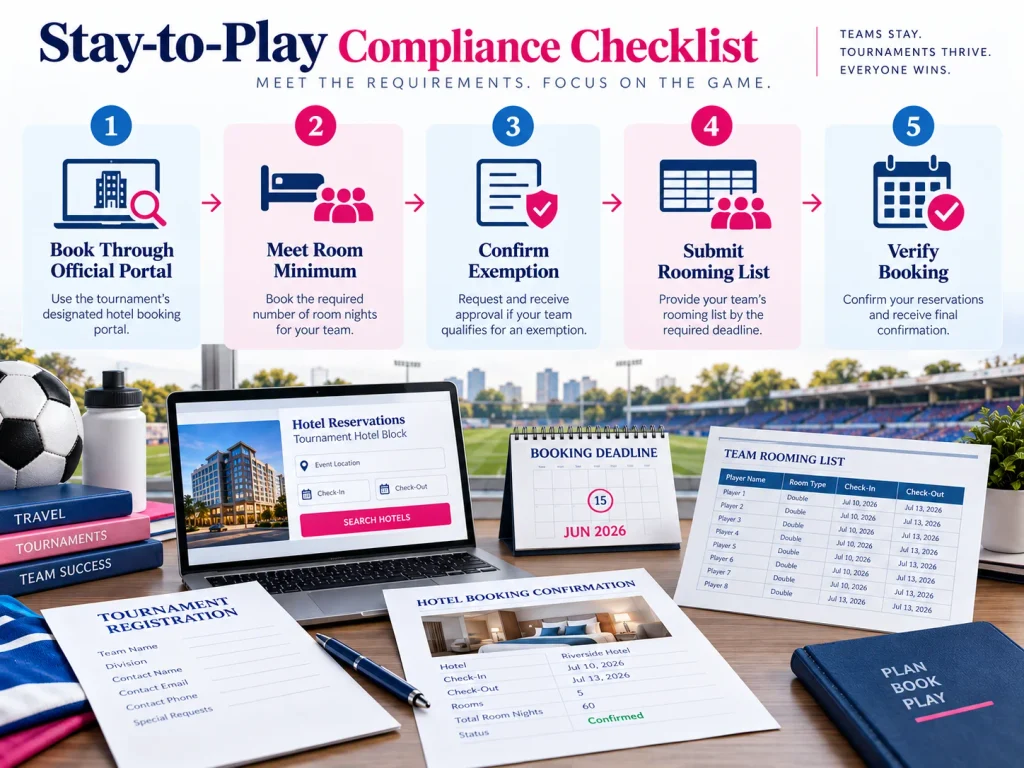
Enforcement is administrative, not legal. The event compares the housing company’s booking report against its accepted-teams list, then applies whatever consequence the policy names.
| Enforcement step | What it looks like | Documented examples |
|---|---|---|
| Single booking channel | Only reservations made in the designated portal count | Team Travel Source’s FAQ states reservations made outside the designated booking site will not satisfy the requirement |
| Hotel-side lockout | Hotel contract bars direct reservations from participants and credits the event for violations | Sports Destination Management describes both clauses as standard in the housing contract |
| Proof of booking deadline | Team submits or confirms a rooming list before a cutoff | Fastbreak AI describes proof-of-booking deadlines roughly 14 to 21 days before competition |
| Rooming list audit | Event cross-checks hotel lists against rosters | Sports Destination Management advises regular audits and puts responsibility on team managers and coaches |
| Non-compliance surcharge | Flat fee added to the team’s entry | Champions Events publishes a $750 surcharge for teams lodging outside its housing partner and $500 per event for booking around it, at 2023 season pricing |
| Buyout or opt-out fee | Priced escape from the requirement | Oklahoma Watch reported a $2,400 opt-out at Premier Girls Fastpitch Nationals |
| Scheduling or eligibility consequence | Team is not scheduled, or players are ruled ineligible | Oklahoma Watch quoted a soccer tournament warning that failure to comply “may result in your team not getting scheduled,” and a Dallas Stars policy under which players could be disqualified and the whole team removed |
Two practical notes for organizers. First, Sports Destination Management’s guidance is blunt: if you do not expect to enforce the policy, do not have one, because selective enforcement is what turns a housing rule into a grievance. Second, the consequences above are drafted policy language from specific events. They are not a standard. Every event writes its own, and the range from a surcharge to expulsion is very wide.
Why Do Organizers and Destinations Use Stay-to-Play?
The honest answer has three parts, and only one of them is about lodging.
Room Nights Buy the Date and the Venue
Team Travel Source’s FAQ frames housing requirements as the way an event demonstrates economic impact, which is what gets it the ideal weekend at the preferred complex. Dan Stuchal, chief operating officer of the Dallas Stars, told Oklahoma Watch that stay-to-play “generates a small amount of revenue” and is “necessary to show economic impact to cities that build the facilities.” Cities that financed a complex want the hotel tax receipts to prove the decision, and a housing report is the cleanest evidence available.
The same economic logic applies when organizers evaluate the overall cost of securing event space. For a broader look at venue pricing, see event space costs and party venue pricing
Rebates Fund the Event
Sports Destination Management describes the mechanic directly: the hotel builds a rebate into the room rate, and that rebate offsets other tournament expenses. Its point-counterpoint piece lists referee rooms, catering and awards as typical uses.
Don Schumacher, who founded the National Association of Sports Commissions, now the Sports Events and Tourism Association, told Oklahoma Watch he had warned for over a decade that such fees were increasingly used to fund events rather than trimming budgets or raising registration fees, and that the pattern has grown worse.
Rate Protection and Logistics
Sports Destination Management argues that without a block commitment, hotels can price against a captive weekend of demand, and an event carrying a block without a housing rule can end up exposed to attrition penalties on rooms it promised to fill. Centralized lodging also makes weather reschedules and last-minute communication far easier.
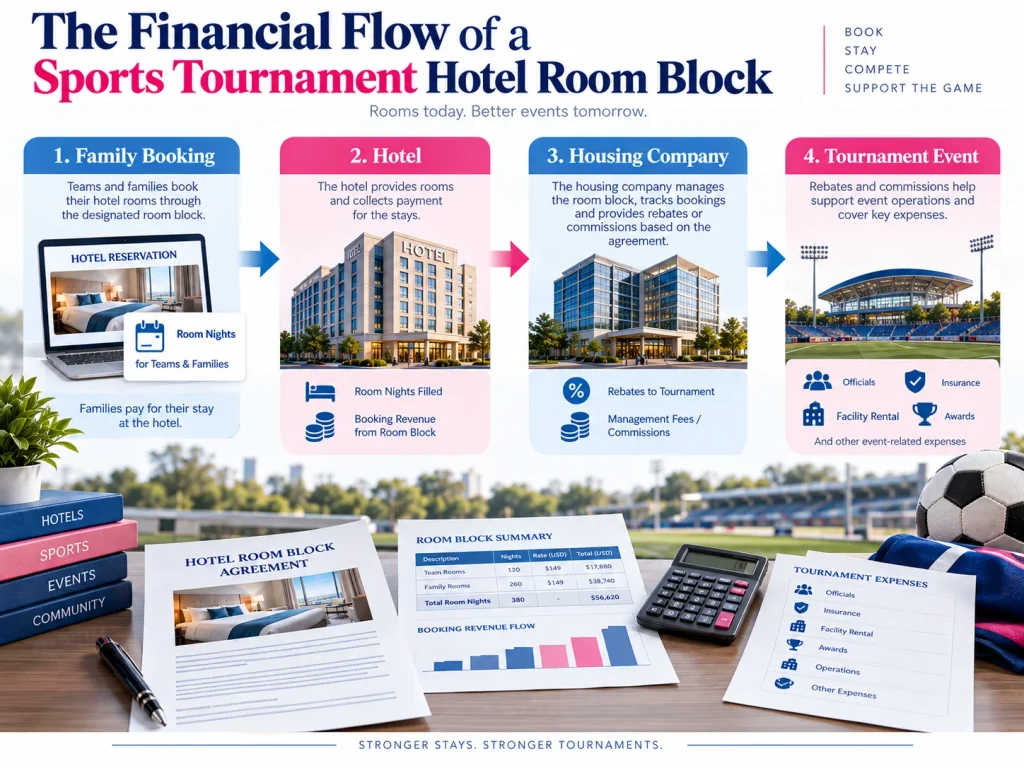
How Do Rebates and Commissions Flow?
| Step | Who pays or receives | What the sources say |
|---|---|---|
| Rate negotiated | Hotel to event or housing company | Rate includes a built-in rebate and a parity commitment for the contract period, per Sports Destination Management |
| Family books | Family to portal | Booking must run through the designated channel to count, per Team Travel Source |
| Rebate actualized | Hotel to housing company or event | Paid per actualized room night, per EventPipe |
| Rebate split | Housing company to event | Oklahoma Watch, citing Varsity Brands court records, described one agreement paying $20 per room and another giving Varsity 30 percent of the booking agent’s commission plus a rebate |
| Event applies proceeds | Event to operating budget | Referees, insurance, facility rental, awards, per Sports Destination Management and Fastbreak AI |
Scale varies enormously. Oklahoma Watch reported that out-of-town families at an Overland Park soccer complex booked around 23,000 hotel rooms a year and paid $7 to $10 per room in rebates. At the other end, the same reporting said court records showed Varsity Brands collecting roughly $4 million a year from room rebates alone.
How Common Is the Practice?
The two best available signals point in different directions, so carry both. Oklahoma Watch, citing Sports Events and Tourism Association data, reported that nearly 40 percent of tournament destinations required hotel stays in 2023, down from 60 percent in 2021.
Nic Collins, executive vice president and chief operating officer of HBC Event Services, told Sports Destination Management that stay-to-play “is more popular than ever” and “is now being used in the majority of all major tournaments.”
Both can be true if requirements are concentrating in the largest events while thinning across the long tail, but neither source proves that.
Who Is Exempt From a Stay-to-Play Requirement?
The commuter waiver is nearly universal. Everything past it depends on the event.
| Exemption | How it usually works | What the sources say |
|---|---|---|
| Local commuting team | Team inside a mileage radius may drive daily with no lodging obligation | Radius varies by event. Fastbreak AI cites 30 to 50 miles with residency proof; Champions Events uses a 75 mile drive radius; Sports Destination Management mentions waivers typically around 100 miles |
| Local team that chooses to stay | Exemption often lapses if the team books a hotel anyway | Champions Events requires local teams that do stay overnight to book through its housing partner |
| Staying with family | Case by case, sometimes only via a paid buyout | Sports Destination Management advises directing these requests to the event manager |
| Accessibility or medical need | Housing company accommodates with advance notice | EventPipe lists disability, medical conditions and service animals; Sports Destination Management says advance notice matters |
| Loyalty points redemption | Sometimes permitted inside the official block only | Fastbreak AI describes points redemptions at properties within the block; EventPipe lists rewards and memberships as a common exemption request |
| Military or first responder | Rate or program exception | EventPipe lists military and first-responder discounts; Fastbreak AI cites official orders with government per diem |
Two cautions. Radius rules are usually measured from the venue, not from your city center, and several policies also require written confirmation of exempt status. Champions Events, for example, asks local teams to email for exemption verification rather than simply not booking.
What Are the Criticisms of Stay-to-Play?
The objections are consistent across reporting, and they are worth stating in the words of the people who made them rather than paraphrasing them away.
Price
Oklahoma Watch documented specific gaps. At a Tulsa hockey event, rooms booked through the tournament ran $127 per night at a Fairfield Inn with a $28 per night non-refundable deposit to a booking agent, which the outlet calculated at 22 percent of the total lodging cost, while it reported the hotel itself charged $99 per room night.
At a Kansas City area soccer event, rooms listed at $170 per night through the tournament were available independently at $85 to $109.
For organizers and teams trying to understand the wider economics of event lodging, comparing these figures with event venue cost per hour can help separate lodging costs from venue costs
Choice and Coercion
Sports Destination Management’s own point-counterpoint acknowledges the sentiment: “I don’t like the idea of being told where to stay,” plus complaints about loyalty programs, family budgets and inconsistent enforcement.
Michelle Hostetler, another parent quoted by Oklahoma Watch, made the market observation that gives the rule its force: larger tournaments have enough applicants that a team refusing to comply is simply replaced.
Antitrust and Consumer Law
Oklahoma Watch reported that the arrangement may raise a tying question. Kent Meyers, an attorney at Crowe and Dunleavy and an adjunct law professor at the University of Oklahoma specializing in antitrust, compared it to a seller with control of a highly desirable product using that control to force an unrelated purchase.
Molly Tolbert, an Oklahoma City attorney quoted in the same piece, argued that buyout fees reveal the purpose: a party genuinely trying to save you money would welcome a cheaper option rather than invoice you for the lost revenue.
These are legal opinions offered to a news outlet, not holdings.
What Has Happened in Court?
Two matters come up repeatedly. Attribute both carefully.
Varsity Brands, the cheerleading events and apparel company, settled an antitrust class action brought in Tennessee by families whose claims included forced lodging. Oklahoma Watch reported that the settlement limited stay-to-play requirements without eliminating them, and that internal documents surfaced in the case showed the program renamed “Stay Smart,” which one document characterized as putting lipstick on a pig.
Fastbreak AI dates the settlement to December 2024 and puts the figure at $82.5 million. The claims were allegations resolved by settlement, and the reporting we read does not describe any court ruling that stay-to-play is unlawful.
Separately, a putative class action was filed in May 2026 in the Western District of Kentucky against Team Travel Source, styled Russell et al. v. The Complete Plan, Inc. d/b/a Team Travel Source, 3:26-cv-00360-CHB.
According to the announcement from plaintiffs’ counsel Almeida Law Group, the complaint alleges the company coerced parents into booking through its platform as a condition of participation, added mandatory nightly housing fees, advertised a lowest-rate guarantee while offering higher rates than competing channels, and declined to match lower rates parents found.
Those are unproven allegations from a plaintiffs’ filing. Reported filing dates for the complaint vary by a few days between sources.
How Should an Organizer Structure a Policy Families Will Accept?
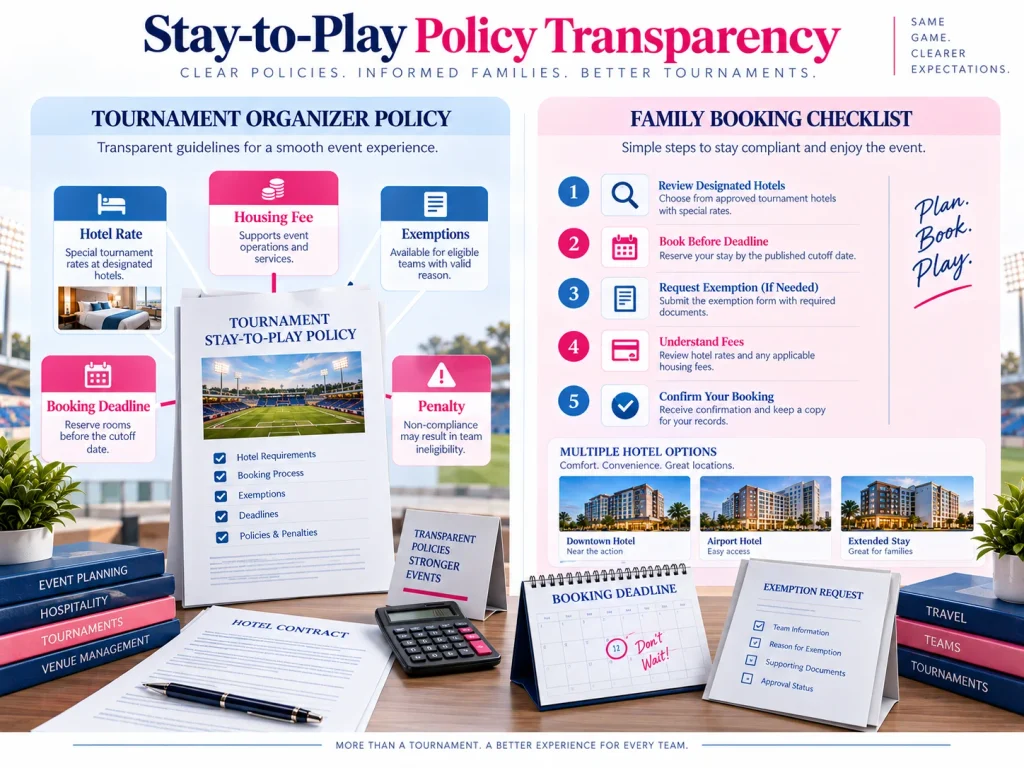
Christine “Tina” Horn, writing for Sports Destination Management, argues that acceptance turns on transparency rather than justification. Her recommendations include publishing the policy everywhere a team looks before registering, keeping the rebate amount modest enough that the rate does not look inflated, offering hotels at several price points, and being explicit that the rebate reduces registration fees rather than functioning as a kickback.
The point-counterpoint piece adds consistent enforcement and early communication as the two factors that most predict whether teams accept the rule.
The table below sets each design decision against how the other side reads it.
| Policy element | Organizer view | Club and family view | Where the two can meet |
|---|---|---|---|
| Mileage radius | Needs to be wide enough to capture real travelers | Feels arbitrary when measured from a venue rather than a metro | Publish the exact measurement method and a named exemption contact |
| Minimum rooms or nights | Protects the block commitment to the hotel | Penalizes small rosters and families splitting rooms | Scale the minimum to roster size instead of a flat per-team figure |
| Rate | Group rate plus parity clause holds price down | Comparison shopping sometimes shows a cheaper open rate | Show the total including fees and taxes next to the property’s public rate |
| Rebate | Funds officials, insurance and facility rental | Reads as an undisclosed markup when unexplained | State that a rebate exists and what it pays for |
| Housing fee | Pays the housing company for service | The fee named in the Team Travel Source complaint | Disclose the fee as a separate line before checkout |
| Exemptions | Too many waivers break the room-night count | Legitimate needs get refused without explanation | Written criteria, a deadline and a written answer either way |
| Penalty | Deterrence has to be credible to work at all | Expulsion for a lodging choice feels disproportionate | Publish the exact consequence, then apply it uniformly |
| Timing | Blocks must be contracted well ahead | Families budget the season before the policy appears | Announce the housing rule with the event application |
| Hotel mix | Fewer properties means better rates and simpler counting | One tier prices some families out | Multiple price tiers inside the block |
For organizers working through the broader hotel-block process, hotel room block management strategies provides another relevant resource
What Should a Club Do to Budget and Comply?
Treat the housing rule as part of the entry cost, because that is how it behaves.
Read the policy before you accept a bid, and price the whole obligation: minimum nights, minimum rooms, the nightly rate with taxes and any housing or service fee, and the buyout figure if opting out is even permitted. Then compare that total against the public rate at the same properties, and keep the screenshots.
If the gap is large, that is information for your board and for next season’s tournament selection, and some events will discuss it if you raise it early.
Confirm exemptions in writing before the deadline rather than assuming a local roster qualifies. Assign one person to own the rooming list, since Sports Destination Management notes that events place compliance responsibility on team managers and coaches, which means a parent who books independently creates a team problem.
Bill families from the total cost rather than the headline nightly rate, and say clearly which portion is lodging and which is the housing fee. Parents tolerate a mandate they understand far better than a surprise.
Key Takeaways
A stay-to-play requirement conditions tournament eligibility on booking through a designated housing channel. Team Travel Source’s FAQ confirms that a direct hotel booking at the same property does not count.
Enforcement runs on booking reports, proof-of-booking deadlines and rooming list audits, with consequences ranging from published surcharges to non-scheduling or removal depending on the event.
Rebates built into the room rate fund officials, insurance and facilities. Oklahoma Watch reported figures from $7 to $10 per room at one destination up to roughly $4 million a year from rebates in Varsity Brands court records.
Local commuting teams are the standard exemption, but the radius varies from about 30 miles to 100 miles across the sources we read, and staying overnight usually voids the waiver.
Criticism centers on price gaps, loss of choice and possible tying. Attorneys quoted by Oklahoma Watch raised the antitrust question, and the Team Travel Source class action filed in May 2026 contains unproven allegations, not findings.
Transparency is the practical fix on both sides: publish the rule, the fee, the exemption process and the penalty before teams register, and price the full obligation before you accept a bid.
Frequently Asked Questions
What is a stay-to-play requirement for tournaments? ▾
It is a tournament rule that traveling teams must book lodging inside the event’s official hotel block, usually through a designated housing company, to be eligible to compete. Organizers use the guaranteed room nights to secure dates and venues and to earn rebates that offset event costs. Teams inside a stated mileage radius are normally exempt.
Is stay-to-play legal? ▾
Stay-to-play is widely used and has not been banned. Oklahoma Watch reported that antitrust lawyers see a possible tying problem, since access to the tournament is conditioned on buying lodging. Kent Meyers of Crowe and Dunlevy compared it to a seller using control of a desirable product to force a second purchase. No source we read described a court ruling that the practice itself is unlawful.
How do tournaments check that you complied? ▾
Compliance is matched against the housing company’s booking report. Team Travel Source’s FAQ states that any reservation made outside the designated booking site will not satisfy the requirement. Fastbreak AI describes proof-of-booking deadlines roughly 14 to 21 days before competition. Sports Destination Management advises organizers to audit hotel rooming lists and to require hotels to refuse direct participant reservations.
What happens if a team does not book through the block? ▾
Consequences vary by event. Champions Events publishes a surcharge for booking around its housing partner. Oklahoma Watch reported tournaments that charged an extra fee to out-of-town teams missing from the booking report, a soccer event warning that teams may not get scheduled, and a Dallas Stars policy under which players could be disqualified and the team removed.
Who is exempt from a stay-to-play requirement? ▾
Local commuting teams inside a mileage radius are the standard exemption, though the radius differs by event: Fastbreak AI cites 30 to 50 miles, Champions Events uses a 75 mile drive radius, and Sports Destination Management mentions waivers around 100 miles. EventPipe also lists accessibility and medical needs, loyalty point redemptions inside the block, and military or first responder cases.
How do rebates work in tournament housing? ▾
The hotel builds a rebate into the negotiated room rate, and the housing company or event collects it per actualized room night. Sports Destination Management describes rebates funding referee rooms, catering and awards. Oklahoma Watch cited an Overland Park arrangement of $7 to $10 per room and, from Varsity Brands court records, $20 per room in one agreement.
Are block rates really cheaper than booking on your own? ▾
Sources disagree. Housing companies argue that group volume plus rate parity clauses hold rates down and prevent spikes from competing events. Oklahoma Watch documented cases where tournament rates ran well above what the same properties charged directly, and a parent it interviewed said she had never seen tournament prices that were comparable or lower. Check both before you assume.
How should a club budget for a stay-to-play event? ▾
Read the housing rule before you register, then price the full requirement: minimum nights, minimum rooms per team, any housing or service fee, taxes, and the buyout amount if you plan to skip it. Bill families from the total, not the headline nightly rate, and confirm your exemption in writing before the proof-of-booking deadline.
Compare vendors for your next event
Search caterers, photographers, florists, planners, and rentals — then send one request to several vendors at once.