Quick answer: To manage room blocks for a conference, run inventory across several hotels, watch pickup weekly against your attrition target, and steer attendees to one official booking channel. Decide early whether a housing bureau or your own team holds the block, carve out sub-blocks for VIPs and exhibitors, and warn attendees about poachers before registration opens.
A 40-room block for a sales kickoff is an administrative task. A 2,000-room-night program spread over six hotels, where every attendee pays their own folio and books whenever they feel like it, is a different job. You are not booking rooms. You are managing a forecast you do not control, against a contract that bills you for being wrong.
This post assumes you already know what a room block is and how attrition clauses work in principle. If not, start with the pillar guide on how to book hotels for a sports tournament, then come back. What follows is the scale version: multiple properties, attendee-paid reservations, pickup over a long booking window, and the people who try to steal your block out from under you.
Who should hold the block: your team or a housing bureau?
The first real decision. Convention and visitors bureaus in most large US destinations offer housing management, usually delivered by a specialist partner. Visit Austin runs its housing bureau through Key Bookings. Visit San Antonio works with Orchid.Events, which describes handling more than 150,000 reservations a year. Sports Destination Management has reported that housing bureaus are now the norm rather than the exception for large multi-hotel events, mostly because bureau staff tend to come out of hotel sales and already know who to call.
| Self-managed | Housing bureau or third-party provider | |
| Best fit | Single hotel, or 2 to 3 hotels, repeat program | Citywide, multi-hotel, exhibitor and VIP layers |
| Who answers attendee phone calls | Your staff | Provider’s reservation centre |
| Inventory visibility | Hotel-by-hotel reports you chase | One dashboard across all properties |
| Sub-block administration | Manual spreadsheets | Built into the system |
| Card handling and PCI scope | Yours, per hotel | Provider’s |
| Cost | Staff hours | Flat fee, hotel commission, or a mix |
| Main risk | Reporting gaps you find too late | Outsourcing money and attendee data to a vendor |
Bureau services are commonly bundled with a destination’s convention package, so the fee question depends on how you were sourced. Where a provider is paid on hotel commission, ask exactly what the commission is calculated on, because that number interacts with any rebate in your rate. More on that below.
If you’re comparing the costs involved in managing event-related services, resources such as how much event planners charge can also help put staff and service costs into perspective.
Self-managing works fine up to a point. The point usually arrives when you have three hotels, an exhibitor block, and a staff member spending Friday afternoons reconciling three PDFs.
How do you split inventory across multiple hotels?
Split by role, not evenly. Attendees self-select on price and walk time, and your allocation should reflect what they actually pick rather than what you wish they would pick.
| Property role | Share of total block | What it is for |
| Headquarters hotel | Largest single allocation | Attached or nearest to the venue, board and committee meetings, staff office |
| Primary overflow, similar tier | Second largest | Absorbs pickup when HQ sells out, same rate band |
| Lower-rate tier | Sized to your student, government and small-employer attendees | Per diem travellers, first-time attendees |
| Upscale or boutique | Smallest | Sponsors, senior members, guests paying their own way |
Two rules that save money. First, do not put your whole commitment in the most expensive hotel because it is closest. Second, keep at least one property outside your contracted commitment as a named alternative you can point late bookers toward, so a sellout at HQ does not send them to a booking site instead of to you.
For organizations comparing different venue and hotel options, you can also review event venue booking options in New Jersey as an example of how property selection can vary by location and event needs.
Sub-blocks and priority groups
A sub-block is a slice of the master block carved out for a defined group with its own booking link or code. Cvent Passkey defines a sub-block as a room type tied to an attendee type, and lets organisers either approve each request manually or auto-generate sub-blocks from live inventory against pre-set rules. EventPipe describes the same pattern for teams, sponsors, staff and speakers.
Typical carve-outs for an association meeting:
- Staff and volunteers. At the HQ hotel, on floors you can find quickly.
- Speakers and board. Fixed count, dates padded by a night either side.
- Exhibitors. Often the largest sub-block after the general attendee pool, and the group most heavily targeted by poachers.
- Sponsors by tier. Sponsorship decks that promise hotel access need matching inventory, or you will be buying rooms at rack rate in month eleven.
- Suites held outside the public block. Housing systems can hold these back so a member does not book the presidential suite by accident.
Give each sub-block its own deadline, earlier than the public cut-off. Unclaimed speaker and sponsor rooms are the easiest inventory to recycle into general sale, and recycling them is free if you do it before the hotel starts counting.
How is room block pickup tracked over time?

Pickup is the count of rooms actually reserved against what you contracted, and the only number that decides your bill. For an attendee-booked conference it arrives late and it arrives unevenly.
PCMA has reported that roughly 40 percent of registrants now book inside the official block, with industry participants worried the figure could slide toward 30 percent. The same discussion cited a citywide event where half the participants registered within three weeks of the meeting. Registration timing drives housing timing, so if your registration curve is back-loaded, your pickup curve will be too.
Track it weekly, not monthly, and read the pace rather than the total.
| Window before arrival | What to look at | What to do about it |
| 9 to 12 months out | Block sizes signed, links live, sub-blocks defined | Test every booking link yourself before it goes public |
| 6 months out | Pickup pace versus the same point last year | Reallocate between properties while hotels are still relaxed about it |
| 90 days out | First honest read on the general pool | Trigger the largest contractual block reduction you negotiated |
| 45 to 60 days out | Sub-block claim rates | Release unclaimed speaker, sponsor and exhibitor rooms into general sale |
| Cut-off week | Pickup against the attrition floor | Talk to the hotel before the date, not after |
| Post-event | Final audit and rebate reconciliation | Build next year’s history file by brand and property |
The three reports to ask for every week
Housing bureaus and hotel group sales desks both produce roughly the same set. Visit Austin’s housing bureau lists these by name:
- Pickup report. Committed, sold and available rooms per hotel per night.
- Rooming list report. Reservations alphabetically or by property.
- History and pace report. New, modified and cancelled activity, which is what tells you whether a flat week is a stall or a wash of cancellations hiding real demand.
If you are self-managing, ask for all three in writing as a contract concession, weekly, from a named person. Hotels run pickup against your rate codes, so any attendee who books outside your codes will not appear. That gap is where most surprise attrition bills are born.
How does attrition work across several properties?

Each hotel contract stands alone. There is no combined performance number, which means a sellout at the HQ hotel does not cover a shortfall at the overflow property. Planners routinely get this wrong and assume a good citywide total protects them everywhere.
Inside each contract, the measurement method matters more than the percentage.
| Method | How the shortfall is measured | Exposure |
| Cumulative room-nights | Total room-nights across the whole stay pattern, checked after checkout | Lower. Strong nights offset weak shoulder nights |
| Per-night | Each date judged on its own | Higher. A soft Sunday bills you even if the mid-week is full |
| Stair-step reductions | Scheduled chances to cut the block at set dates | Depends on the schedule. Push the biggest reduction as late as you can get it |
Published guidance on the allowance itself varies: EventPipe cites 10 to 15 percent, Stova cites 15 to 20 percent, and tighter numbers show up in high-demand markets. Treat any single figure as a starting point rather than a standard.
Three clauses worth pushing for on every contract in the set:
- Cumulative measurement of room-nights, and confirmation of which rooms count. Pre and post nights, staff rooms, discounted government rooms and any rooms booked outside the block but attributable to your group should all be credited. Stova and EventPipe both flag this as negotiable.
- Resale credit. If the hotel resells rooms you failed to pick up, that revenue should reduce your bill. Without the clause you can be charged for rooms the hotel sold twice.
- Damages on profit, not rate. Attrition calculated on the profit margin of an unsold room rather than the full room rate, which is a common ask and sometimes granted.
When reviewing the financial side of a venue or hotel booking, you may also want to compare your expected costs against available event pricing options.
Cut-off dates and rooming lists at conference scale
Conference blocks work on individual attendee reservations against a booking link or code, with a cut-off date after which unbooked rooms return to hotel inventory. Rooming lists still appear, but usually only for staff, speakers and any group you are paying for centrally. Handle those two mechanics separately.
For the attendee pool, the cut-off date is a negotiation, not a given. Later cut-offs improve pickup for a back-loaded registration curve, and post-cut-off inventory management is a standard housing bureau service precisely because so many people book after it. Ask for a later date, ask what happens to rate honouring after it, and get the answer in writing.
For centrally paid rooms, set your internal rooming list deadline two weeks ahead of the hotel’s, then chase. Names, arrival and departure dates, sharing arrangements, and who is billed to the master account: all of it changes right up to the day, and every change after the deadline is a phone call somebody has to make.
What is room block poaching and how do you defend against it?

This is the part that catches first-time conference planners. Companies unconnected to your event contact your attendees and exhibitors, present themselves as your official housing partner or something close enough, and take bookings outside your block. Meetings Today, Associations Now and PCMA have all documented the practice, and PCMA reports that a US poultry association won a court judgment against one such operator for deceptive advertising and trademark infringement. Industry bodies have also backed federal legislation on online booking scams.
The damage lands in three places. Your pickup falls and your attrition bill rises. Attendees sometimes lose money outright, because the more aggressive operators take full payment for reservations that were never made. And the complaints come to you, because to the attendee it looked like your conference asked for the card.
ASAE’s Pam Troop, quoted in Meetings Today, gives attendees four tests worth reprinting in your own words:
| Signal | Official housing | Poacher |
| Contact volume | Sparing | Repeated calls and emails |
| Rate | Comparable to the published block rate | Improbably low |
| Payment | Card guarantee or deposit | Full payment up front |
| Listed on your event site | Yes, by name | No |
What to actually do:
- Name your official housing provider on the event site, with its real domain, and say plainly that nobody else is authorised to take reservations for the meeting. Associations commonly add that the official provider will never cold-call attendees to make a booking.
- Publish the sending domains your housing emails come from.
- Warn before registration opens, then again in the first housing email, then again in the reminder. Poaching outreach tends to start once registration goes live.
- Control your attendee and exhibitor lists. Associations Now points to screening whoever rents or accesses member data as a first line of defence, since published lists are how poachers find your people.
- Set up a reporting inbox and tell attendees to forward anything suspicious. Forwarded emails are what your counsel needs for a cease and desist.
- Involve legal counsel early rather than after the meeting, when the money is gone.
Poaching is not the whole story on out-of-block booking. PCMA’s discussion of the same problem lists rate shopping, loyalty point earning, corporate travel policy that mandates a booking channel, and clumsy housing sites where a reservation never shows up in the attendee’s hotel app. Fixing the booking experience recovers rooms that no cease and desist letter ever will.
Rebates and commissions: where the money moves
Two different payments often sit in the same rate.
A rebate is a fixed amount per room-night built into the rate and paid back to your organisation after the meeting, commonly used to offset convention centre rent or shuttle cost. A commission goes to a third party for the booking, usually calculated on room revenue. HopSkip notes that where both appear, the rebate is typically subtracted from the rate before commission is calculated, so the order of operations changes what everyone receives.
Two cautions. Rebates inflate the visible rate, which pushes price-sensitive attendees out of the block and straight into your attrition exposure. And HopSkip warns that charging attendees a rate which quietly funds the host organisation raises disclosure questions under state law, with hotels generally putting that compliance burden on the group. Talk to your counsel, disclose it, or move the cost into the registration fee where attendees can see it.
A working process
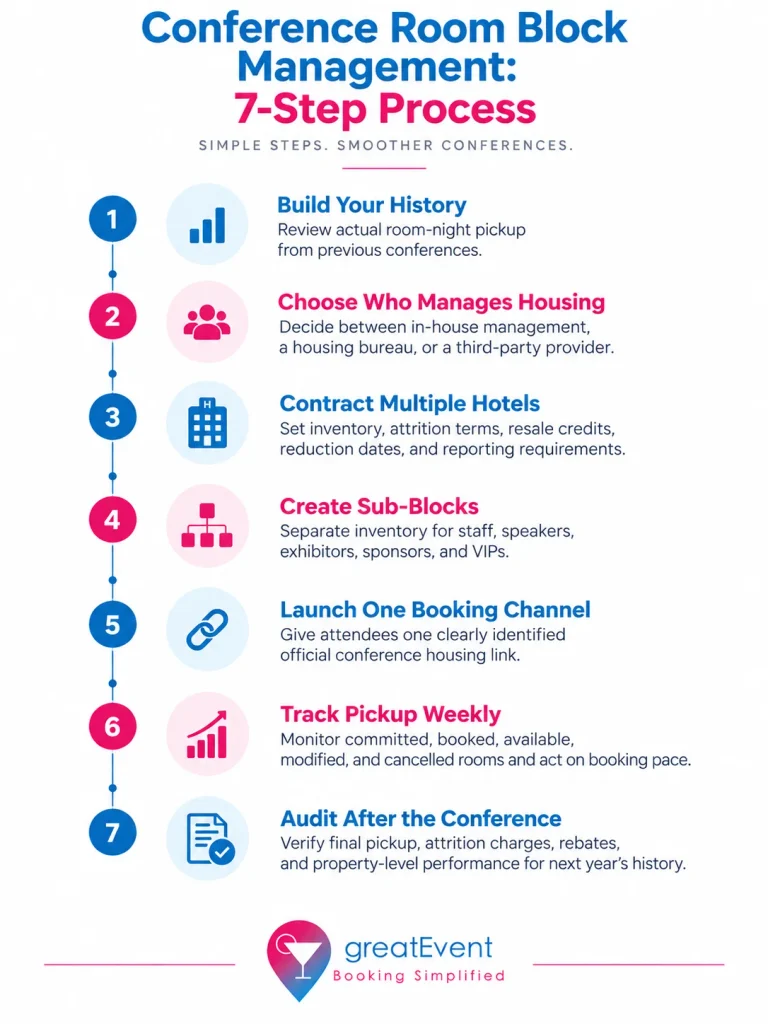
- Build the history file first. Room-nights actually picked up by property and by night, for your last two or three meetings, broken out by brand where you can get it. Contracted numbers are not history.
- Decide who holds the block. Housing bureau, third-party provider or in-house, before you sign anything, because the answer changes what your contracts need to say.
- Contract the set as a portfolio. Cumulative room-night measurement, resale credit, scheduled block reductions and weekly reporting in every agreement, including the small overflow properties nobody worries about.
- Define sub-blocks and their deadlines. Staff, speakers, exhibitors and sponsor tiers, each with its own link or code and a claim date ahead of the public cut-off.
- Launch housing with registration, in one channel. One official link, tested end to end, plus the poaching warning in the same message.
- Read pickup weekly and act on pace. Reallocate between properties, recycle unclaimed sub-blocks, and open any renegotiation before the cut-off date rather than after it.
- Audit and reconcile after the meeting. Final housing report, attrition calculation checked line by line against your own pickup records, rebate reconciled, and the whole thing filed as next year’s history.
Key takeaways
- Every hotel contract in a citywide stands alone. A sellout at the HQ hotel does not offset a shortfall at the overflow property.
- Cumulative room-night measurement, resale credit and scheduled block reductions are the three clauses that decide your real exposure.
- Pickup for attendee-booked conferences is back-loaded. Read pace weekly and act 90 days out, not at cut-off.
- PCMA has reported roughly 40 percent of registrants booking inside the block, so plan block sizes against your own pickup history rather than registration counts.
- Sub-blocks with earlier internal deadlines let you recycle unclaimed speaker, sponsor and exhibitor rooms for free.
- Name your official housing provider on the event site, publish your sending domains, and warn attendees about poachers before registration opens.
Frequently Asked Questions
What are conference attendee room blocks? ▾
They are hotel rooms held for a conference at a negotiated rate, reserved and paid for by individual attendees rather than by the organiser. At scale, the block is usually split across several hotels, each under its own contract, with sub-blocks carved out for staff, speakers, sponsors and exhibitors.
Should you use a housing bureau or manage the block yourself? ▾
Self-manage while you are dealing with one to three hotels and a repeat program you know well. Move to a housing bureau or third-party provider once you have multiple properties plus exhibitor and VIP layers, because you get one dashboard across all hotels, a reservation centre answering attendee calls, and card handling off your plate.
How many hotels should a conference block cover? ▾
Enough to cover your rate bands, not your total headcount. Put the largest allocation in the headquarters hotel, a similar-tier overflow next, then a lower-rate option for per diem travellers and a small upscale property for sponsors. Keep one uncontracted hotel named as an alternative for late bookers.
How do you track room block pickup? ▾
Ask each hotel or your housing provider for three reports weekly: a pickup report by hotel and night, a rooming list, and a history and pace report showing new, modified and cancelled activity. Pickup only counts reservations made against your rate codes, so bookings made outside them will not appear.
What is cumulative attrition and why does it matter? ▾
Cumulative attrition measures your shortfall against total room-nights across the whole stay pattern, checked after checkout, so strong nights offset weak shoulder nights. Per-night attrition judges each date on its own and bills you for a soft Sunday even when mid-week sold out. Cumulative measurement is the lower-risk structure to negotiate for.
What is room block poaching? ▾
Companies with no connection to your conference contact attendees and exhibitors, present themselves as the official housing partner, and take bookings outside your block. Some never make the reservation at all. Your pickup falls, your attrition bill rises, and attendees blame your organisation. Meetings Today, Associations Now and PCMA have all documented the practice.
How do you stop poachers targeting your attendees? ▾
Name your official housing provider and its domain on the event site, state that nobody else is authorised to take reservations, and publish the addresses your housing emails come from. Warn attendees before registration opens and repeat it in every housing email. Control who accesses your attendee and exhibitor lists, and involve counsel early.
Why do attendees book outside the block? ▾
PCMA’s reporting points to rate shopping, loyalty point earning, corporate travel policies that mandate a booking channel, late attendance decisions past the cut-off, and housing sites where the reservation never appears in the attendee’s hotel app. Rebates built into the rate make the block look expensive and add to the problem.
Compare vendors for your next event
Search caterers, photographers, florists, planners, and rentals — then send one request to several vendors at once.