Quick answer: Book youth team rooms about 6–9 months out. Send one RFP to 3–5 hotels near the venue, compare bids on total value, then sign a contract with roughly 20% attrition and a 30–60 day cutoff. Size the block around SafeSport rooming rules first: no unrelated adult shares a room or bed with a minor athlete, and you staff one chaperone per 5–8 athletes.
Booking a hotel for a team of 14-year-olds is a compliance job with a reservation attached. The rate matters. The rooming chart matters more, because a rooming chart that puts one adult in a room with one minor is a problem no group rate fixes.
This guide covers the youth-specific side: supervision ratios, SafeSport lodging consent, waivers, accessible rooms, and who actually pays. For the general mechanics of block size, attrition math, and contract clauses that apply to any team, see How to Block Hotel Rooms for a Sports Team.
What makes a youth block different from an adult team block?
Same RFP process, different constraints. The differences all push in one direction: more rooms, more paperwork, less flexibility.
| Factor | Adult team | Youth team |
| Rooming | Any pairing works | No unrelated adult shares a room or bed with a minor |
| Supervision | None required | One adult per 5–8 athletes |
| Adult vetting | Usually none | Annual background checks for coaches and volunteers are common league policy |
| Paperwork before travel | Roster | Liability waivers, medical release, SafeSport lodging consent |
| Billing | Team or master account | Often parent-paid, per player, collected on deadlines |
| Amenities that decide the bid | Rate, location | Free hot breakfast, laundry, pool, kitchenettes |
Youth travel is not a niche. The Sports & Events Tourism Association reported $60.1 billion in direct spending on participatory sports tourism in the U.S. in 2025, with hundreds of millions of travelers. Destinations openly say major tournaments need ample hotel blocks to work.
That gives you bargaining power. It also means the good hotels near a big venue are gone early.
When you’re comparing tournament venues, remember that the hotel is only one part of the trip budget. The venue itself can be a significant expense, so reviewing event space costs and party venue pricing can help you separate lodging costs from venue-related costs when building the overall budget.
What are the SafeSport rooming rules for minors?
Follow these before you build the rooming list, not after.
- No unrelated adult and minor share a room or bed. This is the rule that shapes your room count. Coaches and chaperones need their own rooms.
- Exceptions require written parental consent. If any deviation is needed, such as two minors sharing, parents sign a SafeSport lodging consent form.
- Never leave a minor with a lone adult. Applies in rooms, hallways, and vehicles.
- Run nightly room checks in pairs. Two adults, together, every time. No one-on-one visits.
Practical effect on your block: a 16-player, 3-coach trip at two players per room is 8 player rooms plus 3 coach rooms. Eleven rooms, not nine. Budget for it before you quote a per-player price to parents.
How many chaperones do you need?
One adult per 5–8 athletes is the working standard. A 20-player squad needs 3 to 4 adults; a 40-player squad needs 5 to 8. Build the ratio from the smaller end if the group is younger or the trip is long.
| Athletes traveling | Chaperones at 1:8 | Chaperones at 1:5 |
| 10 | 2 | 2 |
| 20 | 3 | 4 |
| 40 | 5 | 8 |
| 60 | 8 | 12 |
Every adult on that list needs vetting. Many leagues mandate annual background checks for all coaches and volunteers, so start the screening early enough that a late-added parent chaperone clears before departure. Chaperone ratio requirements vary by state, so check local rules alongside SafeSport.
Which forms do you need signed before departure?

Collect these while you are still collecting deposits. Chasing signatures at the hotel front desk is how trips go sideways.
- Liability waiver for every player, signed by a parent or guardian, covering travel and the hotel stay. Waivers generally cannot absolve gross negligence, so treat them as documentation, not armor.
- Medical release form so a chaperone can authorize treatment.
- SafeSport lodging consent for any rooming arrangement that needs a parental sign-off.
- Travel consent form, and identity or travel documents for minors if you cross a border.
- Code of conduct, signed, with the consequences for violations spelled out in writing before travel.
Do you need accessible rooms in the block?
Yes, and you should name the number in the RFP. The Americans with Disabilities Act requires hotels to provide wheelchair-accessible rooms scaled to property size, roughly one per 25 rooms, so a 101–200 room hotel holds about 5 to 6. That is a small pool competing with every other group in the building.
Ask families about ADA needs during registration. Then request those specific room features in writing, and confirm accessible routes, entrances, and parking. Campus dorms often have limited accessible rooms, which is one more reason they are a weak fit for youth groups.
Who pays: parent-paid or team-paid?
Decide this before you sign, because the contract obligates the team either way.
| Model | How it works | Watch out for |
| Team-paid | Team signs, pays the deposit, and bills families a flat per-player cost | Team absorbs any shortfall if pickup drops below the attrition floor |
| Parent-paid | Families pay their share to the coordinator on deadlines, team remits | You need money in hand before the hotel’s deadlines, not after |
Either way, keep a running ledger of who has paid. Hotel deposits are commonly around 25% at signing with the balance due 60 days before arrival, so your collection deadlines have to sit ahead of the hotel’s. Pad them. If the official cutoff is 90 days, tell families 100 days. Build a 10% contingency into the per-player number, and consider fundraising or a sponsor to soften it.
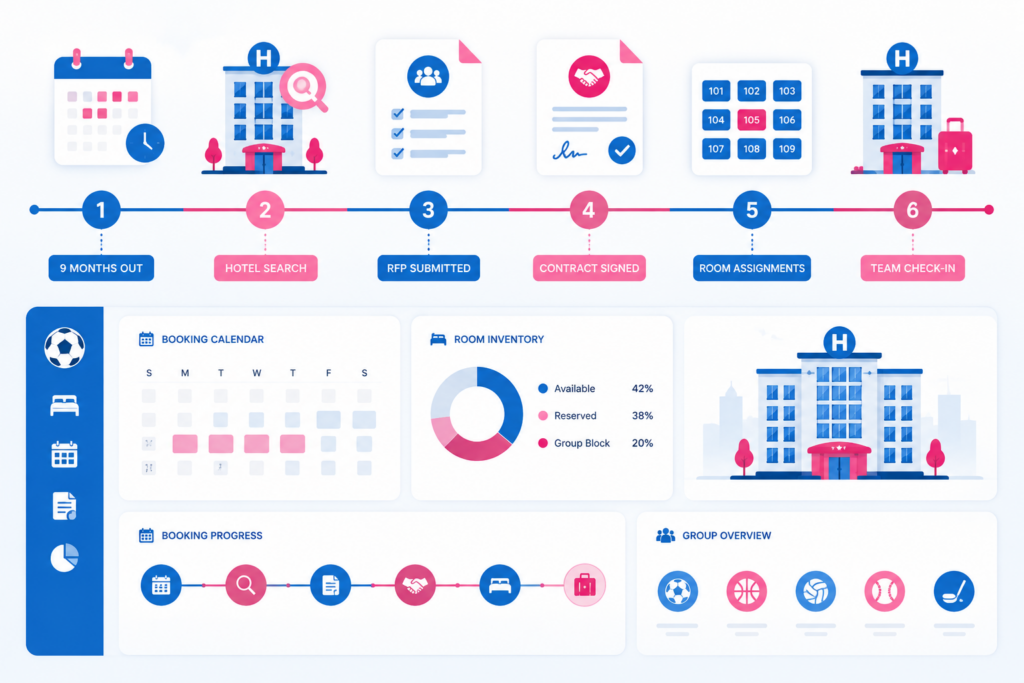
The 7-step youth booking process
- Lock the roster and the safety plan (12+ months out). Sport, team size, dates, budget, chaperone count at 1:5–8, room needs, and must-have amenities. This is where you find out you need 11 rooms and not 9.
- Write the RFP. Event overview, room-night grid by date, target rate, accessible rooms needed, required amenities (shuttle, Wi-Fi, parking, breakfast), and the contract terms you want on attrition, cutoff, and cancellation.
- Send it to 3–5 hotels near the venue, 6–9 months out. Same RFP to all of them, firm bid deadline. Competition drives the offers. Nine in ten groups secure their blocks at least 30 days out, and youth tournament season peaks in fall and late spring, so early is cheap insurance.
- Compare bids on total value and negotiate. Talk to the property’s local sales manager, not a central call center. Push for 20% or more attrition, a resale clause, a late cutoff, one comp room per 20 booked, waived resort or parking fees, and a blended rate so one price covers every room type.
- Sign the contract. Block size, rates, deposit schedule, 20% attrition, cutoff 30–60 days out, cancellation tiers, resale and force majeure. Get the countersigned copy back.
- Collect consents and deposits. Publish each family’s share and deadlines, collect enough to cover the hotel deposit, and bank the signed waivers, medical releases, and lodging consents.
- Submit the rooming list and run the stay. Send names, room types, arrival and departure dates, and any ADA notes in the hotel’s format by the cutoff, usually 30 days out. Confirm breakfast, luggage storage, and bus arrival time. Do a group check-in, run paired room checks nightly, then review the folio at checkout.
Milestones in one line: RFP at 6–9 months, contract signed by 3–4 months, final rooming list about 30 days out, pre-trip briefing 1–2 weeks before.
What does a youth tournament trip actually cost?
Sample two-night estimates, two players per room:
| Expense | Team of 20 | Team of 40 | Team of 60 | Basis |
| Lodging | $3,300 | $6,600 | $13,500 | Rooms × nights × rate |
| Transportation | $200 | $1,000 | $1,500 | Gas, bus charter |
| Meals | $2,100 | $4,200 | $6,300 | ~$35 per meal, 3 per day |
| Other | $500 | $1,000 | $1,500 | Tournament entry, misc. |
| Total | $6,100 ($305 each) | $12,800 ($320 each) | $22,800 ($380 each) |
Treat these as a starting template and swap in your own nights and rates. Meals generally run $30–$50 per person per day. The levers that actually move the number: book off-peak, hold to double occupancy, get breakfast included, take the group discount on the bus, and subsidize one team dinner instead of every meal.
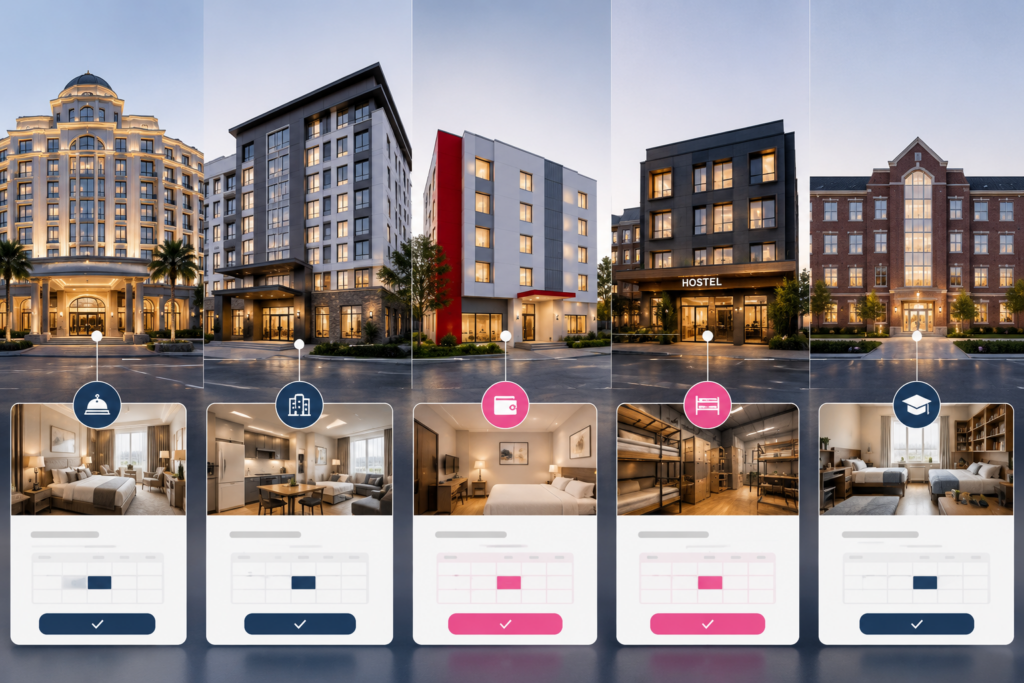
Which lodging types work for minors?
| Lodging type | Typical cost | Pros | Cons |
| Brand hotel | $120–$200/night | Breakfast, pool, staff support, predictable standards | Higher nightly cost, may require a 10+ room block |
| Extended-stay | $100–$180/night | Full kitchens, free breakfast, space for families | Costs more than a motel |
| Budget motel | $80–$120/night | Cheapest rates | Few amenities, older properties, some will not take youth groups |
| Hostel | $20–$50/person/night | Very low cost | Shared rooms and baths, safety concerns, strict rules |
| Short-term rental | Varies, $100+/night | Spacious, multiple beds, kitchen | No front desk, strict cancellation, many ban large groups, insurance gaps |
| University dorm | $30–$70/person/night | Very cheap group housing | Basic, often co-ed floors, summer availability only, limited accessible rooms |
For minors, brand and extended-stay hotels win on the things that matter: a staffed front desk, brand standards, verifiable ADA facilities, and a contract you can enforce. Suite-style properties like Residence Inn or Homewood Suites give you kitchens and space; mid-range select-service like Hampton Inn, Holiday Inn Express, SpringHill, or Comfort Suites deliver free breakfast and reliability. Free hot breakfast is expected on youth blocks, so treat it as a baseline ask rather than a win.
Short-term rentals and hostels only make sense for older teen teams, and only if you have accepted that there is no front desk at 2 a.m. Skip motels that exclude school and youth groups; ask before you build a bid around them.
One question worth asking every property: do you have a youth sports or team block policy? Some hotels run special group terms for teams, including easier changes and fee waivers. Confirm the tournament’s own lodging requirements before you issue the RFP, since major events often steer teams toward designated hotels.
Transportation, meals, and curfew logistics
Charter buses or vans are standard. Book 2–3 months ahead, confirm the driver’s credentials and route, and check there is real space for bags, coolers, and equipment. Flying means coordinating around parents’ schedules and filing consent forms.
For meals, hotel breakfast usually rides in the room package. Beyond that: reserve group restaurants in advance, arrange on-site catering, or give each family a meal credit. Confirm dietary restrictions and food allergies with caterers before the trip, and know where the nearest hospital is. Send parents a plain-language outline, like “breakfast at hotel included, team eats together at 6pm, family pickup at the hotel.”
Curfews and supervision rules can vary by state. Check them, then put them in the code of conduct with the room-check schedule.
What is your emergency plan?
Name a safety officer, usually the head coach. That person carries the medical contact list, nearby hospital addresses, parent phone numbers, insurance details, and a first-aid kit, and runs the group text or app.
Cover accident coverage before you leave. Team liability and accident policies are available through youth sports insurers such as K&K and AG Specialty, and travel or emergency medical evacuation coverage is worth pricing if you are far from home. Walk the hotel exits on arrival and set a meeting point. Keep cash or a card aside for the unexpected.
Parent communication that prevents 40 emails
One clear message beats five vague ones. Cover the itinerary, hotel and emergency contacts, cost and deadline, forms to sign, packing list, and behavior policy.
Subject: [Team] Spring Tournament: hotel and payment details
Dear Soccer Team Parents, we have booked a block of 12 rooms at [Hotel Name] for our Spring Tournament on May 5–7. The cost is $150 per player and covers the room, both nights, and free hot breakfast. Please RSVP by March 15 with payment and a signed travel consent form. Departure time and travel details are below.
Then two reminders: at 60 days before the cutoff, final payment due and roster changes; at 30 days, confirm exact names for the rooming list. On travel day, send arrival time, the hotel phone number, and the coordinator’s cell.
If the tournament is held at an outdoor sports complex or another large outdoor facility, an outdoor event venue guide can help when evaluating space, access, parking, and guest logistics.
Key takeaways
- Room count follows SafeSport, not the roster. No unrelated adult shares a room or bed with a minor, so coaches get their own rooms.
- Staff one chaperone per 5–8 athletes, and background-check every adult before departure.
- Issue the RFP to 3–5 hotels 6–9 months out; sign by 3–4 months; rooming list 30 days out.
- Request accessible rooms by name in the RFP. Hotels hold roughly one per 25 rooms.
- Set your parent payment deadlines ahead of the hotel’s deposit dates and add a 10% contingency.
- Collect waivers, medical releases, and SafeSport lodging consents with the deposits, not at check-in.
Frequently Asked Questions
Can a coach share a hotel room with a player?▾
No. SafeSport guidance says no unrelated adult shares a room or bed with a minor athlete. Coaches and chaperones need their own rooms, which increases the room count you have to block. Any deviation from standard rooming requires a signed SafeSport lodging consent from parents.
How many chaperones does a youth sports team need for a hotel trip?▾
Plan on one adult per 5–8 athletes, and never leave a minor alone with a single adult. A 20-player team needs roughly 3 to 4 chaperones; 40 players needs 5 to 8. Chaperone requirements vary by state, so check local rules alongside SafeSport guidance.
What consent forms do parents need to sign for team travel?▾
A liability waiver, a medical release form, a travel consent form, and a SafeSport lodging consent if the rooming arrangement requires one. Waivers generally cannot absolve gross negligence, so they document the arrangement rather than eliminate risk. Collect all of them alongside deposits.
How far in advance should I book hotel rooms for a youth tournament?▾
Send the RFP 6–9 months out and aim to sign the contract by 3–4 months out. Nine in ten groups secure blocks at least 30 days ahead. Youth travel demand peaks in fall, September through October, and again in late spring, so peak-season events need the earliest start.
Do parents pay the hotel directly or does the team pay?▾
Both models are common. Team-paid means the team signs, pays the deposit, and bills families a flat per-player cost, absorbing any shortfall. Parent-paid means families send their share to the coordinator on deadlines. Either way, set your collection deadlines ahead of the hotel’s, since deposits often run about 25% at signing with the balance 60 days out.
How much does a youth sports team hotel trip cost per player?▾
On a sample two-night trip with two players per room, total costs work out to roughly $305 per player for a team of 20, $320 for 40, and $380 for 60, including lodging, transportation, meals, and entry fees. Meals typically run $30–$50 per person per day. Add a 10% contingency to whatever number you publish.
Do hotels have special policies for youth sports teams?▾
Some do. Ask each property whether it offers a youth sports or team block, which can include easier changes and fee waivers. Free hot breakfast is an expected inclusion on youth blocks, and a common concession is one complimentary room per 20 booked.
What accessible rooms should I request for a youth team?▾
Ask families about ADA needs at registration and name the exact room features in your RFP. Hotels provide accessible rooms scaled to size, roughly one per 25 rooms, so a 101–200 room property has about 5 to 6. Confirm accessible routes, entrances, and parking in writing before you sign.
Compare vendors for your next event
Search caterers, photographers, florists, planners, and rentals — then send one request to several vendors at once.