Quick answer: A first option hold means a hotel or venue keeps your dates and space for you, uncontracted, until an agreed option date. A second option puts you next in line. If the second-option group is ready to sign first, the venue can challenge your hold, and you get a short window to sign (often with a deposit) or let the space go. The published windows we found were 72 hours or less at one hotel brand and three to five business days at two convention centers.
Example scenario (fictional): An agency is placing a client’s two-day leadership meeting for 80 people. The program needs a general session room, two breakouts, and 60 rooms a night for two nights, or 120 room nights. One hotel has the agency on first option until Friday at 5 p.m. hotel time. The client’s CFO signs contracts at a Thursday review. On Wednesday at 10 a.m., the hotel’s sales manager calls: another group wants the same dates and can sign now. The names, numbers, and days are invented, and the same scenario is used in the deadline math later in the post.
This is for US professional planners and agencies who source hotels and venues for clients: corporate meetings, association conferences, incentive programs, sports events, and wedding weekends. It covers what first, second, and later option holds mean, what to ask for, how long holds last in published policies, what happens when another group challenges your hold, and how right of first refusal works. It ends with three email templates and a decision timeline. The full booking sequence, from requirements to final guarantee, is in our step-by-step guide to booking a corporate event venue, and running a block across several hotels is covered in our guide to managing room blocks for a conference. Hold terms vary by property. This post is planning information, not legal advice.
What first, second, and third option holds mean
The Events Industry Council glossary defines an option as “space which is reserved but not yet contracted for an event,” and adds that it is “the right of first refusal to confirm a tentative space reservation if there is demand from another group.” The same glossary describes a second option as “second place on a waiting list”: the group holding it “may book those dates only if the organisation holding the first option decides not to book within a certain period of time.”
The glossary also defines two related terms. A tentative hold is space held “pending a definite booking,” and the glossary adds that “there are no consequences for cancellation.” A definite booking is “space reservations confirmed in writing.” Venues layer their own labels on top. One US convention center’s booking guidelines use the four below, in the order a hold moves through them:
| Status | What it means in that policy | Can another group challenge it? | What moves it forward |
|---|---|---|---|
| Second option | Held behind a first-option group for the same space and dates. It becomes first option if the first hold is released. | It is the position that can start a challenge. | The first option is released, or you challenge it (see below). |
| First option (prospect hold) | Space held without a signed contract, until a release date. | Yes. | Sign the contract and pay the deposit before the release date. |
| Tentative | The venue has issued a contract, but it is unsigned and the deposit is unpaid. | Yes, once the contract due date passes without a signature and deposit. | Return the signed contract and the deposit by the due date. |
| Definite | Contract signed and initial deposit in place. | No. The policy says a definite hold “cannot be challenged.” | You are booked. Contract terms now apply. |
Other venues use different words for the same stages; the hotel documents quoted below say first option, second option, and definite. Whatever the labels, get two things in writing: where you stand in line, and what you have to deliver, and by when, to move up a stage.
What about a third option?
The glossary has no separate entry for a third option, and none of the policies we read define one. In practice, if a sales manager says you are “third option,” ask how many groups are ahead of you and the option date for each. You only get the space if every group ahead of you releases or lets its date pass. Don’t confuse this with an RFP that lists “second and third options” as alternate dates. That is a different use of the word.
Option date, release date, and cutoff date
The glossary defines the option date as “a prearranged date by which a hotel or facility will no longer hold tentative arrangements for a group.” Some venues call that a release date. The trouble is that the same glossary treats “release date” as another name for a room block’s cut-off date, which is the date unbooked sleeping rooms go back on general sale after you have signed. Those are two different deadlines. When a contact says “release date,” ask whether they mean the date your hold expires or the date unbooked rooms in a signed block are released.
How first option holds work at hotels
In the hotel documents we read, the hold is written into the group sales agreement itself. Two published hotel group sales agreements use nearly the same acceptance clause. Until the group signs, the hotel holds “the outlined format and dates” for the group “on a first-option basis” until a named date. If the group cannot commit by then, the 2018 agreement says the offer “will revert to a second option basis or, at the Hotel’s option, the arrangements will be released.” In both documents, what is outlined includes the sleeping room block and the meeting or function space, so one hold covers both.
The clause has two more details worth reading closely. First, the hold applies “unless the Hotel otherwise notifies Group at any time prior to Group’s execution of this document,” so the hotel keeps the right to change the arrangement before you sign. Second, missing the date does not always end the deal. One of the agreements says that if both parties sign after the option date has passed, the agreement is binding anyway, as if it had been signed on time.
A national hotel brand’s published banquet terms for its hotels in the US, Canada, and Puerto Rico work the same way for meeting and event space booked on a banquet event order. Your arrangements are held “on a first option basis until the due date” on the order, and the hotel “may release this first option with no notice required” if the signed order is not back by then. If other business comes along that the hotel can confirm immediately, you are told and given “72 hours, or until the end of your option period (whichever is shorter)” to confirm, or the hotel can research alternate dates for you.

How long does a first option hold last?
We found no published industry standard, so the table below shows only what specific documents say. They show a wide range and two separate clocks: how long the hold lasts if nobody else wants the space, and how long you get to respond if somebody does.
| Published source | How long the hold lasts | Response window if another group is ready to book |
|---|---|---|
| Hotel group sales agreement (2018, for an October 2020 conference) | First option until July 13, 2018. The agreement pages are dated July 11, 2018, two days earlier. | Not stated. The hotel can change the hold at any time before the group signs. |
| Hotel group sales agreement (for a March 2027 board meeting) | First option until May 21, 2026, then second option or release, at the hotel’s choice. | Not stated. |
| National hotel brand, banquet terms for the US, Canada, and Puerto Rico (last revised September 3, 2019) | Until the due date on the banquet event order. | 72 hours, or the rest of the option period if that is shorter. |
| US convention center booking guidelines and 2026 planning guide | Until the release date, which can be extended by mutual agreement. | 3 business days to match the challenger’s deposit and sign, or release. |
| Convention center in Puerto Rico, event planning guide (August 2026) | Up to 45 days after the venue receives confirmation. Dates are released without notice if not confirmed with a signed agreement and deposit. | 5 business days to sign and deliver the agreement and deposit. |
The hold length tells you when you must decide if the market is quiet. The response window tells you how fast you must decide if it isn’t, and that is the one to plan around. If the shortest window in your contracts is 72 hours, your signer, contract review, and deposit approval all need to be able to move inside 72 hours from the day you accept the hold.
Booking windows can block a hold before it starts
Some convention centers rank events partly by the hotel rooms they fill, and the ranking decides who can hold space and how early. One Florida convention center’s scheduling policy puts local corporate meetings, banquets, and events without hotel room nights in its second priority tier. Those events cannot be contracted more than 12 months ahead, and requests for meeting rooms “will only be considered within six (6) months of the event date.” The Puerto Rico guide says its second priority events cannot challenge first priority events as a second option. And at the US convention center above, a group can only start a challenge if it is within its own booking window. If your client’s event is a smaller meeting, ask the venue which tier it falls in before you count on an early hold.
What happens when a second-option group makes a firm offer
Venues call this a challenge. The clearest published version is the US convention center’s booking guidelines, which set out each step:
- The second-option group commits. It is “ready to contract” the dates and space, posts a deposit of up to 100 percent of the estimated rent (the amount is at the center’s discretion), and signs a conditional license agreement.
- The venue tells the first-option group, and the clock starts.
- The first-option group has 3 business days. It can meet the challenge by posting a deposit equal to the challenger’s and signing a license agreement or other acceptable binder, or it can release the space and dates.
- If the first-option group matches, the venue returns the challenger’s deposit and does not execute the conditional agreement.
- If it does not match, the challenger’s conditional agreement is executed and its deposit becomes non-refundable. The venue then notifies both parties.
The hotel version is simpler. Under the hotel brand’s banquet terms quoted above, the hotel tells you it has business it can confirm immediately, and you get 72 hours or the rest of your option period, whichever is shorter. The Puerto Rico guide gives the first-option holder five business days to sign and deliver the agreement and deposit, and its definitions note that a challenge can cover the dates and space “in whole or in part.”
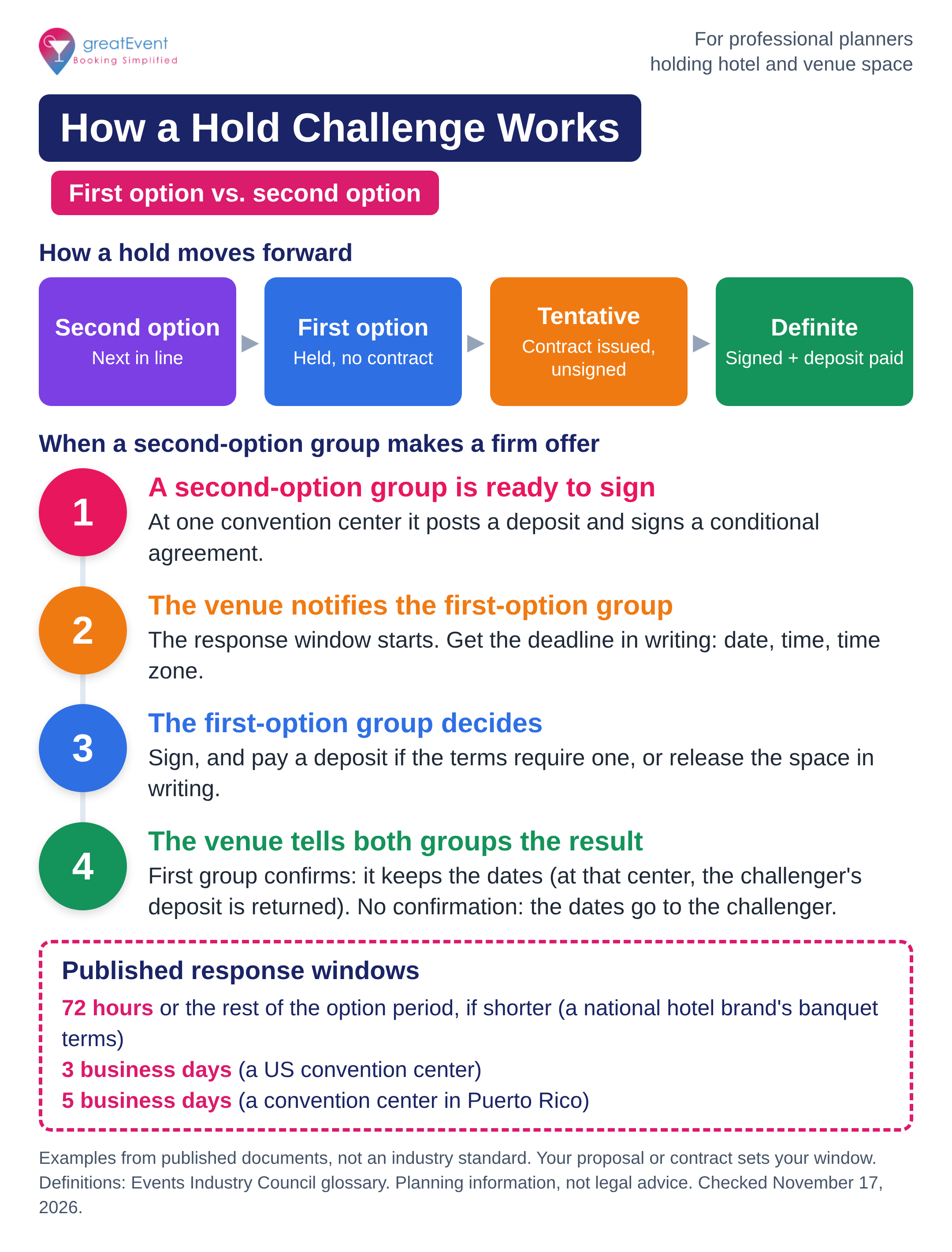
Text version of the infographic: How a hold challenge works. A hold moves from second option to first option to tentative (contract issued, not signed) to definite (contract signed and deposit paid). Step 1: a second-option group is ready to sign, and at one convention center it posts a deposit and signs a conditional agreement. Step 2: the venue notifies the first-option group, and the response window starts; get the deadline in writing, with date, time, and time zone. Step 3: the first-option group signs, and pays a deposit if the terms require one, or releases the space in writing. Step 4: the venue tells both groups the result. If the first group confirms, it keeps the dates (at that convention center, the challenger’s deposit is returned); if not, the dates go to the challenger. Published response windows: 72 hours or the rest of the option period, whichever is shorter (a national hotel brand’s banquet terms); 3 business days (a US convention center); 5 business days (a convention center in Puerto Rico). Your own contract sets your window. Planning information, not legal advice.
If you hold the first option and get the call
- Ask for the deadline in writing: date, time, and time zone. “72 hours” from a 10 a.m. call is not the same as three days from today.
- Ask exactly what keeps the space: a signature only, or a signature plus a deposit, and how much the deposit is.
- Ask whether the other group wants all of your dates and space or only part of them. A partial challenge may leave you room to adjust.
- Tell your client approver the same hour, with the deadline and the amount.
- If you will not book, release the space in writing before the deadline. If you need different dates, ask what the venue can offer.
If you hold the second option
Ask the venue whether its policy allows a challenge and what it takes to start one. Challenge only when your client can sign. Under the convention center policy above, the challenger signs a conditional agreement and puts down its deposit when it starts the challenge. If the challenge succeeds, that agreement is executed and the deposit becomes non-refundable. If it fails, the deposit comes back.
How right of first refusal works
Planners use “right of first refusal” in two ways, and the glossary covers both. The first is the one built into a first option: the right to confirm your tentative space before another group can take it. That is what the option definition quoted earlier describes, and it is what a challenge tests.
The second comes after you have booked. The glossary defines right of first refusal as “a courtesy a facility extends to a previously booked party to approve or disapprove a concurrent booking or to save uncontracted space for the previously booked party for programme growth.” In other words, once your client is booked, the venue may agree to check with you before it books another group into the same days, or to keep extra space open in case your program grows. It is a courtesy, so if you want it, ask for it and get the terms written into the contract: which space, which dates, how much notice, and how long you have to answer.
What to ask for when you request a hold
You can ask for holds in the RFP itself. Our guide to what a hotel RFP should include explains why a stated decision date tells the hotel this is live business. When the answers come back, get these points in writing for each property:
- Hold type and your place in line: first option, second option, or further back.
- What the hold covers: function rooms by name, dates and hours including setup, the sleeping room block night by night, and whether the quoted rates and concessions are held to the same date.
- The option date, with the time and time zone.
- Whether the hold can be challenged, how you will be told, and how long you will have to respond.
- What keeps the space if you are challenged: signature, deposit amount, or both.
- Whether the hold can be extended, and how to ask.
- A second option on your alternate dates, if the first choice is taken.
Hold request email template
Subject: First option hold request: [Client event], [dates], [city]

Hi [Name],

Thank you for the proposal for [client event] on [dates]. We would like to place a first option hold on the program as proposed while our client completes its approvals:

- Function space: [room names], [dates], [hours including setup]
- Sleeping rooms: [rooms per night by date], [total room nights]
- Rates and concessions: as stated in your proposal dated [date]

Could you confirm by email:
1. That this is a first option, or where we are in line if not
2. The option date, with time and time zone
3. Whether another group can challenge the hold, how you would notify us, and how long we would have to respond
4. What we would need to deliver to keep the space if challenged (signature, deposit amount, or both)
5. Whether the hold can be extended if our approval runs past the option date
6. Whether a second option is available on [alternate dates]

We expect a decision by [date]. If we do not go ahead, we will release the hold in writing as soon as we know.

Thank you,
[Name]
[Agency], on behalf of [client]
[Phone]
Decision timeline: from proposals to signature
How early you start depends on the event. Our guide to how far in advance to book a conference venue covers lead times by event size. The timeline below starts later, when proposals arrive and the holds begin. It is a planning framework, not an industry standard. Your contracts set the real dates.
| When | What to do |
|---|---|
| Before you send the RFP | Name the person who approves the budget, the person who signs, and the person who can release a deposit. Put your decision date in the RFP. |
| When proposals arrive | Ask your top two or three choices for a hold the same day. Get the hold type, your place in line, and the option date (with time and time zone) in writing. |
| The next business day | Put every option date and challenge window in your calendar in the venue’s local time. Send the client or internal approver one short status note with the deadlines. |
| Halfway to the option date | Compare proposals on the same basis, finish site visits, and narrow to one or two finalists. If approval will run past the option date, ask for an extension now, in writing. |
| Before the option date | Have the contract reviewed, the signer available, and the deposit approved, so you could answer a challenge inside the shortest window you have seen in your contracts. The shortest published window we found was 72 hours or less. |
| On the option date | Sign and pay the deposit, get a written extension, or release the hold in writing. Do not let it lapse in silence. |
| After you sign | Ask the venue to confirm in writing that the booking is definite. Release every other hold the same day so the next group in line can move. |
Most of the work falls in the midpoint step. Lay the proposals out side by side with our hotel proposal comparison template so the comparison is ready before the option date, and send the recommendation through your client’s approval route early. If the client needs a formal sign-off, our meeting budget approval template separates budget approval from the authority to sign and pay, which are often different people.

The deadline math in the fictional scenario
Back to the agency in the opening example. The hotel’s terms work like the banquet terms above: 72 hours after notice, or the end of the option period, whichever is shorter.
- Notice arrives Wednesday at 10 a.m. Seventy-two hours later is Saturday at 10 a.m.
- The option period ends Friday at 5 p.m. That is 55 hours after the call: 24 hours to Thursday at 10 a.m., 24 more to Friday at 10 a.m., and 7 more to 5 p.m.
- 55 hours is shorter than 72, so the real deadline is Friday at 5 p.m. hotel time.
- The CFO’s Thursday review falls inside that window, so the agency confirms the deadline and deposit by email the same morning and adds the contract to Thursday’s agenda.
Had the call come on Thursday afternoon, after the review, the agency would have needed a signer who could act outside the regular meeting. That’s why the “Before the option date” step in the timeline asks for the signer and the deposit approval to be lined up before any challenge arrives.
Templates for a challenge and a release
Reply when your hold is challenged
Subject: RE: Hold challenge, [client event], [dates]

Hi [Name],

Thank you for letting us know. To make sure we respond on time, please confirm:
1. The deadline to respond: date, time, and time zone
2. What keeps the space: signed agreement, deposit amount, or both
3. Whether the other group wants all of our dates and space, or only part

We are taking this to our client now and will reply by [date and time]. If we cannot go ahead, we will release the space in writing before the deadline.

Thank you,
[Name]
Release a hold you will not use
Subject: Release of first option hold: [client event], [dates]

Hi [Name],

Our client has selected another option for [client event] on [dates]. Please release our first option hold on [function space] and [sleeping rooms], effective today. Thank you for holding the space and for your proposal. We would be glad to send you future programs that fit your property.

Best regards,
[Name]
A prompt release lets the second-option group move up instead of waiting for your option date to pass.
Common hold mistakes
- Treating “we can hold that for you” on a call as a hold. Get the hold type and option date by email.
- Recording the date but not the time and time zone. A 5 p.m. Pacific deadline is 8 p.m. Eastern.
- Assuming rates and concessions are held as long as the space. Ask.
- Assuming the client’s internal approval confirms the booking. The venue confirms nothing until its own conditions are met, usually a signature and a deposit.
- Asking for an extension on the option date itself. Ask at the midpoint, while the venue still has room to say yes.
- Letting a hold you will not use lapse in silence. Release it in writing.
Compare hotels and venues on greatEvent
On greatEvent, start a venue search with the meeting type, location, dates, and attendee count. You can compare hotels and venues side by side, check real-time availability where a venue shows it, or send one inquiry to several venues and get quotes back, as described in our guide to how long it takes to book an event venue. When a venue shows real-time availability and your client’s approval is already in place, you can confirm the space instead of holding it. When the quotes come back, ask each hotel or venue what kind of hold it offers and its option date, so the answers line up before your client decides. For sleeping rooms, we book hotel room blocks. You can also find your vendors and suppliers on greatEvent, from caterers for a welcome reception to transportation for arrival day.
There are no fees for planners. We pay you commission on any qualifying booking you make on greatEvent.
Register as a professional planner
Frequently asked questions
What is a first option hold at a hotel?
▾
It is a tentative hold on the dates, function space, and sleeping rooms in a hotel’s proposal, kept for your group until an option date. If you have not signed by then, the hotel can move you to second option or release the space.
What is the difference between a first option and a second option?
▾
The first option holder can book the space first. The second option holder is next in line and gets the space only if the first group releases it, lets its option date pass, or loses a challenge.
How long does a first option hold last?
▾
There is no single standard. Published examples run from a couple of days to about 45 days, and a challenge can shorten that to 72 hours or a few business days. Your proposal or contract sets the date.
Can a second option holder take my space?
▾
Yes, where the venue’s terms allow a challenge. If the second option group is ready to sign, the venue can give you a short window to sign and pay a deposit. If you do not, the space goes to the other group.
Is a tentative hold binding?
▾
Usually not. A tentative hold can be dropped without penalty. The booking becomes binding when the contract is signed, often with a deposit.
What is a right of first refusal for an event venue?
▾
It is the right to confirm your space before another group can book it. After you book, it can also mean the venue checks with you before booking another group at the same time, or keeps extra space open for your program to grow.
Research and sources
Sources were checked on November 17, 2026. The opening scenario and the deadline math are fictional: the event, room counts, days, and times are invented to show the method. The decision timeline is a planning framework, not an industry standard. Hold terms are quoted from published policies and agreements as examples only; your own proposal and contract control. This post is planning information, not legal advice.
- Events Industry Council, Industry glossary, “Option,” “Second Option,” “First Option,” “Tentative Hold,” “Definite Booking,” “Option Date,” “Release Date,” and “Right of First Refusal,” read November 17, 2026.
- Published booking guidelines of a US convention center (city-owned, privately managed), definitions and challenges sections, read November 17, 2026; and the same center’s event planning guide, revised March 2, 2026.
- Published event planning guide of a convention center in Puerto Rico, August 2026, booking definitions, hold validity, and scheduling priorities, read November 17, 2026.
- Published scheduling policies of a Florida convention center (effective January 1, 2014, revised February 2020), scheduling priorities and definition of terms, read November 17, 2026.
- Published banquet event order additional terms and conditions of a national hotel brand for hotels in the U.S.A., Canada, and Puerto Rico, last revised September 3, 2019, option date clause, read November 17, 2026.
- Published group sales agreement between a full-service hotel and a professional association, 2018, for an October 2020 conference (public record), acceptance clause, read November 17, 2026.
- Published group sales agreement between a full-service hotel and a state agency client, for a March 2027 board meeting (public record), acceptance clause, read November 17, 2026.
Compare vendors for your next event
Search caterers, photographers, florists, planners, and rentals — then send one request to several vendors at once.