Quick answer: A room block cutoff date is the date the hotel releases any unbooked rooms in your group block back to general sale. After it, late reservations usually get the group rate only if the hotel still has rooms and agrees, and your room night commitment stays the same. To extend a cutoff, ask in writing before the date. If you missed it, ask the hotel the same day to add rooms back to your block.
Example scenario (fictional): An agency is running a client’s three-night sales meeting with a block of 50 rooms a night, or 150 room nights. The cutoff is 30 days before arrival, but the client keeps registration open until two weeks before the meeting. Three weeks before the cutoff, 96 room nights are booked. A week later the count is 104, and six people who registered late are asking where to book. The names and numbers are invented, and the same numbers are used in the pace math later in the post.
This is for US professional planners and agencies who manage hotel room blocks for clients: corporate meetings, association conferences, sports teams, and wedding weekends. It explains what the cutoff does, how to negotiate and extend it, and what to do when the date has already passed. It does not cover attrition math or cutting a block, which have their own guides, and the bigger picture of running a block from first estimate to final report is in our guide to managing room blocks for a conference. Contract terms vary by hotel. This post is planning information, not legal advice, so have counsel review contract language that carries real money.
What is a room block cutoff date?
The Events Industry Council glossary defines the cut-off date as the “designated date when a hotel will release any unsold sleeping rooms in a group block and make them available to the general public.” The glossary treats “release date” as another name for the same date. Contracts spell it cut-off or cutoff, and one resort agreement calls it the reservation due date.
Inside the hotel, the cutoff is a setting in the property management system. Oracle’s documentation for its OPERA Cloud property management system explains that on the night of the cutoff date, the system releases rooms that have not been picked up by cutting the block down to the rooms already booked. The released rooms go back into the hotel’s general availability, where any guest can book them. A block can also use “cutoff days” instead of one date, which releases one night of the block at a time, a set number of days before that night. The same documentation notes that the hotel can still increase the block after the cutoff has passed.
So ask your hotel contact two questions when you sign: is the cutoff one date for the whole block, or a number of days before each night? And what time of day does the release run?
What changes at the cutoff
Contracts word this differently, so read your own. The table below uses the EIC definition, Oracle’s documentation, and language from published US hotel group sales agreements, which are listed in the sources at the end.
| Item | Before the cutoff | After the cutoff |
|---|---|---|
| Unbooked rooms in the block | Held for your group. | Released to general sale. The block is cut down to the rooms already booked. |
| New reservations at the group rate | Accepted while rooms remain in the block. | Depends on the contract. One Marriott agreement says the hotel will decide at the cutoff whether it can accept them at the group rate on a space- and rate-available basis. Another clause in the same agreement prices reservations made after the cutoff at the hotel’s then current available rate. |
| Changes, name changes, and additions | Handled inside the block. | One Marriott agreement accepts modifications, name changes, and additions after the cutoff on a space and rate available basis. |
| Reservations already made | Booked. | Still booked. Only unbooked rooms are released. |
| Your booking link or group code | Shows rooms that are still available in the block. | Has no rooms left to offer once the block is cut down to the rooms already booked. |
| Your room night commitment | Set by the contract. | Unchanged unless the contract says otherwise. One agreement states that releasing the rooms does not affect the group’s obligation to use them. |
The cutoff ends the booking window, and your commitment stays in place. Releasing rooms you did not fill does not reduce what you owe under the attrition clause unless the contract says so. What a shortfall costs, and how damages are calculated, is covered in our guide to what happens if you do not fill your block.
Dates that are easy to confuse with the cutoff
| Date | What it controls | Example from a published agreement |
|---|---|---|
| Review or adjustment date | A date before the cutoff when the block can be reviewed and changed. | One Marriott agreement lets the hotel review and adjust the block up to a set date. |
| Rooming list due date | When names for rooms paid or listed by the planner are due. | Often the cutoff itself. One resort contract sets the staff and speaker room list due on the cutoff date. |
| Individual cancellation deadline | When one guest can cancel a single reservation without a charge. | The same resort contract sets 48 hours before arrival, by 4:00 PM local time. |
| Attrition measurement | When your pickup is counted against the commitment. | Two agreements measure usage on each night of the event and post charges at its conclusion. |
The count at the cutoff is not your final number either. EIC defines “wash” as the difference between the reservations on the books at the cutoff date and the final reservations at the end of the event. Cancellations, no-shows, and late additions all change it, up or down.
How far before arrival is the cutoff?
There is no single industry standard. Some reference points from the sources for this post:
- Hotel group sales professionals told Skift Meetings in November 2023 that the standard cutoff is 30 days before arrival, and that a hotel may move it to 14 days out when the planner provides a rooming list.
- One published Marriott agreement holds rooms “until 30 days prior” to the meeting date.
- The 2021 group booking policy published by Remington Hotels, a hotel management company, sets a standard cutoff of 21 days before the group’s arrival.
Late registration makes the cutoff harder to hit. In three PCMA roundtables in 2024, representatives of hotel brands and housing companies named attendees’ late booking decisions, often made after the cutoff, as one of the main reasons only about 40 percent of registrants book inside the block. One participant described a citywide event where half of the participants registered within three weeks of the conference. If your client’s registration stays open past the cutoff, plan for late requests from the start.
What to negotiate before you sign
Ask for these in writing before you sign:
- A cutoff date that fits your client’s registration timeline, written as a calendar date and time, not only “30 days prior.”
- A shorter cutoff for rooms you will send by rooming list, such as staff, speakers, or a team.
- The group rate for reservations after the cutoff, on a space-available basis.
- Reservations made after the cutoff at the group rate counted toward your pickup.
- One or more review dates before the cutoff, when you can release rooms you will not need.
- The group rate on the nights before and after the meeting. One Marriott agreement extends it three days before and after the meeting dates, subject to availability.
These sit alongside the rest of your asks. Our checklist of hotel contract concessions to request has copyable wording for cutoff and review dates, and our corporate guide covers how corporate event room blocks are set up, including rooming lists and billing.
A cutoff timeline: what to do 60, 45, 30, and 21 days out
This timeline is a planning framework, not an industry standard. It counts back from the cutoff date because that is when your options narrow. Move the checkpoints to fit your contract’s review dates and your client’s registration dates.
| When | What to check | What to do |
|---|---|---|
| 60 days before the cutoff | The signed contract: cutoff date and time, any review or reduction dates, rooming list due date, and what the contract says about reservations after the cutoff. | Put each date on the project calendar with an owner. Book a test reservation through the link or code, then cancel it within the hotel’s cancellation terms. Ask the hotel for a pickup report by night and room type every week. |
| 45 days before the cutoff | Pickup by night against the block, and the pace you need: room nights still unbooked divided by weeks left to the cutoff. | Send attendees a reminder that names the cutoff date. Set an internal deadline for staff, speaker, or team names a week or two ahead of the hotel’s date. |
| 30 days before the cutoff | Whether pickup is on pace, and which nights are soft. Ask the hotel how demand looks for your dates. | If the contract has a review or reduction date coming up, decide what to release. If people are still registering, start drafting the extension request with numbers. |
| 21 days before the cutoff | Who still needs a room: late registrants, staff, VIPs, and rooming list gaps. | Email the extension request to your hotel contact for specific rooms and nights, and follow up by phone. Send attendees a second reminder. |
| 7 days before the cutoff | Names on your registration list who are not on the hotel’s list, and reservations booked outside the block. | Send the final reminder. Ask out-of-block attendees whether they can move into the block before the cutoff. |
| Cutoff day | The hotel’s pickup report as of the cutoff, by night and room type. | Confirm in writing what was released and how late requests will be handled. Replace the old booking instructions so late registrants are not sent to a dead link. |
| After the cutoff | Late requests, by name and night. | Use the recovery plan below. Save the pickup history for the next contract negotiation. |
How to work out the pickup pace you need
Pickup pace is the number of room nights still unbooked, divided by the weeks left until the cutoff. In the fictional scenario, three weeks before the cutoff the block has 150 room nights and 96 are booked, which is 64 percent. That leaves 54 room nights, or 18 a week for three weeks. A week later 104 are booked, so 46 remain with two weeks to go, or 23 a week. When the pace you need rises from one week to the next, people are booking more slowly than the deadline allows, and that is the signal to talk to the hotel while the date can still move.
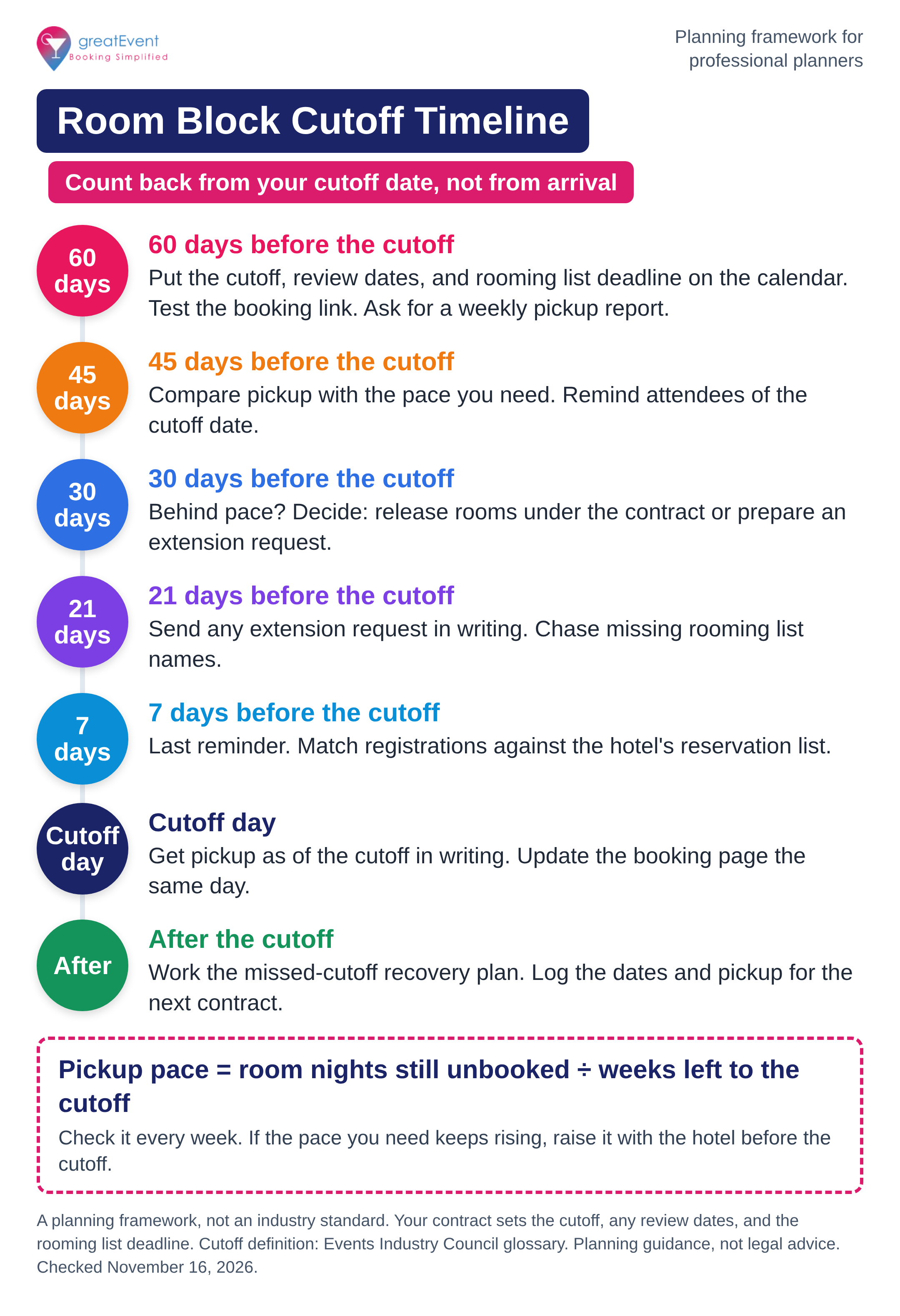
Text version of the infographic: Room block cutoff timeline: count back from your cutoff date, not from arrival. 60 days before the cutoff: Put the cutoff, review dates, and rooming list deadline on the calendar. Test the booking link. Ask for a weekly pickup report. 45 days before the cutoff: Compare pickup with the pace you need. Remind attendees of the cutoff date. 30 days before the cutoff: Behind pace? Decide: release rooms under the contract or prepare an extension request. 21 days before the cutoff: Send any extension request in writing. Chase missing rooming list names. 7 days before the cutoff: Last reminder. Match registrations against the hotel’s reservation list. Cutoff day: Get pickup as of the cutoff in writing. Update the booking page the same day. After the cutoff: Work the missed-cutoff recovery plan. Log the dates and pickup for the next contract. Pickup pace = room nights still unbooked divided by weeks left to the cutoff. Check it every week. If the pace you need keeps rising, raise it with the hotel before the cutoff. A planning framework, not an industry standard. Your contract sets the cutoff, any review dates, and the rooming list deadline.
How to ask the hotel to extend a cutoff date
Whether a hotel will extend is a revenue decision. The Remington Hotels policy says rooms are released at the cutoff “unless inventory is available and it is agreed upon during the revenue call to extend the cut-off date.” A hotel that expects to fill your dates with other guests has less reason to say yes than one with rooms to spare. Your request should make the decision easy:
- Ask before the cutoff. Once the system has released the rooms, you are asking the hotel to put inventory back into the block, which is a different request.
- Ask for specific rooms and nights, with a new date. “Keep the block open” is hard to approve. “Hold 10 rooms on Tuesday and 6 on Wednesday until the 14th” is easy to check against the hotel’s forecast.
- Offer to release the rest on the original date. The hotel gets back the rooms you will not use, while they can still be sold.
- Show your numbers: current pickup by night, registrations still open, and when you will send names.
- Ask whether reservations made during the extension count toward your pickup, and get the change in a written amendment.

Extension request email template
Copy this, fill in the brackets, and send it to your hotel sales or conference services contact. Follow up by phone the same day.
Subject: Cutoff extension request: [Group name], [arrival date], block code [code]

Hi [Contact name],

Thank you for your help with [Group name] at [Hotel name], [arrival date] to [departure date]. Our contract dated [contract date] sets the room block cutoff at [cutoff date and time].

As of today, [number] of our [number] contracted room nights are booked. Registration stays open until [date], and we expect about [number] more attendees to need rooms, mostly on [nights]. This week's pickup and registration counts by night are attached.

We would like to request:
1. A new cutoff of [new date] for [number] rooms on [night] and [number] rooms on [night].
2. Release of all other unbooked rooms on the original cutoff date.
3. The group rate of $[rate] for reservations made through the new date.
4. Reservations made through the new date counted toward our pickup.
5. A written amendment confirming the change.

If you cannot hold all of these rooms, please tell us which nights you can hold, and whether late reservations can still receive the group rate on a space- and rate-available basis.

We can send the staff and speaker rooming list by [date] and an updated registration count every [day of week].

Thank you,
[Your name]
[Title, agency]
[Phone] | [Email]
Missed the cutoff? A step-by-step recovery plan
A hotel can still add rooms after the cutoff if it has them to sell. Work through these steps in order, ideally on the day you find out.
1. Get the pickup report as of the cutoff
Ask the hotel for pickup by night and room type as of the cutoff, and for written confirmation of what was released. You need this to know your real position and to check the hotel’s numbers later.
2. Read what your contract says about late reservations
Look for the words “space available,” “rate available,” or “then current rate.” They tell you whether you are asking the hotel to honor something it already offered or asking for a favor.
3. List exactly who still needs a room
Write down every name, arrival date, departure date, and room type. A specific list is easier for the hotel to check against its availability than a request for “a few more rooms.”
4. Ask the hotel to add rooms back to your block
Send the list and ask for those rooms to be added to the block at the group rate. Hotel systems allow it: Oracle’s OPERA documentation, for one, says a block can still be increased after the cutoff. Whether the hotel agrees depends on what it has left and what it can sell those rooms for.
5. If the group rate is gone, ask what the hotel can offer
Ask what rate the hotel can offer for those nights, and whether reservations at that rate can still count toward your pickup. The hotel may say no to either.
6. If the hotel is full, find rooms nearby
Ask your hotel contact whether a nearby property has rooms on your nights, then request rates or a small block there. For a larger group, compare options the way you did for the original block. Our step-by-step guide to booking a hotel room block includes a scorecard for comparing properties.
7. Tell attendees the new instructions the same day
Update the registration page and booking instructions. Tell late registrants plainly that the group rate may no longer be available and give them the new way to book, so nobody is sent to a link with no rooms left.
8. Protect your pickup credit and document everything
Ask attendees who booked outside the block for their confirmation numbers so you can ask the hotel to count them. Put every agreement in writing, and save the cutoff pickup and late requests in your history file for the next contract. If pickup is short and you need to reduce or cancel a hotel room block, read your contract’s reduction terms before you send anything.

Late reservation request email template
Use this when the cutoff has passed and people still need rooms.
Subject: Late reservations after cutoff: [Group name], block code [code]

Hi [Contact name],

Our cutoff for [Group name] passed on [cutoff date]. The following attendees still need rooms:

[Name] | arrive [date] | depart [date] | [room type]
[Name] | arrive [date] | depart [date] | [room type]
[Name] | arrive [date] | depart [date] | [room type]

Could you add these rooms back to our block at the group rate of $[rate]?

If the group rate is not available, please tell us:
1. The rate you can offer for these nights.
2. Whether these reservations will count toward our pickup.
3. Whether any nights are sold out, and if so, a nearby property you would suggest.

Please reply by [time and date] so we can update attendees today.

Thank you,
[Your name]
[Title, agency]
[Phone] | [Email]
Cutoff notes by segment
The mechanics are the same for every group. Who books the rooms, and when, differs by segment.
Corporate meetings
If a corporate block runs on a rooming list, the cutoff is often the day your list is due. Set your internal deadline for names a week or two earlier, and ask before signing how name changes after the cutoff will be handled.
Associations and conferences
Attendees book for themselves, and many register late. Match the cutoff to the registration calendar, and plan the late-reservation message before registration opens.
Sports teams
Team counts can change late, with roster changes or teams that advance or are knocked out. Ask for a cutoff and rooming list date that fit the schedule, and check what happens to rooms for teams that are eliminated.
Wedding weekends
Guests book their own rooms and may not know a cutoff exists. Put the date on the wedding website and in reminders, and check the cutoff against when RSVPs are due.
Room block cutoff checklist
Copy this into your project plan for each hotel in the block.
ROOM BLOCK CUTOFF CHECKLIST
Client: ______________  Event: ______________  Hotel: ______________
Arrival: __________  Cutoff (date and time): __________  Block code: __________

BEFORE YOU SIGN
[ ] Cutoff written as a calendar date and time
[ ] One date for the whole block, or days before each night?
[ ] Review or adjustment dates before the cutoff: __________
[ ] Rooming list due date: __________
[ ] Group rate after the cutoff, space available, in writing
[ ] Late reservations count toward pickup, in writing
[ ] Group rate on nights before and after the meeting

AFTER SIGNING
[ ] Every date on the project calendar with an owner
[ ] Booking link tested
[ ] Weekly pickup report by night and room type requested
[ ] Cutoff date shown on the registration page and in attendee emails

WEEKLY UNTIL THE CUTOFF
[ ] Pickup by night recorded
[ ] Pickup pace = room nights unbooked / weeks left: ______
[ ] Extension needed? Request sent on: __________

CUTOFF DAY
[ ] Pickup report as of the cutoff received
[ ] Written confirmation of what was released
[ ] Booking instructions updated

AFTER THE CUTOFF
[ ] Late requests listed by name and night
[ ] Add-back request sent to the hotel on: __________
[ ] Out-of-block confirmation numbers collected
[ ] Cutoff pickup saved for the next contract
Compare hotels, venues, and vendors on greatEvent
On greatEvent, start a venue search with the meeting type, location, dates, and attendee count. You can compare hotels and venues side by side, check real-time availability where a venue shows it, or send one inquiry to several venues and get quotes back, as described in our guide to how long it takes to book an event venue. When you request a hotel room block, ask each hotel for its cutoff date, any review dates, and how it handles reservations after the cutoff, so the terms compare cleanly before you sign. You can also find your vendors and suppliers on greatEvent, from caterers for a welcome reception to transportation for arrival day.
There are no fees for planners. We pay you commission on any qualifying booking you make on greatEvent.
Register as a professional planner
Frequently asked questions
What is a room block cutoff date?
▾
It is the date the hotel releases any unbooked rooms in your group block back to general sale. Reservations already made stay booked. After the cutoff, new reservations depend on the contract and on what the hotel has left.
Can a hotel extend a room block cutoff date?
▾
Yes, if it agrees. Ask in writing before the date, for specific rooms and nights and a new date. Hotels weigh the request against their own forecast, so an extension is easier to get on dates they do not expect to sell out.
What happens if attendees book after the cutoff?
▾
It depends on your contract. Contracts often accept late reservations on a space- and rate-available basis, which means the group rate applies only if the hotel still has rooms and agrees. Otherwise attendees pay the hotel’s current rate.
Does the cutoff date reduce my attrition liability?
▾
Usually not. Releasing unbooked rooms at the cutoff does not change the room nights you committed to, unless your contract says it does. To reduce the block, use any review or reduction dates your contract gives you before the cutoff.
Is the cutoff date the same as the release date?
▾
Yes. Release date is another name for the cutoff date. A review date is different: it is an earlier date when the block can be adjusted.
How many days before arrival is the cutoff?
▾
There is no single standard. Thirty days before arrival is common, and some hotels set 21 days or fewer, especially for rooms on a rooming list. Your contract sets the actual date.
Research and sources
Sources were checked on November 16, 2026. The opening scenario and the pace math are fictional: the block size, pickup counts, and late registrants are invented to show the method. The cutoff timeline is a planning framework, not an industry standard. Contract language is quoted from published agreements as examples only; your own contract controls. This post is planning information, not legal advice.
- Events Industry Council, Industry glossary, “Cut-Off Date,” “Release Date,” “Reservation Review Date,” and “Wash,” read November 16, 2026.
- Oracle, OPERA Cloud user guide, “Managing Block Room and Rate Grid” (release 26.2) and “Releasing Block Rooms” (release 26.4), read November 16, 2026.
- Published group sales agreement between a Marriott-branded hotel and a state agency client, 2025 (public record), cut-off date and method of reservations clauses, read November 16, 2026.
- Published group agreement between a Marriott-branded convention hotel and a school client, for an August 2026 event (public board record), cut-off date, room block review, group rate dates, and resale clauses, read November 16, 2026.
- Published letter of agreement between a resort hotel and a state agency client, 2025, for an August 2026 meeting (public record), cut-off date, room list, and cancellation clauses, read November 16, 2026.
- Published group sales agreement between an independent hotel and a nonprofit client, for November 2026, cut-off date and attrition clauses, read November 16, 2026.
- Remington Hotels, Group Booking Policies, 2021, item 5 on cut-off dates, read November 16, 2026.
- Refugio Garcia, “Hotels and Events: Negotiating The Best Terms,” Skift Meetings, November 13, 2023, read November 16, 2026.
- Michelle Russell, “Unlocking the Event Housing Block Dilemma,” PCMA Convene, November 20, 2024, read November 16, 2026.
Compare vendors for your next event
Search caterers, photographers, florists, planners, and rentals — then send one request to several vendors at once.