TL;DR
To book a hotel room block, estimate how many guests actually need rooms, shortlist hotels near your event, request group rates, compare the contract terms, negotiate the rate and protections that matter, establish a reasonable cutoff date, and give guests a simple booking method. The biggest mistake is reserving too many rooms before you understand your guests’ travel patterns and the hotel’s attrition policy.
How to Book a Hotel Room Block: A Practical Guide for Weddings, Corporate Events & More
Booking accommodations for a group is different from asking a hotel for a few individual reservations. You are asking the property to reserve a portion of its inventory for your guests, usually at an agreed group rate and under specific booking conditions.
If you’re organizing a wedding weekend, conference, family reunion, corporate retreat, or milestone celebration, knowing how to book a hotel room block can make the entire guest experience easier.
It also requires more thought than simply calling the closest hotel.
You need to estimate demand, compare properties, understand room types, review the contract, and pay close attention to the cutoff date and attrition provisions. Cvent recommends starting the process early because preferred hotels and favorable contract terms can become harder to secure as the event approaches.
If you’re still working out the broader event budget, resources such as a guide to event space costs can help you understand how accommodation fits alongside venue expenses.
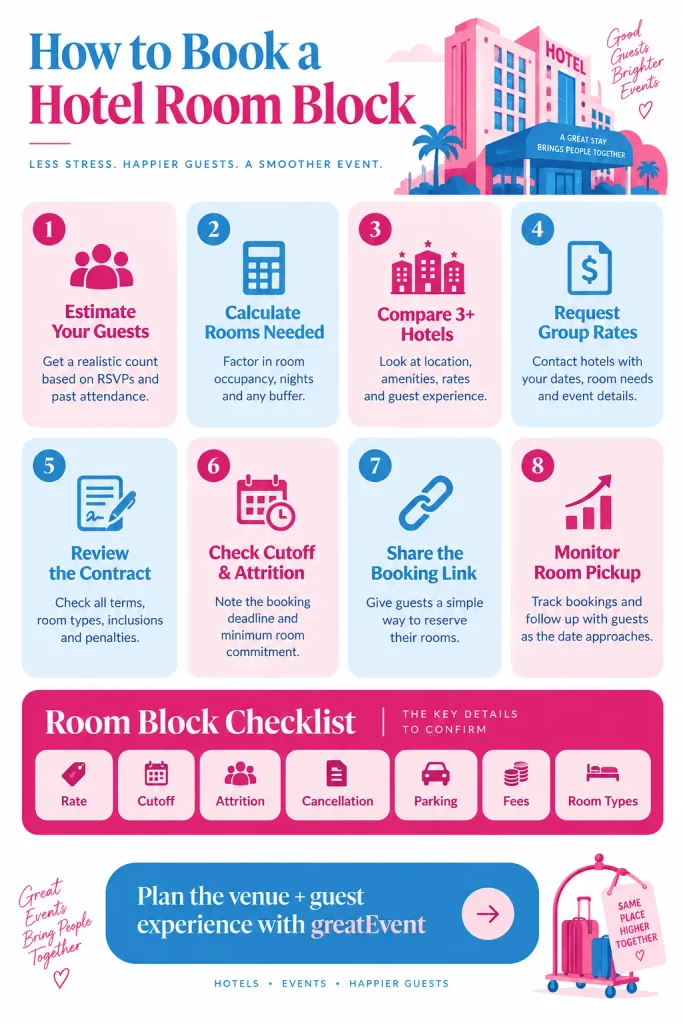
The good news? You don’t need to be a professional event planner to negotiate a useful hotel block.
You just need a clear process.
What Is a Hotel Room Block?
A hotel room block is a group of guestrooms that a hotel sets aside for people attending the same event, wedding, meeting, or group trip.
Instead of every guest searching for a room independently, the organizer works with the hotel to establish:
- A specific number of rooms
- Specific room types
- A group rate
- Eligible stay dates
- A booking deadline
- Cancellation terms
- Any applicable attrition requirements
- A booking method or reservation link
Depending on the hotel and arrangement, guests may pay for their own rooms, while the event organizer may cover some rooms or other expenses.
For example, a wedding couple might negotiate a block of 25 rooms at a hotel close to the reception venue. Guests then reserve and pay for their own rooms using the hotel’s group booking link or reservation code.
For corporate events, the company may pay for some or all accommodations.
The important distinction: a room block does not automatically mean the organizer is paying for every room.
Cvent notes that individual guests commonly pay for their own rooms for wedding blocks, while corporate groups may structure payment differently.
When Should You Book a Hotel Room Block?
Start as soon as your event date and location are reasonably firm.
For weddings, that may mean securing the block after the venue and date are confirmed. For conferences and corporate meetings, accommodation planning should happen alongside venue and attendee planning.
Starting early gives you more options for:
- Hotel location
- Room inventory
- Room types
- Group rates
- Meeting space
- Parking
- Transportation
- Guest amenities
- Contract negotiation
If you’re also deciding whether professional help is worthwhile, understanding how much event planners charge can help you decide which parts of the planning process you want to handle yourself.
A practical timeline
| Planning stage | What to do |
|---|---|
| 9–12+ months out | Research hotels and estimate demand |
| 6–9 months out | Request proposals and compare terms |
| 4–8 months out | Sign the room-block agreement |
| 2–4 months out | Promote the booking link |
| 30–60 days out | Monitor pickup and adjust strategy |
| By cutoff date | Confirm remaining inventory and guest bookings |
| Event week | Reconfirm VIPs, staff, transportation and special requests |
The exact timing varies by event, city, season, and hotel availability.
Step 1: Estimate How Many Rooms You Actually Need

This is one of the most important parts of learning how to book a hotel room block.
Don’t simply take your guest count and assume everyone needs a hotel room.
Instead, estimate:
Expected overnight guests × average rooms per guest group = estimated rooms
For example:
- 150 wedding guests
- 60% expected to travel or stay overnight
- Average of 2 guests per room
That would suggest roughly:
150 × 60% ÷ 2 = 45 rooms
You could then request a block around that number rather than automatically asking for 75 or 100 rooms.
Consider who is actually traveling
Ask:
- How many guests live locally?
- How many are coming from another state?
- Are couples likely to share rooms?
- Are families bringing children?
- Will some guests stay with relatives?
- Are guests likely to extend the trip?
- Is the event during a holiday weekend?
- Are there other major events in the city?
For a wedding, you may also need rooms for the wedding party, immediate family, vendors, or the couple.
For corporate events, consider:
- Employees
- Speakers
- Executives
- Sponsors
- Exhibitors
- Production staff
- Out-of-town attendees
Don’t overestimate simply because a larger block sounds safer.
Step 2: Decide What Type of Hotel You Need
The cheapest hotel isn’t necessarily the best hotel block.
Your guests are buying more than a bed. They’re buying convenience.
Consider the hotel’s:
- Distance from the event
- Room quality
- Price range
- Parking
- Breakfast options
- Restaurant or bar
- Accessibility
- Wi-Fi
- Fitness facilities
- Check-in experience
- Transportation options
- Meeting space
- Cancellation policies
For weddings, proximity can be particularly important because guests may need to travel between the hotel, ceremony, reception, rehearsal dinner, and post-wedding events.
For corporate events, proximity to the meeting venue and reliable Wi-Fi, AV, workspaces, and transportation may matter more.
If your event itself is still being planned, resources such as the 2026 average wedding cost guide can help put the accommodation budget into context.
Step 3: Compare at Least 3 Hotels

Don’t accept the first proposal you receive.
Ideally, compare at least three suitable properties.
Create a simple scorecard:
| Factor | Hotel A | Hotel B | Hotel C |
|---|---|---|---|
| Group room rate | $ | $ | $ |
| Distance to venue | |||
| Parking | |||
| Breakfast | |||
| Wi-Fi | |||
| Room types | |||
| Cutoff date | |||
| Attrition | |||
| Cancellation terms | |||
| Guest amenities | |||
| Transportation |
This makes the decision less emotional and easier to explain to your event team.
For city-specific events, don’t forget that hotel demand can change dramatically depending on what’s happening nearby. For example, organizers planning events in the capital can review events in Washington DC 2026 before finalizing accommodation dates.
Step 4: Ask Hotels for a Group Room Block Proposal
Once you have your shortlist, contact the hotel’s group sales or events team.
Give them enough information to provide a useful proposal.
Include:
- Event name
- Event date
- Check-in date
- Check-out date
- Estimated rooms per night
- Preferred room types
- Number of guests
- Event location
- Meeting or event requirements
- Parking requirements
- Special guest requirements
- Whether you need meeting space
- Whether guests will pay individually
A simple request could look like:
“We’re hosting a wedding for approximately 150 guests on October 17 and expect around 45 guestrooms per night for Friday and Saturday. We’d like to explore a group room block with a competitive rate and flexible cancellation and pickup terms.”
For a birthday celebration or private event, the same principle applies. If you’re building the broader event budget, you may also want to compare accommodation against birthday party planner costs.
Step 5: Understand the Difference Between Courtesy and Guaranteed Blocks
Not every room block carries the same financial risk.
Courtesy room block
A courtesy block generally allows guests to reserve rooms individually without requiring the organizer to guarantee a large number of rooms.
The hotel holds a specified number of rooms until the cutoff date, subject to its terms.
This can be attractive when you don’t know exactly how many guests will book.
Guaranteed or contracted block
A contracted block can provide more inventory and potentially better terms, but it may also create financial obligations if rooms aren’t booked.
Some hotel contracts include attrition provisions that make the organizer financially responsible for a percentage of unused rooms.
Cvent specifically recommends understanding the attrition provision before signing.
Pro Tip: If your guest count is uncertain, don’t agree to a large guaranteed block just because the hotel offers a slightly lower rate.
Flexibility can be worth more than a small discount.
Step 6: Negotiate the Hotel Room Block Rate
Yes, hotel room block rates can often be negotiated.
But don’t focus exclusively on the nightly rate.
Ask about the entire package.
Potential negotiation points
- Room rate
- Complimentary rooms
- Parking
- Breakfast
- Wi-Fi
- Resort or destination fees
- Early check-in
- Late checkout
- Upgrades
- Welcome amenities
- Meeting room rental
- AV fees
- Cancellation terms
- Attrition percentage
- Cutoff date
- Additional rooms
- Suite upgrades
Cvent notes that negotiated group benefits can include discounted rates, shoulder-night pricing, and additional amenities.
If you’re coordinating a corporate gathering, it can also be useful to compare the accommodation strategy with corporate event planner pricing.
Don’t say:
“Can you give me your lowest rate?”
Instead ask:
“What group rate and concessions can you offer based on approximately 40–50 rooms per night?”
That gives the hotel room to structure an actual group proposal.
Step 7: Read the Hotel Room Block Contract Carefully

This is where many inexperienced organizers get into trouble.
Never sign based solely on the room rate.
Review the contract line by line.
Pay particular attention to:
Room rate
Is the rate fixed for the agreed dates?
Cutoff date
When does the hotel stop holding rooms for your group?
Attrition
What happens if the block doesn’t reach its required pickup?
Cancellation
What happens if your event changes or is canceled?
Deposit
Is a deposit required? When is it due?
Taxes and fees
Are taxes, destination fees, parking, or other charges separate?
Room types
How many kings, doubles, suites, accessible rooms, or other categories are included?
Payment responsibility
Are guests paying individually, or is the organizer responsible?
Additional rooms
Can you add inventory if demand increases?
Release policy
When can the hotel release unbooked rooms?
Cvent specifically highlights the importance of reviewing the rate, cancellation policy, cutoff date, attrition policy, and deposit before signing.
Step 8: Understand the Hotel Block Cutoff Date
The cutoff date is one of the most important dates in your contract.
It determines when the hotel stops holding rooms in your block and can release unbooked inventory.
For example:
Event: October 17
Room-block cutoff: September 17
Guests generally need to reserve within the block by the specified deadline to access the contracted group inventory and rate.
The exact cutoff varies by hotel and contract. Cvent notes that hotels may establish different cutoff periods depending on the property and event.
Don’t hide the cutoff date
Put it everywhere:
- Wedding website
- Invitations
- Event website
- Registration page
- Email reminders
- Group text
- Travel information page
A booking deadline that guests don’t know about isn’t useful.
Step 9: Understand Attrition Before You Sign
Attrition is the potential financial responsibility associated with failing to meet a contracted room-block commitment.
Suppose your agreement requires a certain level of room pickup and your guests reserve fewer rooms.
Depending on the contract, you may owe the hotel money for some of the unused inventory.
The exact calculation varies by hotel and contract, so never assume a standard percentage applies.
Ask these questions
- Is there an attrition clause?
- What percentage applies?
- Is attrition calculated by room or room night?
- Are taxes included?
- Is there an allowable pickup threshold?
- Can unused rooms be released gradually?
- Are canceled reservations counted?
- Are rooms booked outside the block credited toward pickup?
- Can the hotel resell released rooms?
- What happens if the event itself is canceled?
Cvent recommends using historical attendance, travel patterns, and booking behavior when estimating the room block rather than simply guessing.
Expert Tip: The cheapest room rate isn’t necessarily the cheapest contract.
A slightly higher rate with flexible attrition can sometimes reduce your overall risk.
Step 10: Create an Easy Booking Process for Guests
Once the contract is signed, your job isn’t finished.
Your guests need to know exactly how to book.
Ideally, provide:
- Hotel name
- Group name
- Group rate
- Booking link
- Reservation deadline
- Check-in date
- Check-out date
- Parking information
- Cancellation information
- Contact information
Some hotel brands offer dedicated attendee or group booking pages. Hilton, for example, provides attendee websites that allow guests to reserve rooms within a group’s special rate.
Make the instructions obvious
Instead of:
Hotel information available upon request.
Use:
Book Your Hotel Room
Hotel: Example Hotel
Group Rate: $189/night
Booking Deadline: September 17
[Reservation Link]
The fewer decisions guests have to make, the better.
Step 11: Monitor Room Pickup
One of the biggest mistakes is assuming that guests will automatically book.
Track reservations periodically.
A simple spreadsheet can include:
| Metric | Target |
|---|---|
| Rooms contracted | 50 |
| Rooms booked | 31 |
| Remaining | 19 |
| Pickup rate | 62% |
| Cutoff date | Sept. 17 |
| Days until cutoff | 30 |
If pickup is slow, send another reminder.
If demand is much higher than expected, contact the hotel early and ask whether additional rooms can be added.
Cvent recommends monitoring pickup throughout the booking period because early visibility gives planners more time to adjust the block.
Hotel Room Block Planning Checklist
Before signing anything, use this checklist.
Before contacting hotels
- Confirm event dates
- Estimate overnight guests
- Determine expected rooms per night
- Identify preferred hotel locations
- Establish a target accommodation budget
- Identify accessibility requirements
- Consider parking and transportation
When requesting proposals
- Ask for group rates
- Ask about room types
- Ask about taxes and fees
- Ask about parking
- Ask about breakfast
- Ask about Wi-Fi
- Ask about concessions
- Ask about complimentary rooms
- Ask about meeting space
Before signing
- Review cutoff date
- Review attrition
- Review cancellation
- Review deposit
- Confirm payment responsibility
- Confirm room inventory
- Confirm rate protection
- Ask about adding rooms
- Ask about releasing rooms
- Get all negotiated terms in writing
After signing
- Get booking link/code
- Add hotel information to event website
- Tell guests the cutoff date
- Send booking reminders
- Monitor room pickup
- Request additional rooms if needed
- Reconfirm VIP accommodations
Common Hotel Room Block Mistakes to Avoid
Blocking too many rooms
More rooms aren’t automatically better.
An oversized block can expose you to unnecessary financial risk if the contract includes attrition.
Choosing a hotel based only on price
A $10 cheaper room isn’t necessarily better if guests have to pay expensive parking or travel farther to the event.
Ignoring the cutoff date
Guests may assume the group rate is available until the event date.
It usually isn’t.
Not asking about fees
Ask specifically about:
- Parking
- Resort/destination fees
- Wi-Fi
- Breakfast
- Taxes
- Early checkout
- Meeting space
- AV
Forgetting accessibility
Make sure the property can accommodate guests who require accessible guestrooms, parking, entrances, bathrooms, and other facilities.
Making guests search for the booking information
Don’t make guests hunt through a long event website.
Give them a direct reservation path.
What About Weddings?
Wedding room blocks are especially useful when guests are traveling from different cities or states.
The block can create a shared home base for the wedding weekend while making transportation and scheduling easier.
For couples planning smaller celebrations, a guide to micro-weddings in Washington, DC can also help with thinking about guest count and event scale.
A wedding room block may work particularly well when:
- Many guests are traveling
- The ceremony and reception are near the hotel
- Transportation will be provided
- Guests need multiple nights
- The wedding includes rehearsal or farewell events
If you’re also deciding who handles different planning responsibilities, event planners vs. coordinators explains how those roles differ.
Choosing the Right Hotel Location
Location can matter more than the room rate.
For example, if you’re planning an event in Washington, DC, guests may value a hotel close to the venue, Metro access, restaurants, and major attractions.
You might compare unique wedding venues in Washington, DC with the surrounding hotel options before deciding where your guest accommodation should be concentrated.
The same principle applies to corporate events.
A hotel that’s 20 minutes farther away may become a poor choice once you factor in transportation costs, traffic, parking, and guest inconvenience.
Hotel Room Block vs. Booking Rooms Individually
| Factor | Room Block | Individual Booking |
|---|---|---|
| Group rate | Often available | Standard/public rate |
| Guest convenience | Higher | Lower |
| Group coordination | Easier | More difficult |
| Inventory | Reserved for group | Subject to availability |
| Negotiation | Possible | Usually limited |
| Event coordination | Centralized | Scattered |
| Financial obligations | May include attrition | Usually individual |
A room block makes the most sense when several guests need accommodation around the same event.
For smaller gatherings, you may not need a formal block.
For example, if you’re organizing a private celebration with only a handful of out-of-town guests, accommodation may be handled individually.
If the event involves a large guest list, formal accommodation planning becomes much more valuable.
When You May Need Multiple Hotels
One hotel doesn’t always need to accommodate everyone.
Consider multiple properties when:
- Your guest count is large
- One hotel can’t provide enough inventory
- Guests have different budgets
- The primary hotel is sold out
- Some guests prefer luxury accommodations
- Families need different room configurations
- Your event takes place across multiple locations
This is particularly relevant for large city events.
If you’re sourcing venues in Washington, DC, for example, comparing hidden-gem event venues in Washington, DC alongside accommodation options can help you think about the entire guest journey rather than treating the venue and hotel as separate decisions.
Hotel Room Block Budget Example
Here’s a simple illustration—not a market-rate estimate.
Suppose you negotiate:
- 40 rooms
- $180 average nightly rate
- 2 nights
Potential room revenue represented by the block:
40 × $180 × 2 = $14,400
But that doesn’t necessarily mean the organizer pays $14,400.
If guests are responsible for their own rooms, individual guests may pay the hotel directly.
Your actual financial exposure depends on the contract, payment structure, concessions, attrition, cancellation terms, and any rooms you agree to cover.
This distinction is critical when building an event budget.
A Better Way to Evaluate a Hotel Block
Instead of asking:
“What’s the cheapest hotel?”
Ask:
“Which hotel provides the best combination of rate, convenience, guest experience, and contractual flexibility?”
Score each hotel across four categories:
1. Guest experience
Location, rooms, amenities, accessibility.
2. Financial value
Rate, fees, parking, concessions.
3. Contract risk
Attrition, cancellation, deposit, cutoff.
4. Logistics
Transportation, check-in, event proximity, room types.
The best option usually balances all four.
If you need event space as well as accommodation, you can also explore DC event venues so your venue and hotel strategy can be planned together.
Special Situations to Consider
Bachelor and bachelorette weekends
For group celebrations, accommodation can become part of the overall event experience.
If you’re deciding when to schedule the celebration, see when to host bachelor or bachelorette parties and then evaluate hotel demand, weekend pricing, transportation, and room availability.
Engagement parties
Engagement celebrations may have fewer overnight guests, but out-of-town family can still make accommodation useful. If you’re sorting out the broader hosting responsibilities, who pays for an engagement party provides useful planning context.
Pop-up and smaller events
For shorter gatherings, you may not need a large contracted block. If you’re planning an event where the venue itself is rented for only a few hours, pop-up party venues in DC can help frame the difference between event-space and accommodation planning.
Final Hotel Room Block Decision Framework
Before you sign, ask yourself five questions:
1. Do we know roughly how many rooms our guests need?
If not, refine your estimate.
2. Is the hotel convenient?
Consider venue distance, transportation, parking, accessibility, and nearby services.
3. Is the rate genuinely competitive?
Compare total guest cost, not just advertised room rate.
4. Do we understand the contract?
You should be able to explain the cutoff, attrition, cancellation, deposit, and payment terms.
5. Can we manage the block?
Make sure you have a clear booking link, deadline, guest communication plan, and pickup-tracking process.
If all five answers are yes, you’re in a much stronger position to sign.
Expert Takeaway
The smartest approach to how to book a hotel room block isn’t simply finding a hotel willing to hold rooms.
It’s finding the right hotel and the right contract for your actual guest demand.
Start early. Estimate conservatively. Compare multiple properties. Negotiate beyond the room rate. Read the attrition clause. Make the booking process easy for guests. Then monitor reservations instead of waiting until the cutoff date to discover that the block is underperforming.
That process protects your budget while giving guests a much smoother experience.
Planning guest accommodations for your next event?
Don’t choose a hotel block in isolation. Compare your venue location, guest count, event format, budget, and accommodation needs together.
With greatEvent, you can explore event venues and services while building a more coordinated plan for your celebration or gathering.
Start with the event location, then build the guest experience around it.
Frequently Asked Questions
How many rooms should I block for an event? ▾
Estimate how many guests are likely to need overnight accommodation, then account for average occupancy per room. Don’t assume every attendee needs a room. Past event data and the number of out-of-town guests can make the estimate more accurate.
What is the cutoff date for a hotel room block? ▾
The cutoff date is the deadline established by the hotel for reserving rooms within the block. After that date, unreserved rooms may be released to the hotel’s general inventory, depending on the contract.
Can I negotiate a hotel room block rate? ▾
Yes. You can ask about the room rate, concessions, parking, breakfast, upgrades, complimentary rooms, cutoff date, attrition, and other contract terms. The final offer depends on the hotel, dates, demand, and size of the group.
Do I have to pay for all the rooms in a hotel block? ▾
Not necessarily. In many wedding and social-event blocks, guests pay for their own rooms. However, a contracted block may include financial obligations if the group doesn’t meet agreed pickup requirements. Always check the contract before signing.
Is it more expensive to book a hotel room block during peak season? ▾
It can be. Hotels may have higher demand during holidays, major conventions, festivals, sporting events, and popular wedding dates. Booking earlier and comparing multiple properties can give you more options.
Compare vendors for your next event
Search caterers, photographers, florists, planners, and rentals — then send one request to several vendors at once.