Quick answer: Event management is the work of taking an event from a client’s goal to a finished program and a final report. It covers six phases: research and brief, design, planning, sourcing and contracting, execution, and close-out and evaluation. Along the way, the event manager owns the budget, the timeline, the contracts with venues and event vendors, the team on site, and the results. Event planning is one part of that work. Event management adds the contracts, the people, the risk, and the follow-up.
Example scenario (fictional): A software company asks a small Chicago agency to “plan the sales kickoff.” The agency books a hotel, orders the dinner, and prints the badges. Two weeks out, the client’s CFO asks what the event is supposed to achieve and how anyone will know it worked. Nobody can answer, because no one wrote it down. The hotel contract has a room block the client never approved, and the attendee list is still changing. The agency planned an event. It did not manage one.
This guide is for professional US event planners and agencies who run meetings, conferences, incentives, trade shows, weddings, and sports events for clients, including corporate teams who hire outside help. It explains what event management means as a discipline, how the work splits into phases, who does what on an event team, how each event type changes the job, and which skills clients pay for.
In this guide:
- What is event management?
- Event management vs event planning vs event coordination
- The six phases of event management
- Roles on an event management team
- Event types and how the work changes
- Core event management skills
- How agencies run event management for corporate clients
- Credentials, software, and AI
- A one-page event management plan you can copy
What is event management?
Event management is the planning, contracting, delivery, and review of an event on behalf of the person or organization that owns it. The owner might be a corporate client, an association, a couple, or a sports club. The event manager is the person responsible for getting that owner from “we want an event” to “here is what happened and what it cost.”
The US Bureau of Labor Statistics describes the job of meeting, convention, and event planners in practical terms. They meet with clients to understand the purpose of the event, plan its scope, time, location, and cost, ask venues and service providers for bids, inspect venues, coordinate services such as rooms, transportation, and food, monitor the event while it runs, and review the bills before approving payment. O*NET, the US Department of Labor’s occupation database, adds tasks such as negotiating contracts with hotels, convention centers, and speakers, planning budgets and agendas, supervising staff and volunteers, and running post-event evaluations.
Put those lists together and you get a working definition that fits planners and agencies:
- It starts with an objective. The event exists to do something for the client, such as close sales, train staff, reward top performers, or celebrate a marriage.
- It runs on contracts. Venues, hotels, caterers, and other event vendors commit to dates, prices, and terms in writing, and someone has to read and negotiate those terms.
- It needs a team. Even a small event involves the client, the planner, venue staff, and several vendors who all need the same facts.
- It ends with a report. Bills get reconciled, feedback gets collected, and the client learns what worked.
Event management vs event planning vs event coordination
People use these three terms loosely, and many job titles mix them. In practice, they describe different amounts of responsibility. Event planning is the design and organizing work. Event coordination is the execution work, often close to the event date. Event management wraps both and adds ownership of the budget, contracts, team, and results.
| Term | Main focus | Typical scope | Who usually does it |
|---|---|---|---|
| Event planning | Designing the event and organizing the parts | Concept, program, venue search, vendor shortlist, timeline | Planners, agency planners, in-house staff |
| Event coordination | Making the plan happen on time | Final confirmations, vendor arrivals, setup, the event day schedule | Coordinators, day-of coordinators, venue event staff |
| Event management | Owning the event from brief to report | Objectives, budget, contracts, team, risk, on-site decisions, evaluation | Event managers, agency leads, senior planners |
For a closer look at where planners stop and coordinators start, including what each costs, see event planners vs coordinators: roles, responsibilities, and costs. If you want a broad, step-by-step overview of planning any kind of event, start with the ultimate event planning guide.
The six phases of event management
Many event teams work through some version of these six phases, whether the event is a 40-person board retreat or a three-day conference. The phases overlap. Sourcing often starts before the design is final, and the planning documents keep changing until the week of the event. Still, naming the phases helps you scope work, price it, and tell the client what they will get at each step.
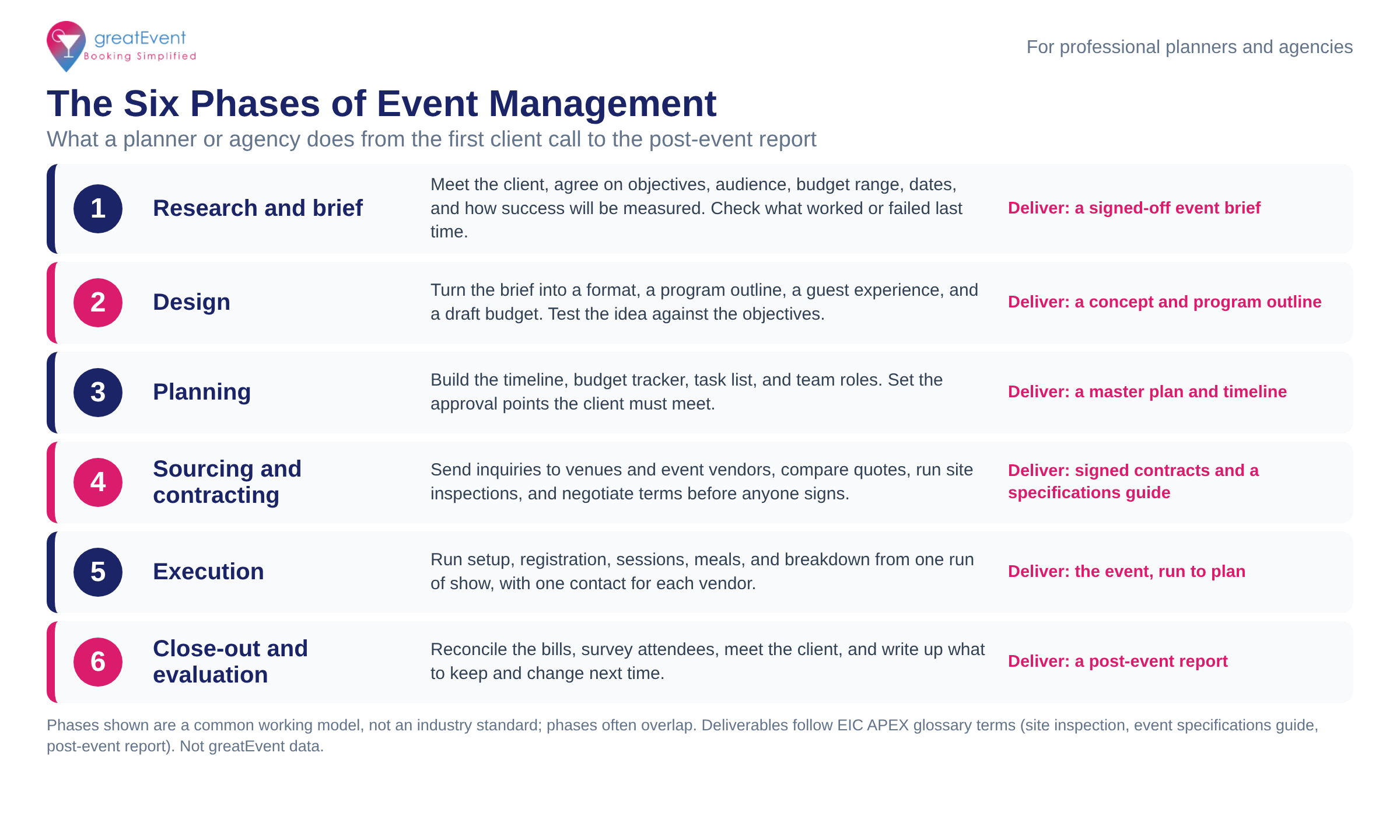
Text version of the infographic:
- Research and brief. Meet the client, agree on objectives, audience, budget range, dates, and how success will be measured. Check what worked or failed last time. Deliver: a signed-off event brief.
- Design. Turn the brief into a format, a program outline, a guest experience, and a draft budget. Test the idea against the objectives. Deliver: a concept and program outline.
- Planning. Build the timeline, budget tracker, task list, and team roles. Set the approval points the client must meet. Deliver: a master plan and timeline.
- Sourcing and contracting. Send inquiries to venues and event vendors, compare quotes, run site inspections, and negotiate terms before anyone signs. Deliver: signed contracts and a specifications guide.
- Execution. Run setup, registration, sessions, meals, and breakdown from one run of show, with one contact for each vendor. Deliver: the event, run to plan.
- Close-out and evaluation. Reconcile the bills, survey attendees, meet the client, and write up what to keep and change next time. Deliver: a post-event report.
1. Research and brief
This phase decides whether the rest of the work goes well. Ask the client why the event exists, who must attend, what a good result looks like, what the budget range is, and who signs off on decisions. Find out what happened at last year’s event, if there was one. Write the answers into a brief and get the client to approve it before you spend time on venues. The event brief template gives you intake questions and a format you can reuse.

2. Design
Design turns the brief into an event people will attend. Choose the format (in person, hybrid, single day, multi-day), sketch the program, plan the attendee experience from invitation to departure, and build a first budget. Each design choice should trace back to an objective in the brief. If the goal is cross-team networking, a long keynote block with theater seating works against it.
3. Planning
Planning converts the design into tasks, owners, and dates. Build a master timeline, a budget tracker, a contact list, and a decision log. Agree on the approval points with the client, such as venue selection, menu, and final attendee numbers, so nobody is surprised later. For a timeline of tasks by month, the event planner checklist guide covers the steps from early pre-planning to wrap-up.
4. Sourcing and contracting
Sourcing is where planning meets money. Send clear inquiries to venues, hotels, caterers, and other event vendors, compare quotes on the same basis, and visit the strongest options. The Events Industry Council’s APEX glossary defines a site inspection as an in-person, on-site review and evaluation of a venue or location for an event, and the hotel site inspection checklist shows what to check. Before signing, read the cancellation, attrition, and force majeure clauses, and ask for concessions in writing. The guides to corporate event hotel room blocks and hotel contract concessions go deeper.
When contracts are signed, pull the details into one event specifications guide. APEX describes it as the document that sets out the complete requirements and instructions for an event, written by the planner and shared with the relevant vendors. It is how your vendors and suppliers all work from the same facts.
5. Execution
Execution covers setup, the event itself, and breakdown. The event manager runs it from a single schedule, often called the run of show, and makes the on-site decisions when something changes. Hotels and venues confirm each food and beverage function and room set on a banquet event order, so check every one against your plan; what is a BEO explains how to read them. The event logistics checklist helps with the moving parts.
6. Close-out and evaluation
The event is not finished when the guests leave. Review the bills against the contracts, settle any disputes, and pay vendors. Survey attendees while the event is fresh; the post-event survey questions guide has question sets you can adapt. Then measure results against the objectives in the brief, using the event ROI guide if the client wants numbers. APEX uses the term post-event report for the record of an event’s details and activities. Writing one after every event gives you a history to plan the next one from.
| Phase | What the client sees | What the event manager owns |
|---|---|---|
| Research and brief | Discovery meeting, approved brief | Objectives, audience, budget range, approval process |
| Design | Concept and draft program | Format, flow, experience, first budget |
| Planning | Timeline and decision dates | Task list, team roles, budget tracker, risk list |
| Sourcing and contracting | Venue and vendor options, contracts to sign | Inquiries, quote comparison, site visits, negotiation, specifications guide |
| Execution | The event | Run of show, vendor management, on-site decisions |
| Close-out and evaluation | Final invoice and report | Bill review, vendor payment, surveys, results, lessons |
Roles on an event management team
On a small event, one planner may hold most of these roles. On a large conference, each role may be a separate person or company. Either way, every role needs an owner, and the client should know who to call for what.
| Role | What they do | Who they report to |
|---|---|---|
| Client sponsor | Sets objectives, approves budget and major decisions | Their own leadership |
| Account lead | Owns the client relationship, scope, and changes to scope | Agency leadership |
| Event manager | Owns the plan, budget, contracts, and on-site decisions | Account lead or the client |
| Event coordinator | Tracks tasks, confirmations, guest lists, and day-of details | Event manager |
| Registration and attendee lead | Runs invitations, registration, badges, and attendee questions | Event manager |
| Venue or hotel convention services manager | Works for the venue; turns your plan into room sets, menus, and orders | The venue |
| Catering or banquet captain | Runs food and beverage service on the day | The venue or caterer |
| Your vendors and suppliers | Deliver contracted services such as catering, photography, florals, and decor | Their own company, under contract to you or the client |
The BLS describes convention service managers as people who work for hotels and convention centers and act as the liaison between the facility and the planner. Treat them as a partner. They know what their building can and cannot do, and a good working relationship with them makes the execution phase easier.
Event types and how the work changes
The six phases stay the same, but the emphasis shifts with the type of event. Here is what tends to change for the event types planners and agencies handle most.
| Event type | Typical client | What gets the most attention |
|---|---|---|
| Corporate meetings | Company departments, leadership teams | Clear agenda, meeting rooms that fit the format, approvals, group room blocks, tight budgets |
| Conferences | Associations, companies, professional groups | Program and speakers, registration, breakout rooms, sponsors, hotel blocks |
| Incentives | Sales and channel teams rewarding top performers | Destination, guest experience, qualifying rules, travel for winners and guests |
| Trade shows | Exhibition organizers, associations, exhibitors | Floor plan, exhibitor services, move-in and move-out schedules, attendee traffic |
| Weddings | Couples and their families | Personal style, guest experience, family decisions, ceremony and reception timing |
| Sports events | Tournament organizers, clubs, teams | Team hotel blocks near the venues, schedules that change, travel for players and families |
The APEX glossary defines a conference as a participatory meeting for discussion, fact-finding, problem solving, and consultation, and a trade show as an exhibition of products or services for a related industry that is not open to the general public. Those definitions matter when you scope work, because a trade show adds exhibitors as a second set of customers.
For the detail behind each type, see how to plan a corporate event, what incentive travel is and how to plan it, and the stay-to-play tournament requirement for sports teams. If you are deciding which side of the business to focus on, corporate vs wedding event planners compares the two.
Core event management skills
The BLS lists communication, interpersonal, negotiation, organizational, and problem-solving skills as the important qualities for meeting, convention, and event planners. Here is how each shows up in client work, plus two more that agencies tend to learn the hard way.
| Skill | What it looks like in practice |
|---|---|
| Communication | Writing briefs, specs, and updates that people read once and understand |
| Interpersonal | Keeping the client, venue staff, and vendors working together under pressure |
| Negotiation | Getting fair rates, concessions, and contract terms without damaging the relationship |
| Organization | Tracking hundreds of details, owners, and deadlines without dropping one |
| Problem solving | Making a fast, calm decision when a speaker cancels or the weather turns |
| Budget control | Building a budget, tracking changes, and reviewing every bill line by line |
| Contract reading | Spotting cancellation, attrition, and minimum spend terms before the client signs |
The hospitality industry guide for event planners explains how hotels, venues, and caterers price their side of the deal, which makes negotiation easier.
How agencies run event management for corporate clients
When an agency manages events for a corporate team, the client brings the objectives and the budget, and the agency brings the process. A few habits keep that relationship healthy.
- Agree on scope in writing. List which phases you own. Some clients want the full six phases. Others only want sourcing and on-site management.
- Name one decision maker. Corporate events often have several stakeholders. Ask who has final approval for budget, venue, and program.
- Set approval dates. Put the dates the client must approve each decision on the timeline, and explain what happens to costs if they slip.
- Handle change in writing. When the headcount, dates, or program change, update the brief, the budget, and the specs at the same time.
- Report against the brief. Close every event with results tied to the objectives the client approved at the start.
How you charge for this work affects how you scope it. The guide to pricing event planning services covers flat fees, hourly rates, and other models. If sponsors help fund the event, event sponsorship for planners covers packages and contracts.
Credentials, software, and AI
Credentials. The BLS notes that certifications for planners are voluntary and not required. Some planners earn one to show experience and knowledge. The best known is the Certified Meeting Professional (CMP) credential, which the Events Industry Council launched in 1985 for meeting professionals.
Software. Event management software supports most of the phases above, from registration and budgets to venue sourcing and room blocks. For what these tools do and how agencies should compare them, see the guide to event management software.
AI. AI tools can draft briefs, summarize surveys, and compare quotes faster, but the event manager still owns the decisions and the contracts. The guide to AI in event management covers practical uses and limits.
A one-page event management plan you can copy
Use this outline at the start of every new client event. Fill in the brackets, share it with the client, and update it as decisions are made.
EVENT MANAGEMENT PLAN: [Event name]
Client: [Company]   Decision maker: [Name, title]   Event manager: [Name]

1. BRIEF
Objectives: [What the event must achieve]
Audience: [Who attends, how many, from where]
Dates and location: [Preferred dates, backup dates, city or region]
Budget range: [Range, and what it includes]
Success measures: [How the client will judge the result]

2. DESIGN
Format: [In person, hybrid, single day, multi-day]
Program outline: [Sessions, meals, social time]
Guest experience notes: [Arrival, accessibility, dietary needs]

3. PLANNING
Approval dates: [Brief, venue, program, menu, final numbers]
Team and owners: [Role, name, contact]
Risks to watch: [Weather, attendance changes, travel delays]

4. SOURCING AND CONTRACTING
Venues contacted: [Names, dates sent, quote received]
Room block: [Nights, rooms per night, cutoff date]
Contracts signed: [Vendor, date, cancellation terms]

5. EXECUTION
Run of show owner: [Name]
On-site contacts: [Venue, catering, each vendor]

6. CLOSE-OUT
Bills reviewed by: [Name, date]
Survey sent: [Date]
Post-event report due: [Date]
Source venues and room blocks for client events on greatEvent
greatEvent helps with the sourcing and contracting phase. On greatEvent, planners can search venues for corporate meetings, conferences, trade shows, weddings, and social events, filter by event type, location, date, capacity, and distance, and compare meeting room capacities side by side. You can send one detailed inquiry to multiple venues and get quotes back, then add services and a hotel room block and finalize the details with your event specialist, so your vendors and suppliers all work from the same facts. For tournaments and team travel, use greatEvent Sports.
There are no fees for planners. We pay you commission on any qualifying booking you make on greatEvent.
Register as a professional planner
Frequently asked questions
What is event management in simple words?
▾
Event management is the work of running an event for a client from start to finish. It covers setting objectives, designing and planning the event, contracting venues and vendors, running the event, and reviewing the results.
What are the main phases of event management?
▾
A common model has six phases: research and brief, design, planning, sourcing and contracting, execution, and close-out and evaluation. The phases often overlap in practice.
What is the difference between event planning and event management?
▾
Event planning focuses on designing and organizing the event. Event management includes planning but also covers the budget, contracts, team, on-site decisions, and evaluation after the event.
What skills does an event manager need?
▾
The BLS lists communication, interpersonal, negotiation, organizational, and problem-solving skills. Planners also need budget control and the ability to read venue and hotel contracts.
Do you need a certification to work in event management?
▾
The BLS describes certifications for planners as voluntary and not required. Credentials such as the Certified Meeting Professional (CMP) are optional, and some planners earn one to show experience.
Research and sources
Sources were checked on October 29, 2026. The six-phase model is a common working framework, not an industry standard. The opening scenario is fictional. Role and event type descriptions are general guidance; contract points are not legal advice.
- US Bureau of Labor Statistics, Occupational Outlook Handbook: Meeting, Convention, and Event Planners, bls.gov.
- O*NET OnLine, Meeting, Convention, and Event Planners (13-1121.00), onetonline.org.
- Events Industry Council, APEX glossary: site inspection, event specifications guide, banquet event order, post-event report, conference, and trade show, insights.eventscouncil.org.
- Events Industry Council, About the Certified Meeting Professional (CMP) program, eventscouncil.org.
Compare vendors for your next event
Search caterers, photographers, florists, planners, and rentals — then send one request to several vendors at once.