Quick answer: The hospitality industry is the set of businesses that house, feed, and entertain people away from home: hotels and other lodging, restaurants and caterers, and venues, attractions, and entertainment. The U.S. Bureau of Labor Statistics files it under leisure and hospitality, which covers accommodation and food services plus arts, entertainment, and recreation. For a planner, the useful part is that each segment prices your event in its own way. A hotel weighs your group against the other business it could sell on the same nights. A caterer prices food and beverage per person and adds a service charge and tax. A venue charges for space and time, often with a minimum spend. Once you know which model you are looking at, you know which numbers can move.
Example scenario (fictional): An agency planner has a brief for a two-day leadership meeting for 80 people: 70 rooms on the peak night, a general session, two breakouts, a welcome reception, and one dinner off-site. She sends the same brief to a downtown hotel, a conference center, and a restaurant with a private dining room. The three quotes come back in three different shapes. The hotel leads with a group room rate and a food and beverage minimum, the conference center with a per person package, and the restaurant with a minimum spend for the room. None of them is wrong; each one prices the way its part of the industry makes money.
This guide is for professional planners and agencies who book hospitality for clients: corporate meetings, conferences, incentive trips, sports team travel, and weddings. It defines the industry, maps the segments you buy from, and explains how hotels make money on group business and why that shapes your quote. It also covers who to talk to at a hotel, what each segment needs in an inquiry, where the negotiating room usually is, and a short glossary of the terms that show up in proposals and contracts.
In this guide:
- What is the hospitality industry?
- The segments planners buy from
- How hotels make money on group business
- Who you talk to at a hotel or venue
- What each segment wants in your inquiry
- Where planners get negotiating room
- Hospitality terms planners should know
- What changes for corporate, sports, and wedding clients
What is the hospitality industry?
There is no single legal definition, so the federal statistics are a practical place to start. The Bureau of Labor Statistics says the leisure and hospitality supersector consists of two sectors: arts, entertainment, and recreation (NAICS 71) and accommodation and food services (NAICS 72). BLS reported about 17 million people employed in the supersector in September 2026, a preliminary figure.
BLS describes accommodation and food services as establishments “providing customers with lodging and/or preparing meals, snacks, and beverages for immediate consumption,” and groups them together “because the two activities are often combined at the same establishment.” That one sentence explains a lot about event pricing. A full-service hotel sells sleeping rooms and catered meals under one roof, so it prices them together. The other sector, arts, entertainment, and recreation, covers live performances and events, museums and historical sites, and recreational facilities.
People also use “hospitality” loosely to include travel and tourism. Air travel and ground transportation are not part of the BLS leisure and hospitality supersector, but planners buy them for the same programs, so they appear briefly below.
The segments planners buy from
Most client events draw on several segments at once. The table shows what you typically book from each, who you deal with, how pricing usually works, and the contract term most likely to cost your client money. Pricing models vary by property and market, so use it as a starting map and confirm pricing with each property.
| Segment | What you book | Who you deal with | How it usually prices | Main contract risk |
|---|---|---|---|---|
| Lodging: hotels, resorts, conference hotels | Room block, meeting space, banquets | Group sales manager, then a conference or convention services manager | Group rate per room night, with meeting space and catering priced against the value of the whole group | Attrition and cancellation charges if pickup falls short |
| Venues and meeting space: convention centers, conference centers, unique venues | Space by the day or hour, sometimes with in-house catering | Venue sales or event manager | Space rental, a minimum spend, or a per person package | Minimums, access hours, and rules on outside caterers |
| Food and beverage: hotel banquets, restaurants, independent caterers | Meals, receptions, private dining | Catering sales manager or restaurant events manager | Menu price per person or per item, plus service charge and tax, often against a minimum | Final guarantee numbers due before the event |
| Travel and destination services | Air, ground transport, tours, local expertise | Airlines, transportation companies, DMCs, and the local CVB or DMO | DMCs charge for services under contract; bureau planning help is generally no-cost | Scope and cancellation terms in each supplier contract |
| Recreation and entertainment: attractions, sports facilities, performers | Buyouts, group tickets, facility time, performances | Group sales at the attraction or facility, or the performer’s agent | Buyout fee, per person ticket, hourly facility rate, or performance fee | Capacity limits, weather plans, and minimum guarantees |
Lodging
Hotels split their business into groups and individual travelers, and the split matters to you. STR, the hotel data firm owned by CoStar, defines group rooms as “typically defined as 10 or more rooms per night, sold pursuant to a signed agreement,” and transient rooms as rooms sold to individuals or to groups using fewer than 10 rooms a night. Once your client needs 10 or more rooms on a night, you are in group territory: a contract, a block, a cutoff date, and attrition terms.
Hotels also differ by class. STR sorts chain hotels into scales from luxury and upper upscale down to economy, with independents counted separately. Its “convention center” property type is a hotel with at least 300 rooms and at least 20,000 square feet of meeting space. Size matters because a hotel’s own meeting space limits how many groups it can host at once. HSMAI, the hotel sales and marketing association, also describes a “group ceiling”, the maximum number of rooms a hotel will give to groups each night. If other groups already fill that ceiling on your dates, you may get a higher rate or a polite no, even when the hotel shows rooms for sale online.

Venues and meeting space
Outside hotels, meeting space comes from convention centers, conference centers, and unique venues such as museums, galleries, and event halls. STR’s glossary counts hotel meeting space as space on the property used for catering and banquet events and leaves public convention centers out. In practice, a convention center next door to your hotel is a separate business with its own contract and rules, even when the hotel sells the package as one. Ask every non-hotel venue three things early: whether catering is in-house or exclusive, what the minimum spend is, and how many hours of access the rental includes for setup and teardown.
Food and beverage
In a hotel, food and beverage for groups is sold by the catering team. The Events Industry Council’s APEX glossary defines a catering sales manager as the “staff person responsible for selling and servicing group and local food and beverage functions.” Restaurants sell private dining by the room, usually with a minimum spend. Independent caterers price per person or per item and add staffing and rentals, which matters when the venue has no kitchen. Whatever the source, the final details end up on a banquet event order. Our guide to reading a banquet event order explains each line.
Travel and destination services
Air travel, ground transportation, tours, and local activities sit next to hospitality rather than inside it. Two kinds of local partners help here. A destination management company is a paid supplier that runs transfers, tours, and activities under contract. A convention and visitors bureau or destination marketing organization promotes the city and helps planners compare hotels and venues, generally at no cost. Our guide to the differences between a DMC, DMO, and CVB covers who to call first and how each is paid.
Recreation and entertainment
This segment lines up with the BLS arts, entertainment, and recreation sector and includes theaters, museums, attractions, stadiums, and sports facilities. For events, these businesses usually sell a buyout of a space for a set time, group tickets, or facility hours, and performers usually quote a fee for the performance. Read the capacity, insurance, and weather terms closely, since outdoor and attraction venues set their own. For team travel, the greatEvent sports booking site lets you search sports facilities and team hotels and hold a team room block with the rate and terms in front of you.
How hotels make money on group business, and why it shapes your quote
STR’s glossary splits a hotel’s total revenue into three parts: rooms, food and beverage, and “other revenue,” meaning everything earned outside the rooms and food and beverage departments. When a sales manager looks at your inquiry, they are estimating what your group adds across all three, minus what it pushes out. That is why two groups of the same size can get very different offers.
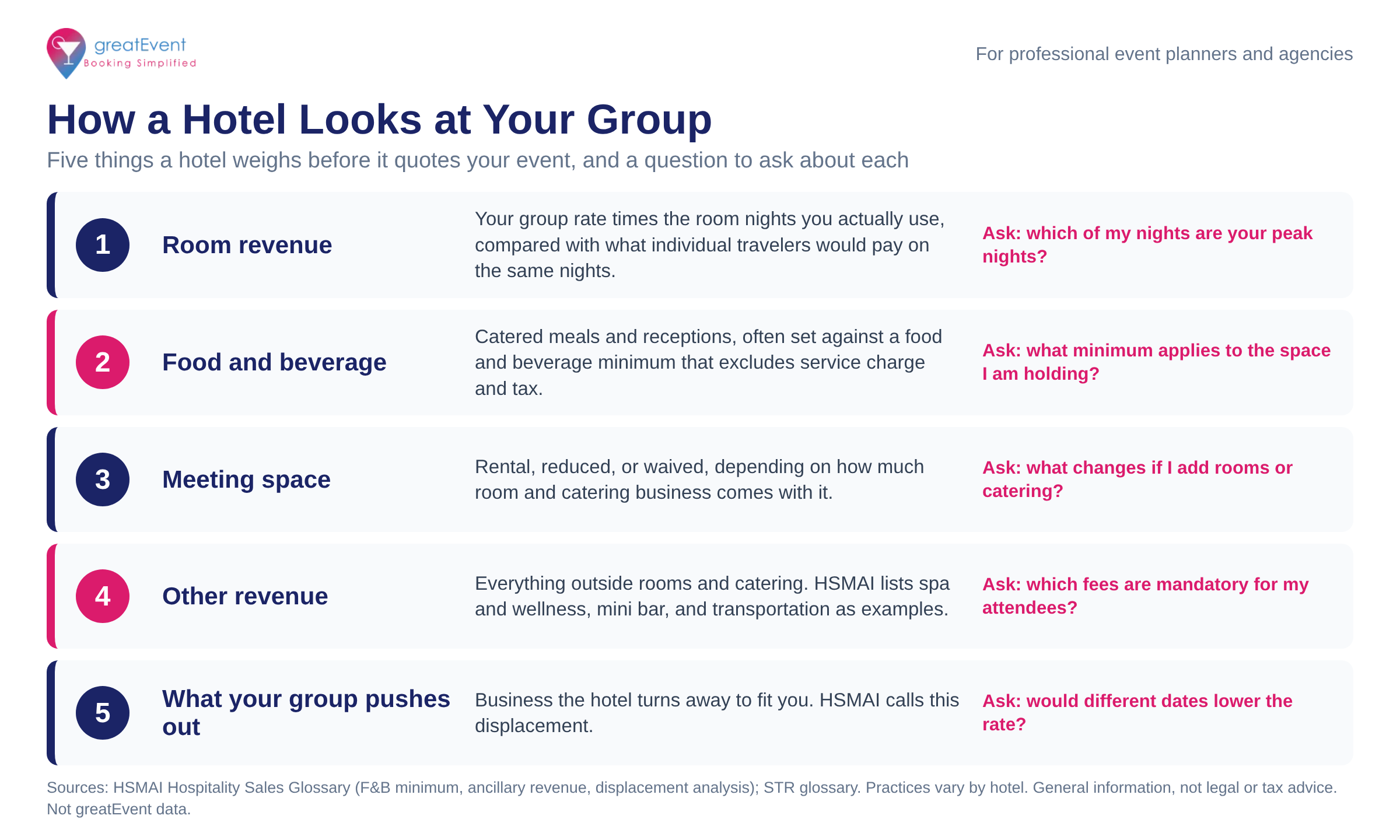
Text version of the infographic:
- Room revenue: your group rate times the room nights you actually use, compared with what individual travelers would pay on the same nights. Ask: which of my nights are your peak nights?
- Food and beverage: catered meals and receptions, often set against a food and beverage minimum that excludes service charge and tax. Ask: what minimum applies to the space I am holding?
- Meeting space: rental, reduced, or waived, depending on how much room and catering business comes with it. Ask: what changes if I add rooms or catering?
- Other revenue: everything outside rooms and catering. HSMAI lists spa and wellness, mini bar, and transportation as examples. Ask: which fees are mandatory for my attendees?
- What your group pushes out: business the hotel turns away to fit you. HSMAI calls this displacement. Ask: would different dates lower the rate?
Room revenue and displacement
Hotels track room performance with three numbers, all defined in STR’s glossary. Average daily rate (ADR) is room revenue divided by rooms sold. Occupancy is rooms sold divided by rooms available. Revenue per available room (RevPAR) is room revenue divided by rooms available. A revenue manager’s job is to push RevPAR up, and your group can either help that number or hold it down.
HSMAI’s glossary describes displacement analysis as a way to “calculate the value of a group sale by contrasting it to transient business that it would displace.” If your peak nights are nights the hotel expects to sell out to individual travelers at high rates, your group has to beat that, so the rate goes up or the offer gets tighter. If your dates fall in a slow period, you are filling rooms that might otherwise sit empty, and you have more room to negotiate. This is why flexible dates, a different arrival day, or a shorter peak can change a quote more than any amount of pushing on the rate.
Food and beverage minimums and banquet revenue
HSMAI defines an F&B minimum as “the total dollar amount of catered events (not including service charge and sales tax) required by the hotel, based on the meeting space and dates being held.” Note that the minimum is usually counted before service charge and tax, so the bill your client pays will be higher than the minimum itself. HSMAI also tracks revenue per available space (RevPAS), total catering revenue divided by the square footage of meeting space, which tells you hotels measure their ballrooms the way they measure their rooms. A group that holds a large ballroom with a small catering spend pulls that number down. For how minimums and room rental trade off, see our guide to F&B minimums vs meeting room rental.

Meeting space rental and when it is waived
HSMAI uses the term space to group room ratio (SGR), the amount of meeting space a group needs compared with the number of sleeping rooms it books. A group with lots of space and few rooms is hard for a hotel to fit, because, in HSMAI’s words, it can leave the hotel “unable to book another group requiring meeting space ‘on top of it.'” Many hotels tie meeting room rental to the rest of your spend. When the room block and catering add up, the rental may be reduced or waived. When they do not, expect a rental charge, a higher minimum, or both. If your program is space-heavy, say so up front and ask the hotel which way it prefers to price it.
Service charges, taxes, and add-ons to plan for
Catering quotes rarely end at the menu price. The APEX glossary defines a service charge as “a mandatory and automatic amount added to food and beverage charges, usually used to defray the cost of labor and service equipment.” It is a separate thing from a gratuity, which the glossary describes as a payment to service staff to recognize good service. The IRS draws the same line for its own purposes: on its tip recordkeeping page, a payment is a tip only if the customer “voluntarily decides to pay it and determines the amount,” required gratuities in a contract count as service charges, and an employer “may distribute service charges or auto-gratuities to employees in any manner it chooses or may retain all or part of the service charges.” So ask the venue whether the service charge goes to staff and whether your client is expected to add a gratuity on top.
Also plan for sales tax on food and beverage, occupancy tax on rooms, and any mandatory hotel fees. The Federal Trade Commission’s Rule on Unfair or Deceptive Fees, in effect since May 12, 2025, requires businesses that offer or advertise a price for short-term lodging, including hotels, to show the total price with mandatory fees included; government charges can be listed separately but must be disclosed before payment. The FTC’s notice of the final rule says it covers business-to-business transactions as well as sales to consumers. For a group contract, ask the hotel to list every mandatory fee, such as a resort or facility fee, say whether it applies to your attendees, and put any waiver in writing. This is general information, not legal or tax advice.
Who you talk to at a hotel or venue
Titles vary, but most full-service hotels use some version of these roles. Knowing who decides what saves you a lot of forwarded emails.
| Role | What they handle for you |
|---|---|
| Group or meetings sales manager | Your inquiry, the proposal, the room block, and the group sales agreement |
| Catering sales manager | Menus, food and beverage minimums, and banquet functions. The APEX glossary describes this role as selling and servicing group and local food and beverage functions. |
| Conference or convention services manager (CSM) | Your main contact after the contract is signed. APEX calls this the “primary contact person assigned to an event” in a hotel or convention center. |
| Revenue manager | Sets pricing and how many rooms go to groups. HSMAI describes revenue management as applying analytics and forecasting to control pricing and inventory. You rarely meet them, but they shape your rate. |
| Director of sales (DOS or DOSM) | Leads the sales team and is often the person to ask when a request goes beyond what your sales manager can approve |
What each segment wants in your inquiry
Quotes come back faster and more accurate when the first message answers the questions each segment will ask anyway. Start from one brief so your vendors and suppliers all work from the same facts.
| Segment | Include in your first message |
|---|---|
| Hotels | Dates and alternates, rooms per night with the peak night, meeting space by day, meals, past pickup if you have it, and decision date |
| Venues | Date, guest count, event type, setup style, access hours needed, and whether you plan to use an outside caterer |
| Caterers and restaurants | Guest count, service style, dietary needs, timing, and whether the venue has a kitchen |
| Attractions and entertainment | Date, time window, group size, buyout or shared space, and any accessibility needs |
| Travel and destination partners | Arrival pattern, transfers, activities, and the budget format you want quoted |
For hotels in particular, the history of past events tells the sales team how reliable your numbers are. If you have pickup reports from the client’s last two programs, include them.
Where planners get negotiating room, by segment
The APEX glossary defines concessions as an agreement where “one party provides something of value to the other party in exchange for something else.” What a seller can give depends on how it makes money:
- Hotels: room rate, the complimentary room ratio (written as, for example, 1/50), meeting room rental, the food and beverage minimum, attrition allowance, and the cutoff date.
- Venues: rental rate on off-peak days, setup and teardown hours, and the minimum spend.
- Caterers and restaurants: menu substitutions to hit a minimum, the guarantee deadline, and room fees on slower nights.
- Attractions and entertainment: time slot, partial buyouts, and add-ons bundled into the fee.
In every case, your best lever is business the seller wants: dates it needs to fill, a pattern that fits around its other groups, or spend that lands in a department it cares about. For corporate travel programs, our guide on negotiating hotel corporate rates covers rate talks in more depth. If pickup is running behind, read how to reduce a hotel room block before the cutoff date. Contract terms are general information here, not legal advice. Have your client or counsel review any agreement before signing.
Hospitality terms planners should know
Definitions below follow the Events Industry Council’s APEX glossary, STR’s glossary, and HSMAI’s sales glossary, shortened for planners.
| Term | What it means | Why it matters to you |
|---|---|---|
| ADR (average daily rate) | Room revenue divided by rooms sold (STR) | The rate the hotel compares your group rate against |
| RevPAR | Room revenue divided by rooms available (STR) | The number revenue managers try to raise |
| Group vs transient | Group: typically 10 or more rooms a night under a signed agreement. Transient: everyone else (STR) | Decides whether you get a group contract or individual bookings |
| Room block | Total sleeping rooms used by and credited to one event (APEX) | The basis for your rate, concessions, and attrition |
| Pickup | Rooms actually used out of the block (APEX) | What attrition is measured against |
| Cutoff date | When the hotel releases unsold block rooms to the public (APEX) | After it, attendees may lose the group rate |
| Attrition | The gap between rooms (or food and beverage, or revenue) used and the amount agreed in the contract (APEX) | Can trigger damages if the shortfall passes the allowed slippage |
| Wash | The difference between reservations at cutoff and final reservations (APEX) | Helps you size the next block realistically |
| F&B minimum | Required catering spend, before service charge and tax (HSMAI) | Sets your floor for meals and receptions |
| BEO | A form hotels use to brief staff on a food and beverage function or room setup (APEX) | Your record of what was ordered |
| Displacement | Comparing a group’s value with the transient business it would push out (HSMAI) | Explains why peak dates cost more |
| Comp ratio | Free rooms earned per number of occupied rooms, such as 1/50 (APEX) | A common concession to ask for |
| Service charge | Mandatory amount added to food and beverage charges (APEX) | Not the same as a voluntary gratuity |
| Master account | The account for event charges the group pays directly (APEX) | Decide early what goes on it and what attendees pay |
For pickup, cutoff, and attrition in more depth, see our hub guide to managing conference room blocks.
What changes for corporate, sports, and wedding clients
The same segments show up in every program, but the weight shifts.
- Corporate meetings and conferences: hotels and meeting space carry most of the cost, so the room block, food and beverage minimum, and meeting room rental decide the budget. Expect a full group contract with attrition and cancellation terms.
- Incentive trips: lodging and food still matter, but recreation, entertainment, and destination services take a bigger share. Resort fees and activity costs need to be spelled out per guest.
- Sports teams and tournaments: the room block is often spread across several hotels near the venue, and arrival patterns follow the schedule. Ask how each hotel handles team blocks, meal rooms, and late checkouts.
- Weddings: room blocks are usually for out-of-town guests who pay for their own rooms, so ask how attrition and cutoff work when you cannot control who books. Catering and venue minimums tend to drive the budget.
Book venues, hotel room blocks, and services on greatEvent
Once you know how each segment prices, the next step is getting comparable quotes. On greatEvent, planners can book venues, meeting space, and hotel room blocks for their clients’ events, and find event vendors such as caterers, photographers, and entertainment. You can send one detailed inquiry to multiple venues and get quotes back, then add services and a hotel room block and finalize the details with your event specialist.
There are no fees for planners. We pay you commission on any qualifying booking you make on greatEvent.
Register as a professional planner
Frequently asked questions
What are the main segments of the hospitality industry?
▾
The core segments are lodging, food and beverage, and arts, entertainment, and recreation. Planners also buy travel and destination services, such as ground transportation and destination management companies, for the same events.
How do hotels price group business?
▾
Hotels weigh the room, catering, and other revenue a group brings against the business it would displace on the same dates. Dates, arrival pattern, and meeting space needs often move the price more than the headcount does.
What is the difference between group and transient hotel business?
▾
Group business is typically 10 or more rooms a night booked under a signed agreement. Transient business is everyone else, mostly individual travelers booking on their own.
Who do I contact at a hotel for an event?
▾
Start with the group or meetings sales manager. After you sign, a conference or convention services manager usually becomes your main contact, and the catering sales manager handles menus and banquet details.
Is a service charge the same as a gratuity?
▾
No. A service charge is a mandatory amount added to the bill, and the venue decides how it is used. A gratuity is voluntary. Ask the venue how its service charge is distributed.
Research and sources
Sources were checked on October 29, 2026. The opening scenario is fictional. No figures in this article are greatEvent data. Pricing models vary by property and market. Contract, fee, and tax points are general information, not legal or tax advice.
- U.S. Bureau of Labor Statistics, “Leisure and Hospitality”, bls.gov. Sector makeup and employment (September 2026, preliminary).
- U.S. Bureau of Labor Statistics, “Accommodation and Food Services: NAICS 72”, bls.gov. Sector definition.
- U.S. Bureau of Labor Statistics, “Arts, Entertainment, and Recreation: NAICS 71”, bls.gov.
- CoStar, STR Benchmark glossary, costar.com. Group and transient rooms, ADR, occupancy, RevPAR, revenue categories, meeting space, chain scales, and convention center hotels.
- HSMAI, “Build Your Business Acumen: 108 Terms” (PDF). Displacement analysis, F&B minimum, group ceiling, SGR, RevPAS, and revenue management.
- Events Industry Council, APEX Industry Glossary, insights.eventscouncil.org: catering sales manager, conference services manager, concessions, complimentary ratio, room block, pick-up, cut-off date, attrition, wash, banquet event order, service charge, gratuity, master account.
- Internal Revenue Service, “Tip Recordkeeping and Reporting”, irs.gov. Tips vs service charges.
- Federal Trade Commission, Rule on Unfair or Deceptive Fees, 16 CFR Part 464, ecfr.gov, and the final rule in the Federal Register (January 10, 2025; effective May 12, 2025).
Compare vendors for your next event
Search caterers, photographers, florists, planners, and rentals — then send one request to several vendors at once.