Quick answer: To plan a corporate event, set one business objective and name a budget owner. Choose the event type, dates, and headcount, and get the budget approved. Book the venue and guest rooms, then lock in vendors, the agenda, and registration. In the final month, confirm headcount, BEOs, and the run of show. Afterward, reconcile costs and report results.
The ten steps, in order:
- Set the business objective
- Get the right people to sign off
- Build and approve the budget
- Choose the event type, format, and dates
- Book the venue and guest rooms
- Line up vendors through procurement
- Build the agenda and content
- Open registration and manage attendees
- Run the final month
- Close out and report
Your VP of Sales wants a kickoff for 150 people in late February: two days, a general session, breakouts, and one hotel night. You can run the logistics in your sleep. The harder part is everything around them. Finance wants a number before you talk to venues, procurement needs to onboard the AV company, IT wants to review the registration form, and nobody has said how anyone will know whether the event worked.
This guide is for in-house corporate meeting planners and agency planners running events for corporate clients. It follows one event from objective to final report and names who signs off at each stage. If you need a general list for any kind of event, use our general checklist for any event type. This one is only about company events.
What is a corporate event? Types and the venue each needs
A corporate event is any event a company organizes or pays for to reach a business goal, such as training staff, closing sales, rewarding employees, or hosting clients. Common types include meetings, conferences, offsites, sales kickoffs, product launches, and client hospitality events.
Corporate event planning is the work of turning that goal into a funded, approved, and booked event, then proving afterward that it delivered. The type you choose shapes the venue you need, so it helps to match them early.
| Event type | Main goal | Venue that usually fits | Must-have space | Guest rooms? | Our deeper guide |
|---|---|---|---|---|---|
| Board or leadership meeting | Decisions and strategy | Boardroom or private hotel meeting room | Quiet room with one table, screen, and privacy | Sometimes | Board meeting room costs; renting hotel meeting rooms |
| Training or workshop | Skills and certification | Meeting room set classroom style | Tables, power at seats, strong Wi-Fi | Sometimes | See step 7 (Wi-Fi) |
| Sales kickoff or all-hands | Alignment and motivation | Hotel ballroom or conference center | General session room plus breakouts | Usually | See step 7 (breakouts) |
| Conference or summit | Education and networking | Conference hotel or convention center | General session, breakouts, exhibit or networking space | Usually | Offsite vs. conference |
| Offsite or retreat | Strategy and team time | Resort, retreat center, or unique venue | Flexible meeting room plus informal space | Usually | See step 3 (offsite costs) |
| Team building | Working relationships | Open floor or activity space | Clear floor, setup time, indoor backup | Only if overnight | Corporate sports event ideas |
| Product launch | Press, buzz, and sales | Unique venue or studio | Stage, lighting, and a reveal moment | Sometimes | Product launch venue guide |
| Client hospitality or mixer | Relationships and pipeline | Private dining room, rooftop, or lounge | Standing room with bars and quiet corners | Rarely | Networking mixer venues |
| Holiday party or awards dinner | Recognition | Ballroom or banquet hall | Rounds, stage, and dance floor or AV for awards | Sometimes | Corporate holiday party venues |
| Hybrid event | Reach remote attendees | Venue with streaming support | Production space, wired internet, camera positions | Depends on format | See step 4 (hybrid) |
| Trade show or expo | Lead generation | Convention or exhibition center | Exhibit hall, loading docks, and meeting rooms | Usually | Not yet covered |
How to plan a corporate event, step by step
The running example below is a 150-person, two-day sales kickoff with breakouts and one hotel night. The numbers are illustrative. Each step names who owns it and what has to be signed before you move on.
1. Set the business objective and how you’ll measure it
Write one sentence that says why the company is spending this money. For the kickoff, it might be “Every account executive leaves with the new territory plan and the product messaging for the year.” Then pick two or three measures you can actually collect, such as attendance against invitations, a post-event survey score, or pipeline created within 90 days.
Agree on who reports those numbers and when. If the measure is pipeline, sales operations has to pull it, so put them on the list now. Owner: planner and executive sponsor. Sign-off: objective and measures approved by the sponsor.
2. Get the right people to sign off
Corporate events stall when someone who can say no hears about the event late. List every approver at the start, along with what each one needs from you:
- Executive sponsor: the objective, the date, and the final go decision
- Budget owner or finance: the budget, the cost center, and the payment process
- Procurement and legal: vendor onboarding, contract review, and insurance certificates
- IT and security: the registration platform and any attendee data you collect
- HR or the travel team: travel policy, duty of care, and the invite list for internal events
Most companies already work this way. In the Amex GBT 2026 Global Meetings and Events Forecast, 76% of meeting professionals said they use meeting approval processes for all or most meetings. If your company doesn’t have a template, our corporate meeting budget approval template gives you one to adapt. Put each approver’s deadline on the timeline. Owner: planner. Sign-off: approver list confirmed by the sponsor.

3. Build and approve the budget
Build the budget before you put a venue on hold. Group it into venue and F&B, guest rooms, AV and production, travel, speakers, registration and technology, transportation, staffing, and a contingency line. Size the contingency using your company’s policy or the budget owner’s guidance. There’s no single industry percentage that fits every event.
Show the total per attendee as well. Finance teams often compare events that way, and it makes trade-offs easier to discuss. Our guide to corporate event cost per attendee helps you sanity-check the number, and for an offsite, use our breakdown of offsite costs per person per day. Expect pressure on price. In the same Amex GBT forecast, cost was the top expected challenge for 2026 (38% of respondents). Owner: planner and budget owner. Sign-off: budget and cost center approved.
4. Choose the event type, format, and dates
Confirm the event type from the table above, then decide whether it’s fully in person or hybrid. If remote teammates need to join, see our hybrid event venue guide before you send any venue requests. Choose a primary date range and at least one backup. Check it against fiscal year-end, quarter-close weeks, major holidays, and other company events. A sales kickoff during quarter-close is a hard sell to the sales leaders you need in the room.
Set the headcount as a range, not a single number. You’ll need it for venue capacity, the room block, and F&B. Owner: planner and sponsor. Sign-off: type, format, date range, and headcount range.
5. Book the venue and guest rooms
Write a one-page requirements sheet first: dates, headcount, room sets, breakouts, AV, F&B, guest rooms, and the budget. For a small or short-notice meeting, you may be able to book a venue in real time. For a multi-day program with guest rooms, most planners send a hotel RFP for group bookings, compare proposals using a hotel proposal comparison template, and visit with a site inspection checklist before legal reviews the contract. Our step-by-step guide on how to book a venue for a corporate event covers the full process.
Size the room block from past pickup, not hope, and treat it as its own decision. See our corporate event room block guide, and for conferences, our guide to managing conference room blocks. Check room capacity by layout with our meeting room capacity chart. Owner: planner, with procurement and legal for the contract. Sign-off: signed venue contract.
Once the budget is approved, you can search meeting and event venues on greatEvent and book instantly where available.
6. Line up vendors through procurement
AV and production, transportation, photography, signage, and any outside entertainment all need contracts. Catering usually comes through the venue. Inside a company, the slow part is often onboarding, not the vendor. A new supplier may need a vendor record, tax forms, a security review, and a certificate of insurance before procurement will issue a purchase order. Ask procurement how long that takes and start as soon as the venue is signed.
Use our venue RFP and production checklist to brief AV. If you’re hiring a full production team, read our guide to choosing a corporate event production company. Owner: planner and procurement. Sign-off: vendor contracts and insurance certificates on file.
7. Build the agenda and content
Map every session to a room, a time, a speaker, and an AV need. For the kickoff, that might mean a general session for 150, four breakouts on day two, and a working lunch. Our guide on how many breakout rooms a conference needs helps you size the breakouts. If sessions rely on live demos or app-based polling, check bandwidth against our meeting Wi-Fi requirements.
Plan AV per session, not per event. List microphones, screens, confidence monitors, recording, and any streaming, and confirm power and internet with the venue in writing. Owner: planner and content leads. Sign-off: agenda approved by the sponsor; speakers confirmed.
8. Open registration and manage attendees
Get the invite list from HR or sales operations, then build a registration form that captures only what you need: name, role, travel details, dietary needs, and accessibility requests. Have IT review the platform if it stores personal data. Hotels and other businesses open to the public are covered by Title III of the Americans with Disabilities Act, but your own planning still decides whether everyone can take part. Our inclusive events guide covers what to ask.
Publish the travel policy with the invitation. Then build the rooming list from registration and send it to the hotel by the cutoff date. Our corporate meeting rooming list guide has a template. Owner: planner, HR or travel, and IT. Sign-off: registration live; rooming list sent.
9. Run the final month
Confirm the final headcount and send your F&B guarantee by the date in your contract. Industry glossaries describe the guarantee as the number of servings you pay for whether or not they’re eaten, often due about 48 hours before the event, but your contract sets the actual deadline. Review and sign every banquet event order (BEO), and keep a log of any venue change orders with their costs.
Write the run of show minute by minute, brief internal staff and vendors, and hold a pre-event meeting with the venue. Confirm the emergency plan: who calls whom, where people gather, and what happens if a keynote speaker can’t travel. Owner: planner. Sign-off: BEOs signed; run of show shared.
10. Close out and report
Reconcile the venue’s final invoice line by line against the contract and the signed BEOs before finance pays it. Check room pickup against the block and any attrition terms. Our guide to room block attrition and shortfalls explains the math. Send the survey within a day or two while the event is fresh.
Then report against the objective from step 1. Attendance alone won’t tell the sponsor much. A one-page summary for the sponsor should cover the measures you agreed on, the final cost against budget, and three things to change next year. In the Amex GBT 2026 forecast, 36% of meeting professionals said they plan to use data and ROI measurement tools to capture the value of meetings. Owner: planner, finance, and the sponsor. Sign-off: final report delivered.
Corporate event planning timeline
The table below is a typical timeline for a mid-size to large company event. It varies by event size: a 20-person workshop can compress it into weeks, while a large conference may start more than a year out. Recent industry surveys point both ways. In Global DMC Partners’ Q3 2025 Meetings and Events Pulse Survey of 151 planners, nearly half of meetings and conferences were planned four to nine months out, and about a third of planners contacted hotels and venues 10 to 12 months ahead. Skift Meetings reported in early 2026 that executive delays are compressing lead times, with some events approved only weeks out.
| When (typical; varies by event size) | What gets done | Owner | Deliverable or sign-off |
|---|---|---|---|
| 12+ months out (large conferences only) | Objective, date options, destination shortlist, early venue and hotel search | Planner, executive sponsor | Objective signed; date range agreed |
| 6 to 12 months | Budget built and approved, approvers named, venue requests sent, site visits, contract review | Planner, finance, procurement or legal | Budget approved; venue contract signed |
| 3 to 6 months | Vendors sourced and onboarded, agenda drafted, registration platform reviewed, room block set | Planner, procurement, IT | Vendor contracts and insurance certificates; registration approved |
| 1 to 3 months | Registration open, speakers confirmed, travel booked, rooming list built, AV finalized | Planner, HR or travel, comms | Registration live; rooming list sent by cutoff |
| Final 2 weeks | Final headcount and guarantee, BEOs signed, run of show, staff and vendor briefing | Planner | BEOs signed; guarantee sent; run of show shared |
| Event week | Pre-event meeting with the venue, setup checks, daily debriefs, change orders logged | Planner, venue team | Change order log; daily issue list |
| 1 to 2 weeks after | Invoice reconciled, attrition checked, survey analyzed, report sent | Planner, finance, sponsor | Final report against the objective |
For venue lead times by event size, see our guide on how far in advance to book a conference venue.
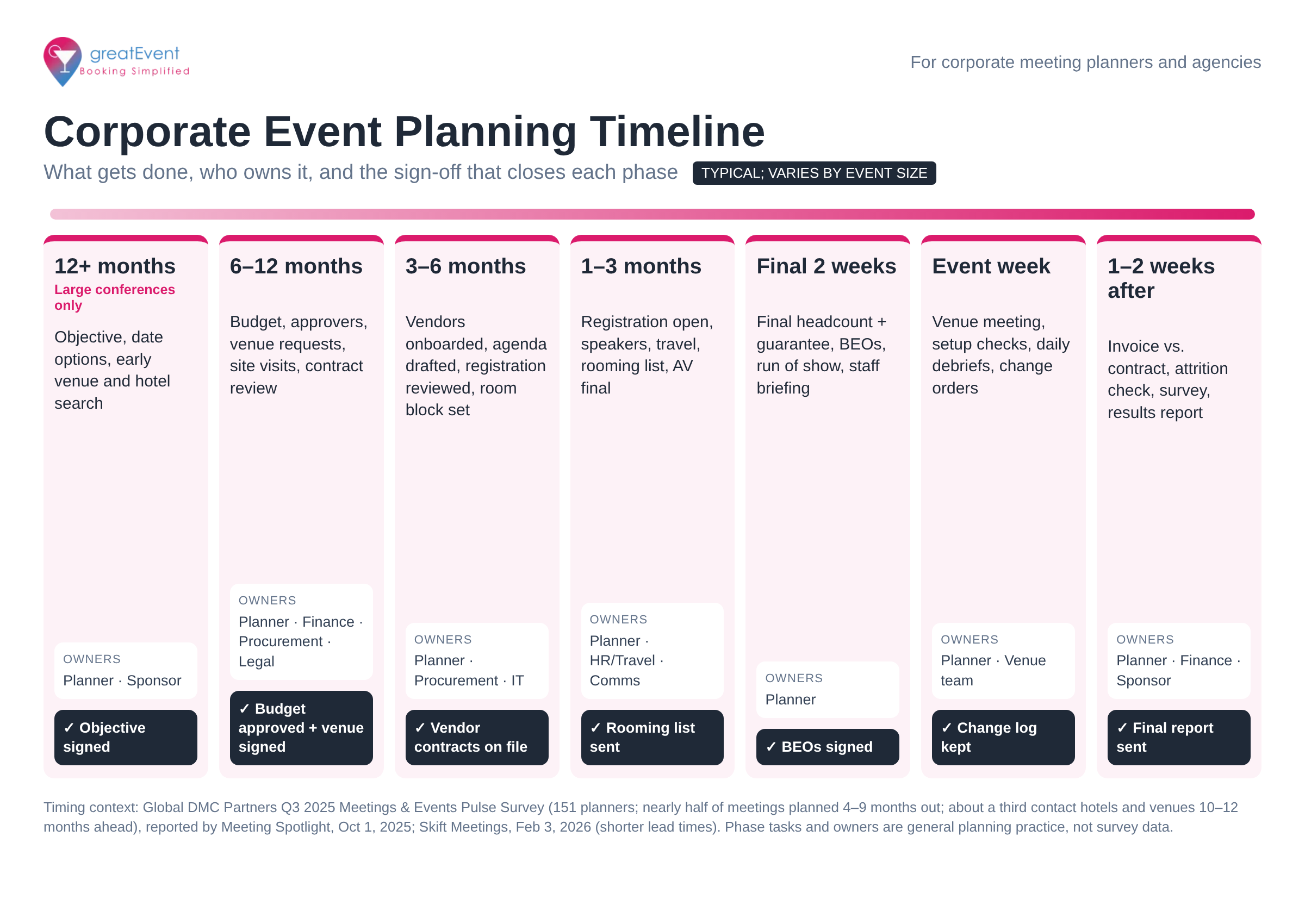
Text version of the infographic: 12+ months out (large conferences only): set the objective and date options; owners are the planner and sponsor; sign-off is the objective. 6 to 12 months: budget and venue; owners are the planner, finance, procurement, and legal; sign-offs are the approved budget and signed venue contract. 3 to 6 months: vendors, agenda, and room block; owners are the planner, procurement, and IT; sign-off is vendor contracts on file. 1 to 3 months: registration, speakers, travel, and the rooming list; owners are the planner, HR or travel, and comms; sign-off is the rooming list sent. Final 2 weeks: guarantee, BEOs, and run of show; owner is the planner; sign-off is signed BEOs. Event week: venue meeting, setup, and change orders; owners are the planner and venue team. 1 to 2 weeks after: invoice reconciliation, survey, and report; owners are the planner, finance, and sponsor; sign-off is the final report.
How the timeline shrinks for smaller events
| Event size | Planning window | Who needs to approve | Venue route | Add a room block? |
|---|---|---|---|---|
| Small internal meeting (under 50, one day, local) | Weeks to a few months | Budget owner; sponsor for anything off-site | Instant booking where available | No |
| Mid-size meeting or offsite (50 to 200, breakouts, one or two hotel nights) | Often 4 to 9 months, in line with the Global DMC Partners survey | Sponsor, finance, procurement, legal | RFP or instant booking, depending on rooms | Yes, sized from past pickup |
| Large conference (200+, multi-day, exhibits) | Often 10 to 12 months or more for venue and hotel contact | All approvers, plus IT and comms | RFP with site visits | Yes, often more than one hotel |
| Urgent event (under 30 days) | Days to weeks | Sponsor and budget owner on a fast track | Instant booking where available; expect fewer options | Only if needed, with a short cutoff |
If you’re short on time, our guide to the fastest way to confirm a corporate event venue covers what to drop and what to keep.
Corporate event planning checklist
Copy this into a document and fill in an owner for each line.
Objective and approvals
- ☐ Business objective written in one sentence Owner: ________
- ☐ Two or three measures and who reports them Owner: ________
- ☐ Approver list with deadlines Owner: ________
- ☐ Executive sponsor named Owner: ________
Budget and dates
- ☐ Budget by category, with a contingency line Owner: ________
- ☐ Cost per attendee calculated Owner: ________
- ☐ Cost center and payment process confirmed Owner: ________
- ☐ Primary and backup date ranges checked against fiscal and holiday calendars Owner: ________
Venue and rooms
- ☐ Requirements sheet sent Owner: ________
- ☐ Proposals compared and site visit done Owner: ________
- ☐ Contract reviewed by legal and signed Owner: ________
- ☐ Room block sized and cutoff date on the calendar Owner: ________
Vendors and agenda
- ☐ Vendors onboarded with procurement Owner: ________
- ☐ Insurance certificates on file Owner: ________
- ☐ Session map with rooms, speakers, and AV needs Owner: ________
- ☐ Wi-Fi and power confirmed in writing Owner: ________
Attendees
- ☐ Invite list from HR or sales Owner: ________
- ☐ Registration form reviewed by IT Owner: ________
- ☐ Dietary and accessibility requests collected Owner: ________
- ☐ Rooming list sent by cutoff Owner: ________
Final month and wrap-up
- ☐ Final headcount and guarantee sent Owner: ________
- ☐ BEOs reviewed and signed Owner: ________
- ☐ Run of show and emergency plan shared Owner: ________
- ☐ Invoice reconciled against contract and BEOs Owner: ________
- ☐ Survey sent and report delivered to the sponsor Owner: ________
Common mistakes on corporate events
- Booking before the budget is approved. A signed venue contract with no approved budget puts you in a bad negotiating spot with finance and the venue.
- No named signer. If nobody knows who can sign the contract, holds expire while the paperwork goes in circles.
- Starting procurement late. Vendor onboarding can take longer than the vendor’s own lead time.
- Sizing the room block on hope. Use past pickup, and set the cutoff date before registration closes.
- No one owns the report. If the post-event report isn’t assigned in step 1, it usually doesn’t get written.
If you’re deciding whether to bring in outside help, our guide to what it costs to hire a corporate event planner covers it from the buyer’s side.
Book your venue on greatEvent
Once the objective and budget are approved, the next job is the venue. Register as a professional planner on greatEvent to search meeting and event venues as well as event vendors, and book instantly where available. Need help finding the right fit? A member of the greatEvent team can help you source venues for your event.
Register as a professional planner
Research and sources
Sources reviewed October 22, 2026. Survey figures describe each survey’s respondents, not every US planner. The sales kickoff example is illustrative. Contract and legal points are general planning information, not legal advice.
- American Express Global Business Travel, “2026 Global Meetings and Events Forecast” (survey of 601 meeting professionals in eight countries by YouGov, July 14 to 21, 2025). Use of meeting approval processes (76%), cost as the top expected challenge (38%), and plans to use data and ROI measurement tools (36%).
- Global DMC Partners, Q3 2025 Meetings and Events Pulse Survey, as reported by Meeting Spotlight, October 1, 2025 (151 respondents). Meeting and conference lead times (nearly half four to nine months out) and hotel and venue contact timing (about a third 10 to 12 months ahead).
- Skift Meetings, “CEOs Who Delay Booking Meetings Are Throwing Money Away,” Barbara Scofidio, February 3, 2026. Executive delays and shorter lead times.
- Association of Conference and Business Events (ACB), “Glossary and Thesaurus of M.I.C.E. Terminology,” hosted by Meeting Professionals International (mpi.org). Definition of the F&B guarantee and its typical timing.
- U.S. Department of Justice, “Introduction to the Americans with Disabilities Act” (ada.gov). Title III coverage of businesses open to the public, including hotels.
Frequently Asked Questions
How far in advance should you plan a corporate event?
▾
It depends on size. Small internal meetings can come together in weeks, mid-size meetings often take four to nine months, and large conferences may start a year or more out.
What are the 5 main types of corporate events?
▾
There’s no official list of five. Common types include meetings, conferences, offsites, sales kickoffs, product launches, team building, and client hospitality events.
Who is responsible for planning a corporate event at a company?
▾
Usually an in-house meeting planner or an agency, working with an executive sponsor who owns the objective. Finance, procurement, legal, IT, and HR each sign off on their part.
What is the difference between a corporate event and a conference?
▾
A conference is one type of corporate event, built around education and networking, often with breakouts. Corporate events also include smaller meetings, offsites, launches, and hospitality events.
Do you need an event planner for a corporate event?
▾
Not always. Small meetings can be run by an in-house coordinator, while large or multi-day events usually benefit from a dedicated planner or agency.
How do you plan AV for a corporate event?
▾
List AV needs session by session, then brief your AV provider or the venue in writing. Confirm power, internet, and rehearsal time before the contract is signed.
How do you measure the success of a corporate event?
▾
Set two or three measures before the event, such as attendance, survey scores, or pipeline. Report them against the objective with the final cost.
Compare vendors for your next event
Search caterers, photographers, florists, planners, and rentals — then send one request to several vendors at once.