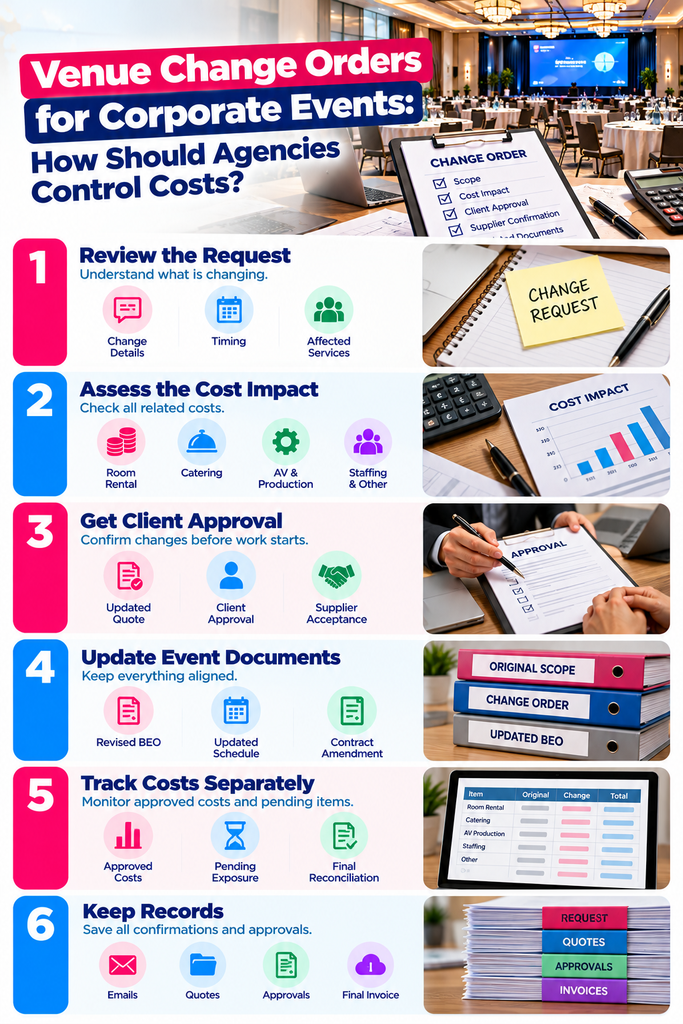
Quick answer: Record the original scope, price the complete change, get the required client authorization and supplier acceptance, and update the event documents before any work starts. Track approved costs separately from pending exposure, then check the final invoice against the agreed scope and what was actually delivered.
A client asks to extend a leadership meeting by an hour. It sounds like one line item. It can touch room rental, technicians, security, catering, and the crew already scheduled to strike the stage. Approve only the extra room hour and you have agreed to a number that is not the number.
This is for corporate event agencies, meeting producers and account managers handling changes after a venue is booked. The workflow below is recommended agency practice. The supplier terms cited are identified separately and apply only where they are incorporated into your actual agreement.
What a venue change order is
A venue change order documents a change to agreed scope: the affected services, the price, the timing, the approvals. Adding a breakout room. Extending rehearsal. Changing catering quantities. Moving installed AV into a different space. A change can raise cost, lower it, or move nothing at all.
It might be called an amendment, a revised quote, or an updated banquet event order. A BEO usually describes operational arrangements such as room setup, meal service and timing, and its contractual weight depends on the agreement it sits under. Keep a reference from each change to the document it revises, and establish which document governs when two of them disagree.
Do not assume an agency approval form changes the venue contract. Hilton’s published standalone BEO terms generally require signed written amendments, while allowing the final attendance guarantee by phone. [1] Check the procedure in the agreement you actually signed, because those two routes are not interchangeable.
Which changes should trigger a cost review
Run this whenever a request changes quantities, timing, space, or how a supplier delivers its work. These are questions to investigate, not charges every venue imposes.
| Change requested | Costs or commitments to check |
|---|---|
| Longer event or rehearsal | Room access, crew hours, catering service, security, delayed teardown |
| Different room or seating layout | Room reset, furniture, technical relocation, revised usable capacity |
| More or fewer attendees | Meal guarantees, minimum spend, staffing, rentals, room capacity |
| Added AV or hybrid session | Equipment, technicians, internet, power, testing and delivery |
| New staging or production design | Rigging, labor, installation time, approvals and removal |
| Earlier delivery or later pickup | Dock appointments, handling, storage and after-hours access |
| Removed service or equipment | Eligible credit, cancellation charges, costs already incurred |
| Venue or supplier substitution | Service equivalence, rework, client acceptance, cost responsibility |
Hilton’s BEO terms identify supplemental charges for things like early setups, late finishes and room resets. Encore’s published terms describe minimum labor calls and additional charges when actual hours or equipment quantities exceed the estimate. [1][2] Get the rules attached to your booking before you approve anything.
Two of these rows have their own economics worth understanding before the conversation starts. Attendee changes run into how a food and beverage minimum interacts with room rental, and adding a breakout runs into how many breakout rooms a conference actually needs.
The approval workflow
1. Establish the baseline and name the payer
Keep the signed venue agreement, the latest accepted BEO, the production quote, room diagrams, the agency statement of work and the client purchase order together, with every version dated. The baseline should state included quantities, access hours, exclusions, and whether each price is fixed, estimated, or dependent on actual use.
That last distinction decides which numbers can move later without anyone approving anything.
Identify who contracted with each supplier and who pays its invoice. An agency buying in its own name has to align supplier commitments with its client agreement. A client contracting directly with the venue may need the agency to coordinate approvals without holding any authority to spend. Record which situation applies for every supplier, because assuming the wrong one is how an agency ends up owing money it never agreed to.
If you are setting that baseline now, the hotel proposal comparison template is where the accepted scope should come from. [6]
Then build a deadline register: meal guarantees, discounted ordering, design approval, labor booking, cancellation. Take the dates from the event documents and set earlier internal review dates, so the client has room to decide rather than being handed a deadline that has already passed.
2. Log the request before you promise anything
Give every request an ID, such as CO-007. Record the requester, the reason, the affected session, the decision time needed, and the scope being replaced. Keep the original request even when the eventual solution looks nothing like it.
Separate client additions from corrections to an agency brief, supplier mistakes and venue-directed changes. Record the proposed cost owner rather than routing every charge to the client by reflex. Where responsibility is disputed, keep it visibly disputed until somebody settles it.
3. Ask every affected supplier for the full price impact
Request an itemized net increase or decrease with quantities, rates, minimum labor calls, overtime assumptions, fees, applicable taxes and confirmed credits.
Ask whether the quote replaces an earlier total or adds to it. Adding a replacement quote onto the original budget double-counts the same work, and it is one of the easiest errors to make and one of the hardest to spot three weeks later.
Ask the venue to confirm operational feasibility alongside price. A later end time can collide with another booking regardless of what the client can afford. For AV, get the supplier’s acceptance of the equipment and crew requirement before you tell anyone the change is confirmed.
Timing changes the price too. Encore EventNow directs customers with events less than two business days away to contact the venue team for availability and confirmation. McCormick Place’s technology guidance lists standard rates for late, incomplete and on-site orders, including changes to a previous order. [3][4] Provider-specific examples, but the pattern is general: the same request costs more the later it lands.
4. Get client approval and supplier acceptance
The client approver needs the business reason, the full client-facing price, the revised forecast, the funding source and the decision deadline. Show agency fees or markups as the client agreement requires, and keep supplier cost and client billing in separate fields so you can read budget impact and margin independently. The corporate meeting budget approval template covers what a finance approver expects to see.
Record approval using whatever method the relevant agreements require. A client’s email approval can satisfy your internal workflow while the venue still needs a signed amendment. Complete any purchase-order revision, then confirm the supplier has accepted and reserved the resources.
Do not treat missing paperwork as protection. Section 2 of Encore’s published terms provides for charges for requested additional equipment, services or labor even where additional forms were never executed. [2] Align your approval process with the supplier contract before the event, not during the dispute.
5. Update the documents and release the work
Issue the revised BEO, production schedule, floor plan, supplier order and budget wherever affected. Mark versions clearly and identify what they supersede. Send each team only the changes relevant to its work, with an effective time and a named owner.
Use statuses that distinguish Requested, Quoted, Client Approved, Supplier Confirmed, Delivered and Reconciled. Keep Declined and Canceled in the history rather than deleting them. A request with client approval but no supplier confirmation has to stay visibly incomplete, because that is the exact state in which people assume something is handled.
Who can authorize extra spending
Agree spending authority before arrival. This matrix is a starting point. Assign real names, backups, limits and approval methods for the event.
| Role | Recommended responsibility |
|---|---|
| Client budget owner | Approve business need, client price and funding within delegated authority |
| Agency account lead | Check client agreement, cost recovery and required procurement steps |
| Agency producer | Verify operational dependencies and coordinate supplier execution |
| Venue or supplier contact | Confirm feasibility, price, resources and accepted change documents |
| Finance or procurement | Update purchase orders and review invoice and payment records |
Share the authorized spending list with the venue and suppliers, and ask them to acknowledge the routing instructions. Hilton’s standalone BEO terms specifically call for written identification of authorized spend signatories and daily review of additional-spend records. [1] Worth raising with your own venue.
Set per-change and cumulative limits. Without the second one, several small approvals quietly clear the allowance nobody thought was at risk. A presenter, executive guest or client employee asking for a change goes to the designated approver unless they already hold that authority themselves.
Calculating the real cost
Net supplier change is added services, labor, mandatory charges and applicable taxes, minus confirmed credits. Then calculate the client-facing change under your agency agreement. A removed item counts as a saving only once the supplier confirms the credit and any cancellation cost.
An illustrative example: an event adds a rehearsal and relocates a breakout session. These amounts are invented to show the arithmetic, not market rates. Each charge is assumed separate with no overlapping labor.
| Change component | Illustrative amount |
|---|---|
| Additional room access | $600 |
| Technical labor | $720 |
| Equipment relocation | $250 |
| Venue reset labor | $300 |
| Quoted service charges and taxes on added scope | $290 |
| Confirmed credit including any related fee or tax reversal | -$200 |
| Net supplier increase | $1,960 |
Assume the agency agreement adds a $150 management fee, with no further tax in this simplified case. The client-facing increase is $2,110. The $290 is an assumed quoted amount, and real tax treatment, including which charges sit in each taxable base, has to be confirmed for the booking.
Now place it against the budget. If the client-facing committed baseline was $48,000 and the approved ceiling is $52,000, the revised commitment is $50,110 and the headroom is $1,890. A separate pending $900 request would take potential exposure to $51,010, leaving $990 if approved.
Keep that pending request visible without calling it committed. The gap between those two words is where agencies lose control of a budget, one reasonable-sounding approval at a time.
Do not fold a contingency reserve into committed costs just because the reserve exists. Show the approved ceiling, committed spending, estimated variable costs, pending requests and remaining reserve as five separate numbers. For estimated labor or consumption, record the expected final cost before the final bill arrives rather than after.
A change order template
Copy these fields into your workflow. Attach the supplier’s revised quote and follow the signing requirements of the underlying agreements. This is an operational record, not a substitute for negotiated terms.
CHANGE IDENTIFICATION
Event and client: [Enter]
Venue and affected supplier: [Enter]
Change ID and version: [Enter]
Requester, request date, and reason: [Enter]
Original agreement, BEO, or quote reference: [Enter]

SCOPE AND OPERATIONAL EFFECT
Original scope: [quantities, room, service, times]
Requested replacement or addition: [Enter]
Affected suppliers and dependencies: [Enter]
Decision deadline and quote expiration: [date, time, time zone]
Effect if declined or delayed: [Enter]
Feasibility or approval still outstanding: [Enter or none]

COST AND FUNDING
Added supplier cost, itemized fees and taxes: [$]
Confirmed credit, cancellation cost accounted for: [$]
Net supplier change: [$]
Agency fee or other agreed client charge: [$]
Total client-facing change: [$]
Fixed or estimated price and assumptions: [Enter]
Revised forecast and remaining budget: [$]
Proposed payer and funding source: [Enter]

AUTHORIZATION AND COMPLETION
Client approver, authority, date, evidence: [Enter]
Agency approval and purchase-order status: [Enter]
Supplier acceptance and revised document reference: [Enter]
Approved spending cap, if applicable: [$ and conditions]
Execution owner and effective time: [Enter]
Documents updated and distributed: [Enter]
Actual delivery, final amount, invoice reference: [Enter]
Keep a companion log with one row per change: ID, supplier, description, cost owner, client-facing amount, status, decision deadline, approver, final billed amount. Link the approval evidence and revised quotes to that row.
Urgent changes on site
Agree a limited exception process before the event. Specify who may authorize spending, which categories qualify, a per-change cap, an aggregate cap, and how fast the written record has to follow. Get supplier acceptance of any proposed spending limit, because a cap the supplier never agreed to is not a cap.
For a discretionary request during the event, ask for a price or an agreed maximum before directing the work. Where the supplier cannot give a fixed price, record the rate basis, minimum hours, the estimate and the escalation point. Urgency does not hand spending authority to everyone wearing a lanyard.
Immediate safety action follows the venue’s emergency procedures, with the circumstances and costs documented as soon as practical afterward. For ordinary operational changes, keep the named client and agency approvers reachable, including a backup for when they are sitting in sessions.
At the end of each event day, review new charges and actual labor with the venue and production leads. Resolve incomplete records while the people who requested and delivered the work are still on site and still remember.
Checking the final invoice
Match the invoice to the accepted baseline, the change log, revised supplier documents and delivery records. For variable charges, compare billed quantities and hours against the agreed rate basis and actual use.
- Verify that a replacement quote and the original amount were not both charged
- Confirm agreed credits and deposit payments appear in the right places. A deposit reduces the balance due; it does not reduce the event’s total cost
- Check service charges and taxes against the quoted bases, including adjustments on credits
- Look for duplicate AV charges appearing on both a supplier invoice and the venue master account
- Separate accepted amounts from questioned items, each with a document reference and a requested correction
Raise discrepancies within the contract’s notice period and follow its payment and dispute process. A missing agency change form is a reason to investigate a charge, not evidence the charge is invalid. Close the log only once delivery, billing, credits and client cost recovery are all reconciled.
Start the next booking with a clear scope
Use greatEvent to explore venues for your next corporate meeting or event. [5] Share the intended layout, production needs and full access schedule before confirming anything, and describe your requirements to EVA if that helps surface options. Confirm the venue’s inclusions and change process, then keep that accepted scope as your cost baseline.
Getting the production requirements right up front removes a whole category of change order later. What production details belong in a venue RFP covers that stage, and meeting packages versus itemized pricing covers why an inclusive quote can make changes harder to price.
Research and sources
Research reviewed October 9, 2026. Supplier terms apply only where incorporated into the relevant agreement, and provider documents change. The approval workflow, authority matrix, cost example, template and invoice checklist are editorial agency practice, not contract language. No contingency percentage or charge level here is presented as an industry standard.
[1] Hilton, Banquet Event Order Additional Terms and Conditions. Additional spend, supplemental surcharges and amendments. Published revision date September 3, 2019.
[2] Encore, General Terms and Conditions. Sections 2 Estimate, 3 Labor Rates and 15 Changes to Event Quote. Verify the version attached to your actual quote.
[3] Encore EventNow, What If I Need to Edit My Order. Order-edit timing and venue-team confirmation for near-event requests.
[4] McCormick Place, Internet Services. Order guidance distinguishing advance and standard rates.
[5] greatEvent, How It Works. Brand connection for venue discovery and EVA. No change-order automation capability is claimed or was verified.
[6] greatEvent, Hotel Proposal Comparison Template for Corporate Meetings. Used for the initial venue cost baseline.
Frequently Asked Questions
Is a BEO the same as a change order? ▾
A BEO describes event arrangements. A change order identifies a revision to agreed scope. A revised BEO can document that revision where the applicable agreement allows it, so confirm the required approvals and which document takes precedence.
Can a venue charge for an unsigned change? ▾
Possibly. It depends on the agreement and the circumstances. Encore’s published terms include payment obligations for certain requested additional services even without extra executed forms. [2] Check the governing terms rather than assuming unsigned means unpayable.
Does reducing scope guarantee a refund? ▾
No. Ask for the net credit after cancellation obligations, committed work and applicable minimums. Only a confirmed credit should move the forecast. Asking to remove equipment or cut catering is not confirmation that you saved anything.
How much contingency should an agency reserve? ▾
Build it around unresolved risks, estimated services and the client’s tolerance for change. There is no universal percentage for corporate venue change orders, and anyone quoting one is guessing. Review the reserve as prices firm up and deadlines pass.
Can a zero-cost change skip approval? ▾
Record it if it affects timing, room layout, service delivery or other suppliers. A zero-dollar venue change frequently creates cost somewhere else. A lighter approval route is reasonable once the affected parties confirm there is no budget or operational risk.
Compare vendors for your next event
Search caterers, photographers, florists, planners, and rentals — then send one request to several vendors at once.