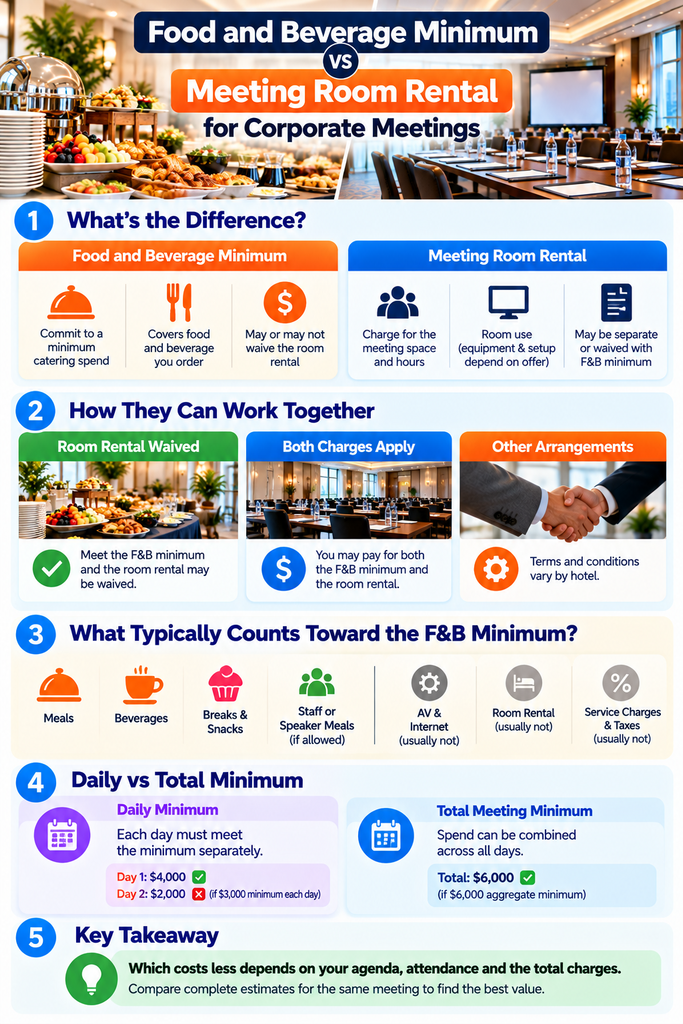
Quick answer: A food and beverage minimum is a commitment to buy a set amount of eligible catering. Meeting room rental is a charge for the space. A hotel might waive the rental when you clear the minimum, charge you both, or do something else entirely. Which is cheaper depends on your catering spend, your attendance and the total charges, not on the rental line by itself.
Start from the agenda. A full-day training program with breakfast, lunch and breaks has nothing in common with a two-hour executive meeting. Compare offers against the meals, room layout, access hours and equipment your meeting actually needs.
What is the difference between an F&B minimum and room rental
| Comparison | Food and beverage minimum | Meeting room rental |
|---|---|---|
| What you commit to | An agreed amount of eligible catering spend | Payment for specified meeting space and hours |
| What you receive | The food and drink you order; inclusions depend on the agreement | Use of the room; equipment, setup and services depend on the agreement |
| Main cost question | What happens if eligible spend falls below the minimum? | What is included, and does catering cost extra? |
| Relationship to other charges | May coexist with rental, fees and taxes | May coexist with an F&B minimum, fees and taxes |
Take a $4,000 minimum against $3,200 of qualifying catering. That is an $800 gap, and the contract decides what happens to it. What the minimum is not is a second $4,000 charge stacked on top of the $3,200 you ordered.
Does meeting the minimum make the room free
Only if the written offer says it waives that particular rental on those particular terms. Residence Inn Miami Sunny Isles Beach lists a rental waiver contingent on an F&B minimum among its value-date group concessions. That is one property’s offer with its own eligibility conditions, not a rule anybody else follows. [1]
Plenty of agreements carry both obligations. Westgate Park City Resort and Spa publishes an F&B minimum policy alongside separate event-space rental terms. [2] Ask the hotel to name every room a waiver covers, breakouts included, and every setup or access charge that survives it.
What counts toward a food and beverage minimum
Use the agreement’s definition of eligible spend, not your own. Track the qualifying catering amount separately from the invoice total. Spending more overall proves nothing about an F&B-only commitment.
| Invoice item | What to confirm |
|---|---|
| Breakfast, lunch and refreshment breaks | Which contracted functions and menu items count, at what billed value |
| Beverages billed on consumption | How actual consumption gets documented and credited |
| Discounted catering | Whether qualifying spend is measured before or after the discount |
| Restaurant meals and individual purchases | Whether these can be credited, and how they must be recorded |
| Staff, speaker or sponsor meals | Whether they count under the same agreement and master account |
| Service charges, gratuities and taxes | Whether excluded from the minimum, and what they apply to |
| AV, internet, labor and room rental | Whether the agreement credits any of it. Do not assume it is F&B spend |
| Deposits and payments | Which charges the payment settles. A deposit is not a catering purchase |
If the agreement excludes service charges and taxes, then $3,200 of catering plus $1,200 of fees and taxes is still $3,200 toward the minimum. Ask the hotel to show the qualifying subtotal on its estimate, separately.
Check whether the minimum applies by day or across the meeting
A two-day program can hit its overall budget and still miss a daily commitment.
Say the contract sets a separate $3,000 minimum each day. Spend $4,000 on day one and $2,000 on day two and you have a $1,000 gap on day two, despite spending $6,000 against $6,000. Rewrite that as a single $6,000 aggregate minimum and the same money clears it.
Which one you signed is entirely a question of scope. Confirm whether spending combines across dates, rooms, departments or functions. For an association conference, find out whether a sponsor’s separately contracted lunch counts toward the organizer’s minimum.
Keep a dollar minimum separate from a meal count
A spending minimum, a menu’s minimum servings, and a final attendance guarantee are three different requirements. Westgate’s published policies address an attendance minimum and a spend minimum separately. [2] Record all of them before comparing anything, because satisfying one says nothing about the others.
Which costs less for the same meeting
Compare complete estimates for the same agenda at expected attendance and at a lower one. This example shows why a rental waiver can be worth less than it looks. The figures are invented for illustration, not quotes or market averages.
Assume both offers include the same room, hours, setup and necessary equipment, that catering runs $80 per billable participant, that attendance can still move before the final guarantee, and that the room works at every size shown.
| Assumption | Offer A, F&B minimum | Offer B, room rental |
|---|---|---|
| Room rental | $0, including when a shortfall is paid | $1,000 |
| F&B minimum | $4,000 | None |
| Shortfall treatment | 100% of the unspent minimum is charged | No shortfall charge |
| Assumed service charge | 25% on catering plus shortfall | 25% on catering, none on rental |
| Assumed sales tax | 8% on all charges, service charge included | 8% on all charges, rental and service charge included |
Those rates are assumptions for the arithmetic, not tax guidance. Real rental charges, shortfall terms, fees and tax bases come from the hotel’s written estimate.
| Billable participants | Eligible catering | Offer A total | Offer B total | Lower total |
|---|---|---|---|---|
| 30 | $2,400 | $5,400 | $4,320 | B by $1,080 |
| 40 | $3,200 | $5,400 | $5,400 | Equal |
| 50 | $4,000 | $5,400 | $6,480 | A by $1,080 |
At 30 participants, Offer A bills $2,400 of catering plus a $1,600 shortfall, and the assumed $1,000 service charge and $400 tax take it to $5,400. Offer B bills $2,400 catering, $600 service charge, $1,000 rental and $320 tax, so $4,320.
At 40 the $800 shortfall plus its $200 service charge exactly equals Offer B’s $1,000 rental before tax. At 50 the planned catering clears the minimum, so Offer A keeps the rental and its tax.
Here is the part worth slowing down for. Spending the $4,000 minimum takes 50 people at $80 each. The two offers cost the same at 40 people. Those are two different numbers, and planners routinely treat them as one. Hitting the spend threshold and winning the cost comparison are separate events, and between 40 and 50 people you are paying a shortfall while still being the cheaper option.
Recalculate if the menu, room requirement, fee or minimum moves.
How to calculate the total without double counting
Build each proposal from its own terms. Billable catering, then any contractually due shortfall, then room rental, required extras, mandatory charges and applicable taxes. Apply each percentage to its stated base. Deduct credited deposits only when you are working out the balance due, never when you are working out the cost.
Use a shortfall formula only when the agreement supports one
For a contract requiring dollar-for-dollar payment of the unspent minimum, the base shortfall is the greater of zero or the minimum minus eligible spend. Under that model, catering plus shortfall equals the greater of eligible spend or the minimum. Do not add the full minimum a second time.
A different contract does it differently, or changes a rental concession while it is at it. Westgate’s published policy calls for the difference between the contracted minimum and the final guarantee, plus tax and service charge. [2] Minneapolis Marriott Northwest’s published event menu describes additional room rental for a revenue shortfall. [5] Both show why the wording decides the number. Neither gives you a formula you can carry to the next hotel.
Ask whether a shortfall also kills the rental waiver
Have the hotel price a specific lower-spend scenario. Does paying the shortfall preserve the waiver? Does a rental charge come back? Can both apply at once? A proposal that says “rental waived” usually leaves all three unanswered. Get the answer into the contract rather than the email.
Confirm fees and taxes on each category
Ask which service, administrative or other mandatory charges apply to catering, to shortfall amounts, to rental and to labor. Then ask for the tax on each category and on those charges. A waived rental does not remove setup labor, AV, internet, room changes or early access.
Tax treatment varies more than people expect. New York’s Department of Taxation and Finance explains that room rental tied to catering sold by a hotel or its hired caterer is taxable even when separately stated. [4] That is New York, not the country. Use the rules where the meeting happens.
Separate a service charge from a gratuity too. Hilton’s published banquet terms define them differently. [3] Ask what each one covers, so finance can approve a complete estimate without assuming staff gratuities are already in there.
How attendance and agenda changes affect the commitment
A lower registration count does not automatically shrink a signed minimum, and it does not necessarily shrink the billable meal count either. Hilton’s published banquet terms bill the final guaranteed attendance or the number served, whichever is greater, with limits on reductions. [3] Check the deadlines and rules in your own agreement.
Forecast each meal separately. A training program might have 60 people in the morning and 45 at lunch. A conference has speakers, staff and participants who eat elsewhere. Build the catering estimate function by function, then test it against the guarantees and the minimum.
Model a lower attendance case before signing
Pick a realistic low case from your registration history or current forecast. Reprice the billable meals, the shortfall and the rental consequences. If the attendance guarantee can no longer be reduced in that scenario, keep the guaranteed quantity in the estimate rather than the hopeful one.
Do not count unconfirmed beverage consumption or optional purchases as revenue toward the minimum. For budget approval, separate what is committed from what depends on choices participants have not made yet.
Negotiate a commitment that fits the program
Before contracting, ask for alternatives that solve the actual mismatch between the space you need and the catering you need. The hotel can accept, decline, or price each one differently:
- A lower F&B minimum with a stated rental fee, priced beside the original offer
- A smaller suitable room or shorter access period with a revised minimum
- An aggregate minimum across approved meeting days instead of separate daily ones
- A defined date for reviewing the minimum against registration, with any permitted reduction stated
- Written credit rules for approved staff meals, sponsor functions or other eligible catering
Ask for the financial result of each change, including what it does to any guest room commitment. Extra catering spend should not be assumed to offset guest room attrition, and a room block should not be assumed to satisfy an F&B minimum.
Do not add food just to make a waiver look worth it
If spending more is genuinely an option, price the additions and confirm they qualify before anyone orders. Compare their final cost against the shortfall or rental alternative, service charges and taxes included. A minimum you can only reach by buying refreshments nobody wanted is the wrong minimum.
What to ask before approving the meeting
Turn the sales proposal into a reviewable budget. Get unresolved items answered in writing before anyone accepts.
- What is the F&B minimum, and does it apply by function, room, day or whole program?
- Which purchases count, how are discounts treated, and what is excluded?
- What room rental is due, and what exactly must happen for it to be waived?
- If eligible spend comes in lower, how are the shortfall and any reinstated rental calculated?
- Which service charges, administrative charges, gratuities and taxes apply to each amount?
- What are the meal guarantees, change deadlines, and charges for reductions or additions?
- What setup, equipment, internet, labor and access hours are included or charged separately?
- How will qualifying spend, deposits and final charges appear on the master account?
A comparison request you can send
Adapt this wording for your brief:
Please price the same meeting agenda two ways, if both are available: with an F&B minimum and waived room rental, and with a fixed rental fee and separately priced catering. For each option, state the eligible catering spend, the minimum, the rental conditions, required extras, mandatory charges and taxes. Show the total at our expected attendance and at our lower-attendance forecast. Explain how a shortfall affects the rental waiver, and identify all guarantee and change deadlines.
Use the response to compare the same requirements rather than two different meetings. A short executive session often suits rental with limited catering. A full-day training program whose catering comfortably clears the minimum often suits the waiver. For a multiday conference, whether eligible spending combines across functions can change the answer by more than either.
The right offer is the one that meets the meeting’s needs at an acceptable total and an acceptable level of commitment. Keep the original forecast, the hotel’s calculation and the final agreed terms together for procurement and finance.
Keep comparing
The hotel proposal comparison template covers the wider evaluation across properties, and meeting packages vs itemized pricing covers bundled pricing. When you explore meeting venues on greatEvent, bring the agenda and the questions above so you can confirm each property’s terms for your dates.
Frequently Asked Questions
Is an F&B minimum an additional fee? ▾
No. It is a minimum purchase commitment, not an extra charge equal to that amount. Eligible catering spending counts toward it. If you fall short, the contract decides what additional amount is due and whether rental or other charges apply too.
Is a food and beverage minimum better than paying room rental? ▾
It can be, when the catering your meeting already needs clears the minimum and the written offer waives rental. Rental often costs less when catering needs are modest or attendance is uncertain. Compare final totals for the same agenda at more than one attendance level.
Can a hotel charge both room rental and an F&B minimum? ▾
Yes. Published hotel policies do include an F&B minimum alongside room rental terms. [2] Treat them as separate obligations unless the offer explicitly links them through a waiver or credit, and confirm whether the arrangement covers every room and the full access period.
Do service charges and taxes count toward the minimum? ▾
Only if the agreement includes them in eligible spend. Keep the qualifying catering subtotal separate from the final invoice, and get the exclusions in writing. Confirm too whether fees and taxes apply to a shortfall, not only to food and drink served.
What happens if fewer people attend? ▾
Check both the dollar minimum and the final meal guarantee. You can still owe for guaranteed meals, a spending shortfall, or a rental adjustment. A forecast change before an allowed reduction deadline is a different thing from people not turning up after the guarantee is fixed.
Can AV or guest room spending satisfy an F&B minimum? ▾
Do not assume it. Ask whether the contract explicitly credits those categories or sets a broader revenue commitment. If it does, confirm the amounts, dates and accounting method. A large hotel bill does not prove an F&B-only minimum has been met.
Can you bring outside catering when paying room rental? ▾
Paying rent does not buy permission. Ask about the property’s policy and any required approval or fee. Hilton’s published banquet terms require prior approval for outside food and nonalcoholic beverages and state that service fees apply. [3] Confirm the terms for your specific property.
Can a deposit reduce the food and beverage minimum? ▾
A deposit is a payment against the agreement, not new eligible catering spend. Track qualifying catering and payments separately, and confirm how the hotel credits the deposit against the final invoice, so you neither subtract it twice nor treat it as a reduction in the minimum. ## Research sources Sources reviewed October 5, 2026. The hotel examples illustrate published terms. They are not current quotes, recommendations or guarantees for a future booking, so confirm the written offer for your property and dates. Every price, fee rate and tax assumption in the worked examples is hypothetical. [1] Residence Inn Miami Sunny Isles Beach, business meetings. A value-date group concession listing waived meeting room rental contingent on an F&B minimum. Eligibility and other conditions apply. [2] Westgate Park City Resort and Spa, catering menu. Policies and Event Information, PDF page 3: separate attendance and spending minimums, shortfall charges, guarantees and event-space rental terms. [3] Hilton, Banquet Event Order Additional Terms and Conditions. Published US, Canada and Puerto Rico terms, last revised September 3, 2019: revenue guarantees, service-charge definitions and outside-food provisions. A published example, not an industry-wide rule. [4] New York State Department of Taxation and Finance, catering guidance. Room rental and service-charge treatment in one state. This article does not apply New York treatment elsewhere. [5] Minneapolis Marriott Northwest, event menu. Catering Policies, PDF page 2: revenue requirements and an additional rental charge for the difference. The file identifies a 2022 menu; no historical prices or fee rates are used as current benchmarks.
Compare vendors for your next event
Search caterers, photographers, florists, planners, and rentals — then send one request to several vendors at once.