Quick answer: Give every hotel the same meeting brief, rebuild each offer using the same quantities, then add mandatory charges and applicable taxes before you compare anything. Only then look at rooms, availability and contract terms. A good comparison shows two things: the expected cost, and the questions nobody has answered yet.
One hotel quotes a lower nightly rate and charges more for meeting space, internet and AV. Another includes all of it and wants a larger catering commitment. Until both sit on the same basis, the cheaper-looking offer is just the one that itemized less.
This covers corporate meetings, training sessions, conferences and association meetings. Use the template to organize the offers, then the worked example to see how a price ranking flips.
Start with the same meeting brief
Before you compare a single price, check what each hotel actually quoted. A proposal for theater seating is not a proposal for classroom seating with laptops. A room offered 9 a.m. to 5 p.m. may not cover the early technical check your team needs.
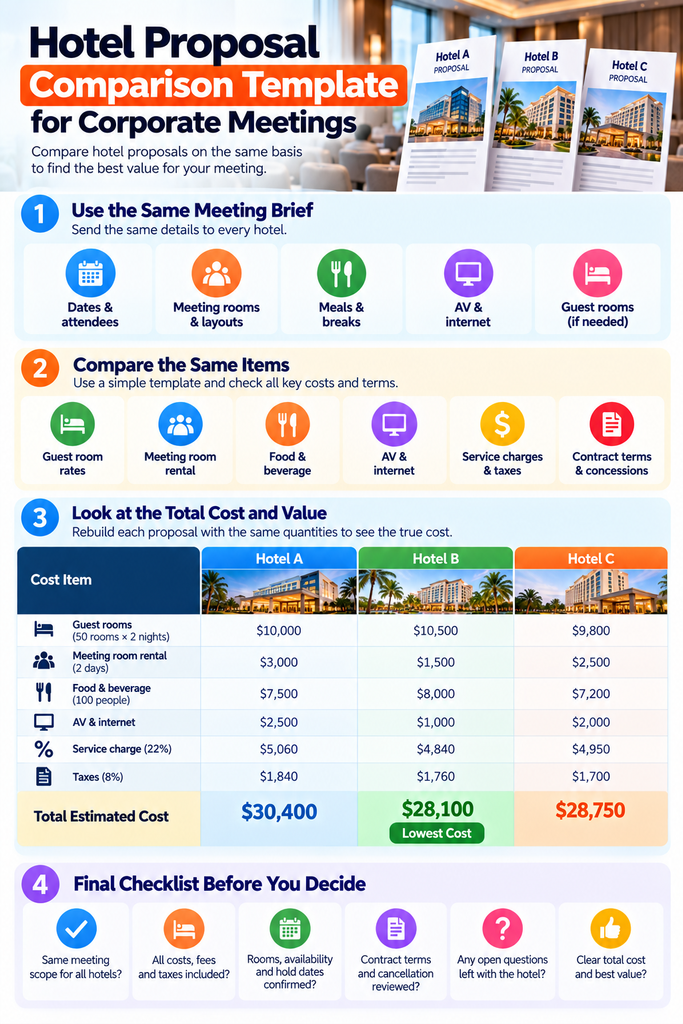
Write one brief and send it to everybody:
- Meeting dates, attendee count, session schedule, and the setup and breakdown hours you need
- Every meeting room and breakout, its layout, and how many people it has to hold
- Meals and breaks by day, at the same quantities and service level
- AV equipment, technical labor, internet, and any outside suppliers
- Guest rooms by night, room type and payer, if anyone is staying over
Keep alternatives separate from the main offer. When a hotel proposes different dates or drops a breakout room, label it an alternative rather than quietly moving the baseline.
For overnight meetings, separate peak rooms from total room nights. Fifty rooms on each of two nights is 100 room nights and a peak of 50. A day meeting has no guest-room requirement at all, so mark that category not applicable rather than leaving it blank.
Still writing the request itself? The hotel RFP guide covers that. This article starts when the responses land.
The comparison template
Copy this into your working document and replace the entry fields. Add a column per hotel. Record the proposal date and version, so an expired rate or a withdrawn concession does not sit in your comparison looking current.
| Comparison field | Record the same basis for each hotel | Hotel A | Hotel B |
|---|---|---|---|
| Proposal reference | Hotel, contact, date, version, expiration | Enter | Enter |
| Availability | Named rooms, dates, hold status, deadline | Enter | Enter |
| Room suitability | Layout, seated capacity, access hours, breakouts | Enter | Enter |
| Guest rooms | Nightly room grid, rate, occupancy, payer | Enter | Enter |
| Meeting rental | Room-by-room charges and rental periods | Enter | Enter |
| Setup and labor | Initial setup, changes, breakdown, staffing | Enter | Enter |
| Food and beverage | Same menus or specifications, meal counts | Enter | Enter |
| Minimum commitments | Eligible spending, thresholds, shortfall terms | Enter | Enter |
| Audiovisual | Equipment, labor, power, supplier restrictions | Enter | Enter |
| Internet | Meeting connection, specification, support | Enter | Enter |
| Other charges | Parking, handling, storage, required venue fees | Enter | Enter |
| Service charges | Percentage or amount, and what it applies to | Enter | Enter |
| Taxes | Category, rate, taxable base, included status | Enter | Enter |
| Credits and concessions | Written benefit, conditions, actual usable value | Enter | Enter |
| Payment and changes | Deposits, billing, reductions, cancellation | Enter | Enter |
| Expected total | Same meeting scope, known charges included | Enter | Enter |
| Open questions | Missing prices, unresolved terms, who owes an answer | Enter | Enter |
Label every cost item one of five ways: Included, Separately priced, Conditionally waived, Not applicable, or Unconfirmed. An empty cell is not evidence that something is free.
For anything included, record where it sits and what quantity or service level it covers. For a conditional waiver, write the condition next to it. Leave unresolved items visible, because a spreadsheet will happily treat a blank as zero and hand you a total that is simply wrong.
Cvent’s supplier documentation makes the same distinctions between cost types and whether taxes and service charges are added or already included. It also warns against entering a fee twice when the room rate already carries it. [1]
Rebuild the cost using the same quantities
Every line has a pricing basis, and you have to keep it. Guest rooms price on room nights. A catering package might price on people multiplied by meeting days. A technician prices by the hour with a minimum call. Lose those units and you end up comparing a one-day quote against a two-day total without noticing.
For a fixed specification, expected hotel cost is the required line items, plus mandatory fees, plus service charges, plus applicable taxes, less any confirmed credit not already applied. Required third-party costs go on their own clearly identified line.
Check what a package includes
If the package covers room rental, lunch and standard meeting internet, do not add those again. Work out instead what your brief needs that the package does not cover. A package that includes a screen can still leave projector rental, microphones and technical staffing unresolved. Get the included equipment and support in writing.
Separate catering spending from the minimum
Record planned eligible food and beverage spending and the required minimum as two separate numbers. The minimum is not automatically an extra charge on top of the catering bill, and what happens if you fall short depends entirely on the agreement.
Say planned eligible spending is $10,500 against a $12,000 minimum. That is a $1,500 gap. Ask how the gap is treated, whether more catering can close it, and whether any separate charge picks up fees or taxes of its own. Check too whether a room rental waiver depends on clearing that minimum.
Ask how service charges and taxes are calculated
Do not assume a service charge is a gratuity, or that every charge is taxed the same way. Hilton’s published banquet terms for the United States, Canada and Puerto Rico distinguish a service charge the hotel retains from a gratuity distributed to service staff. That is one example of why the definitions in the actual agreement matter more than the label. [2]
For each charge, ask what it applies to, whether it is already included, and whether it is itself taxable. Ask for an itemized estimate. There is no single US hotel-meeting tax percentage you can safely apply across categories and destinations.
Count a concession once
A waived $500 fee saves $500 only if that charge would have applied. If the quote already excludes it, you cannot subtract another $500 and call it a saving. Record upgrades and other noncash benefits separately, unless they genuinely replace something you were going to pay for.
Two hypothetical proposals, worked
A company is paying for 50 attendees, two meeting days, and 50 guest rooms on each of two nights. Both hotels meet the same requirements. The company pays all guest-room charges.
These prices are invented to demonstrate the arithmetic. They are not current quotes or US market benchmarks. Assume both catering minimums are met. For this example only, guest rooms carry 15 percent tax and everything else, including the food and beverage service charge, carries 10 percent. Real taxable categories and rates have to be confirmed property by property.
| Cost item and calculation | Hotel A | Hotel B |
|---|---|---|
| Guest rooms, 100 room nights | $199 x 100 = $19,900 | $209 x 100 = $20,900 |
| Meeting rental, two days | $1,200 x 2 = $2,400 | $900 x 2 = $1,800 |
| Food and beverage, 100 person-days | $95 x 100 = $9,500 | $100 x 100 = $10,000 |
| AV equipment and labor | $2,500 | $2,000 |
| Meeting internet | $800 | Included |
| Setup charges | $500 | Included |
| F&B service charge | 24% x $9,500 = $2,280 | 22% x $10,000 = $2,200 |
| Subtotal before taxes | $37,880 | $36,900 |
| Guest-room tax at 15% | $2,985 | $3,135 |
| Other tax at 10% | $1,798 | $1,600 |
| Total for the stated scope | $42,663 | $41,635 |
Hotel A quotes $10 less per room night. Across the block that is a $1,000 saving, and it is the number most comparisons stop at.
Hotel B costs $1,028 less.
Nothing clever happened. Hotel B included internet and setup, charged less for AV and meeting space, and ran a lower service charge percentage. The ranking flipped on charges that never appear in a room-rate conversation, and neither hotel negotiated a better rate than the other.
The non-room taxable bases are $17,980 for Hotel A and $16,000 for Hotel B. Show those, so anyone can check your tax math.
This covers only the hotel scope listed. Airfare, ground transport, insurance and other program costs are out for both. Add any further required charge before you treat the table as a real decision.
If you report a per-attendee figure, keep the denominator honest. Divided by 50 attendees these totals are $853.26 and $832.70 for the whole program. Divide by 100 and you have described cost per attendee-day instead, which is a different number answering a different question.
Compare the commitments behind the price
Price is half the comparison. A lower estimate is worth little if the room cannot hold the agenda or the payment schedule does not fit how your company pays. Keep these next to the cost summary rather than in a separate document nobody opens.
Verify the actual rooms and access times
Ask for room names and a layout drawn for your attendee count, your equipment and what people will actually be doing. Look at the space left for screens, presentation areas, aisles and movement. Confirm breakouts for the hours you need them, which matters most when sessions run at the same time.
Check access before and after each session, rehearsals and equipment removal included. Hilton’s US short-term meeting terms list possible charges for elaborate setups, extra equipment, late room clearance and some labor tied to outside contractors. Treat those as things to clarify, not fees that apply everywhere. [3]
Distinguish availability from a confirmed booking
Record whether the space is available, held provisionally, waiting on another group’s decision, or confirmed. Write down the deadline and the time zone it expires in.
Cvent’s proposal workflow separates first option, second option, and availability with limitations. Those labels exist because a positive answer about availability still needs explaining. Ask what exactly is held, and what action secures it. [1]
Compare reductions and cancellation separately
For an overnight meeting, record the room commitment, allowable reductions, how reductions get measured, and the deadlines. Groups360 points out that attrition can be measured per night or cumulatively across the event. Two offers quoting the same percentage can land very differently on the same booking pattern. [4]
Ask each hotel to run a lower-attendance scenario on its own terms. Then, separately, ask what you would owe if the meeting were canceled on a given date. Do not stack cancellation exposure onto the operating total as though both will happen.
Separate payment timing from total cost
A deposit credited against the final bill is an advance payment, not an extra cost. Put deposits and due dates in a payment schedule, then show how they reduce the balance. Record refund conditions, and whether direct billing needs its own approval.
Carry three views into the decision: expected cost if everything goes to plan, cash needed before the meeting, and what is owed under specified change or cancellation scenarios. Have whoever handles finance and contracts at your organization look at the commitments before anyone accepts.
Resolve the gaps before you choose
A missing price is a question, not a saving.
Build one clarification list per hotel, referencing the proposal version and the same brief. That gives the sales team a concrete set of items instead of a vague request to sharpen their pencil.
A workable clarification reads something like this:
Please revise the proposal using 50 attendees, two meeting days and 100 room nights. Confirm access to the named meeting room from 7 a.m. to 6 p.m. on both days. Itemize audiovisual labor, meeting internet and setup charges. Show each service charge and tax with its calculation base, identify any conditions attached to concessions, and state the availability deadline. Please mark any requirement you cannot meet.
Keep the revised response and update the comparison once. If catering is not chosen yet, use the same written specification for both hotels and label any remaining estimate as an estimate. Ask when it becomes firm and what would change it.
Choosing among the hotels that qualify
First separate what cannot be traded from what can. The date, a usable room configuration, the access you need, essential technology, and your approved spending limit. An unresolved requirement stays unresolved however attractive the total looks.
Among the options that clear that bar, weigh what matters to this meeting. A training program lives or dies on working space and reliable technical support. An association conference depends on breakouts being close and the room block having give in it. A short executive meeting cares about travel time and billing that does not generate work.
If stakeholders want a weighted scorecard, agree the criteria and weights before anyone scores anything. Keep the financial calculation beside the score, because a strong overall score will otherwise hide a missing requirement or an unpriced service.
Document the recommendation
Write a short decision summary: which hotel, its comparable expected cost, the operational reasons, the material commitments, and anything still unresolved. Recommending the more expensive option is fine, as long as you show the difference and name the specific benefit paying for it.
Before approval, check the final agreement actually reflects the rooms, hours, inclusions, concessions and charges you compared. Carry that specification into the hotel’s later operational documents, the banquet event order included, and check every subsequent change against it.
For the negotiation that follows, see the corporate hotel rate guide. If you are starting a new search instead, explore meeting options on greatEvent and keep the same requirements all the way through.
Frequently Asked Questions
What should a hotel proposal comparison include? ▾
The same meeting dates, attendee counts, room layouts, guest-room pattern, catering, AV support and access hours for every hotel. Then mandatory charges, taxes, concessions, payment timing and change conditions. Keep unresolved requirements visible so the total does not imply everything has been priced.
How do you compare a package with an itemized proposal? ▾
List what the meeting requires and mark which items the package covers. Add the cost of whatever falls outside it, then apply the quoted charges and taxes. Compare that against the itemized offer at the same quantities, and do not charge the package twice for anything already included.
Does a lower guest room rate mean a lower meeting cost? ▾
No. Guest rooms are only part of an overnight meeting’s cost. In the worked example above, Hotel A’s lower rate saves $1,000 on rooms while Hotel B comes in $1,028 cheaper overall. Your own result depends on quantities, inclusions, fees and taxes.
Is a hotel service charge the same as a gratuity? ▾
Do not treat them as interchangeable. Read the definitions in the hotel’s agreement and ask how each is applied. Hilton’s published banquet terms, for instance, distinguish a service charge the hotel retains from a gratuity distributed to designated service staff. [2]
Should attendee-paid guest rooms be in the comparison? ▾
Include them in a clearly labeled program view if you are assessing the full cost of attending, and keep the organizer’s cash budget separate. Identify who pays each charge and whether the organizer carries contractual exposure for unused rooms. That stops attendee payments being read as company spending.
What should you do when the hotel has not priced an item? ▾
Mark it unconfirmed, describe the service you need, and ask for a written price or inclusion statement. A clearly labeled planning allowance is fine while you research, but it is not a quote and should never be presented as one. Resolve the essential gaps before the total decides anything.
How many hotel proposals should you compare? ▾
There is no right number. Build a shortlist of hotels that can actually meet the requirements and return comparable information. Two complete, suitable offers beat a larger pile of incomplete ones.
Can this template be used for a meeting with no overnight rooms? ▾
Yes. Mark guest rooms and room-block terms not applicable, then compare meeting space, catering, technology, access hours and payment conditions. greatEvent’s meeting intake form has an option for when overnight accommodation is not needed. [5] ## Research sources Sources reviewed October 1, 2026. Hotel documents illustrate the terms published in those documents and do not establish universal fees or conditions. The comparison method and the worked example are original to this article. [1] Cvent, Creating a Proposal. Supports the distinctions between availability statuses, cost types, included charges and additional fees. [2] Hilton, Banquet Event Order Additional Terms and Conditions. Published for the United States, Canada and Puerto Rico. Used for its definitions of service charges and gratuities. [3] Hilton, Express Agreement Short Term Meeting Additional Terms and Conditions. US terms illustrating setup, equipment, room-clearance and outside-contractor labor considerations. [4] Groups360, Five Tips to Avoid Room Block Attrition. Supports the distinction between nightly and cumulative attrition measurement. [5] greatEvent Meeting Intake Form. Confirms the day-only accommodation option and the separate peak-room and total-room-night fields.
Compare vendors for your next event
Search caterers, photographers, florists, planners, and rentals — then send one request to several vendors at once.