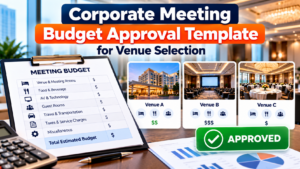
Quick answer: A budget approval should state the business purpose, the recommended venue, the total expected cost, the requested spending limit, the alternatives you considered, the payment deadlines and the financial commitments. Attach the comparable proposals, and name the people authorized to approve the budget, sign the agreement and release payment. Under most policies those are three different decisions.
Use the template below once your shortlist is ready for an internal decision. It is built for corporate meeting planners, professional planners working for business clients, executive assistants arranging meetings, and association or conference teams who need the approval documented.
What a meeting budget approval request should include
The approver needs a clear recommendation and enough evidence to understand what it costs and what it commits them to:
- The meeting’s business objective, sponsor, dates, location, attendance and required format
- The recommended venue and why it meets the essential requirements
- Expected cost, proposed reserve, requested spending limit and funding source
- The alternatives considered on the same scope, including any policy exception
- Deposit schedule, cancellation exposure, minimum commitments and the decision deadline
- Unresolved questions, conditions for proceeding, and the approval record
GBTA’s public Strategic Meetings Management course outline connects meeting programs to business objectives, stakeholder involvement, spending, risk and organizational policy. [1] This article applies those considerations to a single venue decision. The template is an original planning aid, not a GBTA form and not a replacement for your company’s process.
Know which approval you are asking for
Four different things get called approval, and conflating them is how planners end up signing something nobody authorized.
An initial planning budget sets what is available for sourcing. Venue-selection approval tests a specific recommendation against that budget. Contract authorization decides who can commit the organization. Payment authorization decides who can release funds. Say which one you are requesting rather than writing “approved” and hoping.
If your company requires approval before sourcing starts, follow that first. Cvent’s budgeting guidance recommends setting a budget early and updating it as planning develops. [2] Once comparable offers arrive, replace the early estimates with documented figures and send the recommendation through the required route.
Keep the decision summary short. Attach the cost worksheet, the proposals, the room specifications and the relevant contract terms, so a reviewer can check the detail without reading a month of email.
The template
Replace the brackets. Use this as the internal decision summary and attach the completed cost worksheet. Fill in approval names and dates only after the decision actually happens.
Meeting and request owner
Meeting: [name]
Business unit or client: [name]
Sponsor: [name and role]
Planner: [name and role]
Dates and city: [details]
Expected attendance: [number]
Lower and higher attendance scenarios: [numbers]
Guest room requirement: [rooms by night, total room nights, and payer]
Business purpose and required outcome
Purpose: [decision, training need, or business task]
Success measure and owner: [deliverable, measurement date, accountable person]
Essential venue requirements: [rooms, layouts, access hours, accessibility,
  technology, and anything else that cannot be traded away]
Recommendation and alternatives
Recommended venue: [property, named rooms, quote version and date]
Reason for selection: [business fit, and material cost or operational differences]
Alternatives considered: [venues, comparable totals, reasons not selected]
Policy exception, if any: [reason and required approver]
Amount and funding requested
Expected cost: [$]
Proposed reserve: [$ and basis]
Requested spending limit: [$]
Existing budget cap: [$]
Remaining headroom or additional funding needed: [$]
Funding source and cost center: [details]
Included scope, and costs paid elsewhere: [details]
Timing and financial commitments
Decision needed by: [date, time, time zone]
Quote expiration and room-hold terms: [separate deadlines and conditions]
Deposit and payment schedule: [amounts, due dates, refund conditions]
Cancellation and reduced-attendance exposure: [amounts or formulas by date]
Deposit treatment in those amounts: [included, credited, or additional]
Conditions and decision record
Open items: [question, owner, deadline, estimated cost effect]
Conditions before signing or paying: [specific checks]
Decision: [approved / approved with conditions / revise / declined]
Authorized amount and scope: [$ and what the approval permits]
Budget approver and date: [details]
Contract signatory and payment approver: [names or roles under policy]
Reserve-release authority and reapproval triggers: [details]
Attachments: cost worksheet, current proposals, requirement checks, payment schedule, contract review, policy exceptions.
Build a complete cost worksheet
Use the same dates, quantities, layouts, meals and technology for every venue. Each amount should already include that line’s mandatory fees and taxes. Keep the supporting calculation showing quantities, rates, charge bases and quote references, and never add an included charge twice.
| Cost category | Venue A | Venue B | Basis and evidence |
|---|---|---|---|
| Meeting space, setup and access | $___ | $___ | Rooms, hours, quote and date |
| Catering and any expected shortfall | $___ | $___ | Functions, guarantees, minimums |
| AV, internet and technical labor | $___ | $___ | Equipment and support hours |
| Required accessibility services | $___ | $___ | Needs, provider, responsibility |
| Organization-paid guest rooms | $___ | $___ | Room nights and payer |
| Airfare or rail | $___ | $___ | Travelers, fare estimate and date |
| Ground transportation and parking | $___ | $___ | Trips, vehicles, parking days |
| Planner, staffing and other suppliers | $___ | $___ | Scope, quote and date |
| Other required costs | $___ | $___ | Itemize and explain |
| Expected cost subtotal | $___ | $___ | Sum without duplication |
| Proposed reserve | $___ | $___ | Specific uncertainty and basis |
| Requested spending limit | $___ | $___ | Expected cost plus reserve |
Label every amount quoted, estimated or unresolved. For anything unresolved, record an owner and a due date and write TBD rather than zero. Use $0 only for a confirmed zero cost, and “not applicable” for something outside the program. A zero in an approval document reads as a priced item that costs nothing, which is rarely what you meant.
Show which budget pays each cost
Keep the organizer’s funding request separate from the total cost to the organization. If travelers charge flights to a central travel budget, show those in a company-wide view and name that budget owner. If attendees pay personally, label those separately.
What you should not do is quietly leave travel out when it changes the venue decision.
Set the reserve from identified uncertainty
Build the reserve from actual risks: unbooked fares, a possible extension of room access. Explain each allowance and say who can authorize spending it. This template does not prescribe a percentage, because a percentage is a guess dressed as a policy. Follow your company’s rules, and do not use a reserve to hide an unpriced essential service.
Expected cost per attendee is expected cost divided by expected attendance. Corporate event cost per attendee covers what that figure usually contains, and what it costs to hire a corporate event planner covers the line most budgets forget. State whether that includes travel and lodging. A per-attendee figure for a whole program is a different number from per attendee per day.
A worked example
Two suitable venues for a one-day planning meeting with 40 attendees. Fifteen need two hotel nights each, so 30 room nights. Both meet the same layout, accessibility, technology and access-hour requirements.
Every price, offer and estimate below is invented to illustrate the process. None is a market benchmark or a quote from a real venue. Cost lines include all assumed mandatory charges and taxes, and the company funds every listed expense from the meeting budget.
| Cost item | Venue A | Venue B |
|---|---|---|
| Meeting room and setup | $2,400 | $3,000 |
| Catering for 40 attendees | $4,800 | $4,600 |
| AV, internet and technical support | $2,400 | $1,400 |
| Required accessibility services | $600 | $600 |
| Guest rooms for 30 room nights | $6,600 | $7,200 |
| Ground transportation and parking | $1,400 | $600 |
| Estimated airfare for 15 travelers | $6,000 | $6,000 |
| Expected cost subtotal | $24,200 | $23,400 |
| Proposed reserve | $1,500 | $1,200 |
| Requested spending limit | $25,700 | $24,600 |
| Headroom below the existing $26,000 cap | $300 | $1,400 |
| Expected cost per attendee | $605 | $585 |
Venue B comes in $800 cheaper, despite charging $600 more for the room itself. Lower catering, much lower technical support, and less transportation make up the difference. This is a forecast, not a saving anyone has banked.
Each reserve carries a $900 allowance for fare changes across 15 travelers. Venue A adds $600 for possible extra room access, Venue B adds $300. Planning assumptions, not amounts owed.
A sample recommendation
Recommend Venue B for the 40-person corporate planning meeting. Request a spending limit of $24,600: $23,400 expected cost plus a $1,200 reserve. This sits within the existing $26,000 cap. Both venues meet the essential requirements and Venue B has the lower comparable expected total. Approval remains subject to the documented contract and payment reviews.
The business case should also name the meeting’s output, for example an agreed operating plan with owners and a review date. Do not invent a financial return for a meeting whose result will be measured some other way.
Show cash timing and cancellation exposure separately
The venue with the lower expected cost can want a larger deposit and carry heavier cancellation terms. Those differences belong in the approval request, because the cost worksheet will not show them.
| Illustrative commitment | Venue A | Venue B |
|---|---|---|
| Deposit due at signing | $5,000 | $6,000 |
| Expected cost if the meeting proceeds | $24,200 | $23,400 |
| Total venue cancellation charge at a selected review date | $8,000 | $10,000 |
| Deposit treatment if canceled at that date | Credited against the $8,000 | Credited against the $10,000 |
| Additional venue amount due if the deposit is already paid | $3,000 | $4,000 |
More invented terms for the example. The cancellation figures are the total venue obligation at one defined date, including assumed charges. They exclude airline and other supplier cancellation costs, so they are not total program exposure. A real approval attaches the full schedule of changes by date.
Two things get double counted here, constantly.
Venue B’s $6,000 deposit is part of its expected cost, not $6,000 on top of it. And that same deposit is credited inside the illustrative $10,000 cancellation amount, so adding it again overstates the scenario.
The meeting-as-planned budget and the cancellation scenario describe two different futures. Do not add the full cancellation charge to the cost of a meeting that goes ahead. If a shortfall applies even when the meeting proceeds, that one does belong in the operating estimate.
A budget limit does not cap the signed agreement
Your internal spending limit means nothing to the venue’s contract, and a reserve is not insurance against every obligation. Have the right reviewer assess cancellation, guest room attrition, catering guarantees, payment timing and anything else that could exceed the planned cash outlay.
Hilton’s published banquet terms address option dates, deposits, attendance guarantees, cancellation, and who can approve additional spending. [3] A useful illustration of what sits outside the room rate. The terms for your meeting come from your agreement.
Translate the risk into a decision
In the example, Venue B wants $1,000 more at signing and carries $2,000 more cancellation exposure at the review date, against an $800 expected cost advantage.
So the cheaper venue is also the riskier one, and if the date is at all uncertain, the $2,000 matters more than the $800. That is the tradeoff to put in front of the sponsor, in those terms, rather than leading with the lower total and letting the commitment surface later.
How to prepare the request
Confirm the essentials before comparing price
Check availability for the actual dates and access hours, capacity in the required layout, breakout needs, technical support, attendee access and any company-specific requirement. Record the evidence and the unresolved items. A low total cannot rescue a room that will not support the agenda.
The US Department of Justice’s accessible-meeting guidance covers location, furniture arrangement and how meeting content is communicated. [4] Use those dimensions when confirming requirements with the venue and any relevant specialist. Price required services into the base plan and verify who provides them. Accessibility is not an upgrade line.
Explain why the recommendation is worth approving
Connect the venue to the business outcome and explain the material differences between viable options. If the one you want costs more, give the dollar difference and the specific requirement it serves. Keep measurable cost differences separate from judgments about convenience or meeting quality, because a reviewer can check one and not the other.
Follow your organization’s rules on how many proposals. If only one venue is viable, document why and get any required exception. This template sets no three-quote rule and no dollar threshold.
Work backward from the real deadline
Record quote validity, room-hold expiry and payment deadlines separately, with time zones. Ask whether another booking can challenge the hold. Hilton’s published terms show that an option can carry a defined deadline and be challenged by other business. [3] A room described in a proposal is not a confirmed room.
Route it through actual policy
The sponsor confirms the business need. The budget owner and finance review funding. Procurement and the designated contract reviewer assess sourcing and terms. Authorized people sign and pay. One person may hold several of those roles, and your real authority rules decide, including client authorization when an agency submits the request.
Give every approval condition an owner and a deadline. If your company allows conditional approval, say which actions have to wait until the conditions close. Keep a dated version of the decision and the proposals behind it.
Reapprove material changes, then reconcile
Use your organization’s change thresholds. The usual triggers: a higher total, different dates or venue, more room nights, new nonrefundable commitments, or a change to an essential requirement. Say who can release the reserve and approve on-site extras. Afterwards, compare actual invoices with the approved version and explain the variance.
Cvent’s budgeting guide treats the budget as an ongoing process with stakeholder reviews and a final review after the event. [2] Keep that review tied to the original business objective, not only to the spending total.
Before you submit
Start from comparable offers and a clear brief. The hotel proposal comparison template aligns the costs and requirements across properties, and meeting packages vs itemized pricing covers bundled pricing. Then use this template to present the recommendation internally.
Research sources
Sources reviewed October 5, 2026. The template, worksheet, recommendations and worked example are original editorial tools and do not reproduce any organization’s approval policy. Every example price, reserve, deposit and cancellation amount is hypothetical.
[1] GBTA, Strategic Meetings Management course overview. Public outline covering business objectives, stakeholder engagement, spend, risk and policy. No claim is made to the paid course or member-only templates.
[2] Cvent, Event Budgeting Guide. Guidance on establishing the budget early, maintaining it through planning, and reviewing it with stakeholders and after the event. Published August 9, 2023.
[3] Hilton, Banquet Event Order Additional Terms and Conditions. Published US, Canada and Puerto Rico terms, last revised September 3, 2019. Used to illustrate option dates, deposits, guarantees, cancellation and additional-spend authorization, not as universal or current terms for any particular booking.
[4] US Department of Justice, accessible meeting guidance. Archived “Meeting on a Level Playing Field” guidance on meeting location, room arrangement and access to content. Used for planning considerations, not as a legal compliance assessment.
Frequently Asked Questions
Who should approve a corporate meeting budget? ▾
Whoever your approval policy and delegated authority say. The business sponsor, budget owner, finance, procurement and contract reviewers often hold different responsibilities. Identify the required approvers rather than assuming a manager’s budget approval also permits contract signing or payment.
How do you justify a more expensive venue? ▾
Compare the same scope, then state the additional cost and the business requirement it buys. A higher room rental can still produce a lower overall cost when technology, lodging or transportation differ. If it stays more expensive, explain the tradeoff and name who accepts it.
Should deposits be included in the meeting budget? ▾
Include the underlying expense once, and show the deposit in the payment schedule. A deposit credited toward the final bill is part of that cost, not an extra. Record the refund conditions and how the deposit is treated on cancellation.
How much contingency should a meeting budget include? ▾
Base the reserve on company policy and identified uncertainty, and record the reason for each allowance and who can authorize it. This template does not recommend a universal percentage. Keep known required costs in the base estimate, and either resolve missing prices or label them explicitly as estimates.
Do you need three venue quotes for approval? ▾
Not because of this template. Follow your organization’s sourcing rules and any client requirements, and compare viable options on the same basis. Where only one venue meets the essentials, document why and get any required exception.
Does budget approval confirm the booking? ▾
No. Internal approval and venue confirmation are separate states. Confirm the hotel’s acceptance requirements, the authorized signatory, the required payment and the written confirmation. Track the room hold and quote deadline while the internal decision is still running.
What if a quote has missing costs? ▾
Mark them unresolved rather than entering zero, and assign an owner to get the price. If policy allows approval on an allowance, disclose the estimate and its basis, define the spending limit, and say which actions need the final quote or renewed approval.
Where should planners start before using this template? ▾
With comparable venue offers and a clear meeting brief. Align the costs and requirements first, then present the recommendation internally.
Compare vendors for your next event
Search caterers, photographers, florists, planners, and rentals — then send one request to several vendors at once.