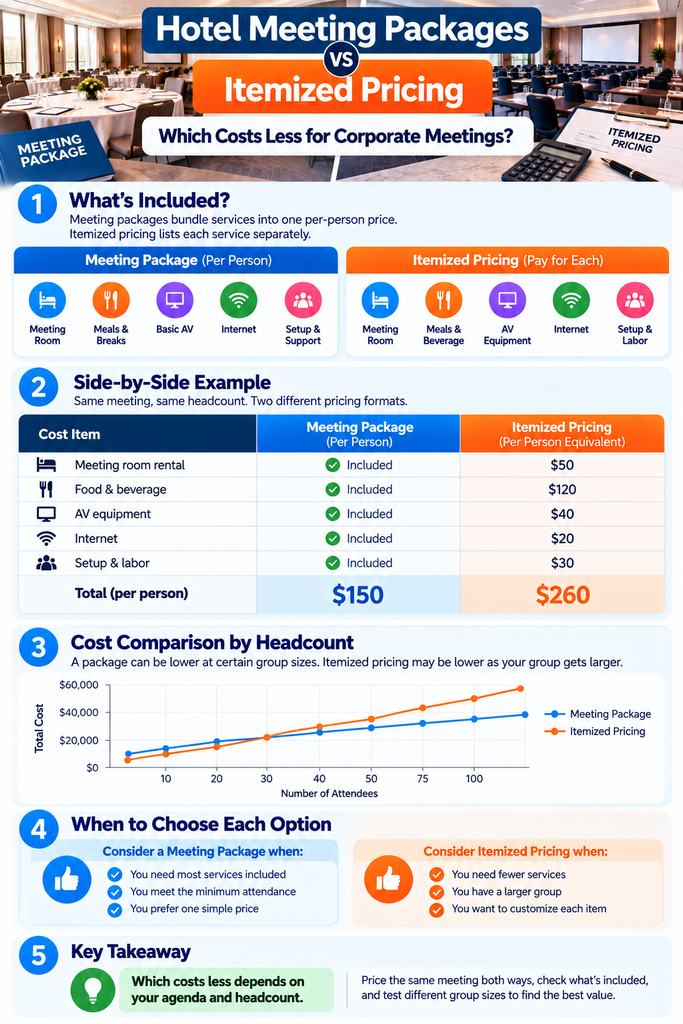
Quick answer: A package wins when its inclusions match your agenda and your attendance clears its minimum. Itemized pricing wins when you need fewer services, or when you have enough people to spread the fixed room and equipment costs. Price the same meeting both ways, then test it at different headcounts, because the answer changes as the group changes.
The pricing format decides more than the opening quote. It decides which services you are buying as a bundle, which changes get repriced, and what happens to the bill when the program moves.
Examples below use clearly labeled hypothetical prices. None of them is a national average.
Understand the package you are being offered
Day meeting packages
A day meeting package bundles meeting space and daytime services into a per-person price, with no overnight rooms. Which meals, what equipment, how many access hours, which charges are included: all of that is up to the venue. Ask for the written specification rather than reading the name and assuming.
Complete meeting packages
The Events Industry Council defines a complete meeting package, or CMP, as a per-person arrangement covering lodging, meals and support services, and identifies the term as mainly North American. [1] For a real booking, confirm when the package starts and ends, the room occupancy it assumes, and which meals it covers on arrival and departure days.
Modified packages and daily delegate rates
A modified package takes components out. At Babson Executive Conference Center the modified complete package drops dinner, and the day package drops both overnight accommodation and the full breakfast buffet. Those are Babson’s definitions, not industry rules.
Sourcing internationally, you will also meet the daily delegate rate, or DDR. The Events Industry Council describes it as a per-person day rate covering room rental, lunch and coffee breaks, with basic AV sometimes included, and notes the term is used mainly outside North America.
Itemized pricing lists everything separately: room rental, catering, equipment, technical labor. Separate prices show you what each component costs, but minimums, fees and taxes still have to be checked before any total means anything.
Compare the inclusions before the prices
List what your meeting actually needs. For each offer, mark every item included, separately priced, conditional, or unconfirmed. An inclusion only has value if you need it and the specification actually meets the need.
| Component | What to verify in the package | What to price in the itemized offer |
|---|---|---|
| Main meeting room | Named room, layout, access hours, exclusivity | Equivalent room and rental period |
| Breakout rooms | Included quantity, attendee thresholds, hours | Each required room for its actual use |
| Catering | Meal counts, menu level, dining location, breaks | The same meals and service specification |
| Audiovisual equipment | Equipment list, quantities, room allocation | Equivalent equipment in every required room |
| Technical labor | Setup help, operating support, service hours | Required staff time and any minimum call |
| Internet | Connection type, intended use, support | An equivalent connection and support level |
| Room changes | Initial setup, resets, additional access | Every required setup and change |
| Guest rooms | Room type, occupancy, nights, included meals | Matching room nights plus required meals |
| Parking and other fees | Who and what the inclusion covers | Applicable quantities and mandatory charges |
| Charges and taxes | Which are included, which remain extra | All applicable charges on the correct bases |
Published packages show why the details matter
Emory Conference Center Hotel’s day package lists meeting space, lunch, refreshment breaks, standard AV, internet, parking and applicable service charges. Its published meeting-space terms include one breakout room per 50 attendees.
Babson’s description says breakout rooms cost extra depending on requirements, specifies its included AV package for the general session room only, and prices private dining separately.
Run a conference with concurrent sessions and those two venues need completely different additions. These are illustrations of how inclusions differ, not a price comparison or a recommendation of either property. Get a current offer for your own dates.
On technology, ask about the task rather than the kit. A projector and screen tell you nothing about whether remote participants can hear a question from the floor. “Internet included” tells you nothing about whether a dedicated connection, a production network, or a particular support arrangement comes with it.
Turn the advertised rate into a comparable price
Ask the hotel for a total against your actual agenda, with the package rate explained, the billable participant count stated, the minimum named, and the required additions priced. Then ask for an itemized alternative for the same agenda. Some venues offer only one model, in which case compare a second venue on the same specification.
Confirm the fee and tax treatment
Service charges included does not mean taxes included. If a quote says “plus-plus”, ask what each additional charge is, what percentage or amount, and what it applies to. Get the final estimate in dollars alongside the rate description.
A hypothetical illustration: a $120 package carries a 24 percent service charge, then a 9 percent tax applied to both the package and that service charge. The arithmetic is $120 x 1.24 x 1.09, or about $162.19 per person. For 40 people, charging on the full bill, $6,487.68.
Those percentages are invented, not a statement about local tax treatment. The point is that a $145 per-person quote with everything included would be cheaper here, despite the higher advertised base.
Match the rental period to the agenda
A half-day package is a defined booking window, not a promise that any four or five hours qualify or that the price is half the full day. Emory publishes separate morning and afternoon windows. [4] Check that your lunch, technical check and equipment removal all fit inside the window you are being sold.
For a meeting finishing at noon, ask whether the package still covers lunch afterward and when the room has to be clear. Early access or a late finish gets priced before you choose between half day and full day.
Separate essential additions from optional upgrades
Price the essentials before you compare anything: extra breakout rooms, microphones you actually need, technical support, an agreed dietary accommodation. Keep genuine upgrades in a separate scenario so they do not contaminate the baseline.
If you will not use something that is included, ask whether there is a modified package or a substitution. Declining a meal or bringing your own equipment does not automatically generate a credit. Get any change and the revised total into the written offer.
See how attendance changes the answer
Two hypothetical offers for the same one-day meeting. Both cover a suitable main room, equivalent AV, meeting internet, lunch and refreshment breaks. Neither includes guest rooms or breakouts, because this meeting needs neither.
Every amount below already includes the assumed mandatory charges and taxes. Teaching figures, not quotes from the properties above.
| Pricing component | Package offer | Itemized offer |
|---|---|---|
| Room, equipment, internet | Included in the per-person package | $1,000 room + $600 AV + $200 internet |
| Catering and per-person services | Included in the $150 package rate | $100 per person |
| Minimum commitment | 30 paid participants | No additional minimum here |
| Comparable total | $150 x the greater of attendees or 30 | $1,800 + $100 x attendees |
Each row below is a planning scenario before the final guarantee. Assume the venue can take the group with the same room and equipment, and that itemized catering quantities can still move without a charge.
| Planned attendees | Package total | Itemized total | Lower cost |
|---|---|---|---|
| 20 | $4,500 | $3,800 | Itemized by $700 |
| 30 | $4,500 | $4,800 | Package by $300 |
| 36 | $5,400 | $5,400 | Equal |
| 50 | $7,500 | $6,800 | Itemized by $700 |
| 75 | $11,250 | $9,300 | Itemized by $1,950 |
At 20 attendees the 30-person minimum still bills $4,500. That is $225 for every person who actually turns up, against a package rate advertised at $150.
At 30 the package is cheaper. At 50 the itemized offer takes over, because its fixed $1,800 spreads across more people while its per-person cost stays at $100.
So a package does not quietly become the better deal as a meeting grows. It depends entirely on how the fixed charges, the per-person rates, the minimum and the inclusions interact. Add a room or more equipment for a bigger group and the whole calculation restarts.
Find the break-even, and its limits
Once the minimum is cleared, the two totals meet where $150 x attendees equals $1,800 + $100 x attendees. That is $1,800 divided by $50, so 36 attendees.
Generalized: break-even attendance is the itemized fixed cost divided by the difference between the package rate and the itemized per-person cost. It only works when that difference is positive, the answer sits inside the permitted attendance range, and both offers cover the same scope.
What the formula cannot see is the minimum. Below 30 the package stays at $4,500 regardless, and comparing $4,500 against $1,800 + $100 x attendees gives a second equality at 27.
Which produces the actual answer, and it is narrower than anyone expects. Under these assumptions the package only wins between 28 and 35 attendees. Eight numbers. The totals tie at 27 and again at 36, and outside that band the itemized offer is cheaper in both directions.
A spreadsheet testing every realistic headcount beats a single break-even figure, because a single figure hides the minimum. Recalculate whenever rates, minimums, room requirements or added services change.
Use the billable count, not the headcount
That table is a planning comparison, not a promise of a smaller bill when people fail to show. Keep four numbers apart: your current forecast, the package minimum, the final guaranteed number, and the number actually served. Ask which one controls each charge, and when reductions stop being accepted.
Hilton’s published banquet terms include a final attendance guarantee and bill on the guarantee or the number served, whichever is greater. That illustrates why attendance changes get tested against the actual agreement rather than against the brochure. It is not a universal package rule.
Price mixed attendance and overnight stays separately
If 25 of 40 participants stay over and 15 commute, ask whether the hotel will combine complete and day packages. Get the rate and inclusions for each group, then check nobody loses a required meeting service and nobody is charged twice for lodging or meals.
Confirm whether a complete package prices per person or per room, and what shared rooms do to the number. Map the package onto the actual arrival and departure pattern too. A package that opens with dinner on arrival night will not line up with a comparison built on calendar meeting days.
For a multiday program, build the estimate day by day. Forty on Tuesday and 25 on Wednesday can hit daily minimums very differently from an assumed flat 40. Ask whether the hotel measures each day separately.
Choose the model that fits the meeting
The right answer is whichever suitable offer gives the most useful combination of cost, service and flexibility for this agenda. A package makes an estimate easier to read, which is not the same as every needed service being in it. Itemized pricing makes components visible, which is not the same as a lower total.
When a package deserves a close look
A recurring full-day training program uses the same room, the same lunch, the same breaks and the same equipment every time. If the package matches that specification and attendance reliably clears the minimum, bundling is genuinely easier to budget and repeat.
An overnight conference can suit a complete package when the meal schedule and room pattern fit. Ask how visiting speakers, staff and local participants get charged, rather than assuming one package covers everybody.
When an itemized offer deserves a close look
A short executive meeting needs a room, a display and coffee. No lunch. A hybrid session with real production requirements needs more than any standard package contains. Either way, price the actual specification and compare it against the package plus whatever you would have to add.
If attendance is genuinely uncertain, compare what each offer permits you to change. Itemized proposals carry catering minimums, fixed labor commitments and nonrefundable rental too. Compare the terms rather than assuming separate line items are automatically flexible.
Questions to ask before approving a package
- Which rooms, layouts, access hours, meals, equipment and support are included for this agenda?
- Which participants count toward the package, and what minimum applies to each day?
- When is the final guarantee due, and how are reductions or extra attendees charged?
- Which required services sit outside the package, and what is the total after all charges and taxes?
- Can unused components be removed or exchanged, and what written adjustment would apply?
- What changes if we need another breakout room, different technology, or longer access?
Keep the package specification next to the final quote. For the wider decision across hotels, the hotel proposal comparison template records room suitability, availability and payment timing alongside price.
Still writing the brief? The hotel RFP guide covers what to gather. You can also explore meeting options on greatEvent, then confirm the package and itemized inclusions for your dates.
Frequently Asked Questions
Are hotel meeting packages cheaper than itemized pricing? ▾
Sometimes. Price the same agenda both ways and test your expected attendance against the package minimum. A package can be cheaper at one group size and more expensive at another. In the worked example above it wins only between 28 and 35 attendees.
What does a day meeting package include? ▾
Usually meeting space, daytime catering, refreshment breaks, and some equipment or support, without overnight rooms. The venue decides the specifics. Check room access, breakout space, internet, technical labor, parking and taxes separately rather than reading them into the name.
Does a complete meeting package include guest rooms? ▾
The Events Industry Council’s definition includes lodging, meals and support services. [1] Verify the room type, occupancy basis, number of nights, and which arrival and departure meals are covered. A modified package, or one venue’s particular use of the term, may cover something different.
Is a daily delegate rate the same as a day meeting package? ▾
Both bundle daytime meeting services into a per-person rate. The Events Industry Council identifies daily delegate rate as a term used mainly outside North America. [2] Compare the written inclusions, booking hours and charges rather than the label.
Does a half-day package cost half as much as a full day? ▾
Do not assume it. Ask for both prices against your actual schedule. A shorter meeting still needs setup, equipment, staffing and catering. Check whether early access, lunch or a late finish would add charges to the half-day option.
What happens if fewer people attend than the package minimum? ▾
Check the minimum and the final guarantee terms. If the agreement requires payment for 30, then 20 arrivals does not reduce the bill to 20 packages. Ask for the reduction deadlines and a written example of how the hotel would bill your low-attendance scenario.
Can unused meals or equipment be removed from a package? ▾
Ask whether the venue offers a modified package, a substitution or a credit. A component can stay in the bundled price whether you use it or not. Compare the revised written total rather than subtracting your own estimate of what the unused item was worth.
How should taxes and service charges be compared? ▾
Ask for a final dollar estimate showing what is already included and what gets added. Confirm what each percentage applies to, and whether the service charge is itself taxed. Apply the same quantities to both offers and count every charge once. ## Research sources Sources reviewed October 1, 2026. Venue descriptions are examples of published inclusions, not guarantees for a future booking. Every price and calculation in the worked examples is hypothetical. [1] Events Industry Council, Complete Meeting Package. Industry definition and its North American usage. [2] Events Industry Council, Daily Delegate Rate. Definition and its predominant usage outside North America. [3] Babson Executive Conference Center, Meeting Package Options. Published complete, modified and day package descriptions, including extra-cost breakout and private dining options. [4] Emory Conference Center Hotel, Meetings and Conferences. Published day and complete package inclusions, breakout allocation, and half-day booking windows. [5] Hilton, Banquet Event Order Additional Terms and Conditions. Example of final attendance guarantees and billing provisions, not presented as industry-wide rules.
Compare vendors for your next event
Search caterers, photographers, florists, planners, and rentals — then send one request to several vendors at once.