Quick answer: To book a venue for a corporate event, write down your dates, headcount, room setups, and budget. Send an RFP or check live availability, and get a written hold on your top choices. Tour the finalists, compare full proposals, negotiate the contract, and pay the deposit. Then sign off the BEOs and confirm your final guarantee.
You’re booking a 120-person, two-day sales meeting with a general session and four breakouts. Three hotels said they had space. Two weeks later, one released your dates because the hold expired. The other two sent proposals that price meeting rooms in completely different ways, and finance wants to know who’s signing.
All of that happened after the venues were picked. It’s part of the booking process, which is where most of the surprises come from.
This is for corporate meeting planners, in-house or agency, booking hotels, conference centers, or convention centers in the US. It walks through the steps from “we need a venue” to “signed and confirmed.” It doesn’t cover costs or lead times in depth, and it isn’t legal advice. Your contract and your company’s counsel have the final word.
The nine steps at a glance:
- Define requirements and who signs
- Source venues: RFP, direct inquiry, or live availability
- Shortlist and request holds
- Do the site visit
- Compare proposals line by line
- Negotiate and review the contract
- Sign and pay the deposit
- Lock in BEOs, room sets, AV, and the final guarantee
- Run final confirmations
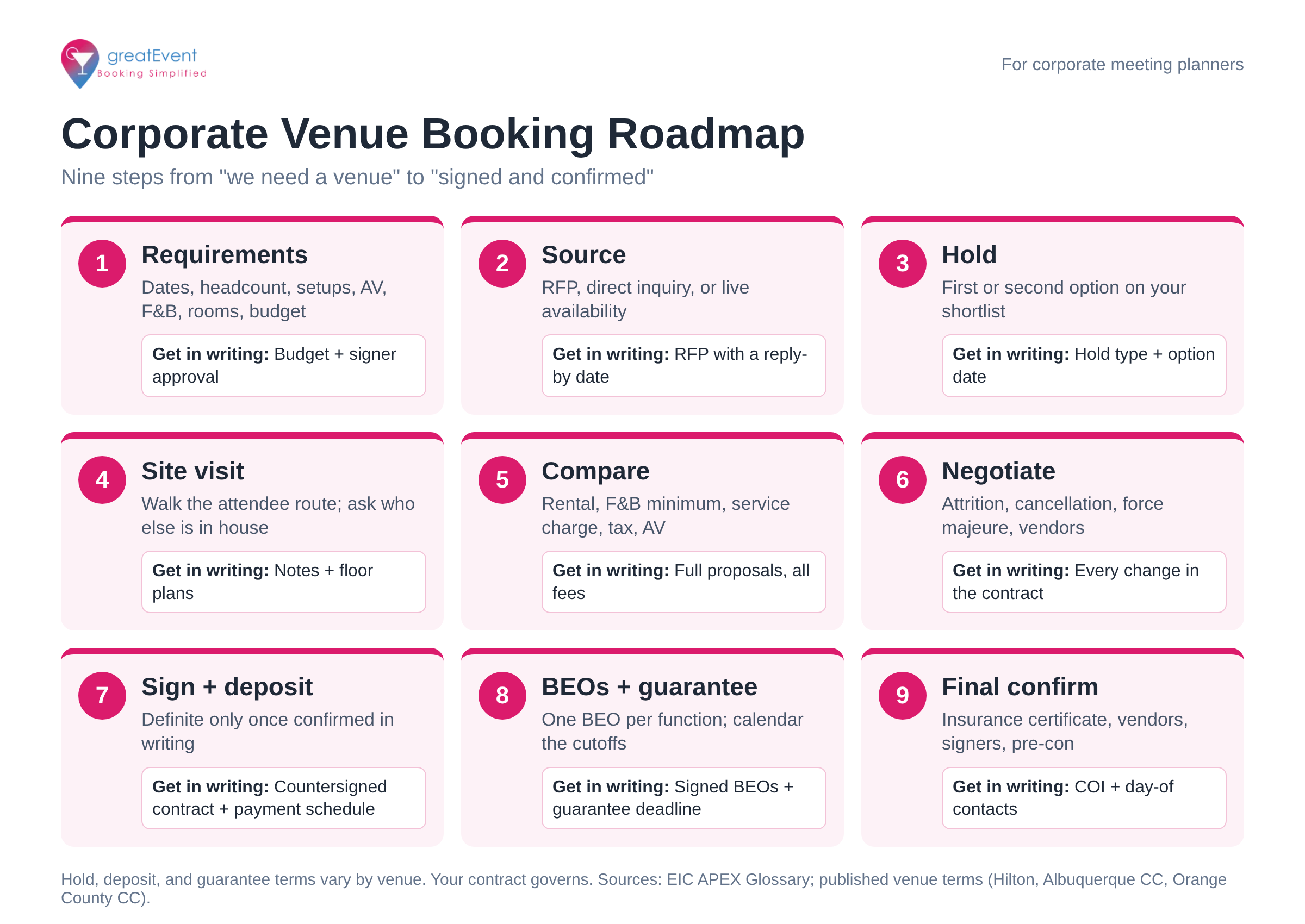
Text version of the infographic: Corporate venue booking roadmap. 1) Requirements: get budget and signer approval in writing. 2) Source: send an RFP with a reply-by date, or check live availability. 3) Hold: get the hold type and option date in writing. 4) Site visit: get notes, floor plans, and other groups in house. 5) Compare: get full proposals with all fees. 6) Negotiate: get every agreed change in the contract. 7) Sign and deposit: get the countersigned contract and the payment schedule. 8) BEOs and guarantee: get signed BEOs and the guarantee deadline. 9) Final confirmations: get your certificate of insurance, vendor approvals, and on-site contacts confirmed.
Before you contact venues: your requirements sheet
Venues can only quote what you tell them. If you only need a conference room for 12 people one afternoon, your requirements fit in an email. For a 120-person meeting with breakouts, meals, and sleeping rooms, write them down first, or every proposal will answer a slightly different question.
Get the room math right before you send anything. Setup style changes capacity a lot, and the published numbers on a floor plan don’t account for your stage, screens, or AV. A meeting room capacity chart by layout helps you sanity-check each room, and our guide to how much meeting space you need covers the full space plan.
Copy this sheet and fill it in before you talk to any venue:
CORPORATE VENUE REQUIREMENTS SHEET
Event name: ____________   Organization (legal name): ____________
Dates: first choice ________  backups ________ / ________
Pattern: arrival day / meeting days / departure day
Headcount: low ____  expected ____  high ____

MEETING SPACE (one line per room, per day)
Room use       | Setup style   | People | Times (incl. setup)
General session| ____________  | ____   | ____________
Breakouts (x__)| ____________  | ____   | ____________
Meals/breaks   | ____________  | ____   | ____________

AV: screens ___ mics ___ stage ___ hybrid/streaming? Y / N
Food and beverage: meals ___ breaks ___ dietary needs ___
Sleeping rooms: nights ___ rooms per night ___ ___ ___
Accessibility needs: ____________
Budget: total ____ owner ____________
Approvals: who signs ____________  PO needed? Y / N
People often skip two lines: backup dates and the approval path. Flexible dates give a venue room to say yes, and knowing who signs can save you a week later. If lead time is your worry, see how far in advance to book a conference venue.
Step-by-step: how to book a corporate event venue
Each step below covers what to do, what to get in writing, and the mistake that usually bites.
1. Define requirements and who signs
Finish the requirements sheet, then settle who can sign. Venue contracts are commitments of real money, and model contract guidance for associations has the signers warrant they actually have authority to sign. So find out now whether that’s you, your manager, procurement, or legal, and whether you need a purchase order.
Use your organization’s legal name on every request. Some venues ask for it on the inquiry form itself.
Get in writing: budget approval and the name of the authorized signer. Common mistake: finding out after the contract arrives that legal needs two weeks to review it.
2. Source venues: RFP, direct inquiry, or live availability
Pick the route that fits the event. A request for proposal (RFP) makes sense when you need several rooms, meals, sleeping rooms, or multi-day space, because it makes every venue answer the same specs. For a single meeting room on a known date, a direct inquiry or live availability is usually faster. If you’re weighing speed, our piece on how long it takes to book a venue looks at what the RFP route costs you in time.
Venue rules shape this too. Orange County Convention Center’s published scheduling policy, for example, treats local corporate meetings as second-priority events and only considers meeting room requests within six months of the event date. Ask about booking windows before you build your timeline around a venue.
Get in writing: the RFP, with a reply-by date. Common mistake: a vague RFP that gets back quotes you can’t compare.
3. Shortlist and request holds
Once a few venues look right, ask each to hold your space. The Events Industry Council’s APEX glossary calls this an option: space reserved but not yet contracted. A first option gives you the right of first refusal. A second option means you’re next in line, and you only get the dates if the first group doesn’t book within a set period.
Every hold has an option date, the point when the venue stops holding tentative space for you. A tentative hold carries no penalty if you drop it. But it can disappear faster than you expect. Hilton’s published standalone banquet terms give a group 72 hours, or the rest of its option period if that’s shorter, to confirm once another group is ready to book. At the Albuquerque Convention Center, a second-option group can challenge a first option, and the first-option holder then has three business days to match the challenger’s deposit and sign, or let the dates go.
Get in writing: hold type (first or second option), rooms, dates, and the option date. Common mistake: treating a verbal “we’ll hold it for you” as a hold.
4. Do the site visit
Tour the finalists before you sign, in person if you can and virtually if you can’t. Walk the route your attendees will take from the lobby to each room, and note any stairs, even a couple. Check where your rooms sit relative to the lobby, the pool, or a noisy kitchen.
Ask one question every time: is another group in house over our dates? If so, find out where its meeting space is. That’s the kind of detail a floor plan won’t show you.
Get in writing: your notes, current floor plans, and any promises the sales manager made on the tour. Common mistake: touring the ballroom and never seeing the breakout rooms.
5. Compare proposals line by line
Line the proposals up on the same items: room rental, F&B minimum, service charge and admin fee, tax, AV, and sleeping rooms. A proposal that waives room rental isn’t automatically cheaper. That waiver is often tied to an F&B minimum, which is counted before service charges, admin fees, and taxes. Miss it, and the rental can come back onto your bill. Our breakdown of F&B minimums vs. room rental explains the trade-off.
Watch for room resets too. Flipping a room from theater to rounds for dinner often carries a reset charge. So do extra setup or teardown hours outside your contracted times.
Get in writing: a full proposal from each venue, with every fee named. Common mistake: comparing rental prices only.
6. Negotiate and review the contract
Most of the financial risk sits in the contract. Go through attrition, the F&B minimum, cancellation, force majeure, cutoff dates, fees, outside vendors, insurance, and change terms. The clause table below covers what each one means and what to ask for.
Model the bad case before you sign. If attendance drops 20%, what do you owe on the room block, the F&B minimum, and the meal guarantees? If you can’t answer that from the contract, it isn’t clear enough yet.
Get in writing: every negotiated change, inside the contract or a signed addendum. Common mistake: agreeing to a concession by email that never makes it into the contract.
7. Sign and pay the deposit
Under the APEX glossary, a definite booking is a space reservation confirmed in writing. Until your booking is confirmed in writing, treat it as tentative.
Deposits vary widely, so read the schedule rather than assuming. The Albuquerque Convention Center’s standard schedule is 50% at signing and 50% between 60 and 180 days before move-in. Orange County Convention Center asks second-priority events for at least 25% of the anticipated rental at signing and the remaining 75% 45 days before the lease starts. For a standalone function, Hilton’s published terms make the deposit refundable up to 14 business days before the event. Model contract guidance also suggests spelling out that your deposit is refunded in full if the contract ends under force majeure.
Get in writing: the countersigned contract and the full payment schedule. Common mistake: missing a deposit due date, which can put your dates back in play.
8. Lock in BEOs, room sets, AV, and the final guarantee
After signing, the details move to banquet event orders, one per function. They control the room set, timing, menu, counts, and charges, so review each one line by line. Our guide shows how to review a BEO before you sign it.
Then calendar the guarantee deadlines, because they differ. Hilton’s published banquet terms ask for an expected count 10 business days out and a final guarantee by noon local hotel time three business days out. The Albuquerque Convention Center’s planning guide lists final catering guarantees five business days out at noon. Use whatever your own contract and BEOs say.
If you’re bringing in outside AV or other contractors, tell the venue early. Hilton’s terms, for one, ask for 10 days’ notice and may require proof of insurance from your vendors.
Get in writing: signed BEOs, the AV order, and the guarantee deadline. Common mistake: missing the guarantee cutoff. Under Hilton’s terms, for example, the earlier expected count then becomes the billing number.
9. Run final confirmations
The last two weeks are about paperwork that’s easy to forget. Many venues require a certificate of insurance, which is proof from your insurer that a policy is in effect. The Albuquerque Convention Center, for example, wants it no later than 30 days before occupancy, naming specific parties as additional insureds. Ask your venue for its exact wording and send that to your broker.
Name the people who can approve extra on-site charges, in writing. Hilton’s terms ask for that list on or before arrival. Then book a pre-con meeting, which APEX describes as a meeting at the venue just before the event with your team, the venue’s department heads, and your contractors.
FINAL CONFIRMATIONS (two weeks out)
[ ] Contract, all amendments, and signed BEOs in one folder
[ ] Final guarantee date and time noted in the venue's time zone
[ ] Certificate of insurance sent, with the right additional insureds
[ ] Outside vendors approved, insured, and given load-in times
[ ] Rooming list sent, if you have a room block
[ ] Names of people authorized to approve on-site charges, in writing
[ ] Accessibility and auxiliary aid requests confirmed
[ ] Signage, registration, and room assignments match the agenda
[ ] Day-of contacts swapped (venue, AV, catering, your team)
[ ] Pre-con meeting scheduled with the venue team
Get in writing: the insurance certificate, vendor approvals, and the day-of contact list. Common mistake: leaving the certificate of insurance to the week of the event.
Contract clauses to check before you sign
Each of these clauses can cost you money. Definitions follow the APEX glossary and published venue terms; the asks are common negotiating points, not guaranteed outcomes.
| Clause | What it means | What to ask for |
|---|---|---|
| Attrition | The gap between the sleeping rooms, food and beverage, or revenue you contracted and what you actually deliver. Damages usually kick in once you fall below an allowed shortfall. | A cumulative (not per-night) calculation, a date when you can resize the block without penalty, and a credit for rooms the venue resells. |
| F&B minimum | The catering spend you’ve committed to, usually counted before service charges, admin fees, and tax. | Exactly what counts toward it, and whether waived room rental comes back if you miss it. |
| Cancellation schedule | Liquidated damages you owe if you cancel, often stepping up as the event gets closer. | Dated tiers in writing, credit for resold space, and terms that also cover the venue canceling on you. |
| Force majeure | Lets either party end the contract when events beyond its control make the meeting illegal, impossible, or impracticable. | Named events, including travel disruptions that keep attendees away, and a full deposit refund if the clause applies. Watch for narrow wording that only covers the venue being unable to host. |
| Room block cutoff | The date the hotel releases unsold rooms in your block to the public. | Group rates honored after cutoff on a space-available basis. |
| Service charge and admin fee | A mandatory charge added to catering, usually a percentage. It isn’t necessarily a gratuity. | The percentage, what it applies to, whether tax is charged on it, and how much (if any) goes to staff. |
| AV exclusivity and outside vendors | Some venues name an exclusive provider for AV, catering, or utilities and charge fees when you bring in your own. | Patch or access fees, notice deadlines, and insurance requirements for outside vendors, before you sign. |
| Insurance and indemnity | Who covers whom if someone is hurt or property is damaged, and what coverage you must prove. | Mutual indemnity, limited to each party’s own negligence, and the venue’s certificate of insurance requirements in writing. |
| Date and headcount changes | How much you can adjust attendance, space, or dates before charges apply. | Attendance estimates treated as nonbinding, a space release date, and the change window before the final guarantee. |
Attrition is easier to understand with numbers. Say you block 50 rooms on Tuesday and 50 on Wednesday with 80% cumulative attrition: you need 80 room nights across both nights, and the signer pays for any shortfall below that. Also keep cancellation and force majeure apart: cancellation is you choosing to call off the event, while force majeure applies when neither side is able to go ahead.
Decision table: which booking route fits your event?
Use this as a starting point, not a rule. The right route also depends on the venue’s own booking policies.
| Your event | Start with | Hold to ask for | Clause to watch first |
|---|---|---|---|
| Small meeting: under 50 people, one room, within 8 weeks | Live availability or a direct inquiry | Instant booking, or a short written hold with a clear expiry | Cancellation and any minimum spend |
| Mid-size meeting or offsite: 50 to 200 people, breakouts, sleeping rooms | A short RFP to your shortlist | First option with a written option date | Attrition and the F&B minimum |
| Large conference: 200+ people, multi-day, exhibits | A formal RFP with your event history | First option, and ask how the venue handles challenges from other groups | Cancellation tiers, exclusive vendors, and force majeure |
| Urgent booking: under 30 days out | Live availability and instant booking | Skip long holds; get the booking confirmed in writing | Cancellation and the final guarantee date |
Common booking mistakes
Letting a hold lapse. Put every option date in your calendar the day you get it. If you need more time, ask for an extension before the date passes, not after.
Comparing rental only. The cheapest room rental can come with the biggest F&B minimum. Compare the total, with service charges and tax included.
Signing without modeling attrition and F&B. Run a low-attendance scenario first so you know what you’d owe if fewer people show up.
No named signer. If nobody at your company has confirmed who signs, the contract waits for approval while your hold runs out.
Missing the guarantee deadline. Guarantees often run in business days and the venue’s local time. A Friday deadline in Pacific time isn’t the same as Friday in Eastern.
Next step on greatEvent
On greatEvent you can search meeting and event venues and book instantly where available. If you’d rather have help, a person on the greatEvent team can help you source venues for your shortlist. There are no fees for planners. We pay you commission on any qualifying booking you make on greatEvent.
Register as a professional planner
Research and sources
Sources reviewed October 20, 2026. Venue policies quoted here are published examples from specific venues, not industry-wide rules. Your contract and the venue’s own terms govern.
- Events Industry Council, APEX Industry Glossary (insights.eventscouncil.org): definitions of option, second option, option date, tentative hold, definite booking, attrition, guarantee, force majeure, cut-off date, service charge, exclusive contractor, certificate of insurance, indemnification clause, site inspection, rooming list, and pre-con meeting.
- Albuquerque Convention Center, Booking Guidelines (albuquerquecc.com/planners/meeting-rooms-and-facilities/booking-guidelines/): first and second option, release date, challenge process, deposit schedule, and cancellation schedule.
- Albuquerque Convention Center, Event Planning Guide (PDF revised March 2, 2026): final catering guarantees, certificate of insurance timing, exclusive services, and outside AV patch fees.
- Orange County Convention Center, Scheduling Policies (occc.net/Planner-Scheduling-Policies, effective January 1, 2014, rev. February 2020): second-priority events, meeting room request window, deposit schedule, and option definitions.
- Hilton, Banquet Event Order Additional Terms and Conditions, U.S.A., Canada, and Puerto Rico (hilton.com, last revised September 3, 2019): first option and 72-hour confirmation, deposit refund window, expected count and final guarantee, outside contractors, additional-spend signers, and impossibility clause.
- American Phytopathological Society, What to Look for in Your Hotel/Venue Contract (apsnet.org, PDF, undated): attrition example, F&B minimum, setup and reset charges, service charges and admin fees, accessibility, and insurance questions.
- ASAE and Venable LLP, Hotel or Convention Center Contract Provision Guidelines (asaecenter.org, PDF, undated): warranty of authority, attrition and resale, food and beverage guarantees, deposits, cancellation, force majeure, and indemnification.
Frequently Asked Questions
What is a first-option hold on a venue?
▾
It’s a tentative reservation that gives you first right to book the space until an agreed option date. If you don’t confirm by then, the venue can release it or offer it to the next group in line.
Do I need an RFP to book a corporate event venue?
▾
Not always. A simple one-room meeting can often be booked directly or through live availability, while multi-day events with sleeping rooms and catering usually go smoother with a written RFP.
How much deposit do venues ask for to book an event?
▾
There’s no standard amount. Deposits and due dates vary by venue and event, so get the full payment schedule in writing before you sign.
Can I rent a hotel meeting room without booking guest rooms?
▾
Often, yes. Many hotels book standalone meetings and functions, though pricing and food and beverage minimums may differ from a package with a room block.
What is the difference between the venue contract and the BEO?
▾
The contract sets the commercial terms, such as dates, space, minimums, and cancellation. A BEO is the work order for one function that spells out exactly what gets set, served, and charged.
How far in advance should I book a conference venue?
▾
It depends on your event size, dates, and city, so start as soon as your dates and headcount are firm.
Who should sign the venue contract for a company?
▾
Someone with authority to commit your organization to the money involved. Confirm who that is, and get internal approval, before the contract arrives.
Compare vendors for your next event
Search caterers, photographers, florists, planners, and rentals — then send one request to several vendors at once.