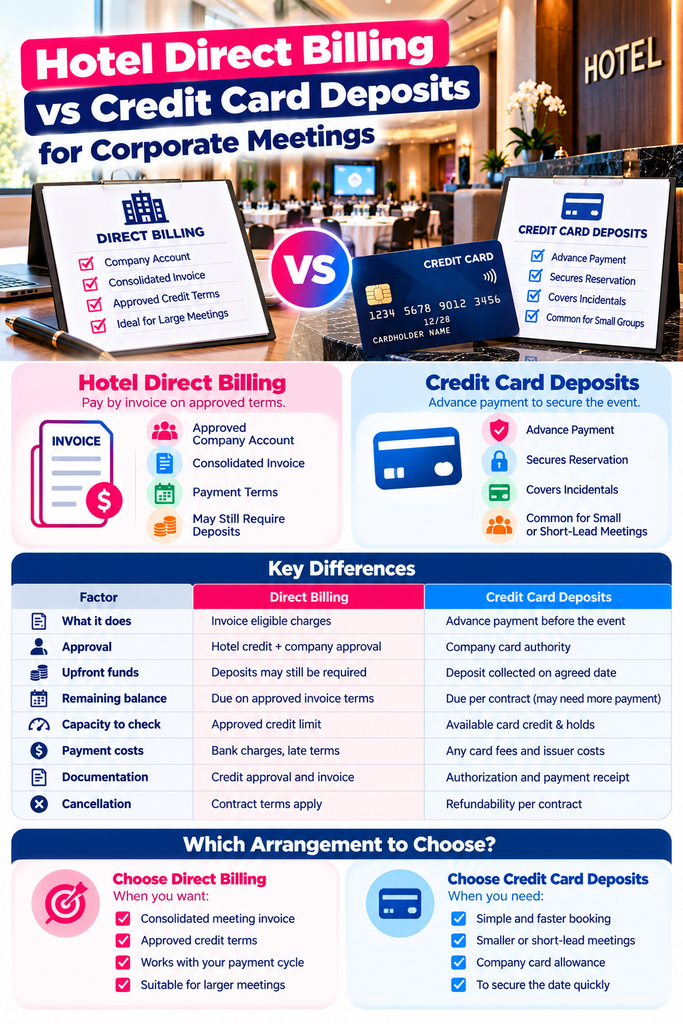
Quick answer: Direct billing lets an approved company pay eligible meeting charges on the hotel’s invoice terms. A credit card deposit is an advance payment toward the event. They are frequently used together, because direct billing may still require a deposit. Compare approval requirements, payment deadlines, credit limits, fees, and cancellation exposure before you book.
Check whether the hotel’s payment schedule works with your company’s purchasing process. A venue can fit the agenda and the budget and still want money before accounts payable can release it. A corporate card can cover the deposit and then run out of available credit before the balance.
Use this guide to agree a payment plan with hotel accounting, procurement, and the meeting’s budget owner. The hotel terms cited are specific published policies, and other US properties may set different ones.
What direct billing is
An approved credit arrangement under which the hotel invoices the named company for eligible charges, with payment due under agreed terms. The approval should specify the payer, the event, the covered charges, the credit limit, and the payment deadline.
Get written approval from the hotel’s authorized credit or accounting team. Submitting an application is not receiving approval, and your company’s purchase order does not establish hotel credit. Ask whether an existing account covers this property and this meeting, since approval at one hotel may not carry across the brand.
Direct billing does not mean no money changes hands in advance. Virgin Hotels Las Vegas’s published planning guide describes an initial deposit even where credit is established, with additional deposits determined by accounting, alongside its eligibility and application conditions. Confirm the current requirements for your own event.
What a credit card deposit is
A payment the hotel collects before the meeting under the agreement. It should appear as a credit against the event’s charges at reconciliation. The contract sets the deposit schedule, the refund conditions, and whatever payment obligations remain.
Four terms often get mixed up:
- A deposit is money collected
- An authorization hold temporarily reserves available credit
- A card authorization records permission for specified transactions
- A guarantee supports obligations defined in the booking terms
Ask the hotel which one it intends to do, and for how much.
Chase explains that authorization holds reduce available credit while they remain in place. So a hold affects your purchasing capacity before any charge posts. Ask the hotel and the card issuer about the release process instead of assuming every hold clears in the same number of days.
How the two compare
Compare the terms the hotel offers. Not every property offers both routes.
| Decision factor | Approved direct billing | Credit card deposit |
|---|---|---|
| What it does | Provides invoice terms for eligible charges | Pays an agreed amount before the meeting |
| Approval | Hotel credit approval plus company purchasing approval | Company spending authority, accepted card, hotel authorization |
| Upfront funds | Deposits may still be required | Deposit collected on the agreed date |
| Remaining balance | Due on the approved invoice schedule | Due under the contract; may require further prepayment |
| Capacity to check | Approved hotel credit limit and covered costs | Available card credit, transaction controls, holds |
| Payment costs | Accepted settlement methods, bank charges, late-payment terms | Any disclosed card fee and issuer costs |
| Documentation | Credit approval, master account instructions, invoice, remittance | Authorization, payment receipt, card records |
| Cancellation | Contract obligations remain relevant | Refundability and additional liability follow the contract |
A master account is the hotel account that collects charges assigned to the organizer. It is not a payment method. It can be settled through approved direct billing or another accepted arrangement. Define what posts to that account separately from how and when it gets paid, because those two decisions have different owners inside your company.
Which arrangement to choose
Direct billing, when the invoice terms fit
Direct billing suits a company that wants a consolidated meeting invoice, has lead time for credit review, and can pay inside the hotel’s terms. It can reduce what hits a corporate card, where the approved arrangement allows the balance to be invoiced after the event.
Ask finance to confirm its payment cycle fits the agreed due date. If the company pays in 45 days and the hotel requires 30, resolve that before you commit. Those numbers are only an example.
Card payment, when the booking needs a simpler route
A card deposit can be practical for a smaller or short-lead meeting where hotel credit review cannot finish in time, provided company policy permits it. Check the full schedule first: a modest deposit can be followed by a large pre-event charge that nobody budgeted for in that month.
Use an approved corporate payment method and confirm the cardholder’s authority. Check expiration, transaction limits, available credit, and whether fraud controls might block a five-figure hotel payment. Arrange an authorized backup route for when the first one fails.
A combination, only where the hotel accepts it
Do not assume a card can pay the deposit while direct billing covers the rest. Bellagio’s published meeting guide permits cards for certain prepaid programs but states that cards are not accepted where direct billing has been requested, or for outstanding direct-bill balances. That is one property’s rule, but it’s the kind of restriction to check before you choose a route.
Before you apply for direct billing
Ask hotel accounting for the current application, the required supporting documents, the submission deadline, and the expected decision date. Involve whoever is authorized to supply company financial information, and use the hotel’s approved submission channel.
- Identify the legal entity that will sign and pay, with its billing address and accounts-payable contact
- Provide the meeting dates and estimated master account total, including taxes, service charges, and eligible supplier charges
- Ask what company, financial, banking, or trade-reference information is required, and collect only what was asked for
- Confirm whether a room block, minimum spend, or other eligibility condition applies
- Request the approved credit amount, covered categories, deposit schedule, expiration, and the conditions for reviewing or changing approval
- Agree the fallback payment deadline if the application is declined, incomplete, or still pending
The published timelines vary a lot. Virgin Hotels Las Vegas’s guide calls for an application at least 60 days before arrival. Bellagio’s calls for receipt no later than 90 days before main arrival, and warns that applications inside 60 days may be declined for consideration. Treat those as prompts to start early, not as a nationwide timetable.
Ask when the payment clock starts, too. Hilton’s standalone BEO terms provide a post-event payment period measured from receipt of the final bill, for customers with sufficient credit facilities. Confirm the trigger in your own contract instead of treating “net 30” as self-explanatory, because net 30 from the event date and net 30 from the invoice date can be a month apart.
Before you pay a card deposit
Get the amount, collection date, and purpose in writing. Confirm whether the authorization covers the deposit only, scheduled installments, the final balance, or additional event charges. Ask what notice and approval apply to later charges.
Request a receipt identifying the meeting and the deposit. Record the payment reference and masked card identifier in the event file. Confirm how the payment will appear on the final statement and which department resolves a missing deposit credit, because that conversation is much harder to start after the event.
For virtual cards, have the hotel and your card administrator align allowed dates, amount, and merchant controls with the planned transactions. Confirm the hotel accepts the proposed card for the deposit and for anything after it. The same authorization does not automatically work at every payment stage.
Use the hotel’s approved secure payment process. PCI Security Standards Council guidance prohibits sending unprotected primary account numbers by email, text, or chat. Keep full card details out of shared meeting spreadsheets and ordinary email threads, however convenient the thread is.
How the schedules affect the budget
Compare the total and the timing separately. A lower deposit improves when funds leave the organization only if the remaining terms also work for finance. It does not reduce the meeting’s price or the amount committed under the contract.
Illustrative only. A meeting is estimated at $40,000 and finishes at $42,000 after approved additions. Assume no separate payment fees and that the hotel accepted both arrangements.
| Payment stage | Direct bill with deposit | Card prepayment |
|---|---|---|
| At signing | $8,000 deposit by accepted bank payment | $8,000 charged to corporate card |
| Before the meeting | No additional payment | $32,000 charged to corporate card |
| After reconciliation | $34,000 invoiced, due 30 days after receipt | $2,000 additional charge on the agreed date |
| Total collected by hotel | $42,000 | $42,000 |
The direct-bill balance is $42,000 minus the $8,000 deposit, so $34,000. The card balance is $42,000 minus the $40,000 already paid, so $2,000. The deposit is part of the total, not an extra expense, which sounds obvious until someone adds it to the forecast twice.
The card column shows when the hotel collects. When the company pays the card issuer depends on a separate agreement and billing cycle. Finance should model both dates, plus any holds temporarily reducing available credit. A hold is not a paid deposit. The budget approval template covers how to present those two dates to an approver who will otherwise read them as one.
Which charges belong on the master account
Write the billing allocation before arrival. Identify exactly which meeting charges, guest-room charges, and incidentals the organizer pays, then separately identify attendee-paid items and suppliers invoicing the company directly.
| Charge category | Billing instruction to confirm |
|---|---|
| Meeting room rental and catering | Organizer account, approved functions, any spending limits |
| Guest rooms and applicable taxes | Named guests or rooming-list categories covered by the organizer |
| Personal incidentals | Attendee pays, unless specifically authorized otherwise |
| AV and other suppliers | Hotel master account or separate supplier invoice, never both |
| Additional services | Named approver, scope, and limit for extra spending |
| No-shows and cancellation charges | Contractual payer and agreed documentation |
The guest-room row depends on getting the rooming list categories right first, and the additional-services row is where venue change orders land.
Give attendees accurate instructions. Even where the company pays room and tax, ask whether guests must present a card for incidentals and what authorization applies. Direct billing of selected charges does not produce a cardless check-in, and attendees who were told otherwise will say so at the front desk.
If an agency is involved, establish whether the hotel bills the agency or the corporate client, then match that against the agency’s client agreement and funding schedule. A client’s slow reimbursement should not become a gap between the hotel’s due date and the agency’s available cash.
Does the payment method change cancellation liability?
Do not treat the deposit as a cap on what you may owe. Read cancellation, room-block attrition, minimum-spend, and refund provisions alongside the payment schedule. Paying by card, or holding invoice terms, establishes no right to cancel without further charges.
Hilton’s published standalone BEO terms address deposits and cancellation charges separately, and allow certain cancellation charges to be collected from the card on file. Confirm your total contractual exposure, which can be a different number from the amount already paid. Room block attrition and shortfall charges and how a food and beverage minimum works cover the two provisions most likely to produce a number nobody expected.
Ask what happens to a deposit after a permitted cancellation, a date change, or an overpayment. Confirm whether the remedy is a refund or a future credit, who receives it, and on what conditions. For a disputed charge, follow the hotel contract and your company’s payment process. A card dispute is not a substitute for resolving the underlying obligation.
Fees and invoice terms
Ask about payment-related charges before comparing options. Record whether a quoted card fee applies to the deposit, the whole master account, or only some transactions. Confirm the accepted methods for settling an approved direct-bill invoice, since card settlement is sometimes restricted.
Visa’s US guidance describes the conditions and disclosure requirements for credit card surcharging. Do not assume every hotel charges the same fee, or that a quoted fee is permitted in every situation. Ask hotel accounting to confirm the current policy for your card and location.
Keep the payment due date, invoice delivery address, purchase-order reference, and dispute-notice deadline together. Finish vendor onboarding before the first payment falls due. Escalate a missing internal purchase order promptly rather than letting it delay the hotel’s invoice and expire a discount.
After the meeting, match the invoice against the agreed scope, the approved additions, the guest-room allocation, and the receipts. Verify every deposit and credit once. Investigate anything appearing on both the hotel master account and a separate supplier bill. Follow the contract’s process for disputed and undisputed amounts separately.
A payment confirmation brief
Send this to hotel accounting and your finance contact. It is a planning record. It does not replace the hotel’s credit approval or the contract.
EVENT AND PAYER
Meeting name and dates: [Enter]
Hotel and contracting legal entity: [Enter]
Invoice recipient and accounts-payable contact: [Enter]
Purchase order and vendor-onboarding status: [Enter]
Estimated master account total: [$]

PAYMENT ARRANGEMENT
Requested route: [Direct bill / card / agreed combination]
Direct-bill approval, credit limit, covered charges: [Enter or n/a]
Deposit amounts, methods, collection dates: [Enter]
Any authorization hold and release process: [Enter or none]
Remaining balance, due-date trigger, accepted method: [Enter]
Payment fees and scope of card authorization: [Enter]
Fallback if credit approval is not granted by the decision
date: [Enter]

BILLING AND RECONCILIATION
Organizer-paid and attendee-paid charges: [Enter]
Authorized extra-spend approvers and limits: [Enter]
Separate supplier invoices: [Enter]
Cancellation and deposit refund terms: [Reference agreement]
Invoice delivery, review, and dispute process: [Enter]
Hotel accounting confirmation and company approval: [Names, dates]
Confirm the payment plan while comparing venues
Use greatEvent to explore venues for your next corporate meeting. Compare the room, the services, the total price, and the payment timing together rather than settling payment after you have chosen. Confirm the hotel’s deposit and billing arrangements with its accounting team so the booking fits your approval process.
Two companion pieces: booking a hotel room block for a corporate event covers billing allocation for the rooms side, and the hotel proposal comparison template is where payment timing belongs as a comparison column rather than a footnote.
Research and sources
Research reviewed October 9, 2026. The published hotel documents describe those properties’ own policies and were current at the dates noted; confirm the terms attached to your booking. The checklists, the payment example, and the confirmation brief are editorial planning tools. No deposit percentage, approval timeline, card fee, or payment term here is presented as an industry standard.
- Virgin Hotels Las Vegas, Meeting and Event Planning Guide, Accounting and Credit section. A historical published example with a 2021 filename; verify current event terms.
- Chase, What Is a Credit Card Hold and How Does It Work. Authorization holds and their effect on available credit. Not a product recommendation.
- Bellagio, Meeting Planners Guide, retrieved version V1.26, Credit and Credit Card Authorization sections. Property-specific conditions.
- Hilton, Standalone BEO Additional Terms and Conditions. Deposit, payment, and cancellation sections. Page revision September 3, 2019.
- PCI Security Standards Council, FAQ 1085. Restrictions on sending unprotected payment card account numbers through end-user messaging.
- Visa, Rules and Policies. US credit card surcharge conditions and linked guidance. No conclusion about any state’s law is drawn here.
- greatEvent, How It Works. Venue discovery only. No hotel credit approval or financing capability is claimed or was verified.
- greatEvent, Book a Hotel Room Block for a Corporate Event.
- greatEvent, Hotel Proposal Comparison Template for Corporate Meetings.
Frequently Asked Questions
Does direct billing mean no deposit is required? ▾
No. A hotel can approve invoice terms and still require money upfront. Ask for the complete schedule, including any additional deposits and which portion is eligible for direct billing.
Is a master account the same as direct billing? ▾
No. A master account groups the charges assigned to the organizer. Direct billing is a payment arrangement for eligible charges. Specify the billing allocation and the settlement method as two separate decisions.
Can a company pay a direct-bill invoice by credit card? ▾
Only where the hotel accepts that method for the account. Some published policies restrict card payment of direct-bill balances. Confirm the settlement method during credit approval, not when the invoice lands.
Is a purchase order enough to secure direct billing? ▾
Do not assume so. A purchase order records your company’s purchasing authorization. You still need the hotel’s written acceptance of the arrangement and its credit-approval requirements met.
Is a card authorization hold a paid deposit? ▾
No. A hold reserves available credit. A paid deposit is a collected payment. Check the hotel receipt and transaction status before marking a deposit as paid, and confirm release timing with the hotel and the issuer.
Which option is better for a short-lead meeting? ▾
An approved corporate card is often practical where credit review cannot finish in time, provided the card supports every required charge. Confirm company policy, accepted methods, fees, and the full prepayment schedule before choosing it.
Compare vendors for your next event
Search caterers, photographers, florists, planners, and rentals — then send one request to several vendors at once.