Quick answer: Price event planning services from your own numbers first. Work out how many hours you can actually bill in a year and what the business needs to earn, and divide to get an hourly floor. Then estimate the hours each job takes and quote that total in the format your client prefers: a flat fee, an hourly or day rate, a percentage of the event budget, a per-person fee, or a hybrid with disclosed commissions. Put a minimum fee, a retainer, a payment schedule, and a change-order rate in every contract so the price holds when the scope grows.
A client asks for a quote on a 150-person leadership meeting, and you have until Friday. You could look up what other planners charge and land somewhere in the middle. The trouble is that their number says nothing about your overhead, your hours, or how much of your week you actually get paid for. Price from someone else’s rate and you can stay busy all year and still come up short.
This is for US independent planners and agencies who price their own work: corporate meeting and event planners, professional wedding planners, and sports travel coordinators. If you’re on the buying side, our guide to what clients pay event planners covers it from the client’s view. Everything below is planning information, not tax, legal, or accounting advice. Have an accountant check your rate math and tax set-aside, and have an attorney review your contract terms.
The five ways planners charge
Most pricing comes down to a handful of models. In Northstar Meetings Group’s 2026 Independent Planner Pricing Survey of more than 370 independent planners, flat or project fees were the most common primary model at 39%. Markups came next at 25%, then percentage of budget (12%), commissions (11%), and hourly or daily rates (10%), with 3% choosing “other.” Many respondents said they mix models depending on the client.
| Model | How it works | Fits best when | Watch out for |
|---|---|---|---|
| Flat or project fee | One price for a defined scope | You can estimate the hours and the scope is written down | Scope creep. Cap revisions, calls, and site visits in numbers. |
| Hourly or day rate | Billed for time actually worked | Consulting, short engagements, or a vague scope | Clients may push back on open-ended bills. Track hours carefully. |
| Percentage of budget | A set share of the event spend | Large events where work grows with the budget | Your fee falls if the budget is cut but the work isn’t. Add a minimum. |
| Per-person | A fee per attendee or traveler | Programs where effort tracks headcount, such as group travel | Headcount drops lower your fee faster than your hours drop. |
| Hybrid with commissions or markups | A base fee plus disclosed commissions or a markup on vendor costs | You place hotel rooms or vendors that pay commission | Disclosure. Tell the client in writing how you’re paid. |
Northstar’s analysis argues that knowing how much you need for a scope of work matters more than which model you use. Once you know the number, the model is mostly a payment format.
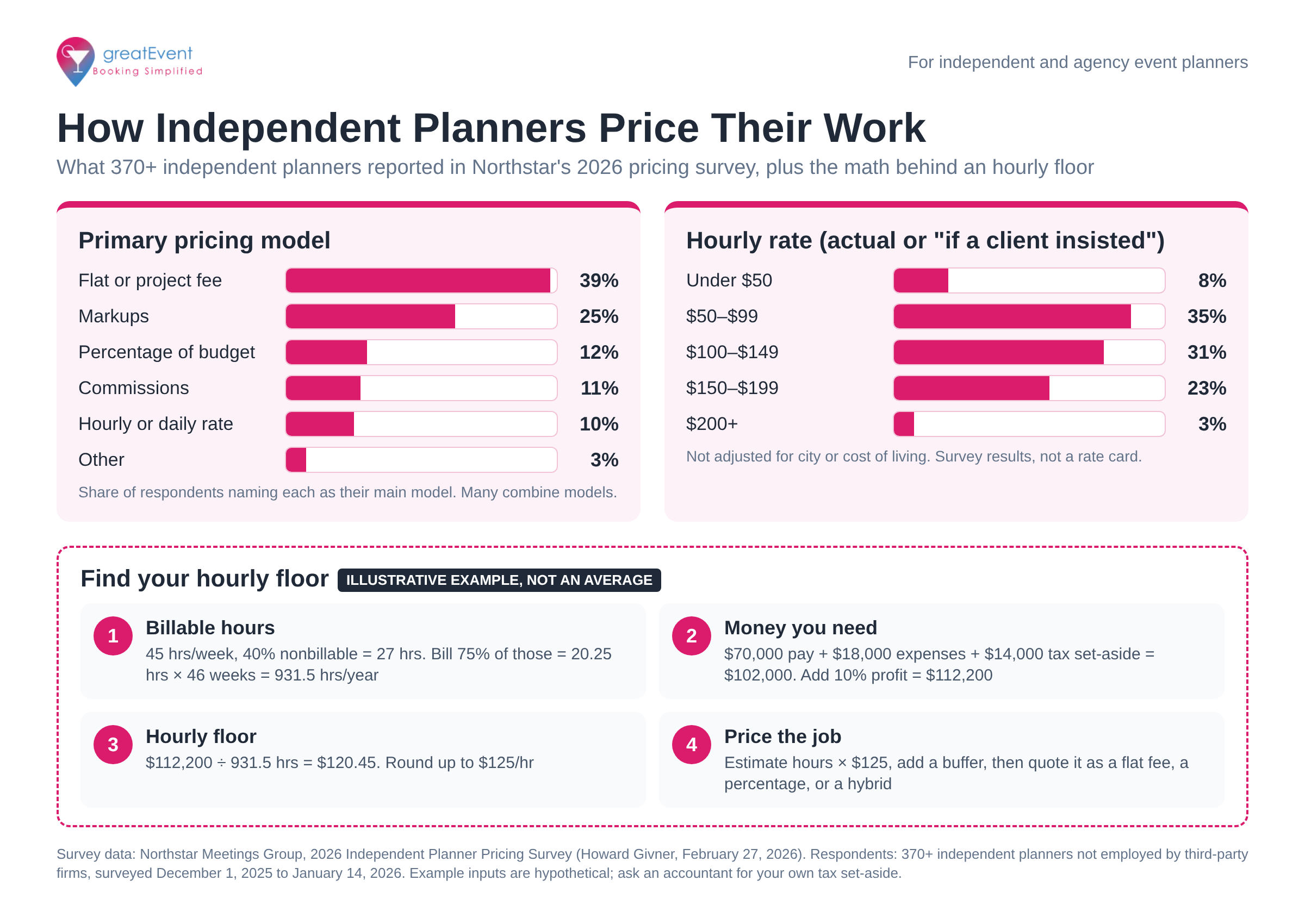
Text version of the infographic: Primary pricing model among Northstar’s 2026 respondents: flat or project fee 39%, markups 25%, percentage of budget 12%, commissions 11%, hourly or daily rate 10%, other 3%. Hourly rate, actual or what planners would charge if a client insisted: under $50, 8%; $50 to $99, 35%; $100 to $149, 31%; $150 to $199, 23%; $200 or more, 3%. These rates aren’t adjusted for city or cost of living. The illustrative example in the next section explains the four steps.
Start with your numbers: the hourly floor
Your hourly floor is the lowest rate that covers your pay, your costs, taxes, and a profit cushion. Below it, every job loses money, even when the client is happy. You need four inputs.
1. Billable hours you can actually sell
Not every working hour is billable. Bookkeeping, marketing, proposals, and admin take time no client pays for. Northstar’s analysis uses an example of a 45-hour week with 40% nonbillable time, which leaves 27 billable hours. It then adds a second step many planners skip: you rarely sell all of those hours. The share you do bill is your utilization rate, and if it’s low, your rate has to go up to reach the same income. Northstar also found that only 20% of respondents always track their hours, so if you don’t track yours, start there.
2. What the business has to earn
Add the pay you want to take home, your annual business expenses (insurance, software, marketing, accounting, travel you can’t bill), and a tax set-aside. Self-employed planners in the US generally owe self-employment tax for Social Security and Medicare, which the IRS lists at 15.3%, on top of income tax, and you may have to pay estimated taxes quarterly. Your accountant can tell you what to set aside. Then add a profit margin so the business has a reserve for slow months.
3. Divide, then round up
Here’s the math with made-up inputs. Treat it as an illustrative example, not an average or a recommended rate.
| Step | Illustrative input | Result |
|---|---|---|
| Billable hours per week | 45-hour week, 40% nonbillable | 27 hours |
| Hours you actually bill | 75% utilization of 27 hours | 20.25 hours a week |
| Billable hours per year | 20.25 hours × 46 working weeks | 931.5 hours |
| Annual need | $70,000 pay + $18,000 expenses + $14,000 tax set-aside | $102,000 |
| Add profit | 10% of $102,000 ($10,200) | $112,200 |
| Hourly floor | $112,200 ÷ 931.5 hours | $120.45, rounded up to $125 |
Compare your result with the survey bands as a reality check, not a target. In Northstar’s 2026 data, planners with eight or more years in business were more likely to charge $100 or more an hour (68%) than those with zero to three years (36%). Rates also didn’t account for local cost of living, so a planner in a lower-cost city may charge less for similar work.
4. Set a minimum fee
A minimum fee keeps small jobs from eating your calendar. Base it on the smallest project you’re willing to take. If your shortest realistic engagement is 24 hours of work, then at $125 an hour your minimum is $3,000. Put it in your price list and your contract, and apply it to percentage and per-person quotes too.
Flat fee, hourly, percentage, or hybrid: when to use each
Turn the hourly floor into a quote. Estimate the hours for each phase (discovery, sourcing, contracting, design, vendor management, onsite, and wrap-up), multiply by your rate, and add a buffer for the unknowns you can’t scope yet.
Illustrative example: you estimate 72 hours for a one-day, 150-person leadership meeting. At $125 an hour that’s $9,000. A 15% buffer adds $1,350, so you quote a flat fee of $10,350. If the client wants percentage pricing on a $90,000 event budget, check what a given percentage would produce. At 12%, it would be $10,800, close to your estimate, so the percentage holds up. If the budget drops to $60,000, though, 12% is only $7,200 for roughly the same work. That’s why percentage quotes need a minimum fee.
Per-person pricing has the same weak spot. At an illustrative $60 per attendee, 150 people bring in $9,000. If registration falls to 90, you get $5,400, and your hours barely change. Pair it with a minimum or a headcount floor.
Hourly works when the scope is too fuzzy to estimate. Flat fees suit clients who want one approved number, as long as you write the scope limits down. A hybrid, such as a smaller planning fee plus commissions you disclose, can work for programs heavy on hotel rooms. Don’t count on commission arriving fast, though, or on it being paid on the full block. Our explainer on how hotel group commissions work for agencies covers pickup and payment timing.
Corporate vs. wedding pricing
The same math works for both. What changes is how each client approves and pays for a quote, which is where the differences between corporate and wedding planners show up.
| Factor | Corporate and association clients | Wedding and social clients |
|---|---|---|
| How work arrives | Often by RFP. In Northstar’s 2026 survey, 95% of planners said they’re asked to answer RFPs at least sometimes. | Usually by inquiry and consultation |
| What the buyer compares | Line items, scope, and terms, often across several agencies | Overall package value and fit with the planner |
| Common formats | Flat project fee, day rates for onsite staff, management fee plus disclosed commissions | Tiered packages (full, partial, coordination-only) with a fixed fee |
| Payment terms to confirm | Purchase orders, invoice terms, and who approves payment | Retainer at signing and a fixed installment schedule |
| Notes | Ask early who signs and how invoices get paid | The Association of Bridal Consultants discourages charging a percentage of the wedding cost |
For corporate quotes, it helps to know what buyers expect to see. Our breakdown of corporate event planner costs is written for the client side, so it’s a useful check on how your proposal will be read. If you coordinate team travel, the same math applies to a per-team or per-traveler fee. Just add a minimum.
Build packages with scope limits in numbers
Packages make pricing easier to buy, as long as each tier says exactly what’s included. Many planners split full planning, partial planning, and coordination-only work, and the difference between planners and coordinators is a sensible place to draw the line between tiers. “Vendor management” can mean almost anything, so put a number on it.

Scope items worth capping in every package:
- Planning calls or meetings (for example, up to 6)
- Venue site visits (for example, up to 3)
- Rounds of revisions on floor plans, timelines, or budgets
- Vendors you source, contract, and manage
- Onsite hours and staff on event day
- Response time on email and messages
- Travel outside your local area, billed separately
The numbers in parentheses are examples. Use counts that match how your hours actually add up.
Vendor commissions and markups: disclose them
Most independent planners take commissions at least some of the time. In Northstar’s 2026 survey, 87% said they accept them at least sometimes (13% always, 33% most of the time, 41% sometimes), and 13% never do. Among those who accept them, 24% said they always disclose that to clients. Howard Givner, who wrote Northstar’s analysis, put it this way: “the difference between a commission and a kickback is one word: disclosure.”
Professional codes of ethics say the same. The Wedding Industry Professionals Association (WIPA) Code of Ethics allows commission or referral arrangements only when they’re transparent and in the client’s best interest, and rules out undisclosed kickbacks. The Association of Bridal Consultants says its code requires members to disclose payments received from suppliers. Put your compensation in the contract: your fee, any markup on vendor costs, and any commission you expect, including hotel commissions.
Retainers, payment schedules, and change orders
There’s no standard retainer amount, so set yours to cover the early work you do before the event is locked in. Decide in the contract whether it’s refundable, and when. Then tie the remaining payments to dates, not to milestones the client controls.
Illustrative schedule on the $10,350 flat fee above: 40% at signing ($4,140), 30% 90 days before the event ($3,105), and 30% 30 days before ($3,105). That adds up to $10,350.
Scope creep is easier to handle when the price for extra work is already agreed. A change order is a short written amendment that describes the added work, its price, and any effect on the schedule, signed before you start. Say the client adds a welcome dinner the night before: at an estimated 10 hours and $125 an hour, the change order is $1,250. Quote your hourly change-order rate in the original contract so this conversation is quick.
Ask an attorney to review your retainer, cancellation, and change-order clauses, and ask your accountant how to record retainers and whether your state taxes any of your services.
Copyable price list and pricing worksheet
Copy these into a document or spreadsheet and replace the bracketed items with your own numbers.
PRICING WORKSHEET
Hours per working week:                [__]
Nonbillable share (admin, marketing):  [__]%
Utilization (share of billable hours you sell): [__]%
Working weeks per year:                [__]
= Billable hours per year:             [__]

Owner pay target:                      $[__]
Business expenses (annual):            $[__]
Tax set-aside (ask your accountant):   $[__]
Profit margin:                         [__]%
= Annual revenue needed:               $[__]

Hourly floor = revenue needed / billable hours = $[__] (round up)
Minimum fee  = smallest project hours x hourly floor = $[__]

PRICE LIST
Full planning (from):                  $[__]  Includes up to [__] calls, [__] site visits, [__] vendors, [__] onsite hours
Partial planning (from):               $[__]  Includes up to [__] calls, [__] vendors, [__] onsite hours
Coordination only (from):              $[__]  Starts [__] weeks before the event; [__] onsite hours
Hourly consulting:                     $[__] per hour, [__]-hour minimum
Onsite staff (per person, per day):    $[__]
Change orders:                         $[__] per hour, or quoted per item
Travel outside [area]:                 billed at cost / $[__] per day
Minimum fee for any engagement:        $[__]
Retainer at signing:                   [__]% (refundable until [date/condition])
Payment schedule:                      [__]% at [__] days, [__]% at [__] days
Commissions and markups:               [Disclose what you receive and from whom]
Source venues for client events on greatEvent
Once your pricing is set, the next job is sourcing. Register as a professional planner on greatEvent to search meeting and event venues as well as event vendors for client events and book instantly where available. There are no fees for planners. We pay you commission on any qualifying booking you make on greatEvent.
Register as a professional planner
Research and sources
Sources reviewed October 22, 2026. Survey figures describe the respondents to one survey, not every US planner. All dollar inputs in the examples are hypothetical and checked for arithmetic only. Tax and contract points are general planning information, not professional advice.
- Northstar Meetings Group, “2026 Independent Planner Pricing Survey,” analysis by Howard Givner, February 27, 2026 (northstarmeetingsgroup.com). Primary pricing models, hourly rate bands, rates by years in business, time tracking, the 45-hour and 27-billable-hour example, utilization, commission acceptance and disclosure, and RFP frequency.
- Internal Revenue Service, “Self-employment tax (Social Security and Medicare taxes)” (irs.gov). The 15.3% self-employment tax rate and the note on quarterly estimated taxes.
- U.S. Bureau of Labor Statistics, Occupational Outlook Handbook, “Meeting, Convention, and Event Planners” (bls.gov). Background on planner duties. Its wage data covers employed planners and excludes the self-employed, so it isn’t used as a fee benchmark here.
- Wedding Industry Professionals Association, “Member Code of Ethics” (wipa.org). Transparency in pricing and contracts, and disclosure of commission and referral arrangements.
- Association of Bridal Consultants, “Wedding Planner FAQs” (abcweddingplanners.com). Hourly and fixed-fee pricing, discouraging percentage-of-cost fees, and disclosure of supplier payments.
Frequently Asked Questions
What’s the most common way independent planners charge?
▾
Flat or project fees. Many planners also combine models, such as a flat fee plus disclosed commissions, depending on the client and the event.
Should I charge hourly or a flat fee?
▾
Use hourly when the scope is unclear or the job is short. Use a flat fee when you can estimate the hours and write the scope limits into the contract. Either way, price from your own hourly floor.
How do I calculate my hourly rate as an event planner?
▾
Divide what your business needs to earn in a year, including pay, expenses, tax set-aside, and profit, by the hours you can realistically bill. Round up.
How much should a retainer be?
▾
There’s no standard amount. Set it to cover the work you do before the event is confirmed, and state in the contract whether and when it’s refundable.
Do I have to tell clients about vendor commissions?
▾
Yes, disclose them. Professional codes of ethics for planners expect it. Put your fee, markups, and any commissions in writing before you book.
How do I stop scope creep?
▾
Cap calls, site visits, revisions, and onsite hours in each package. Put a change-order rate in the contract, and get a signed change order before you start extra work.
Compare vendors for your next event
Search caterers, photographers, florists, planners, and rentals — then send one request to several vendors at once.