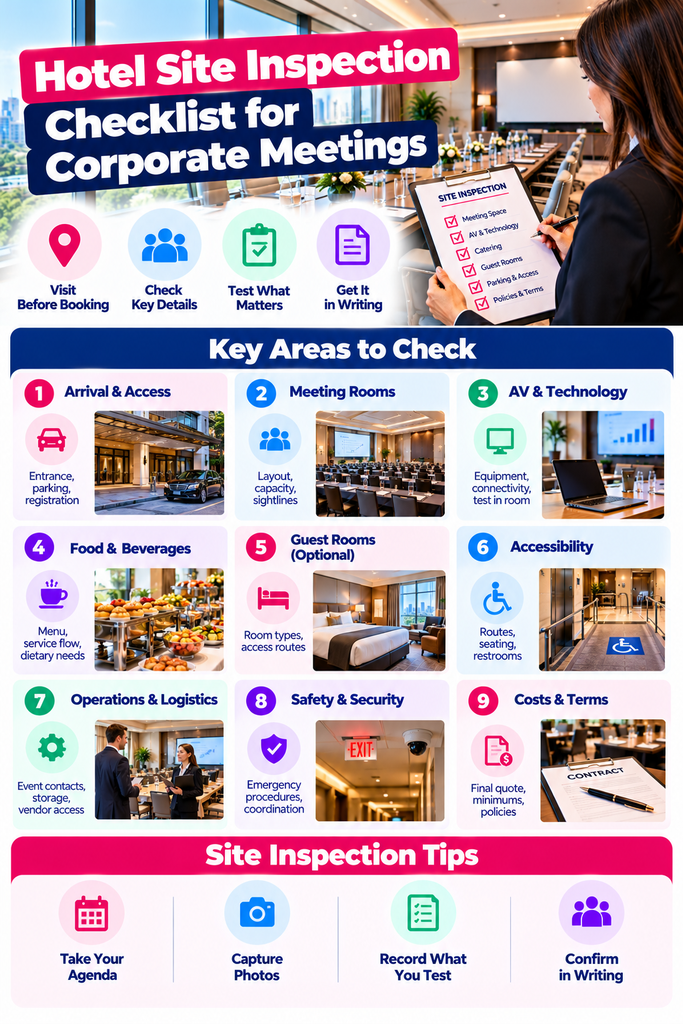
Quick answer: A site inspection checklist should cover the exact meeting rooms, the layout, attendee routes, accessibility, AV and internet, catering, guest rooms where needed, staffing, safety coordination, and total costs. Record three things separately: what you observed, what you tested, and what still needs written confirmation before you select the hotel.
The visit should show whether the property can deliver your agenda. A ballroom that looks generous on a tour needs a different setup once you add screens, tables, catering, and circulation space. A quiet corridor on a Tuesday afternoon may be shared with another group on your meeting date.
The checklist suits corporate meetings, training programs, executive off-sites, and association conferences. Confirm property policies and specialist requirements for your own event.
When to inspect
Arrange the visit after basic fit is confirmed: dates, meeting-space needs, location, a plausible budget. Inspect before a binding commitment when the meeting’s complexity or its unresolved requirements justify the trip.
A later planning visit, to refine delivery details, is a separate exercise from deciding whether to book.
Cvent recommends reviewing the shortlist with stakeholders before visiting, assessing how attendees will move through the property, and recording findings while they are fresh.
For a straightforward meeting at a familiar property, a live video walkthrough and current documents may resolve everything outstanding. For a new venue with complex production, simultaneous sessions, or demanding access needs, an in-person visit exposes what photographs hide. Choose the method based on what is still unverified, not on a headcount rule.
What to send before the visit
Give the hotel a brief so it can make the right spaces and the right people available: agenda, attendance by session, layouts, access hours, catering, overnight-room needs, technical requirements, known accessibility arrangements. Mark essential requirements separately from preferences.
- Request a tour of the actual proposed rooms and routes. If a room is occupied, arrange another viewing or record it as unverified. A similar room does not prove the proposed room will work
- Ask for current floor plans, room dimensions, layout-specific capacities, the proposal, and relevant supplier policies in advance
- Invite the hotel’s event operations contact and, where needed, AV, network, catering, facilities, and security representatives. Bring your own technical or accessibility specialists when their input could change the decision
- Agree any equipment demonstration, menu tasting, photographs, and associated charges beforehand. Get permission before recording or viewing another organization’s event
Bring a marked-up agenda and proposal, a device for notes and permitted photos, and the laptop or presentation setup you intend to use. Number your requirements so every piece of evidence traces back to a specific room, session, or service.
The checklist at a glance
For each area, record a status: confirmed, open, unsuitable, or not applicable. Use “confirmed” only where the evidence supports the requirement. A sales assurance stays open until the detail behind it is resolved.
| Area | Inspect or test | Evidence to retain |
|---|---|---|
| Arrival and movement | Entrance, drop-off, parking, registration, routes between sessions | Marked route and transfer times |
| Meeting rooms | Exact rooms, layouts, usable seating, sightlines, noise, lighting, temperature | Room names, plans, photos |
| Access and turnover | Setup, testing, meeting, reset, and teardown windows | Room-by-room access schedule |
| Accessibility | Attendee and presenter routes, seating, restrooms, communication arrangements | Specific arrangements agreed |
| AV and internet | Presentation and call test, service scope, connectivity, support | Equipment list, test conditions, contacts |
| Catering | Meal location, service flow, dietary process, timing | Menu scope, guarantees, priced inclusions |
| Guest rooms if needed | Representative contracted categories, access routes, group arrival | Room categories and lodging terms |
| Operations and logistics | Event contacts, storage, deliveries, vendor access, simultaneous events | Responsibilities and procedures |
| Safety coordination | Emergency contacts, briefing process, event-specific arrangements | Current hotel procedures |
| Costs and commitments | Required extras, minimums, changes, items discovered on the tour | Revised itemized proposal |
Check the rooms against the real agenda
Walk each proposed room holding the session plan. Identify where attendees, presenters, screens, cameras, catering, and support staff will physically go. Ask the hotel to confirm capacity in that configuration and what approvals the layout needs.
Then sit where the least-favored attendee will sit. Check the view of the screen and the speaker from the back and the sides. Ask to hear the microphone and room audio if that service is in the offer. Note columns, glare, service activity nearby, and sound coming through partitions.
For initial planning, use the meeting room capacity chart, then verify the named room with the hotel. A general area estimate cannot confirm a particular setup.
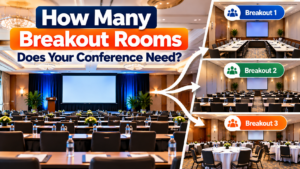
Build the room schedule around access as well as session time. If a room turns from classroom to lunch seating, ask who performs the reset, how long it takes, where attendees wait, and whether the price includes that labor. Check that adjacent breakouts can run at the same time without bleeding into each other, which how many breakout rooms a conference needs covers from the planning side.
Meetings & Conventions flags room obstructions, acoustic separation, and exclusive or preferred AV suppliers in its hotel inspection checklist. Resolve those before you accept the venue’s presentation of the space.
Walk the attendee and presenter routes
Follow the journey from the arrival point through registration, the main session, breakouts, meals, restrooms, and departure. Time the route, then label the conditions, because a quiet walkthrough tells you nothing about how long 200 people take. Identify shared elevators, narrow waiting areas, and competing traffic.
For accessibility, examine the complete route and the proposed setup. Ask how attendees and presenters reach their seats, any stage, meal service, and restrooms. Confirm the specific arrangements rather than accepting a general statement that the property is accessible.
The US Department of Justice’s 2010 ADA Standards address physical accessibility across routes, doors, assembly areas, and lodging. A planner’s walkthrough can identify questions. It does not certify compliance, so route unresolved technical requirements to the qualified parties.
Ask who arranges communication support and how it gets tested. The Department of Justice identifies aids and services including assistive listening, captioning, and qualified interpreters. What is appropriate depends on the communication and the participant’s needs.
Record agreed responsibilities, ordering deadlines, and any supplier costs for internal review. Keep personal medical details out of an inspection report that will circulate.
Test the AV, and clarify the internet
Meet the team that will support the meeting. Encore’s site-visit guidance recommends identifying the technical contact, the team’s responsibilities, and whether support is on site or remote, all before signing.
Ask for a demonstration using representative content on the proposed equipment. Check slide readability, microphone coverage, camera framing, remote-participant audio, and the connection between a presenter’s laptop and the display. Confirm who supplies adapters, who operates the system, and whether rehearsal support is included.
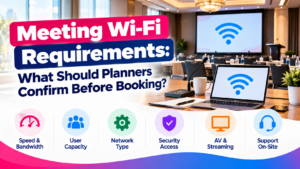
Give the network team your expected simultaneous users, devices, applications, and critical activities. Ask which service is shared, what capacity is committed to your event, whether wired connections are needed, and how support escalates a problem. Encore describes planning bandwidth around individual event components and separating critical uses from general attendee traffic. What to confirm about meeting Wi-Fi covers those questions in full.
A speed test in an empty room measures one device at one moment, and it verifies nothing about service under event load. Record the test location, connection, time, and conditions, then have IT or your production lead review the proposed service against the program.
If the demonstration uses upgraded equipment or a different network from the quoted offer, mark that difference immediately. A test only informs the buying decision when you know what was tested and what you are being sold. What production details belong in a venue RFP sets out how to specify that in writing beforehand.
Catering and guest rooms
Walk the meal and break locations during the same route review. Ask how the hotel serves your headcount inside the available break, where lines form, and whether service activity interrupts nearby sessions. Ask what happens when the preceding session runs late.
Discuss dietary requests and allergies with the catering lead: what information they need, labeling, preparation and service processes, and who handles attendee questions on the day. Do not promise an allergen-free environment on the strength of a tasting or a verbal assurance.
If lodging is part of the program, view representative room categories from the offer, including the specific accessible features needed, rather than the suite they show everyone. Compare the room-block proposal against what you were shown, group check-in arrangements, and the route to the meeting space. Ask about planned work affecting those areas. Guest-room quality, renovation plans, and dietary arrangements also appear in the Meetings & Conventions checklist.
For a meeting with no overnight rooms, mark this section not applicable and focus on daytime access. Confirm the meeting offer stands without a guest-room purchase commitment, which whether hotels rent meeting rooms to non-guests covers.
Operations and supplier rules
Ask who takes responsibility after the sales handoff. Record the event manager, the on-duty escalation contact, and support coverage across setup, sessions, and teardown. Discuss simultaneous events without asking for another client’s confidential information: your questions are about noise, shared areas, loading, and staffing.
Ask about construction or maintenance planned for your dates, including affected routes and rooms. Identify the alternative if essential space becomes unavailable, and get material commitments into the booking documents.
For equipment and materials, inspect the approved delivery route, the storage location, and the access to the meeting room. Have your vendor verify dimensions, weight restrictions, power needs, and technical approvals. Confirm delivery appointments, handling fees, supplier restrictions, and after-hours charges before the budget is final.
ARIA’s published Meeting Planners Guide is one example: it sets property-specific AV and production rules, security arrangements, and shipping procedures. Treat them as things to ask about, since other hotels set their own terms. Request the current guide for your shortlisted property.
Meet the hotel’s responsible contact about emergency coordination, attendee briefing, assistance arrangements, and who communicates instructions. Record current contacts and procedures. Have your risk or security team review anything outside a planner’s expertise.
Turning findings into a decision
Start with the essentials. An unresolved requirement that could stop the meeting working stays visible even when the hotel performs well everywhere else: insufficient capacity in the required layout, an unresolved accessible route, an unverified critical connection, access hours that cannot absorb setup.
Then compare the remaining venues against the same agenda and the same total cost. Carry the inspection findings into the commercial review with the hotel proposal comparison template, including mandatory services, minimum purchases, overtime, and anything the visit surfaced. Items discovered on a tour can become change orders later, so price them now rather than on site.
Keep observations separate from promises. A useful record carries the hotel and visit date, the named room, the requirement, the evidence, the open question, the owner, the deadline, the cost impact, and the decision. Label every photo, test, floor plan, and written response so another reviewer can find it.
| Example finding | Evidence needed to close it | Decision treatment |
|---|---|---|
| The presenter test used a different room from the proposed one | Test or technical confirmation for the named room and quoted system | Keep the requirement open |
| A room reset falls inside the next session’s setup window | Revised schedule and staffing confirmation with any added price | Reassess schedule and total cost |
| The inspected room fits the approved layout | Current plan and hotel confirmation for the agreed setup | Record as confirmed, subject to documented scope |
Those are hypothetical. Set a deadline and an owner for each unresolved item, and revisit the comparison if a solution changes the price, the room, the schedule, or the attendee experience. Where it changes the total, check it against what a meeting room costs for a full day before accepting it.
Send a short follow-up while the findings are fresh:
Please confirm the attached room schedule and resolve items [numbers] by [date]. For each item, identify the solution, the responsible person, the supporting document, and any cost change.
Get material scope and commitments into the agreement and the event documents before you rely on any of it.
Find and evaluate your next meeting venue
Start your search on greatEvent with the meeting type, location, date, and attendee count. Once you have suitable options, use this checklist to verify the rooms and services your agenda depends on. Keep the inspection findings alongside the offer, so your team can select and book with a clear record of what has been confirmed and what has not.
Research and sources
Reviewed October 15, 2026. The checklist and the decision method are editorial planning recommendations. The sources support the identified practices and examples. Hotel-specific rules vary, and the example findings table is hypothetical.
- Cvent, Making the Most of Your Site Visit. Published August 20, 2019. Used for stakeholder preparation, attendee flow, and recording findings. No historical figures or complimentary-visit assumptions are adopted.
- greatEvent, Meeting Room Capacity Chart. Related layout resource; no numeric capacity rule is imported from it.
- Meetings & Conventions, Checklist for Site Inspecting a Hotel. Published January 8, 2025. Room obstructions, acoustics, supplier arrangements, lodging, renovations, and dietary questions.
- US Department of Justice, 2010 ADA Standards. Primary physical-accessibility reference. This article provides no legal certification or dimension-based compliance test.
- US Department of Justice, Effective Communication. Primary guidance on communication aids and services.
- Encore, Five Key Questions for an AV Site Visit. Published October 26, 2023. Technical contacts, support location, responsibilities, and pre-contract discussion.
- Encore, Dedicated Event Internet Services. Published February 27, 2024. Event-component planning and prioritizing critical internet uses. No device-count benchmark is adopted.
- ARIA, Meeting Planners Guide V4.26, printed pages 5 and 27 to 28. Supplier, security, and shipping rules. No property fee or deadline is presented as an industry standard.
- greatEvent, Hotel Proposal Comparison Template. For comparing offers and carrying forward unresolved items.
- greatEvent, Homepage and Business Meeting Search. No booking or inventory guarantee is asserted.
Frequently Asked Questions
What is a hotel site inspection for a corporate meeting? ▾
A structured review of a shortlisted hotel against your meeting’s requirements. The planner examines the proposed spaces, tests the relevant services, and confirms operational and commercial details to support the venue decision.
Who should attend the site visit? ▾
The meeting planner, plus anyone whose expertise could change the decision. Depending on the program that might be a stakeholder, a production or IT lead, an accessibility specialist, or a security representative. Ask the hotel to bring its own operations and technical contacts.
How long should a site inspection take? ▾
Long enough to review every essential space and complete the agreed tests. A single-room meeting and a multi-day conference need different schedules. Send your inspection agenda first and ask the hotel to confirm a realistic duration, including staff discussions and any tasting.
Can a virtual site inspection replace an in-person visit? ▾
A live video walkthrough can verify room identity, routes, and visible features when travel is impractical. Request current plans and demonstrations. Record what stays uncertain, particularly acoustics, attendee flow, and technical performance, then decide whether those gaps justify the trip.
Are hotel site inspections free? ▾
Ask in advance. Confirm charges for travel, lodging, tastings, equipment demonstrations, and staff time, along with any credit offered after booking. Follow your organization’s travel, gifts, and procurement policies.
What should planners do afterward? ▾
Consolidate the findings, get written answers to open items, revise the total budget, and compare venues against the same requirements. Confirm the agreed scope in the booking documents and assign owners to the remaining planning tasks.
Compare vendors for your next event
Search caterers, photographers, florists, planners, and rentals — then send one request to several vendors at once.