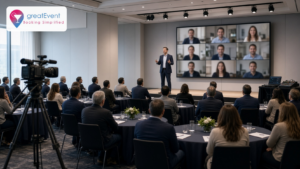
Quick answer: A corporate event production company plans and runs the technical side of your event: audio, video, lighting, staging, rigging, and often streaming. There’s no standard price, because cost depends on event size, the venue’s labor rules, the services you need, complexity, and lead time. To choose one, send every bidder the same brief, compare quotes line by line, and check references, crew, and insurance.
Example: You’re producing a 350-person sales kickoff in a hotel ballroom. There’s a general session with an LED wall, four breakouts, and a live stream for remote staff. The hotel’s in-house AV team and two outside production companies each send a quote. One prices everything as a single “production package” line, another lists each crew member by the hour, and the third leaves out what the hotel charges outside companies to connect to its house sound system. None of them says what happens to labor costs if rehearsal runs past midnight.
Before you can choose between those bids, you have to put them in the same format and fill in what each one leaves out. Many planners find this part of the process difficult: in a Meetings Today survey of 70 corporate, association, and third-party planners in March 2026, 25.4% said AV and production terms and rates took the most time and effort of any contract issue they negotiate.
This is for corporate event agencies and in-house event teams in the US who hire production for meetings, conferences, and launches. It covers what production companies do, how they price, what drives cost, and how to write a brief, compare quotes, and score bidders. The prices and rules quoted here are published examples from specific venues and sources, not national averages.
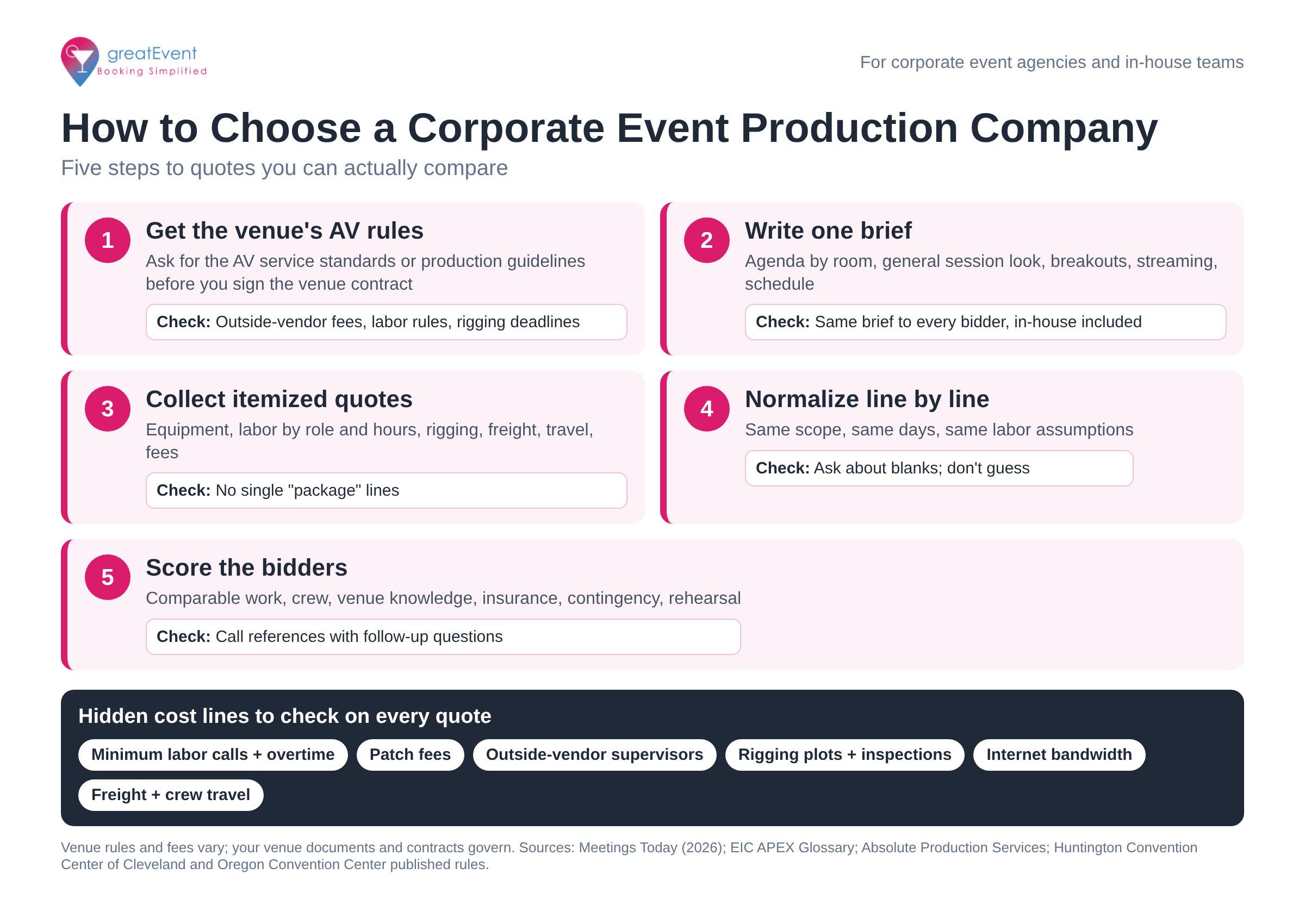
Text version of the infographic: Choosing a corporate event production company in five steps. 1) Get the venue’s AV rules: ask for the AV service standards or production guidelines before you sign the venue contract. 2) Write one brief: agenda by room, general session look, breakouts, streaming, schedule, and venue rules. 3) Collect itemized quotes: equipment, labor by role and hours, rigging, freight, travel, and fees. 4) Normalize: put the in-house quote and the outside quotes on one line-item sheet with the same scope and days. 5) Score bidders: comparable work, crew, venue knowledge, insurance, contingency, and rehearsal. Hidden cost lines to check: minimum labor calls and overtime, patch fees, outside-vendor supervisors, rigging plots and inspections, internet bandwidth, and freight and crew travel.
What a corporate event production company does (and doesn’t do)
The Events Industry Council’s APEX glossary describes a production company as one that presents special effects and theatrical acts, and notes it may contract to put on an entire event or only parts of one. In corporate events, that usually means the technical show: sound, screens and LED walls, lighting, staging, rigging, cameras, and the technical director who calls cues from the control room.
A good production partner also helps shape the show itself. Jim Russell, global head of business events services at Maritz, who spent 36 years on the AV and production side with Freeman and PSAV (now Encore), told Meetings Today that “AV should not be seen simply as a cost center,” but as a lever for what the meeting is trying to achieve.
Unless you hire them for it, assume the production company won’t negotiate your venue contract, manage your room block, or deal with catering, and that those jobs stay with you or your planner. Write that boundary into the production scope so that no task ends up uncovered by both contracts.
Production company vs. planner vs. venue in-house AV
You have three ways to get production done, and you can mix them.
| Option | What it usually covers | Where it’s strong | What to watch |
|---|---|---|---|
| Venue in-house AV | A contractor the venue keeps on site, sometimes as its exclusive provider | Knows the rooms, the power, and what has worked there before | Revenue share with the venue, and whether you get experienced techs |
| Outside production company | Equipment, crew, and show design brought in for your program | Gear chosen for your event, and a team that may already know your program | The venue’s rules and fees for outside providers |
| Event planner or agency | The whole event: venue, suppliers, schedule, budget | One owner for every moving part | Whether production is subcontracted, and how the planner’s own fee works |
When a venue has an in-house AV contractor, the APEX glossary notes that planners aren’t always required to use it, but may be charged a surcharge or facility fee for bringing in an outside contractor. Scott Frankel, president of event-production firm Animatic Media, told Meetings Today that the revenue share between an in-house AV company and the hotel “might be as much as 50 percent,” which is why in-house rates and fees can be negotiable, especially for off-season business or groups spending heavily on food and beverage.
An agency or planner usually charges for managing the whole event, so its fee works differently from a production quote. If you’re weighing whether to hand production to your agency, it helps to understand how event planners charge first, so you know whether production is inside their fee or billed on top.
How production is priced
There’s no single industry rate card; one Chicago production company says it doesn’t publish one because every event is different. What you’ll see instead is some mix of these models:
| Pricing model | How it works | What to ask |
|---|---|---|
| Fixed (flat) proposal | One price for an agreed scope | Exactly what’s in scope, and the rate for changes after you sign |
| Itemized equipment and labor | Each piece of gear and each crew role priced separately | How many days and hours each line assumes |
| Hourly labor calls | Crew billed per person per hour, with a minimum call | The minimum call, overtime triggers, and meal penalties |
| Percentage-based charges | A fee calculated as a percentage of other costs | What base the percentage applies to, and whether it’s taxed |
| Venue fees outside the quote | Charges the venue bills for outside providers | The venue’s AV service standards or production guidelines document |
Percentage-based charges are easy to miss because they don’t appear as separate equipment or labor lines. At the Huntington Convention Center of Cleveland, the exclusive AV provider’s 2026 rules say an 8% pre-production development fee may be included as a percentage of total equipment and labor, and a 20% service charge applies to basic equipment rentals for limited set-ups. Those figures apply only to that venue and aren’t an industry standard, but they show why you should ask what base every percentage is calculated on before you compare totals.
What drives production cost
Absolute Production Services in Chicago names five factors that move the number most: event size and duration, the venue, the services required, program complexity, and lead time. A one-day meeting and a three-day conference need different amounts of crew time and equipment rental. Rush timelines carry premiums for freight, extra crew, and expedited design.
Labor rules
Labor is often the largest line in a production budget, according to the same company, and the venue’s labor rules decide how much each hour of crew time costs. Cleveland’s published 2026 rules show the kinds of terms to look for:
- Every labor call has a four-hour minimum.
- Work after eight hours in a day, or 40 in a week, is billed at time and a half.
- Work between midnight and 6:00 AM is billed at double time, and so is work on recognized holidays.
- Missed meal breaks trigger double-time penalties.
- Labor calls canceled with less than 24 hours’ notice are charged in full.
- Stagehands appointed by the venue’s exclusive AV provider must make up at least half of the crew loading, setting up, and striking AV equipment, and IATSE Local 27 has jurisdiction over certain AV and rigging work.
Minimums, overtime triggers, and night rates vary from venue to venue, so get the rules for your venue before you compare quotes. Under rules like Cleveland’s, every hour a rehearsal runs past midnight is billed at double time.
Rigging
Flying LED walls, speakers, or lighting means rigging, and at some venues only an exclusive provider can do it. The Oregon Convention Center’s July 2026 rate sheet lists an eight-hour minimum for rigging labor and requires rigging plots at least 30 days before move-in. In Cleveland, outside production companies pay a one-time CAD review fee for plot approval, with a rush fee inside 30 days.
Venue fees for outside providers
Bring in an outside company and the venue may charge for supervisors, audio and video patches, power, rigging, and internet. Meetings Today reports those terms sit in a property’s “AV service standards” or “production guidelines” document. Audio Visual One’s vice president of national sales told the magazine she has found charges for podiums and requirements for multiple load-in and load-out supervisors in these documents, and advised planners to agree to no more than one supervisor.
Internet, streaming, and cameras
Internet is easy to underestimate because the bandwidth a program needs only becomes clear once presenters, streaming, and attendees’ devices are all counted. Frankel described a planner who budgeted $3,600 for meeting-space internet on a three-day event and ended at $18,000 after a last-minute upgrade to the service. Check your meeting Wi-Fi requirements early. If you’re adding a remote audience, the venue matters as much as the crew, so read up on choosing a hybrid event venue before you lock the room.
To see how production fits into the full budget next to venue, food and beverage, and travel, look at the corporate event cost per attendee.
Get the AV terms before you sign the venue contract
Many planners sign the venue contract first and only then look at AV terms, which leaves them with little room to negotiate. Frankel’s advice in Meetings Today is to hold off signing until you have the rates and terms from the in-house AV company, “even if you plan to use your own AV partner.” He adds that properties often won’t hand over the production guidelines before signing unless you ask for them.
The AV clauses in the venue contract deserve a close read as well. Meetings Today quotes one hotel contract that gave its in-house firm first right of refusal to match outside bids, and made the group pay technician and patch fees if it went outside anyway. For meetings taking place after 2026, the same Audio Visual One executive recommends that the contract spell out the percentage increase that will apply to AV rates, based on today’s rates.
Write a production brief so quotes are comparable
A provider can only price what you ask for, so anything missing from your request is likely to come back later as an extra charge. Frankel told Meetings Today about a first-time event lead whose AV request left out breakout audio, laptop switching, and video engineering. The provider quoted exactly what she sent without asking a single question, and the original $45,000 quote became an $82,000 final bill.
Copy this brief, fill it in, and send the same version to every bidder, including the in-house team. If you need sign-off on the budget before you go out to bid, pair it with a meeting budget approval request.
CORPORATE EVENT PRODUCTION BRIEF
Event name: ____________   Organization (legal name): ____________
Dates: ____________   Venue: ____________   Rooms: ____________
Attach: floor plans + the venue's AV service standards / production guidelines

AUDIENCE
In-room: ____   Remote viewers: ____   Accessibility needs: ____________

AGENDA BY ROOM (one line per session)
Room | Date + time | Format (keynote, panel + Q&A, talk, awards) | Presenters
____ | ____________ | ________________________________ | ____

GENERAL SESSION
Stage size ____  Screens / LED ____  Lighting look ____
Cameras on stage (IMAG)? Y / N   Teleprompter? Y / N   Show caller? Y / N
Walk-up music / video playback ____  Presenter laptops (own / provided) ____

BREAKOUTS
Number of rooms ____  Per room: mics ____ screen ____ laptop switching ____

STREAMING / RECORDING
Live stream? Y / N   Platform ____   Recording deliverables ____
Wired internet needed (upload speed) ____

SCHEDULE
Load-in ____  Rehearsal ____  Show ____  Strike ____  (venue access times)

VENUE RULES (from the venue documents)
Exclusive services ____  Labor / union rules ____  Rigging plot due ____
Patch fees ____  Power ____  Internet ____  Insurance (COI) ____

BUDGET AND DECISIONS
Budget range ____  Who approves changes ____
Quote format: use the line-item comparison template; itemize labor
Quotes due: ____  Walkthrough with bidders: ____
Normalize quotes: a line-item comparison template
Absolute Production Services points out that a lower quote isn’t always better value, because it may simply cover less. Put every quote on one sheet with the same scope, the same days, and the same labor assumptions. When a bidder leaves a line blank, ask that bidder to price it rather than filling in your own estimate.
| Line item | What to confirm | In-house | Company A | Company B |
|---|---|---|---|---|
| Equipment | Listed by category: audio, video, lighting, staging | ____ | ____ | ____ |
| Labor | Role, rate, hours, and days for each crew member | ____ | ____ | ____ |
| Labor rules | Minimum call, overtime, night and holiday rates, meal penalties | ____ | ____ | ____ |
| Rigging | Crew, points, motors, plot review and inspection fees | ____ | ____ | ____ |
| Venue fees | Patch, supervisor, power, and internet charges | ____ | ____ | ____ |
| Streaming and recording | Platform, operator, bandwidth, deliverables | ____ | ____ | ____ |
| Freight and travel | Trucking, crew travel, per diem | ____ | ____ | ____ |
| Expendables | Tape, batteries, cable ties | ____ | ____ | ____ |
| Pre-production | Design, project management, rehearsal time | ____ | ____ | ____ |
| Service charge and tax | Percentage, and what it applies to | ____ | ____ | ____ |
| Change pricing | How additions after signing are priced | ____ | ____ | ____ |
| Total | Same scope, same days, same assumptions | ____ | ____ | ____ |
Include the “change pricing” row even if your scope feels final, because added sessions, extended rehearsals, or new equipment after signing are priced under whatever terms you agreed up front. A written venue change order process keeps those additions visible before they reach the final invoice.
Vetting scorecard: how to choose a production company
Once quotes are comparable, score the bidders on more than price: who will run your show, how well they know the venue, and what they’ll do if something fails.
| Criterion | What good looks like | How to check | Score (1-5) |
|---|---|---|---|
| Comparable work | Events of similar size, format, and venue type | References you can call with follow-up questions | ____ |
| Crew | A named lead and experienced technicians on your show | Ask who will run each room, not just who sells it | ____ |
| Venue and labor knowledge | Has worked under this venue’s rules, or has read them | The quote mentions labor agreements and venue fees | ____ |
| Rigging and power | Qualified riggers and electricians for flown gear | Ask about ETCP certification, and confirm the rigging plot deadline | ____ |
| Insurance | Coverage that meets the venue’s requirements | A certificate of insurance before load-in | ____ |
| Contingency | Backup gear, a backup internet plan, a process for late slide changes | Ask them to walk you through what happens when something fails | ____ |
| Rehearsal and communication | Pre-con, tech checks, and rehearsal built into the schedule | Rehearsal time shown in the quote | ____ |
| Quote clarity | Line items you can actually read | Labor broken out, no vague “package” lines | ____ |
On crew, Meetings Today advises negotiating for veteran technicians to run your program, not mostly newer techs with less training and troubleshooting experience. For flown gear, the Entertainment Technician Certification Program (ETCP) certifies arena riggers, theatre riggers, entertainment electricians, and portable power distribution technicians, and it focuses on the health and safety of crews, performers, and audiences. And if a quote for a union venue never mentions labor agreements, Absolute Production Services calls that either an oversight or a sign the company isn’t familiar with the venue, and you should ask the bidder directly how it has priced union labor.
Rehearsal time should be in the schedule and in the quote. “If your general sessions have a lot of moving parts, there needs to be a walk-through, at least for the main players,” Mason Freitas, a veteran production specialist for AVL Solutions in Greenville, South Carolina, told Meetings Today. Planners at a July 2026 Meetings Today roundtable added pre-con meetings, tech checks, and repeated testing to the list.
Next step on greatEvent
Once your production brief is written, use it to shortlist venues that can handle the show and the event vendors you’ll need alongside them. On greatEvent you can search for meeting and event venues as well as event vendors, and book instantly where available. If you’d like help, a person on the greatEvent team can help you source venues. There are no fees for planners. We pay you commission on any qualifying booking you make on greatEvent.
Register as a professional planner
Research and sources
Sources reviewed October 21, 2026. Rates and rules quoted here are published examples from specific venues and companies, not industry averages. Your venue’s documents and your contracts govern.
- Meetings Today, “Event Contracts Survey: Planners’ Biggest Sticking Points” (Rob Carey, March 31, 2026): survey of 70 corporate, association, and third-party planners; 25.4% cited AV and production terms and rates.
- Meetings Today, “Setting the Stage: Expert Advice for Affordable, Effective AV and Production” (Rob Carey, May 15, 2026): comments from Jim Russell (Maritz), Scott Frankel (Animatic Media), Audio Visual One’s vice president of national sales, and Mason Freitas (AVL Solutions) on in-house vs. outside AV, revenue share, AV service standards, supervisor fees, rate escalation, the internet and RFP case examples, and rehearsal.
- Meetings Today, “Expert Planner Chatter on Managing AV Costs, Budgets, Risk and Communication” (Tyler Davidson, July 31, 2026): addressing AV at the RFP and contract stage, testing, contingency, and vetting partners.
- Events Industry Council, APEX Industry Glossary (insights.eventscouncil.org): production company, in-house contractor, exclusive contractor, audiovisual, technical director, rigging, and certificate of insurance.
- Absolute Production Services, “How Much Does Corporate Event Production Cost? (2026 Guide)” (absolutepros.com, September 14, 2026): cost drivers, what quotes usually include, and proposal red flags.
- Huntington Convention Center of Cleveland, Guidelines for Audiovisual and Rigging Services: Work Rules and Rates (rev. January 1, 2026): labor minimums, overtime, meal penalties, cancellation, union jurisdiction, percentage fees, patch fees, and rigging plot review.
- Oregon Convention Center, Equipment, Services, and Labor Rates (updated July 2026): rigging labor minimums, exclusive rigging provider, and rigging plot deadline.
- ESTA, Entertainment Technician Certification Program (etcp.esta.org): certification areas and purpose.
Frequently Asked Questions
What does a corporate event production company do?
▾
It designs and runs the technical side of your event, such as audio, video, lighting, staging, and rigging. It can produce the whole show or just parts of it.
How much does a corporate event production company cost?
▾
There’s no standard price, because cost depends on event size, the venue and its labor rules, the services you need, program complexity, and lead time.
Is in-house AV cheaper than an outside production company?
▾
Not always. Compare the in-house quote with outside quotes plus the venue’s fees for outside providers, such as patch fees and supervisors.
What is a patch fee?
▾
It’s a venue charge for connecting an outside AV system to the venue’s house sound system.
When should I bring in a production company?
▾
Ideally before you sign the venue contract, while AV terms and outside-vendor fees are still negotiable.
What should a production quote include?
▾
Equipment by line item, labor by role, rate, and hours, plus rigging, venue fees, freight, travel, and any management or service fees.
Is an event planner the same as a production company?
▾
No. A planner manages the overall event and its suppliers, while a production company handles the technical show.
Compare vendors for your next event
Search caterers, photographers, florists, planners, and rentals — then send one request to several vendors at once.