Quick answer: Call the convention and visitors bureau (CVB) or destination marketing organization (DMO) first, while you are still choosing the city and the hotel. Its sales team can check dates, rates, and space across many hotels, and planners usually pay nothing for that help. Call a destination management company (DMC) once you know the program needs local ground work: airport transfers, tours, activities, off-property dinners, themed events, or on-site staff. A DMC is a paid supplier that works under a written contract, so ask for itemized costs and agree on the pricing format before you compare proposals.
Example scenario (fictional): An agency planner gets a brief from a software client for a three-night sales incentive for 140 people in a coastal city she has never worked in. The client wants one main hotel, a welcome dinner somewhere memorable, airport transfers for every flight, and a half-day group activity. She has six weeks to send options. Should she call the hotels, the local bureau, or a DMC? In practice she will talk to all three, and the order she calls them in decides how much work she does twice.
This guide is for professional planners and agencies who already run events for clients: corporate meetings, association conferences, incentive trips, sports team travel, and destination weddings. It explains what a destination management company does, what a DMO or CVB does, when to call which, and how each one is paid. It also includes a comparison table, a decision table, and copyable emails for both. If incentive programs are new to your agency, start with our overview of how incentive travel programs work.
In this guide:
- What a destination management company does
- What a DMO or CVB does
- DMC vs DMO vs CVB at a glance
- When to call which
- How costs work
- Email templates for a bureau and a DMC
- Checklist before you sign
What a destination management company does
The Association of Destination Management Executives International (ADMEI) says a DMC is officially defined as “a professional services company possessing extensive local knowledge, expertise, and resources, specializing in the design and implementation of events, activities, tours, transportation, and program logistics”. Put simply, a DMC is the local team you hire to design and run the parts of a program that happen outside the meeting room.
The Events Industry Council’s APEX Destination Management RFP template lists the kinds of work planners send to DMCs, including:
- Meet and greet, transportation, and staffing
- Daytime and evening tours, dine-arounds, and off-property events
- Team building, outdoor activities, golf, and guest programs
- Themed events, décor, entertainment, and speakers
- Gifts and youth programs
ADMEI notes that a DMC can coordinate details between multiple vendors on your behalf and may be able to negotiate rates you would not get going direct. That is the point of hiring one: a single contract and a single local team for a lot of moving parts.
How to check a DMC’s credentials
Before you hire a DMC, ask about credentials. ADMEI runs an accreditation program, and its accreditation standards require that an accredited DMC (ADMC):
- directly provides four of the five core DMC services: tours and activities, transportation, event management, entertainment, and program logistics
- has been a registered business for at least five years (three if started by an established ADMC)
- has at least one Destination Management Certified Professional (DMCP) on staff
- carries insurance that includes at least $2 million in general liability coverage
- signs written contracts that state the services, fees and billing procedures, and term and termination
- is a member of the local CVB, tourist bureau, or chamber of commerce
Accredited or not, any DMC should be able to answer the same questions: how long have you operated here, which services do you deliver yourselves, who on your team holds a certification, and what insurance do you carry.

What a DMO or CVB does
The Events Industry Council glossary describes a convention and visitors bureau as an incorporated nonprofit agency or local government entity that promotes the economic development of a community through travel and tourism. The glossary uses nearly the same wording for a destination marketing organization (DMO), and both entries say these groups assist planners with information on local resources and services, site selection, and other pre-conference and post-convention services.
So for planning purposes, a CVB and a DMO do the same job. The names vary by place. Destinations International, the trade association for these groups, lists convention and visitors bureaus, destination marketing or management organizations, and tourism offices or authorities as examples of destination organizations, “primarily nonprofits”. Its Canadian FAQ adds regional tourism organizations to the list. When this guide says “bureau,” it means any of them.
Note that “DMO” can stand for destination marketing organization or destination management organization. A DMO is a different thing from a DMC, even though the acronyms are one letter apart. The DMO promotes the place. The DMC sells services in it.
What planners can ask a bureau for
Destinations International calls destination organizations “your free planning partners” and says that reaching out early lets the bureau offer you “all its available, no-cost services.” On the sales side, its guide sums up the help as “dates, rates and space.” The services it lists include:
- date and availability guidance and sourcing support
- site visit support and pre-cons
- introductions to DMCs, transportation companies, and other vendors
- offsite venue and private dining guidance
- official greetings and welcome letters
- information tables and on-site registration help
- pick-up reports and economic impact insights after the event
Individual bureaus publish their own menus, and they differ. Visit Chapel Hill says it will check rates and availability and gather quotes, put together a bid packet, coordinate site visits, check your dates against town events, and help find caterers, florists, photographers, speakers, and group transportation. Destination Dayton says its sales manager will collect bid proposals on your behalf, that many of its services are complimentary, and that “some restrictions do apply.” Its housing service is typically offered to groups that need three or more hotels. Ask each bureau what it offers for your group size and dates rather than assuming.
How bureaus are funded
Bureau services are free to you because someone else pays for the bureau. Destinations International says the mainstay of destination organization funding is the hotel, transient occupancy, or room-night tax, which hotels collect and the government passes on in whole or in part to the destination organization. The same paper also describes tourism improvement districts and membership programs. In Canada, many destination organizations rely on a visitor based assessment, most commonly a flat fee on hotel stays. The details differ by city.
With so much funding tied to hotel stays, it makes sense that bureaus focus on groups with sleeping rooms. Destinations International advises including the destination organization if your event needs 10 overnight guest rooms or more. Read each bureau’s terms, too, since some services or incentives depend on group size, room nights, or new business.
Site visit and booking incentives
Some bureaus offer incentives to win a program. One example is Experience Scottsdale’s Site See & Fly Free program, which offers one planner complimentary airfare, site inspections, and overnight accommodations. When checked for this article, it required an active RFP with at least 80 group rooms on the peak night and a two-night stay, capped airfare at $600 per ticket, applied to new business only, and asked for two weeks’ notice. Programs like this vary from city to city and change over time, so always read the current terms on the bureau’s own site.
DMC vs DMO vs CVB at a glance
A CVB and a DMO play the same role, so they share one column here.
| Question | Destination management company (DMC) | DMO or CVB |
|---|---|---|
| What it is | A private company that designs and runs local events, activities, tours, transportation, and program logistics | Usually a nonprofit or government entity that promotes the destination and helps planners bring groups there |
| Who pays it | You or your client, under a written contract | Mainly public funding such as hotel occupancy taxes, plus other models such as assessments or memberships. Its planner services are generally no-cost. |
| What you get | A proposal with program ideas, itemized services and costs, staffing, and on-site delivery | Hotel availability and rates, bid gathering, site visit support, vendor introductions, welcome letters, and attendance promotion, depending on the bureau |
| When to call | Once the city and main hotel are set, or early if the program is mostly ground work | At the start, while you are still comparing cities and hotels |
| Best for | Transfers, tours, activities, dine-arounds, themed events, and on-site staff | Choosing the city, sourcing hotels, planning site visits, and finding local contacts |
| Who you contract with | The DMC, for the services in its proposal | The hotels, venues, and vendors you choose. The bureau helps you find and compare them. |
When to call which
Many programs use both. The table below matches common situations to the first call. For hotel sourcing, pair it with our guide to writing a hotel RFP for group bookings.
| Situation | Call first | Why |
|---|---|---|
| You have not picked the city yet | CVB or DMO | Sales teams track dates, rates, and space across hotels and can gather bids for you. |
| The event needs 10 or more rooms on any night | CVB or DMO, plus the hotels | Destinations International advises including the bureau at this size. |
| Attendees will stay in three or more hotels | CVB or DMO housing team, where offered | Some bureaus run housing for multi-hotel groups. Ask about terms. |
| You need a site visit | CVB or DMO | Destinations International lists site visit support among bureau services, and some bureaus offer site visit incentives. |
| You need airport transfers or shuttles | DMC | Transportation is a core DMC service. |
| You want tours, team building, or a dine-around | DMC | These are on the APEX DMC RFP statement of need. |
| You need names of local caterers, photographers, or florists | CVB or DMO | Bureaus can introduce local vendors. Hire a DMC if you want one company to manage them. |
| You need staff on the ground to run the program | DMC | Both appear on the APEX DMC RFP statement of need. |
| You want a welcome letter or help promoting attendance | CVB or DMO | Many bureaus list these among their planner services. |
| You are planning a tournament with teams in many hotels | CVB or DMO | Ask whether the bureau has a sports sales contact or works with a local sports commission. |
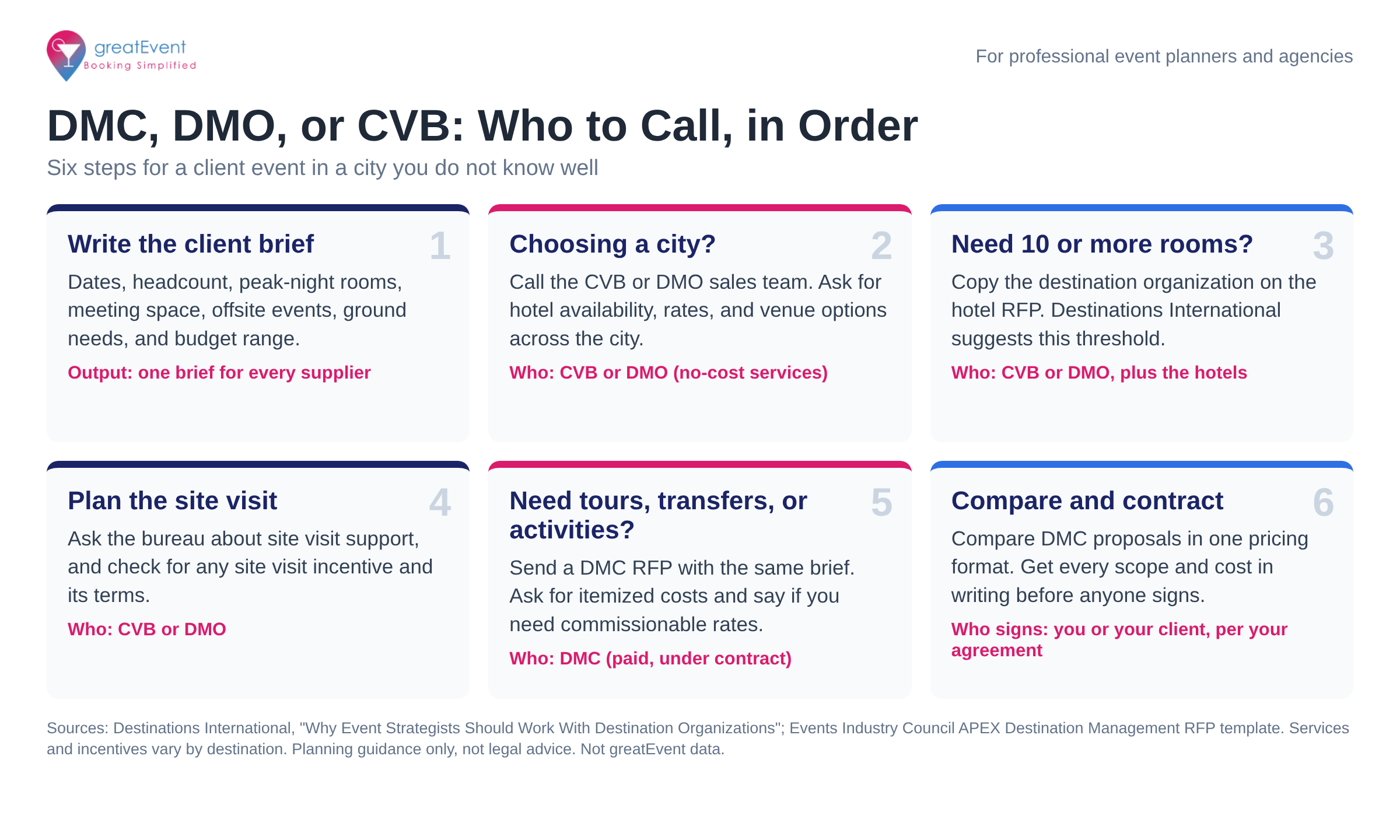
Text version of the infographic:
- Write the client brief: dates, headcount, peak-night rooms, meeting space, offsite events, ground needs, and budget range. Use one brief for every supplier.
- Choosing a city? Call the CVB or DMO sales team and ask for hotel availability, rates, and venue options across the city.
- Need 10 or more rooms? Copy the destination organization on the hotel RFP, as Destinations International suggests.
- Plan the site visit. Ask the bureau about site visit support, and check for any site visit incentive and its terms.
- Need tours, transfers, or activities? Send a DMC RFP with the same brief. Ask for itemized costs and say if you need commissionable rates.
- Compare and contract. Compare DMC proposals in one pricing format, and get every scope and cost in writing before anyone signs.
A sensible order for a program like the one in the opening scenario: send the brief to the bureau and three or four hotels, use the bureau to set up the hotel site inspection, then send a DMC request once the hotel and dates are close to final. If your client’s program is mostly ground work, such as a multi-city incentive, bring the DMC in earlier. Destinations International lists introductions to DMCs among bureau services, so the bureau is a reasonable place to get a first shortlist.
How costs work
What a CVB or DMO costs you
Destinations International describes bureau services to planners as free and no-cost, and individual bureaus such as Visit Chapel Hill say the same about their meeting services. Some services come with conditions. Destination Dayton, for example, notes that “some restrictions do apply,” and incentive programs such as Scottsdale’s have room-night minimums. Ask up front whether anything has a fee or a qualifying threshold. You still pay the hotels, venues, and vendors you book. The bureau does not replace those contracts.
How DMCs price a program
DMCs charge for their services, and there is no single standard model. A Skift Meetings article on DMC pricing describes three common approaches: a package price for the whole program, a price per person, and cost-plus, which is a markup over the DMC’s costs. Some contracts combine models. The article also notes that DMCs now often ask planners how they prefer to see pricing, and that a DMC’s volume with local suppliers can sometimes earn discounts a planner would not get alone.
The practical advice is to start with your budget and say how you want costs shown. Three proposals in three formats cannot be compared, so ask every DMC for the same format and the same line items.
Commissionable or net rates
The APEX Destination Management RFP asks planners to state whether the DMC should quote rates as “Commissionable / Net”. In general, commissionable rates build in a commission paid to the planner or agency, and net rates do not, so the planner bills the client for its own fee separately. Say which you need in your first request, because it changes every number in the proposal. How you disclose commissions to your client depends on your agreement with that client. This is general information, not legal advice.
What to get in writing
The APEX template asks DMCs for a listing of all services and related costs, references, experience with events of similar size, and proof of insurance such as commercial general liability, auto liability, workers’ compensation, and errors and omissions. ADMEI’s standards call for contracts that state the services, the fees and billing procedures, and the term and termination terms. Before you sign, check that the contract covers:
- every service in scope, with quantities and times
- what is included in each price, such as staff, taxes, gratuities, and fees
- the deposit and payment schedule
- cancellation terms and what happens if headcount drops
- who carries which insurance, with certificates on file
Have your client or your own counsel review contract terms. This section is general information, not legal advice.
Email templates for a bureau and a DMC
Start both emails from the same brief so your vendors and suppliers all work from one set of facts. Our event brief template covers the fields in more detail. Replace the bracketed text before you send.
Email to the CVB or DMO
Subject: RFP: [client industry] [meeting / incentive], [month year], [peak rooms] rooms peak night

Hello [name],

I am a [planner / agency] sourcing a program for a client and would like your help with hotels and venues in [city].

Event: [type and purpose]
Preferred dates: [dates], alternates: [dates]
Attendees: [number]
Room block: [rooms per night, by night], peak night [number]
Meeting space: [general session size and setup, breakouts, meals]
Offsite events: [welcome dinner, activity, etc.]
Budget range: [range or "available on request"]
Decision date: [date]

Could you please:
1. Share this RFP with hotels that fit these dates and this size.
2. Send venue ideas for an offsite dinner for [number] guests.
3. Tell me about site visit support and any incentives, with their terms.
4. Introduce two or three DMCs you work with.
5. Let me know if any of your services have a fee or qualifying threshold.

Thank you,
[name, company, phone]
Request for proposal to a DMC
Subject: DMC RFP: [client industry] program in [city], [dates], [number] guests

Hello [name],

[Bureau contact / colleague] suggested your company. I am requesting proposals from [number] DMCs for the program below.

Dates and hotel: [dates], staying at [hotel], [number] guests
Services needed: [airport transfers / meet and greet / welcome dinner / half-day activity / staffing]
Arrival pattern: [flights or arrival windows, if known]
Target budget: [total or per person]
Rates: please quote [commissionable / net]
Pricing format: [package / per person / itemized cost-plus], with every service and cost listed

Please include:
- years operating in [city] and events of similar size in the last three years
- which services you deliver yourselves and which you subcontract
- three references
- insurance types and limits
- deposit, payment, and cancellation terms

Proposals due: [date]. Site visit: [date]. Decision: [date].

Thank you,
[name, company, phone]
Checklist before you sign
- ☐ One written brief shared with the bureau, the hotels, and every DMC
- ☐ Bureau asked about no-cost services, fees, and any thresholds
- ☐ Incentive terms saved from the bureau’s own page, with the date you checked
- ☐ Hotel RFP sent with the bureau copied, if you need 10 or more rooms
- ☐ At least two DMC proposals in the same pricing format
- ☐ Commissionable or net rates stated in writing
- ☐ Every service listed with its cost, and inclusions spelled out
- ☐ Insurance certificates and three references checked
- ☐ Deposit, payment, cancellation, and headcount terms reviewed by the client
- ☐ Room block terms confirmed with the hotel
The last item matters most when the program depends on sleeping rooms. For the details of pickup, cutoff dates, and attrition, see our hub guide to managing room blocks for a conference. For tournaments with teams spread across properties, our guide to booking hotels as a sports tournament organizer covers room blocks and attrition for team travel.
Book the venue and room block on greatEvent
A bureau helps you narrow the city, and a DMC runs the ground program. The venue and the rooms still need booking. On greatEvent, planners can book venues, meeting space, and hotel room blocks for their clients’ events, and find event vendors such as caterers, photographers, and entertainment. You can send one detailed inquiry to multiple venues and get quotes back, then add services and a hotel room block and finalize the details with your event specialist.
There are no fees for planners. We pay you commission on any qualifying booking you make on greatEvent.
Register as a professional planner
Frequently asked questions
What is a destination management company?
▾
A destination management company (DMC) is a local professional services company that designs and runs events, activities, tours, transportation, and program logistics for groups. Planners hire a DMC under a written contract.
What does DMO mean?
▾
DMO stands for destination marketing organization or destination management organization. It is usually a nonprofit or government entity that promotes a place to visitors and helps planners bring groups there.
What is a CVB?
▾
A CVB is a convention and visitors bureau. It promotes a city or region for travel and meetings and helps planners with hotel sourcing, site visits, and local contacts.
Is a CVB the same as a DMO?
▾
For planners, yes. CVB, DMO, and tourism office are different names for destination organizations. The name depends on the place.
Do CVBs charge planners?
▾
Destinations International describes bureau services for planners as free. Some services or incentives have conditions such as group size, so ask each bureau about its terms.
How do DMCs charge?
▾
DMCs commonly quote a package price, a per person price, or cost-plus, and some combine them. Ask for commissionable or net rates and an itemized list of services and costs.
Research and sources
Sources were checked on October 28, 2026. The opening scenario is fictional. No figures in this article are greatEvent data. Bureau services and incentives change, so confirm current terms with each bureau. Contract points are general information, not legal advice.
- Association of Destination Management Executives International (ADMEI), “What Is a DMC and How Does It Benefit Me?”, admei.org. DMC definition and benefits.
- ADMEI, Accreditation Standards (ADMC), admei.org. Core services, years in business, DMCP, insurance, contracts, and local bureau membership.
- Events Industry Council, APEX Industry Glossary, “Convention and Visitors Bureau (CVB)” and “Destination Marketing Organisation (DMO)”, insights.eventscouncil.org.
- Events Industry Council, APEX Destination Management RFP template (PDF). Statement of need, commissionable or net rates, proposal contents, and insurance.
- Destinations International, “Why Event Strategists Should Work With Destination Organizations”, destinationsinternational.org. No-cost services, the 10-room guideline, and service lists.
- Destinations International, community benefit and funding model paper (PDF). Hotel tax funding, tourism improvement districts, and memberships.
- Destinations International, frequently asked questions on destination marketing fees in Canada (PDF). Names for destination organizations and visitor based assessments (flat fees on hotel stays).
- Skift Meetings, “Is DMC Pricing Fair?” (December 16, 2024). DMC pricing models.
- Experience Scottsdale, “Site See & Fly Free”, experiencescottsdale.com. Incentive terms as published on October 28, 2026.
- Visit Chapel Hill, “Free Meeting Planning Services”, visitchapelhill.org.
- Destination Dayton, “CVB Services”, destinationdayton.org.
Compare vendors for your next event
Search caterers, photographers, florists, planners, and rentals — then send one request to several vendors at once.