Quick answer: Incentive travel is a company-paid group trip that rewards employees, sales teams, dealers, or partners for hitting set performance goals. The people who qualify, often with a guest, travel together to a resort or upscale hotel for a few days of free time, group meals, an awards dinner, and sometimes a short business session. Planners book it as a group program: guest rooms, event spaces, and activities.
Incentive travel is a trip people earn. A company sets a performance goal for a fixed period, and everyone who meets it travels at the company’s expense. Because the trip is the reward, the agenda is mostly free time and recognition, with little work.
For planners, that creates a timing problem. You usually need the resort, the room block, and a private space for the awards dinner lined up before anyone knows exactly who qualified or how many guests are coming.
This guide is for corporate meeting planners, agency planners working for a client, and the HR, sales, and channel leaders who own reward programs. It explains what incentive travel is, how it differs from the other events you run, and how to plan the part that lands on your desk: the hotel, the room block, the venues for the welcome reception and awards dinner, meeting space, and group activities. Flights and ground transfers come up only where they affect hotel choice. Tax points are general planning information, not tax advice, so check the details with your tax advisor.
In this guide:
- What incentive travel is
- Incentive trip vs. offsite vs. conference vs. business trip
- Who plans an incentive trip
- How a program is structured
- Booking the hotel, rooms, and venues
- Planning timeline
- Hotel shortlist scorecard
- Measuring results
- Common mistakes
What is incentive travel?
The Society for Incentive Travel Excellence (SITE), the industry’s global association, describes incentive travel as “a powerful business tool to reward and unlock human potential to achieve corporate objectives.” In plain terms, a company sets a goal, the people who beat it earn a trip, and the trip is built to feel like a reward they could not easily give themselves.
SITE also calls incentive travel the “I” in MICE, the industry shorthand for meetings, incentives, conferences, and events. That line helps when you explain the program to stakeholders: corporate meetings usually aim to inform or educate people, while incentive travel aims to motivate and inspire them.
What companies call incentive trips
Inside a company, the trip rarely goes by “incentive travel.” Sales teams call it President’s Club, Sales Club, or Circle of Excellence. Manufacturers and software companies run dealer, channel, or partner trips for the resellers who sell their products. Whatever the name, the program has the same parts: a goal, an earning period, a list of qualifiers, and a trip.
Why companies use incentive travel
SITE lists the usual objectives as increasing sales, building morale and loyalty, increasing market share, and encouraging teamwork and better customer service. It names financial services and insurance, automotive, consumer goods, and direct selling among the sectors that use incentive travel. Motivation is the draw. In a 2023 Incentive Research Foundation (IRF) survey of 400 people working in sales, 91% said a group incentive trip is “very” or “extremely” motivating.
Like any corporate event, an incentive trip should start from a written objective that leadership signs off on. If you need the general steps for setting objectives, approvals, and a budget, our guide on how to plan a corporate event covers them.
Incentive trip vs. offsite vs. conference vs. business trip
An incentive trip is a reward that people earn, so the agenda is mostly free time and recognition. An offsite exists to get work done as a team. A conference educates or informs a larger audience. A business trip is ordinary travel for one person’s job. The table shows how those purposes change what you book.
| Incentive trip | Corporate offsite | Conference | Business trip | |
|---|---|---|---|---|
| Main purpose | Reward and motivate top performers | Team work sessions, planning, alignment | Education, information, networking | Get a specific job done |
| Who goes and how they are chosen | Earned by hitting a goal | Invited by leadership | Registered attendees | Assigned by a manager |
| Guests | Often allowed (a partner or companion) | Rarely | Sometimes, for social events | No |
| Agenda balance | Mostly free time and recognition, little work | Mostly working sessions | Sessions plus networking | Work |
| Typical venue | Resort or upscale hotel in a destination people want to visit | Retreat center, hotel, or unique venue | Conference hotel or convention center | Any business hotel |
| Guest rooms | Group block with upgraded rooms and suites for hosts and top earners | Group block | Large block, often with a housing process | Individual booking |
| Signature event | Awards dinner | Team working session | General session | None |
| Who covers the traveler’s costs | The company covers nearly everything | The company | The company or the attendee, through registration | The company, under travel policy |
| How success is measured | Performance against the goal, earner retention, participant feedback | Team outputs and decisions | Attendance and session evaluations | Whether the trip did its job |
If you are choosing between a working offsite and a conference rather than a reward trip, see our comparison of a corporate offsite vs. conference.
Who plans an incentive trip?
Incentive programs involve more people than most meetings. In IRF’s 2026 Trends Report, a channel program “typically might include input and review from program administrators, sales, marketing, finance and a c-level executive sponsor.” Here is who usually does what:
- Program owner. A sales, HR, or channel leader who sets the goal, the qualification rules, and the budget range, and who signs off on the destination.
- In-house meeting planner. Sources and books the hotel, the event spaces, and the activities, manages the room block and rooming list, and runs the trip on site.
- Incentive house or travel and event agency. Some companies hand all or part of the program to an outside firm that designs the trip, handles air, and staffs the program.
- Destination management company (DMC). A local partner for activities, transfers, offsite venues, and local suppliers. IRF’s 2026 Trends Report says 29% of respondents to the 2025 Incentive Travel Index called a good DMC a destination “must-have.”
- The hotel’s group sales and conference services team. Group sales negotiates the block and event space. Conference services works through room sets, menus, and the event orders with you after signing.
- Finance and procurement. Review the budget, the hotel terms, and the results. IRF’s 2026 measurement study found these teams are seen as much less supportive of incentive programs than senior leadership, so bring them in early.
If your team is weighing outside help for a first program, our guide on hiring a corporate event planner explains the options.
How an incentive travel program is structured
Qualification rules and the earning period
The program owner writes the rules before the earning period opens. They should answer five questions in plain language: who is eligible, which metric counts (revenue, units, new accounts, margin, customer scores), what the threshold is (a fixed target, a percentage of quota, or the top performers by rank), how long the earning period runs, and when and how qualifiers will be announced. SITE describes qualifiers as “those who exceed the targets set for qualification,” so the target has to be clear enough that people can track where they stand.
The rules decide your room count. A fixed target means the number of qualifiers can swing with a strong or weak year. A rule that rewards a set number of top performers by rank fixes the earner count, which makes the hotel side much easier to plan. Ask the program owner which one you are working with before you send a single hotel request.
The budget range belongs in the rules stage too. Our template for per-person offsite budgeting works for laying out lodging, meals, and activity lines for a group trip.
Who travels
Four groups usually travel, and each one changes your counts:
- Earners, the people who qualified.
- Guests. SITE notes that incentive travel is usually offered to the qualifier plus a significant other. In IRF’s 2023 survey, being able to bring a guest ranked among participants’ top priorities.
- Executive hosts, the leaders who attend to recognize earners, often with their own guests. Plan suites or upgraded rooms for them.
- Staff: the planner, the program owner’s team, and any agency or DMC staff on site.
Guests split your room count from your dinner count. Most earners share a room with their guest, so 50 earners who can each bring one could need about 50 rooms, while up to 100 people need seats at the awards dinner, before you add hosts and staff. Ask early whether the guest policy is one guest per earner, whether children are allowed, and whether earners can pay to bring extra family. Each answer changes the room mix and the dinner count.
A typical trip, day by day
The most important thing participants want is ample time to relax, according to IRF’s 2023 attendee survey. They do not want to be overscheduled with group activities, and the least appealing activities were ones that involve mingling with large groups. The same survey found that being recognized in front of peers ranked among the least important parts of the trip. Plan one strong awards moment and keep the rest of the agenda light.
On length, the survey split for trips within North America: 45% said four to six days is ideal and 41% said seven to 10 days. For international trips, 54% chose seven to 10 days. Many winners stay longer anyway: 66% said they extended a North American incentive trip and 70% extended an international one, so expect requests for extra nights before or after the group dates.
| Day | What happens (sample itinerary, four-night US resort) | What you book |
|---|---|---|
| Day 1 | Arrivals through the afternoon; welcome reception in the evening | Arrival-day check-in plan, welcome gifts, reception space with a weather backup |
| Day 2 | Short business session in the morning; free afternoon | Meeting room for the earner count, AV, a coffee break |
| Day 3 | Optional group activity; free time | Activity with a capacity limit and a sign-up list |
| Day 4 | Free day; awards dinner in the evening | Private dining space or ballroom, staging, AV, photographer, dinner menu |
| Day 5 | Departures | Late checkout requests, luggage storage, extension nights |
This sample itinerary shows one common pattern. Some companies skip the business session entirely. Others move the awards dinner to the first full night so the rest of the trip is unscheduled.
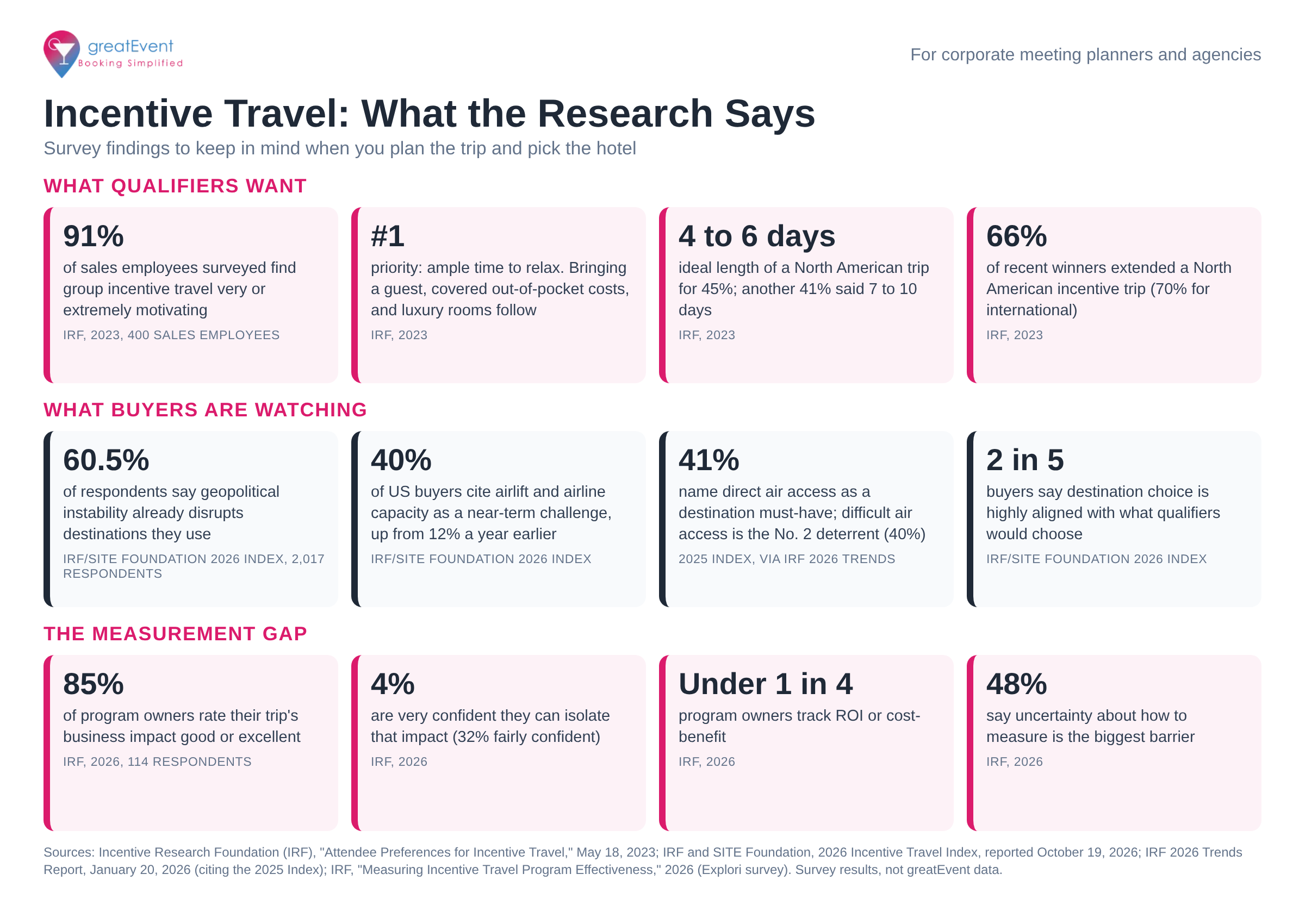
Text version of the infographic. What qualifiers want (IRF, 2023, 400 sales employees): 91% find group incentive travel very or extremely motivating; ample time to relax is the top priority, followed by bringing a guest, covered out-of-pocket costs, and luxury rooms; 45% say four to six days is the ideal North American trip and 41% say seven to 10 days; 66% extended a North American trip and 70% an international one. What buyers are watching: 60.5% say geopolitical instability already disrupts destinations they use, and 40% of US buyers cite airlift and airline capacity as a near-term challenge, up from 12% a year earlier (IRF and SITE Foundation 2026 Incentive Travel Index); 41% name direct air access as a must-have and 40% call difficult air access the second biggest deterrent (2025 Index, via the IRF 2026 Trends Report); 2 in 5 buyers say destination choice is highly aligned with what qualifiers would choose (2026 Index). The measurement gap (IRF, 2026): 85% of program owners rate their trip’s business impact good or excellent, 4% are very confident they can isolate that impact, fewer than 1 in 4 track ROI or cost-benefit, and 48% say uncertainty about how to measure is the biggest barrier.
Booking the hotel, rooms, and venues for an incentive trip
Three things make the booking side harder than a regular group meeting. The resort has to feel like a prize, the block has to flex with a qualifier count you will not know for months, and the awards dinner needs a room that fits every earner and guest.
Choosing the destination and resort
In SITE’s view, the destination’s appeal is what makes the trip a reward, and a place that isn’t truly attractive won’t create the emotional pull that makes people work to qualify. The 2026 Incentive Travel Index found that 2 in 5 buyers say their destination choice is highly aligned with what qualifiers would choose. You can do better by asking past earners, or a sample of likely qualifiers, where they would want to go. In IRF’s 2023 survey, the five most motivating destinations were Hawaii, the western US, the Caribbean, the eastern US, and the southwestern US, so many favorites are close to home for US teams.
Then check the practical side:
- Travel time: according to IRF’s 2026 Trends Report, the 2025 Index found direct air access was the most cited destination must-have (41%), difficult air access was the second biggest deterrent (40%), and ground transfer time from the airport to the hotel also matters. Map flight options from the cities most of your earners will fly from.
- Season and dates: weather, peak rates, local events, and school holidays if guests include families.
- Private spaces: an indoor room for the awards dinner and a backup for any outdoor event.
- Safety and risk: in the 2026 Index, 60.5% of respondents said geopolitical instability is already disrupting the destinations they use. Keep a second destination in mind and review travel advisories before you announce.
- Accessibility: accessible guest rooms, step-free routes to event spaces, and activities everyone can join.
Use a hotel RFP for group bookings to collect proposals on the same terms, and walk the shortlist with a hotel site inspection checklist before you commit.
Sizing the room block when you don’t know who will qualify
This is the question planners ask most about incentive room blocks, because the hotel wants a number months before the earning period ends. A practical approach:
- Start from history. Use the earner count and guest rate from past programs. If this is the first year, ask the program owner to model how many people would have qualified last year under the new rules.
- Plan rooms for pairs, seats for people. Count one room per earner plus rooms for hosts and staff, then count dinner seats for earners, guests, hosts, and staff separately.
- Split the room types. Standard rooms for most earners, upgraded rooms or suites for top earners and executive hosts, and a few single rooms for earners who travel alone.
- Ask for review dates. Request dates in the hotel agreement when you can adjust the block without penalty, and line one up with the end of the earning period.
- Plan for extensions. Ask whether the group rate applies to nights before and after the main dates, since many earners will want to stay longer.
Once you have a working number, you can book the hotel room block for your incentive group through greatEvent. For block mechanics, see our guides on booking a hotel room block for a corporate event and how many rooms make a group block. Before you sign, read up on what happens if the block doesn’t fill and how to cancel or reduce a block, since a weak sales year can leave you with fewer qualifiers than planned. To track pickup through the earning period, our hub on managing room blocks has the basics.
Comparing hotel proposals and terms
Resort proposals for incentive groups bundle a lot: room rates by type, suite upgrades, resort charges, event space, food and beverage commitments, and the room block terms. Put them side by side in a hotel proposal comparison template so you can compare total cost as well as room rates. Our guide to negotiating hotel group rates covers what to ask for, and the breakdown of meeting packages vs. itemized pricing helps if the resort quotes both ways.
The awards dinner and welcome reception
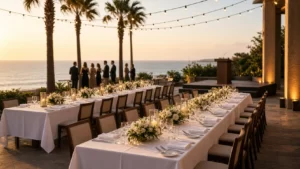
The awards dinner is where SITE’s point about recognizing high achievers in front of their peers comes to life. Choose a space that fits every earner, guest, host, and staff member at dinner tables with room for a small stage. Options include a private dining room, a ballroom, a resort terrace or lawn with an indoor backup, or an offsite venue such as a restaurant buyout.
If the dinner moves off property, our guide on booking a venue for a corporate event walks through the steps. Check whether the space has a food and beverage minimum or a room rental, and compare the two with our guide to F&B minimums vs. room rental. Every function then gets a banquet event order; here is what a BEO covers and how to review one. For the recognition moment itself (stage, lighting, screens, walk-up music, and a photographer), corporate event production companies can handle the show.
Given IRF’s finding that public recognition ranks low for many participants, keep the program tight: a short welcome from the host, the awards, and then dinner and conversation.
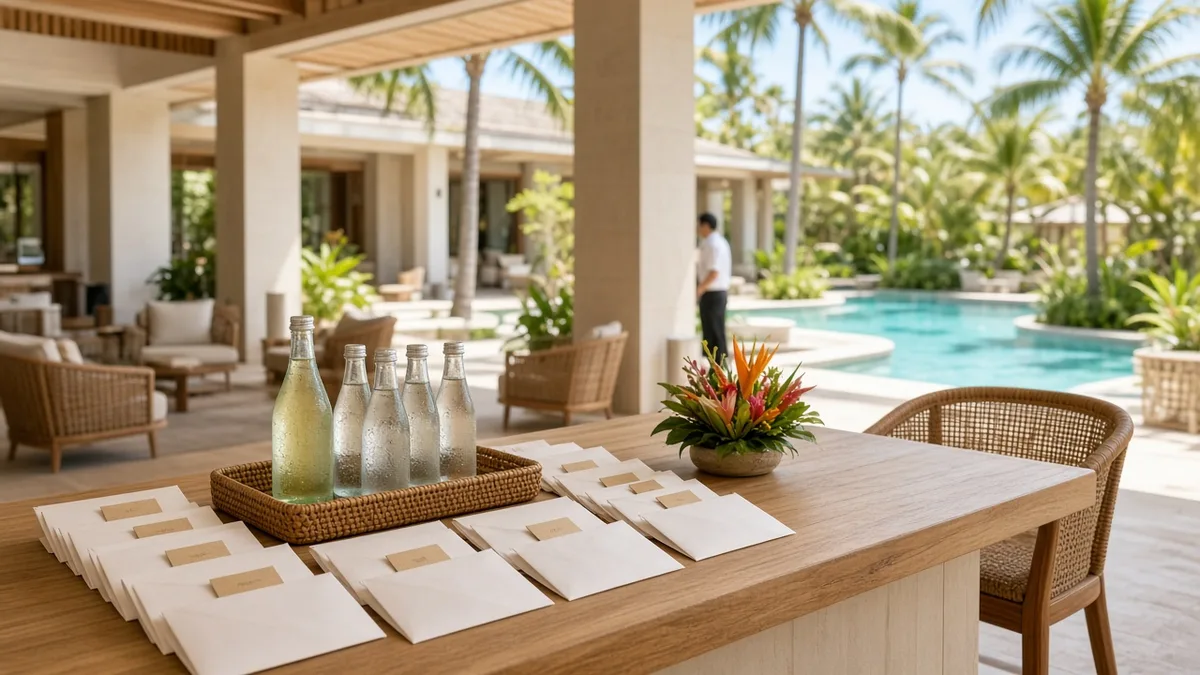
Meeting space for the business session
If the program includes a business session, book one meeting room on the same dates as the block, set for the earner count (guests usually skip it). Use the meeting room capacity chart to match the room to the layout you want. Schedule it in the morning so the afternoon stays free.
Group activities and team experiences
One or two shared activities is plenty. IRF’s 2023 survey found unique culinary activities had the most overall appeal, with cultural and spa or wellness options close behind. Offer choices with sign-ups instead of one mandatory outing. For ideas on the venue side of group activities, see our checklist for planning a team building event, and for active groups, these corporate sports event ideas.
Rooming list, special requests, and accessibility
Once qualifiers are confirmed, collect guest names, arrival and departure dates, room type, bed preference, extension nights, dietary needs, and accessibility needs in one registration form. Our guide to the corporate meeting rooming list covers what to send the hotel and what to keep off it. Under the ADA rules for places of lodging (28 CFR 36.302(e)), hotels must hold accessible guest rooms for people with disabilities until all other rooms of that type are rented, and must block and remove a reserved accessible room from all reservation systems. Name the travelers who need those rooms on the rooming list. For the rest of the program, our guide to inclusive events covers activities, dietary needs, and communication.
Searching for venues for your incentive trip? On greatEvent, professional planners can search meeting and event venues and book instantly where available. See how real-time venue booking compares with a traditional RFP.
Incentive trip planning timeline
No single lead-time standard fits every incentive program, so the timeline below shows the phases in order without months. The right windows depend on group size, destination, and season. IRF’s 2026 Trends Report notes that more stakeholders in the approval chain mean more time spent building consensus, so leave room for reviews.
| When | What gets done | Owner | Deliverable |
|---|---|---|---|
| Before the earning period opens | Write the program rules, set the budget range, build a destination shortlist, send hotel RFPs or check live availability, sign the hotel agreement with review dates | Program owner; planner | Signed-off rules, budget range, hotel agreement |
| During the earning period | Promote the trip and share standings, review the block at each review date, secure the awards dinner and reception spaces, shortlist activities | Program owner; planner; hotel | Block adjustments, event space confirmed, activity shortlist |
| Qualifiers confirmed | Announce earners, collect guest details, finalize block size, send the rooming list, collect dietary and accessibility needs, review BEOs | Planner; hotel conference services | Final rooming list, signed BEOs, registration data |
| Final weeks | Write the run of show and awards script, lock AV and staging, order welcome gifts, brief staff, manage late changes | Planner; production partner; DMC | Run of show, awards script, staff briefing |
| On site | Run arrivals, the welcome reception, the business session, activities, the awards dinner, and departures | Planner; hotel; DMC | Daily check-ins, incident log |
| After the trip | Check the hotel bill against the agreement and BEOs, compare pickup to the block, survey earners, report results against the goal | Planner; program owner; finance | Reconciled bill, survey results, results report |
For general booking lead times, see how far in advance to book a venue. For the on-site side of the trip, from rooming lists to shuttles and BEOs, use our event logistics checklist. Late requests from earners (an extra night, a room change, a second guest) will come, so agree on how you will handle venue change orders before the final weeks.
Destination and hotel shortlist scorecard
Score three or four candidate resorts from 1 (poor) to 5 (excellent) on each line. Set a weight from 1 to 3 for how much each line matters to your program, multiply, and add up the weighted totals. Write deal-breakers at the bottom so a high total cannot hide one.
| Criterion | Weight (1 to 3) | Resort A | Resort B | Resort C |
|---|---|---|---|---|
| Appeal to qualifiers (would they choose it themselves?) | ____ | ____ | ____ | ____ |
| Travel time and direct flights from main origin cities | ____ | ____ | ____ | ____ |
| Dates and season (weather, peak rates, local events) | ____ | ____ | ____ | ____ |
| Room types for the block (standard, upgraded, suites for hosts and top earners) | ____ | ____ | ____ | ____ |
| Flexibility on block size and review dates | ____ | ____ | ____ | ____ |
| Private space for the awards dinner, plus a weather backup | ____ | ____ | ____ | ____ |
| Meeting room for the business session | ____ | ____ | ____ | ____ |
| Group activities on property or nearby | ____ | ____ | ____ | ____ |
| Food and beverage options and minimums | ____ | ____ | ____ | ____ |
| Accessibility (rooms, routes, activities) | ____ | ____ | ____ | ____ |
| Safety and destination risk | ____ | ____ | ____ | ____ |
| Estimated total cost per person (your own estimate) | ____ | ____ | ____ | ____ |
| Weighted total | ____ | ____ | ____ | ____ |
| Deal-breakers and notes | ____ | ____ | ____ | ____ |
Copyable incentive trip planning brief
Copy this into a document and fill it in with the program owner before you contact any hotel. It gives every hotel and partner the same facts.
INCENTIVE TRIP PLANNING BRIEF

PROGRAM
Program name: ______________________
Program owner and approvers: ______________________
Objective (the result the trip should drive): ______________________
Metric and qualification threshold: ______________________
Earning period (start and end dates): ______________________
Qualifier announcement date: ______________________

TRAVELERS
Expected earners (low / likely / high): ____ / ____ / ____
Guest policy (one guest per earner? children?): ______________________
Executive hosts (and their guests): ______________________
Staff, agency, and DMC on site: ______________________

TRIP
Preferred dates and alternates: ______________________
Number of nights: ____   Extension nights allowed? ____
Destination shortlist: ______________________
Main origin cities for flights: ______________________

HOTEL AND ROOMS
Room pattern by night: ______________________
Room types (standard / upgraded / suites): ____ / ____ / ____
Review dates needed (tie one to the end of the earning period): ______________
Accessible rooms needed (confirm at registration): ______________

EVENTS AND VENUES
Welcome reception (count, indoor or outdoor, backup): ______________
Business session (earner count, layout, AV): ______________
Awards dinner (total count, stage, AV, photographer): ______________
Group activities (options, capacity, sign-up method): ______________

MEASUREMENT
KPIs and baseline: ______________________
Data owner and access: ______________________
Earner survey date: ______________________
Results report due to: ______________________
Measuring whether the incentive trip worked
In IRF’s 2026 study “Measuring Incentive Travel Program Effectiveness,” 85% of program owners rated their program’s impact on business objectives good or excellent, yet only 4% were very confident their approach isolates that impact (32% were fairly confident). Fewer than one in four track ROI or cost-benefit, and 48% named uncertainty about how to measure as the biggest barrier. The study also found that measurement tends to focus more on attendee satisfaction and event execution than on business performance.
A simple plan you can set up before the earning period opens:
- Pick the KPI and the baseline first. If the goal is new-account revenue, record each eligible person’s prior-year figure before the program launches.
- Compare against a group. Look at the change for people who were eligible versus the change in prior years, or against teams outside the program.
- Agree on data access early. The IRF study found that third parties name lack of client data access as their main barrier. If an agency will measure results, settle data sharing up front.
- Survey earners. Ask what they valued, what they would change, and whether the trip affects their plans to stay with the company.
- Track earner retention. Compare turnover among earners with turnover among eligible people who did not qualify.
Finance will want the case in a familiar format. Our corporate meeting budget approval template gives you one to adapt.
Common mistakes
- Contracting rooms for a qualifier count nobody tested. Model the rules against last year’s results before you sign.
- Forgetting guests. Rooms track earners, but the awards dinner, activities, and transfers track people. Count both.
- No private space for the awards dinner. A shared restaurant or an outdoor space with no backup puts the main event at risk.
- Overscheduling. Participants rank free time first. Fill every day and the trip starts to feel like work.
- No review date in the hotel agreement. Without one, you have no planned point to adjust the block when the qualifier count changes.
- Announcing the destination before the hotel is confirmed. Once the destination is public, you lose the option to switch quietly.
Plan your next incentive trip on greatEvent
Once the program rules and budget range are set, the next step is the shortlist. On greatEvent, planners can book hotel room blocks for their earners, guests, and hosts. Register as a professional planner to search meeting and event venues as well as event vendors, and book instantly where available. Need help finding the right fit? A member of the greatEvent team can help you source venues for your program.
Register as a professional planner
Research and sources
Sources reviewed October 23, 2026. Survey figures are reported as each organization published them and are not greatEvent data. Tax and accessibility points are general planning information, not tax or legal advice; confirm what applies with your tax advisor and counsel. The sample day-by-day itinerary is illustrative.
- Society for Incentive Travel Excellence (SITE), “What is Incentive Travel” (siteglobal.com). Definition, incentive travel as the “I” in MICE, qualifier plus significant other, destination appeal, objectives, and sectors.
- Incentive Research Foundation and SITE Foundation, 2026 Incentive Travel Index, research by Oxford Economics, reported in “Key Insights and Trends Reported in 2026 Incentive Travel Index,” October 19, 2026 (theirf.org). 2,017 respondents in 83 countries; geopolitical disruption, airlift, and destination alignment findings.
- Incentive Research Foundation, “Attendee Preferences for Incentive Travel,” May 18, 2023 (theirf.org). Survey of 400 full-time sales employees eligible for an incentive travel award in the past three years; motivation, priorities, activities, trip length, extensions, and destination preferences.
- Incentive Research Foundation, “IRF 2026 Trends Report,” January 20, 2026 (theirf.org). Stakeholders, DMCs, and air access findings from the 2025 Incentive Travel Index.
- Incentive Research Foundation, “Measuring Incentive Travel Program Effectiveness,” 2026, with news release dated June 30, 2026 (theirf.org). Explori survey of 114 respondents plus eight interviews; confidence, ROI tracking, barriers, and data access.
- Internal Revenue Service, Publication 15-B (2026), “Employer’s Tax Guide to Fringe Benefits” (irs.gov). Taxability of fringe benefits and limits of the achievement award exclusion.
- U.S. Department of Justice ADA regulations, 28 CFR 36.302(e), reservations made by places of lodging (ecfr.gov). Holding and blocking accessible guest rooms.
Frequently Asked Questions
What is an incentive trip?
▾
An incentive trip is a company-paid group trip that people earn by hitting a performance goal. Qualifiers, often with a guest, spend a few days at a resort or upscale hotel with free time, group meals, and an awards dinner.
Is incentive travel the same as a corporate retreat or offsite?
▾
No. An incentive trip is a reward, so the agenda is mostly free time and recognition. An offsite or retreat brings a team together to work, with working sessions filling most of the day.
Who usually goes on an incentive trip?
▾
The people who qualified, their guests if the program allows them, executive hosts who recognize the earners, and the staff who run the trip. SITE notes that the reward is usually offered to the qualifier plus a significant other.
How long is a typical incentive trip?
▾
In a 2023 Incentive Research Foundation survey, 45% of sales employees said four to six days is the ideal length for a North American trip and 41% said seven to 10 days. For international trips, 54% chose seven to 10 days.
How far in advance should you book a hotel for an incentive trip?
▾
It depends on group size, destination, and season. Plan to have the hotel agreed before the earning period opens, with review dates that let you adjust the block once you know who qualified.
How many hotel rooms should you block for an incentive trip?
▾
Start from past earner counts or a model of last year’s results under the new rules. Count one room per earner plus rooms for hosts and staff, add suites for top earners and hosts, and ask for review dates so the block can change with the qualifier count. You can book the room block through greatEvent.
Are incentive trips taxable for employees?
▾
In many cases, yes. IRS Publication 15-B says any fringe benefit is taxable unless the law specifically excludes it, and the achievement award exclusion doesn’t apply to vacations, meals, or lodging. A benefit given to an employee’s family member can be treated as the employee’s. Confirm how your program is handled with your tax advisor.
What is the difference between incentive travel and MICE?
▾
MICE stands for meetings, incentives, conferences, and events. Incentive travel is the “I” in MICE. SITE notes that corporate meetings usually aim to inform or educate, while incentive travel aims to motivate and inspire.
Do incentive trips have to be international?
▾
No. Many programs stay domestic. In the 2023 IRF survey, four of the five most motivating destinations for participants were in the US: Hawaii, the western US, the eastern US, and the southwestern US, plus the Caribbean.
Compare vendors for your next event
Search caterers, photographers, florists, planners, and rentals — then send one request to several vendors at once.