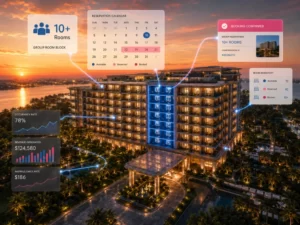
Quick answer: In U.S. hotels, a group room block starts at 10 rooms per night. Marriott, Hilton, Hyatt, and IHG all treat 10 or more rooms as group business, and the AHLA Uniform System of Accounts defines group room revenue the same way. Below 10 rooms you usually book individually or ask for a courtesy hold instead.
That number decides whether you get a group rate, whether you sign a contract, and whether you can book online or have to go through a sales manager.
If you are also comparing the cost of the event itself, understanding event space costs and party venue pricing can help you separate your hotel budget from your venue expenses.
Why 10 rooms is the line
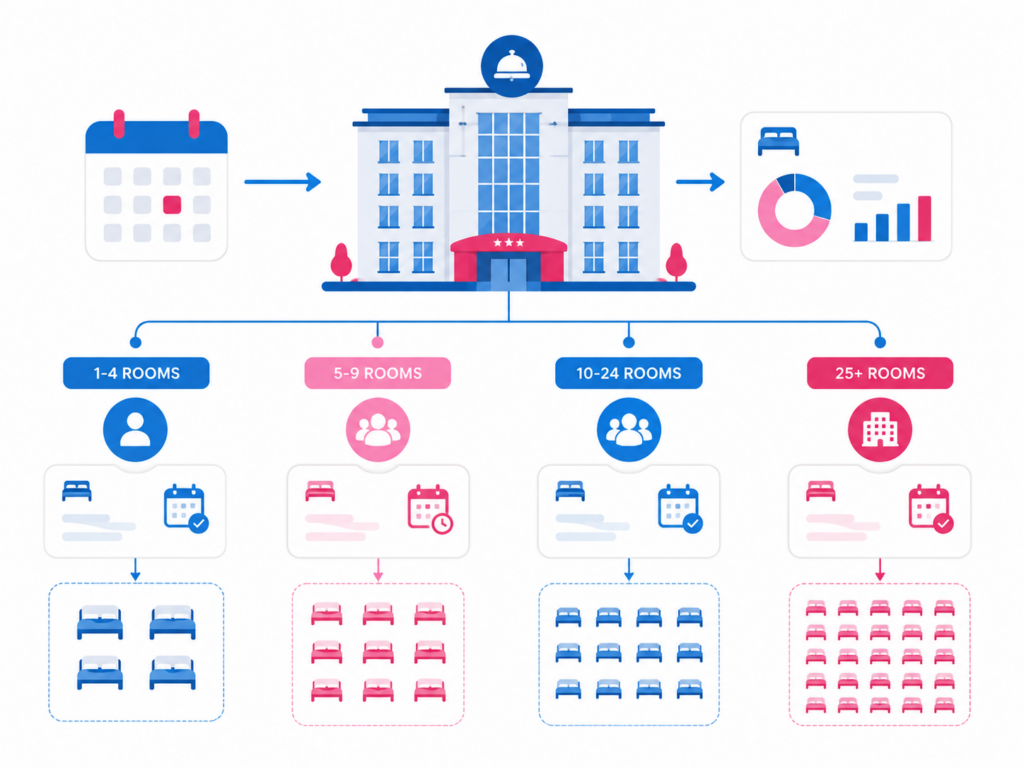
Ten rooms per night is not a coincidence across brands. It is the accounting definition. The AHLA Uniform System of Accounts counts blocks of 10 or more rooms as group room revenue, so hotels price and staff for group business at that threshold. Corporate travel guidance says the same thing: most hotels require a minimum of 10 rooms per night to qualify for a room block.
One detail trips people up. The threshold is per night, not total. Fifteen rooms spread across three nights at five rooms a night is not a group block. Five rooms per night is.
What each major chain counts as a group
| Source | Group threshold | What it means for you |
| AHLA Uniform System of Accounts | 10+ rooms per night | The accounting standard: group room revenue means blocks of 10+ rooms. |
| Marriott | 10–25 rooms online | Hold 10–25 rooms on the website; larger blocks go through an RFP. Standard contract attrition around 20%. |
| Hilton | 10+ rooms | Online blocks up to 25 rooms. Above 25, contact the hotel or group sales. |
| Hyatt | 10+ rooms | Awards points for reserving 10+ rooms on peak nights. Group rates via sales or RFP. |
| IHG / Holiday Inn Express | 10+ rooms | Their own prompt: “Need 10+ rooms? Request a proposal.” |
| Direct Travel (corporate travel guide) | 10+ rooms per night | “Most hotels require a minimum of 10 rooms per night to qualify for a room block.” |
| Cvent | Varies by hotel | Hotels set a minimum number of guestrooms to qualify for a discounted block rate. |
The practical read: 10 rooms gets you a group rate, roughly 25 rooms is where self-service booking stops, and anything larger is a conversation with a sales manager.
How many rooms should you actually block?
Estimate 1 to 2 people per room, then size the block to who is genuinely traveling. Typical ranges:
| Event type | Typical block size | Usual structure |
| Wedding or destination wedding | 10–30 rooms | Courtesy holds are common. Contracted wedding blocks often carry an ~80% pickup requirement. |
| Small social event or local business meeting (10–20 attendees) | 10–20 rooms | A small block, frequently with no meeting-space commitment attached. |
| Sports team or school trip | 10+ rooms | Handled much like a corporate group; group rates start at the same 10-room threshold. |
| Corporate or association conference | Dozens to hundreds, often 50–100+ | Frequently split across multiple hotels, with firm attrition clauses and F&B guarantees. |
greatEvent’s RFP form uses 150 rooms as its example peak night count: normal for a mid-sized conference, far out of scale for a wedding.
For weddings, room blocks are only one part of the planning process. A detailed wedding planning checklist can help you coordinate accommodation, venue selection, guest planning, and other major booking decisions.
What if you need fewer than 10 rooms?
You still have options, just not a contracted group block.
- Under 5 rooms. Book individually, or ask for an informal courtesy hold. Rarely anything to sign.
- 5 to 9 rooms. Ask for a courtesy block or a small block. Usually no strict contract and no penalty language.
- Independents and boutiques. Some take blocks as small as 5 to 10 rooms. Others with limited inventory set minimums higher than the chains do.
Discounted group rates and block minimums are linked. A hotel might require 10 to 15 rooms before releasing a discounted rate, and may attach a food-and-beverage or meeting-space minimum to the same deal.
Courtesy block vs. contracted block
Size is only half the question. The other half is who carries the risk.
| Courtesy block | Contracted (guaranteed) block | |
| Typical size | Roughly 10–20 rooms held at a time | 10 rooms up into the hundreds |
| Deposit | None | Usually required |
| Attrition | None | About 10–20% allowance, so you fill roughly 80–90% |
| Unsold rooms | Released at the cut-off date, no penalty | You pay the shortfall, often at the negotiated group rate |
| Cancellation | No financial penalty | Escalating fees. Hotels may retain part of the deposit at 60–90 days out and charge the full attrition penalty inside 30 days. |
Courtesy blocks dominate weddings and small social events, because nobody wants to guarantee rooms for guests who may never book. Contracted blocks take over once meeting space and deposits enter the picture.
For a wedding, this decision should also be considered alongside the rest of the budget. Looking at average wedding costs can help couples understand how hotel rooms fit alongside venue, catering, photography, and other major expenses.
What shifts the threshold up or down
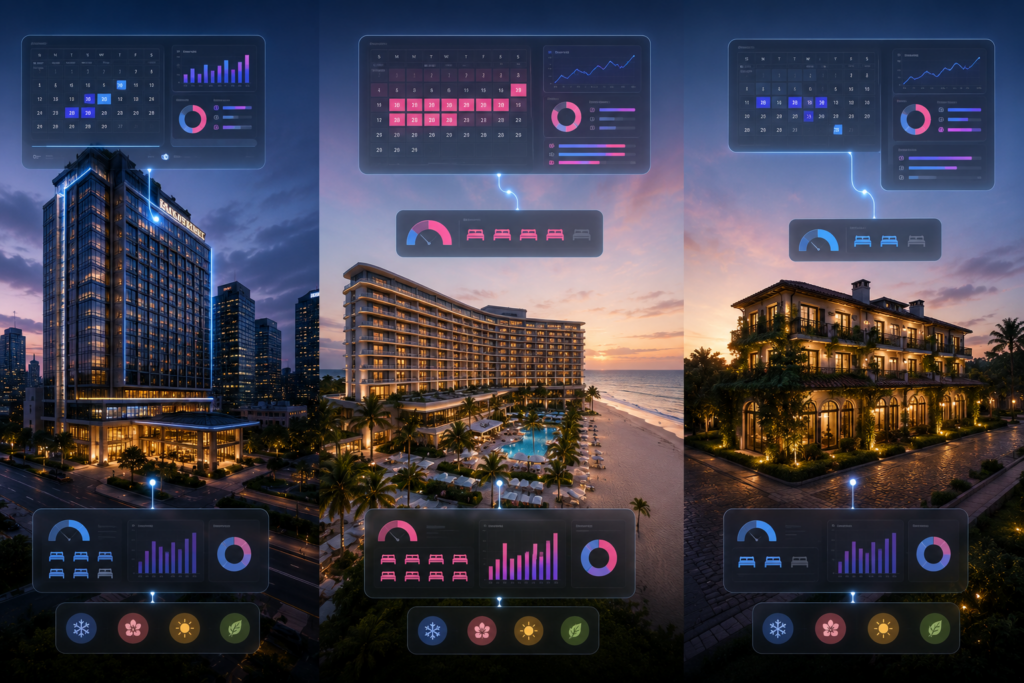
The 10-room floor is standard, not universal. Downtown urban hotels get stricter in peak season: fewer courtesy blocks, tighter attrition. Resorts and secondary markets often welcome groups with lower thresholds or off-season amenities. Event type matters too. Conferences bring food-and-beverage and meeting spend, so hotels court them. A 12-room rooming-only block has less to trade with.
Key takeaways
- 10 rooms per night is the standard U.S. threshold for a group room block.
- Count per night, not in total. Peak-night room count is what hotels price against.
- About 25 rooms is where online self-booking ends and group sales begins.
- Weddings typically block 10–30 rooms; conferences run 50–100+, often across several hotels.
- Contracted blocks carry roughly 10–20% attrition. Courtesy blocks carry none and release at the cut-off.
Frequently Asked Questions
How many rooms is considered a group room block? ▾
Ten or more rooms per night. Marriott, Hilton, Hyatt, and IHG all treat 10+ rooms as group business, and the AHLA Uniform System of Accounts defines group room revenue as blocks of 10 or more rooms. Corporate travel guidance confirms that most hotels require a minimum of 10 rooms per night to qualify for a block.
Is 5 rooms a room block? ▾
Not a contracted group block at most hotels. At 5 to 9 rooms you can usually get a courtesy block or a small informal hold, typically with no contract and no penalty. Some independent or boutique hotels will accept a block as small as 5 to 10 rooms.
How many rooms do I need for a discounted group rate? ▾
Usually 10, and sometimes 10 to 15 before a hotel releases its discounted block rate. Group rate minimums track block size, and the hotel may also attach a food-and-beverage or meeting-space minimum to the discount.
How many rooms should I block for a wedding? ▾
Most wedding blocks run 10 to 30 rooms. Many are set up as courtesy blocks so unsold rooms release at the cut-off with no penalty. If you sign a contracted block instead, expect a pickup requirement around 80%.
Can I book a group block online? ▾
Up to a point. Marriott lets you hold 10 to 25 rooms online, and Hilton allows online blocks up to 25 rooms. Above roughly 25 rooms you contact the hotel or submit an RFP to group sales.
What is the difference between a courtesy block and a contracted block? ▾
A courtesy block carries no deposit and no financial penalty; unsold rooms are simply released by the cut-off date. A contracted block generally requires a deposit and includes attrition and cancellation terms, so you pay for rooms your group does not fill.
What happens if my group doesn’t fill the block? ▾
On a contracted block you pay for the shortfall, usually at the negotiated group rate. A typical attrition allowance is about 10 to 20%, meaning you need to fill roughly 80 to 90% of the rooms you booked. On a courtesy block there is no penalty.
Compare vendors for your next event
Search caterers, photographers, florists, planners, and rentals — then send one request to several vendors at once.