TL;DR
Choosing a corporate event venue near Washington, DC starts with the attendee journey, not the address. Define the event objective, determine whether DC, Maryland, National Harbor, or Northern Virginia makes the most sense, match capacity to the actual room setup, verify AV and Wi-Fi, review privacy and catering, account for hotels and transportation, calculate the full event cost, send a detailed RFP, and score the final shortlist. The goal is not simply to find an attractive room—it is to find a venue that makes the entire event easier to execute.
A corporate event can have an excellent agenda and still feel poorly planned if the venue creates friction. A cramped room affects participation. Weak Wi-Fi interrupts presentations. A difficult parking situation can put attendees in a bad mood before the first session begins. And a beautiful venue with the wrong layout can make networking, catering, and speaker transitions unnecessarily difficult.
Choosing a corporate event venue near Washington, DC is especially nuanced because “near DC” can mean several different venue markets, including the District itself, nearby Maryland, National Harbor, and Northern Virginia. Each can produce a different attendee experience and a different cost structure.
That makes venue selection less about finding the most impressive room and more about matching the space to the purpose, audience, schedule, technology, travel requirements, and total budget.
If you are still determining dates or want to understand the local event landscape first, reviewing upcoming events in Washington, DC can provide useful context before you commit to a venue and date.
This guide walks through 10 practical steps for comparing venues, preparing an RFP, evaluating proposals, and making a defensible final decision.
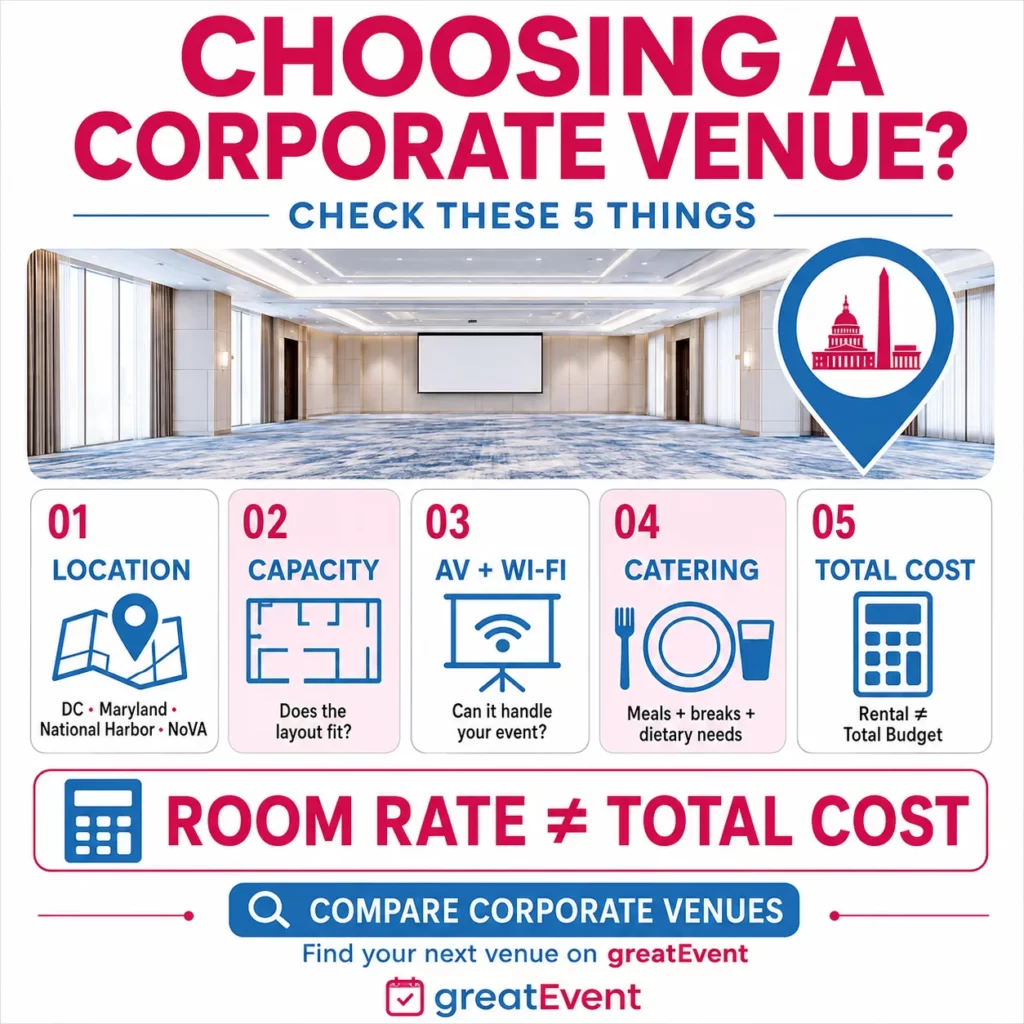
Why “Near Washington, DC” Means More Than One Venue Market
A corporate event listed as being in Washington, DC does not necessarily need to take place inside the District.
Central DC may be the logical choice for events connected to downtown offices, government-related meetings, museums, public transportation, or city-based activities. Maryland may work better for regional attendance, parking, hotel access, or flexible meeting space. National Harbor can suit multi-day programs where lodging, dining, waterfront surroundings, and meeting space need to work together. Northern Virginia can be practical for attendees coming from Virginia, Maryland, or DCA.
The important point is to choose based on attendee movement, not simply the city name.
The attached source also highlights the scale of the area’s meeting infrastructure. For example, the Walter E. Washington Convention Center is described as a major large-scale option, while National Harbor provides a destination-style alternative with substantial meeting and hotel capacity.
For current planning purposes, Destination DC also lists the Walter E. Washington Convention Center at 2.3 million square feet, with capacity for up to 45,000 attendees and 77 breakout rooms, plus more than 7,700 hotel rooms within walking distance.
National Harbor offers another distinct model. Its official meetings resources currently highlight 8 hotels, 15 special venues, 3,400 guest rooms, and more than 1.1 million square feet of meeting space across the destination.
The right market depends on the event—not the other way around.
10 Steps to Choosing the Right Corporate Event Venue
Step 1: Define the Purpose of the Corporate Event
Before requesting proposals, write down exactly what the event needs to accomplish.
A leadership retreat, training session, client reception, product launch, annual meeting, conference, and company holiday gathering can require completely different spaces.
The attached planning framework recommends answering six questions before contacting venues: objective, audience, program type, attendance, overnight requirements, and must-have event elements.
Match the event type to venue priorities
| Event Type | Venue Priorities |
|---|---|
| Leadership retreat | Privacy, breakout rooms, lodging, comfortable environment |
| Training session | Classroom seating, Wi-Fi, power access, breakout space |
| Client reception | Atmosphere, food service, networking flow, convenient location |
| Product launch | Stage, production support, branding flexibility, media access |
| Annual meeting | Registration area, main stage, multiple rooms, hotel access |
| Holiday gathering | Banquet service, flexible layout, social space |
A clear event brief also prevents unnecessary spending.
For example, if your program is a four-hour training session, paying for a massive ballroom and extensive production infrastructure may not create meaningful value.
Likewise, a multi-day leadership meeting may need far more than a room with 100 chairs.
Before comparing proposals, review how event space costs typically run for party venues to understand the difference between room rental and the broader event budget.
If your company is also benchmarking several types of events, a broader event cost comparison can reinforce the same budgeting principle: separate space, food and beverage, services, staffing, and other expenses rather than treating the venue rate as the complete event cost.
Pro Tip: Write the event brief before you write the RFP. It becomes the filter for every venue decision that follows.
Step 2: Decide Whether DC, Maryland, National Harbor, or Northern Virginia Is More Practical
Location should follow your attendee profile.
Ask:
- Where are most attendees traveling from?
- Will they commute during peak traffic?
- How many people need hotel rooms?
- Are attendees arriving through DCA, IAD, or BWI?
- Is public transportation important?
- Does the event include evening activities?
- Is this a single-day meeting or multi-day program?
Washington, DC vs. nearby markets
| Market | May Suit | Key Questions |
| Central Washington, DC | Downtown offices, public transit, government meetings, city programs | Is parking practical? Can attendees arrive efficiently? |
| Maryland | Regional attendance, parking, hotel access, flexible meeting space | How will guests travel from DC and area airports? |
| National Harbor | Multi-day programs, waterfront experiences, dining and entertainment | Do hotel rooms and activities fit the budget? |
| Northern Virginia | Regional accessibility and proximity to corporate offices or DCA | Does it work for attendees coming from Maryland and DC? |
National Harbor can be particularly useful when the meeting and attendee experience need to operate almost like one destination. Its official event resources emphasize waterfront venues, hotels, restaurants, private dining, and activities in one walkable environment.
For a smaller program, however, you may not need a full convention destination.
Pop-up party venues in DC with hourly rentals can provide ideas for shorter-format programs where a full-service convention hotel would be more space than you need.
Key Takeaway: The best location is the one that minimizes friction for the largest share of your attendees.
Step 3: Match Capacity to the Actual Meeting Format
Headcount is only the starting point.
A venue that holds 200 people in theater seating may not comfortably hold 200 people for classroom training, banquet dining, or a program with breakout rooms.
Your floor-plan requirements may include:
- Main meeting room
- Breakout rooms
- Registration area
- Catering area
- Speaker holding room
- Staff office
- Storage
- Sponsor or display space
- Guest circulation
- Restrooms
- Loading access
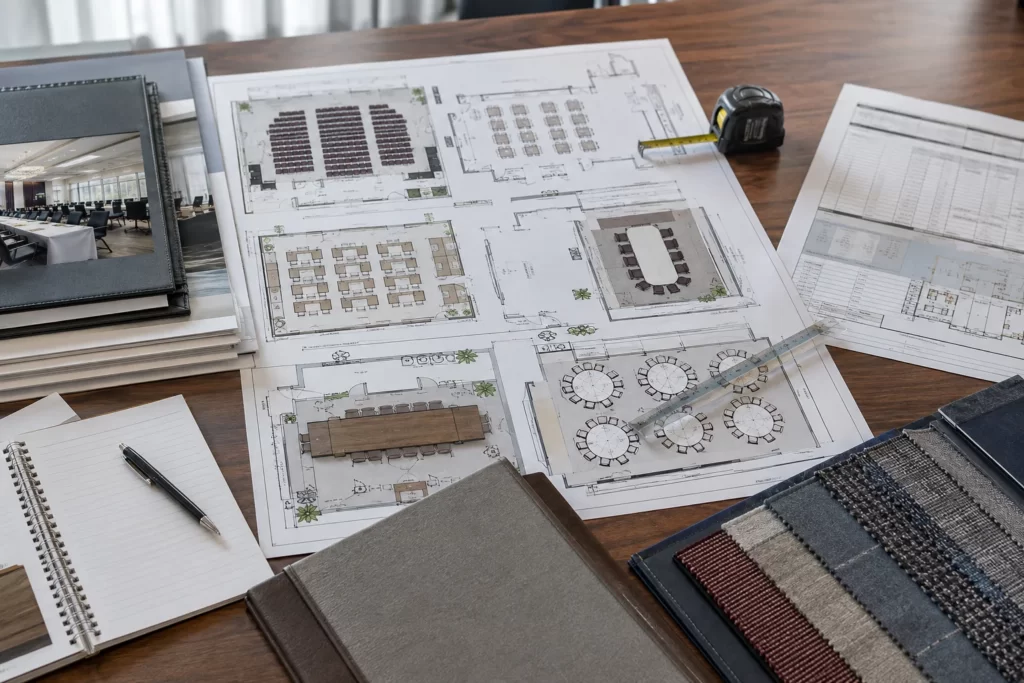
Ask venues to provide capacity for each required setup, not simply one maximum capacity number.
You should also request a floor plan showing columns, doors, stages, screens, service areas, loading areas, and emergency routes. The source specifically recommends checking how attendees move between simultaneous sessions because poor transitions can create operational problems.
For outdoor networking, team-building, or a reception component, an outdoor event venue space guide for 100 guests can help you think through circulation, weather backup, and layout before adding outdoor space to your requirements.
For smaller executive meetings, don’t automatically assume a traditional hotel ballroom is the best option. DC has smaller and unconventional spaces that can work well for private briefings and leadership sessions.
You can also explore hidden gem event venues in Washington, DC for ideas when the goal is a more intimate environment.
Common Mistake: Comparing venues by maximum capacity instead of capacity in your actual setup.
Step 4: Confirm Technology, AV, and Production Requirements
Technology is easy to overlook because successful technology becomes almost invisible.
Failed technology is different.
Before signing, ask about:
- Wi-Fi bandwidth
- Dedicated event network
- Presentation screens
- Microphones
- Speakers
- Video conferencing
- Lighting
- Recording
- Streaming
- Power
- Technical staffing
- Speaker preparation areas
- Presentation loading
- Camera positions
- Testing time
Do not settle for “Wi-Fi is available.”
Ask how much bandwidth is dedicated to the event space, whether the connection is included, and how many simultaneous video connections it can support. The source identifies Wi-Fi as one of the most frequently under-briefed items in corporate RFPs.
Also clarify who supplies the equipment, who operates it, and who is responsible when something fails.
For hybrid meetings, request a technical discussion before signing. A visually impressive room may still be unsuitable if it lacks appropriate acoustics, power distribution, network capacity, or camera positioning.
Step 5: Evaluate Privacy, Security, Accessibility, and Professionalism
A public-facing networking reception and an executive strategy meeting have very different privacy requirements.
Ask:
- Are meeting rooms sound-isolated?
- Can another event be heard nearby?
- How are guests checked in?
- Where can signage be placed?
- Is package delivery supported?
- Where can equipment be stored?
- What are loading procedures?
- Who has staff access to the meeting area?
- What accessibility features are available?
- What security procedures apply?
Accessibility should be evaluated as part of the attendee experience rather than added at the end of the planning process.
Professionalism also begins before the event.
Pay attention to:
- Response time
- Proposal accuracy
- Clarity of communication
- Change management
- Event-day contact
- Contract documentation
A venue that communicates clearly during the sales process is easier to evaluate than one that gives incomplete answers or changes terms from one conversation to the next.
If you are comparing multiple venue categories, event venues in DC can be a useful starting point for broad market exploration.
And when the event calls for a more distinctive setting, explore unique wedding venues in Washington, DC as inspiration for unconventional spaces that could also suit receptions, client gatherings, or executive social events.
Step 6: Compare Catering, Dining, and Break Logistics
Food service affects more than the menu.
It affects the agenda.
A 15-minute coffee break becomes much less useful if attendees must walk several minutes to another floor, wait in a line, and then return to the meeting room.
Review:
- Breakfast
- Lunch
- Coffee breaks
- Reception service
- Dietary accommodations
- Beverage service
- Menu minimums
- Service charges
- Taxes
- Timing
- Food placement
- Outside catering policies
- F&B exclusivity
Ask whether meals and breaks can happen near the meeting space.
The attached source also recommends reviewing outside-catering restrictions and food-and-beverage exclusivity before comparing proposals.
If your program includes a social component, cost responsibility should be equally clear. For example, if a client, sponsor, or partner is contributing to a reception, clarify who pays for which elements rather than leaving shared expenses ambiguous. The same planning principle applies in this guide to who pays for an engagement party: define financial responsibility before commitments are made.
For company celebrations or employee appreciation events, it can also help to understand birthday party planner fees as a reference point for how event scope changes professional-service costs.
Expert Tip: Treat food breaks as part of the floor plan. A poorly located break can cost more agenda time than you expect.

Step 7: Review Hotel Rooms and Attendee Logistics
If attendees are traveling, the venue decision is also a lodging decision.
Request:
- Number of rooms available
- Group rates
- Room types
- Release dates
- Breakfast options
- Parking
- Transportation
- Shuttle options
- Distance between hotel rooms and meeting space
- Airport access
The DC region has three major airports serving different portions of the audience: DCA, IAD, and BWI. The right venue depends partly on where your attendees originate and how they will reach the event.
Think about the complete movement:
Airport → hotel → meeting room → meals → evening activity → hotel → airport
A venue with a slightly higher room rate may still deliver better value if it significantly reduces transportation requirements and attendee friction.
If your event has multiple components
A corporate retreat might include a leadership meeting, dinner, outdoor activity, and team-building session. In that situation, the venue should be evaluated as an ecosystem rather than a single room.
A step-by-step event planning checklist can be adapted to track parallel logistics even though its original context is weddings.
And if your program includes an optional social outing, reviewing when to host bachelor or bachelorette parties offers another example of how timing and seasonal demand can influence venue availability.
Step 8: Calculate the Total Event Budget
The room rental is only one line item.
Your real corporate event budget may include:
| Cost Category | Venue A | Venue B | Venue C |
| Room rental | |||
| Food and beverage | |||
| AV and technology | |||
| Staffing and security | |||
| Setup, cleanup and overtime | |||
| Parking and transportation | |||
| Hotel rooms | |||
| Taxes and service charges | |||
| Estimated total |
Include every cost that affects delivery.
That means reviewing:
- Room rental
- F&B minimums
- AV
- Wi-Fi
- Staffing
- Security
- Furniture
- Setup
- Cleanup
- Parking
- Transportation
- Hotel rooms
- Service charges
- Taxes
- Overtime
- Cancellation penalties
- Room-reset fees
Current external industry data reinforces why this broader view matters. GBTA’s July 2026 forecast projects meetings and events cost per attendee per day at approximately $263 in 2026, with food and beverage and production identified as major cost pressures.
For your own RFP, however, use venue-specific proposals rather than applying a national average to a specific Washington, DC event.
And if you need broader context on professional event-service pricing, see how much event planners charge before comparing planner proposals.
Common Mistake: Choosing the cheapest room rental without calculating the total cost of delivering the event.
Step 9: Prepare a Strong Corporate Venue Request
A vague RFP creates vague proposals.
Instead of writing:
“Please send pricing for a corporate meeting.”
Give the venue enough information to understand the event.
Your corporate venue request should include:
- Event name
- Event objective
- Preferred date
- Date flexibility
- Arrival time
- Departure time
- Attendance by day
- Attendance by session
- Room setup
- Breakout-room requirements
- Food and beverage requirements
- Technology requirements
- Accessibility requirements
- Hotel-room requirements
- Budget range
- Decision date
- Special considerations
If you are uncertain about the ideal layout, describe the agenda and ask the venue to recommend a configuration.
That approach can reveal operational details you may not have considered.
Should you hire a planner or coordinator?
This decision should happen early because it affects how much of the sourcing and RFP process your internal team needs to manage.
For additional context on how professional event fees change by scope, compare planner pricing across event types.
Important: If you are publishing this article with strict one-time internal linking, use the planner-pricing link only once. The recommended production version should therefore retain the link in Step 8 and remove it from this paragraph.
A good RFP should make it possible to compare proposals on an apples-to-apples basis.
Step 10: Score the Final Shortlist
Once proposals arrive, avoid choosing based on the venue that “feels best.”
Use a scorecard.
The attached source recommends weighting attendee access and meeting capacity heavily, followed by technology, total value, hotel logistics, food and beverage, and privacy/professionalism.
Corporate Venue Scorecard
| Criterion | Suggested Weight | Key Question |
| Attendee access | 20% | Can the audience arrive easily and reliably? |
| Capacity and layout | 20% | Does the venue support every session? |
| Technology | 15% | Can it deliver the required production? |
| Total value | 15% | Is the complete cost reasonable? |
| Hotel and travel logistics | 10% | Are lodging and transportation practical? |
| Food and beverage | 10% | Can catering support the agenda? |
| Privacy and professionalism | 5% | Does the environment suit the event? |
| Contract flexibility | 5% | Are payment, cancellation and change terms manageable? |
A scorecard does not make the decision automatically.
It makes the decision explainable.
That matters when stakeholders disagree or leadership asks why the lowest-priced proposal was not selected.
If your company is considering a national retreat, the same evaluation framework can be extended to New York event venues or San Antonio event venues. The destination changes, but the fundamental questions—access, capacity, technology, food, lodging, and total cost—remain the same.
Corporate Event Venue Checklist for Washington, DC
Before signing a contract, confirm each item in writing.
Venue and Event Requirements
- Event objective and success criteria defined
- Audience profile and travel origins mapped
- Dates confirmed and flexibility noted
- Arrival and departure times specified
- Attendance by day and session recorded
- Required room setups confirmed
- Breakout-room count and sizes confirmed
- Floor plan reviewed
- Emergency routes reviewed
- Registration area identified
Technology
- Wi-Fi bandwidth confirmed
- AV equipment confirmed
- Video-conferencing capability confirmed
- Streaming requirements confirmed
- Technical staffing confirmed
- Outside AV policy confirmed
- Production testing time confirmed
- Power requirements confirmed
Food and Beverage
- Menu selected
- Dietary accommodations confirmed
- F&B minimum reviewed
- Service charges reviewed
- Outside catering policy confirmed
- Break locations confirmed
- Meal timing confirmed
Travel and Accessibility
- Parking confirmed
- Public transportation reviewed
- Accessibility requirements confirmed
- Airport access reviewed
- Hotel room block secured
- Release dates documented
- Transportation plan confirmed
Contract and Operations
- Total cost confirmed
- Taxes and service charges included
- Overtime charges understood
- Deposit schedule reviewed
- Cancellation policy reviewed
- Insurance requirements confirmed
- Vendor contracts aligned
- Event-day primary contact identified
- Final proposal, floor plan and production plan match
The attached source emphasizes the final document check because inconsistencies between the proposal, contract, floor plan, and production plan can create expensive surprises.
For national organizations comparing multiple markets, you can also compare wedding venues in Washington, DC and Maryland venue options to understand how the venue inventory changes across the broader region.
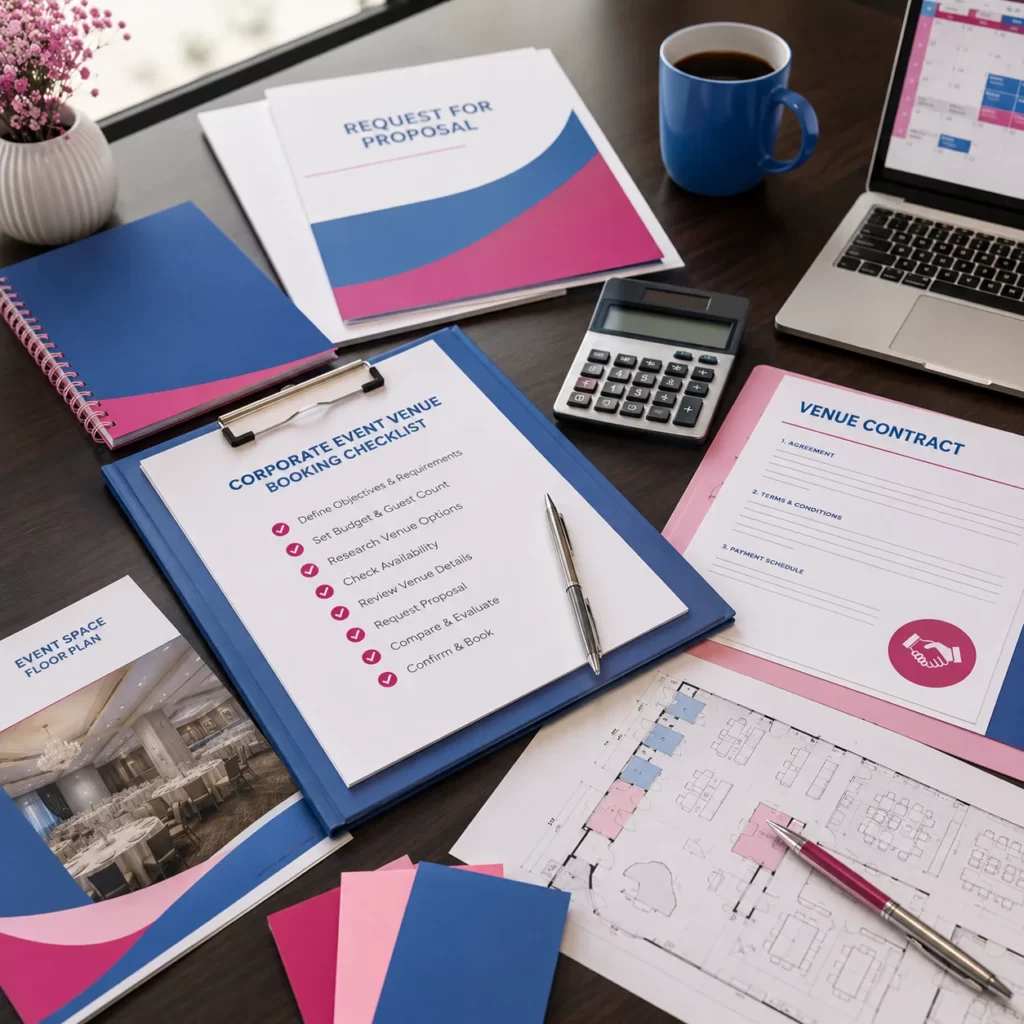
How Early Should You Book a Corporate Event Venue Near Washington, DC?
Timing depends on the size and complexity of the program.
Large conferences, multi-day meetings, executive programs with significant hotel requirements, and events tied to major seasonal demand should be sourced earlier than simple single-day meetings.
The attached source identifies spring conference activity, fall association meetings, and December holiday gatherings as periods where venue availability can become more competitive. It recommends longer lead times for large or multi-day programs and shorter—but still proactive—planning windows for single-day meetings.
Government-related dates can also affect hotel capacity and attendee travel.
For a smaller executive briefing, however, you may have more flexibility. That is where intimate spaces and unconventional venues can become particularly useful.
Destination DC’s current venue resources show that the city has a broad mix of conventional meeting facilities, hotels, museums, waterfront spaces, rooftops, and smaller venues.
The key is to begin with your requirements rather than waiting until the calendar becomes crowded.
If you are considering professional support, event planners vs. coordinators explains how their responsibilities and pricing can differ.
What Makes a Corporate Event Venue “Good”?
The best venue is rarely the one with the most impressive lobby.
It is the venue that makes the entire event journey work.
A strong corporate event venue should provide:
- Convenient attendee access
- Appropriate capacity
- Flexible layouts
- Reliable technology
- Good acoustics
- Practical catering
- Accessibility
- Parking or transportation options
- Appropriate privacy and security
- Transparent pricing
- Responsive venue support
- Contract terms your organization can accept
The attached source summarizes this philosophy well: the venue should function as the base for arrival, participation, meals, networking, and travel—not simply as a room.
That is the mindset that separates venue sourcing from venue shopping.
If professional planning support is part of the budget, compare what it costs to hire a corporate event planner before deciding whether planning should remain in-house.
Final Word: Start With the Attendee Journey
The best corporate event venue near Washington, DC is the one that makes it easy for attendees to arrive, participate, network, and stay engaged while giving your team the infrastructure required to deliver the program.
Start with the purpose.
Then choose the right market.
Match capacity to the actual layout.
Verify AV and Wi-Fi.
Review privacy and security.
Audit catering.
Solve hotel and transportation logistics.
Calculate the complete budget.
Send a detailed RFP.
Then score the shortlist.
The attached source distills the process into those 10 decisions: purpose, market, capacity, technology, privacy, catering, lodging, budget, RFP, and final scoring.
For smaller executive meetings, don’t overlook intimate or unconventional DC spaces. Destination DC currently highlights everything from smaller historic venues to museums, waterfront spaces, rooftops, and specialized meeting environments, giving planners considerable flexibility beyond traditional hotel ballrooms.
For smaller leadership programs, micro-wedding venues in Washington, DC can also provide useful inspiration for intimate, hospitality-focused spaces with a more personal atmosphere.
Ready to Compare Corporate Event Venues?
Once you know your attendee count, preferred location, room setup, technology requirements, and budget, the next step is comparing real options.
Use greatEvent to search corporate meeting and event venues near Washington, DC and evaluate venue options based on the requirements that matter to your program.
The goal is not to find the venue with the longest feature list.
It is to find the venue that gives your attendees the easiest experience and your team the clearest path to a successful event.
Frequently Asked Questions
What are the best corporate event venues near Washington, DC? ▾
The best venue depends on your attendee profile, event format, room requirements, budget, and travel needs. Compare DC, Maryland, National Harbor, and Northern Virginia using the same criteria: access, capacity, technology, catering, hotel logistics, privacy, and total cost.
Is it better to host a corporate event in DC or Maryland? ▾
Neither is automatically better. Central DC can be useful for downtown offices, public transportation, museums, and government-related meetings, while Maryland and National Harbor may offer advantages in parking, hotel access, and flexible space. Choose based on where attendees are traveling from and what the program requires.
How much does it cost to host a corporate event at a venue near Washington, DC? ▾
Costs vary by attendance, event format, venue, technology, catering, lodging, transportation, and contract terms. Your comparison should include room rental, F&B, AV, Wi-Fi, staffing, parking, transportation, hotel rooms, taxes, service charges, and overtime rather than focusing only on the room rate. Current GBTA research forecasts global meetings and events costs at about $263 per attendee per day in 2026, but venue-specific proposals should drive your actual budget.
How can I book a corporate event venue near Washington, DC through greatEvent? ▾
Start by defining your event date, attendance, format, location requirements, and services needed. Then compare suitable venue options and evaluate capacity, location, services, and other event requirements before making your selection.
When is the best time of year to book a corporate venue near Washington, DC? ▾
Demand can be stronger during spring conference season, fall association meetings, and December holiday events. Large or multi-day programs should be sourced earlier because hotel rooms, meeting space, and related services can become more difficult to secure. Government-related dates can also affect local availability.
Compare vendors for your next event
Search caterers, photographers, florists, planners, and rentals — then send one request to several vendors at once.