Quick answer: Corporate event transportation in Washington, DC is usually four separate bookings, each priced and scheduled on its own: airport transfers, executive car service for individual VIPs, group transfers by van or motorcoach, and offsite movements to dinners or activities. For each one, confirm the vehicle type, the exact pickup point, the total time on hire (not just the drive time), and who manages the passenger manifest. In the District, motorcoaches may stop only where the rules allow it, and engines generally may not idle for more than three minutes. At Reagan National and Dulles, sedan and limousine pickups must be prearranged with an operator the airports permit. A single “ground transportation” line in a budget usually hides three or four of these bookings.
Example scenario (fictional): An agency planner signs a downtown DC hotel for a 120-person client meeting four months out. The coach that will take 80 of those guests to a Georgetown dinner gets booked three weeks before the event. By then the pickup window, the parking, and the driver’s hours all depend on choices someone else already made. Transportation gets arranged last and goes wrong first.
This is for professional planners and agencies running corporate meetings for clients in Washington, DC and the greater Washington metro area, including nearby Maryland and Northern Virginia. It covers what to book, what to confirm, which District and airport rules affect your plan, what to ask a provider, how to budget, and when to book. It does not give prices, because rates depend on the provider, the vehicle, and the date. For the wider event plan, see our event logistics checklist.
In this guide:
- The four bookings, and why they are separate
- What to confirm before you book
- DC and airport rules that shape your plan
- Working with a DC-based provider
- Questions to ask any DC transportation provider
- Copyable transport manifest and provider question sheet
- Budgeting ground transportation
- When to book
- FAQ
The four bookings, and why they are separate
Planners often ask for “transportation” as one line and get back a number that answers only one of these four questions.
| Booking type | What it covers | How it is usually priced | What drives the price |
|---|---|---|---|
| Airport transfers | Arrivals and departures, usually individuals or small groups | Per movement | Number of movements, waiting time for late flights, meet-and-greet staff |
| Executive car service | Named VIPs, speakers, board members | Per hour, with a minimum | Hours on hire rather than distance; vehicle class |
| Group transfers | Hotel to venue and back, by van, minibus, or motorcoach | Total time the vehicle is committed | Vehicle size, total hours, driver time, parking |
| Offsite movements | Dinners, activities, tours | Total time the vehicle is committed | Number of stops, waiting time, a late-night return |
These pricing units are planning guidance, so ask each provider how it charges. A motorcoach is often priced on the whole time it is committed to you, including the hours it waits outside the restaurant, and that surprises people. A coach that drops at 6 p.m. and collects at 10 p.m. has usually been on hire for all four hours, not just the 40 minutes it spent driving.
What to confirm before you book
The exact pickup point
A hotel’s street address and the place a full-size coach can legally stop are often a block apart. Ask for a map pin, an entrance name, and confirmation that the vehicle may stop there at your time of day. An address is not a pickup point. The District’s rules for where a motorcoach may stop are covered in the next section.
The total time on hire
That means the whole window the vehicle is committed to you, including positioning before the first pickup and release after the last drop. Then ask what happens when your session runs 30 minutes over, because sooner or later one will.
Who manages the manifest
Someone has to hold the list of who is on which vehicle, at what time, and from where. If that is not clearly the provider’s job, it is yours, and it is more work than it sounds. The same discipline behind a rooming list applies here: names, times, and vehicle assignments change, and a version nobody owns goes stale fast. A copyable manifest is in the template section below.
Driver hours
Driver hours matter more than planners expect. On a multi-day program with early departures and late returns, federal duty limits for bus drivers shape your schedule, not the other way around. Have the carrier confirm the itinerary works before you publish it to attendees. The limits are summarized in the next section.
Where the vehicle waits between movements
A coach that drops a group at 9 a.m. and collects at 4 p.m. has to be somewhere for seven hours. Ask whether staging or parking is included, where it is, and what it costs. Our team hotel bus parking and drop-off checklist covers the access questions in detail, and most of them apply to a corporate group too.
DC and airport rules that shape your plan
The rules below come from District agencies, the airport operators, and federal regulations. They are written for operators, yet each one affects your schedule or your pickup points. Your provider is responsible for following them. Your job is to make sure the plan you hand over doesn’t depend on breaking them.
Motorcoaches in the District
The District Department of Transportation’s motorcoach guidance on goDCgo says parking is limited because the city hosts so many events. Its rules include:
- Don’t let passengers on or off in “Loading Zones” or at Metrobus stops.
- Don’t park in areas posted “No Parking” or “No Standing,” or in metered spaces while the meters are in effect, unless the meters are designated for motorcoaches.
- Don’t park next to a residential property, school, playground, hospital, church, or park. A standing vehicle that is not loading or unloading passengers counts as parked, whether or not the engine is running.
- Bus parking is not permitted in several “high impact zones,” including parts of the National Mall and K Street between 30th and 31st Streets in Georgetown.
- Motorcoaches giving city tours must have a licensed DC guide on board.
DDOT’s printed Motorcoach Operators Guide adds that motorcoaches may park or load only at designated curbside locations, within posted time limits, or at off-street facilities, and should not stop, load, or park on streets with rush-hour restrictions. That guide dates from 2013, so treat posted signs as the final word.
Idling is the rule your attendees will notice. Under the District’s engine anti-idling law, as described by the Department of Energy and Environment, gasoline and diesel vehicles generally may not idle for more than three minutes while parked, stopped, or standing. At 32°F or below, the regulation allows up to five minutes to run the heat. Private non-commercial passenger vehicles are exempt, and DOEE lists a $500 civil infraction for a first violation. The regulation itself (20 DCMR 900.1) names buses with 12 or more seats and says the limit applies even when the engine runs the air conditioning. So a coach waiting at the curb in July can’t keep its air conditioning running for long. Plan boarding so guests aren’t sitting in a parked coach for long stretches.
Charter buses also need the right registration. goDCgo says a bus from any US state or Canadian province carrying a chartered party, with seats for more than 15 passengers, must have either proportional registration through the International Registration Plan or Class B commercial registration plus a DC trip permit. That is the operator’s job, but it’s a fair question for an out-of-town carrier. goDCgo also lists a motorcoach hotline run with Destination DC, 1-855-67-BUSES, for parking, permitting, and routing questions.
Programs that cross into Virginia face separate rules. goDCgo notes that Arlington County’s tour bus zones are first come, first served and can’t be reserved, and that some motorcoach spaces in Old Town Alexandria need a free permit obtained in advance.
Airport pickups at DCA, IAD and BWI
The Metropolitan Washington Airports Authority (MWAA) runs Reagan National (DCA) and Dulles (IAD). Its passenger pages for Reagan National and Dulles say MWAA authorizes only permitted sedan and limousine services, and that pickups require a prearranged reservation. Airport regulations prohibit soliciting passengers. MWAA’s limousine permit page says any for-hire limousine operator providing pickups or drop-offs at either airport must be authorized to provide that service. So ask any car service you book for DCA or IAD to confirm it holds the MWAA permit.
BWI Marshall is run separately. Its transportation page puts the taxi stand outside baggage claim on the lower level, and app-based rides at the curbs on the Departures/Ticketing level. Its shuttle page says hotel and off-airport parking shuttles pick up only at designated zones on the Arrivals/Lower Level roadway. BWI’s public pages don’t describe where chartered coaches or prearranged car services meet groups, so get that location in writing from your provider and include it in the arrival instructions.

Bus driver hours
Federal hours-of-service rules for drivers of passenger-carrying commercial motor vehicles are in 49 CFR 395.5. They apply subject to the exceptions and exemptions in section 395.1, so the carrier is the one to confirm how they apply to your trip.
| Rule (49 CFR 395.5) | What it says | What it means for your schedule |
|---|---|---|
| Driving limit | No more than 10 hours of driving after 8 consecutive hours off duty | A long airport-run day plus an evening dinner run can use up one driver |
| On-duty limit | No driving after being on duty 15 hours, following 8 consecutive hours off duty | Ask the carrier how the waiting time between your movements counts toward the 15 hours |
| Weekly limit | No driving after 60 hours on duty in 7 days, or 70 hours in 8 days if the carrier runs vehicles every day | On multi-day programs, ask whether the same driver stays for the whole program |
If your first pickup is at 6 a.m. and the dinner return is close to midnight, ask the carrier directly whether you need a second driver or a second vehicle. The answer can change the quote.
Checking a bus company
The Federal Motor Carrier Safety Administration asks travel planners to “Look Before You Book.” Its Bus Safety Search lets you look up a company, ideally by USDOT number, and check its safety rating, any out-of-service notice, five public safety categories, whether it has active for-hire authority with “Yes” next to “Passenger,” and whether insurance is on file. FMCSA notes that a company with no USDOT number may operate within a single state, in which case the state oversight agency, usually the state DOT, holds its safety information. Our event logistics checklist covers the rest of the carrier check, including accessible vehicles.
| Rule or check | Applies to | Source |
|---|---|---|
| Load only where permitted; not in loading zones or at Metrobus stops | Motorcoaches in the District | goDCgo (DDOT) |
| Idling limit: 3 minutes; up to 5 minutes for heat at 32°F or below | Gasoline and diesel vehicles in the District (private non-commercial cars exempt) | DOEE, 20 DCMR 900 |
| IRP registration, or Class B plus a DC trip permit | Charter buses with seats for more than 15 passengers | goDCgo (DDOT) |
| Prearranged pickups by permitted operators only | Sedans and limousines at DCA and IAD | MWAA |
| Designated shuttle zones on the Arrivals level | Hotel and off-airport parking shuttles at BWI | BWI Marshall |
| 10-hour driving and 15-hour on-duty limits | Drivers of passenger-carrying commercial motor vehicles | eCFR |
| Safety rating, passenger authority, insurance on file | Bus companies | FMCSA |
Working with a DC-based provider
One advantage of a local agency over a national booking platform is that the pickup point question gets answered by someone who has actually stood there.
Arrival DC, Hospitality Partners is one example, and it recently signed up with greatEvent as a service provider. Its website describes it as a boutique agency serving diplomats, executives, and private planners in Washington, DC and the greater Washington metropolitan area, and says it partners with corporate and private planners. Its services page lists four areas that matter to a meeting planner:
- Transportation. Airport transfers with meet and greet, manifest management, chauffeured black-car and SUV service, event transportation, logistics management, and staff support.
- Executive hospitality. On-site coordination, meeting support, VIP handling, and guest relations.
- Concierge services. Itinerary planning, private dining, tickets, and personal assistance.
- Special experiences. Washington experiences and VIP tours arranged by locals.

Its FAQ page lists executive sedans, SUVs, sprinter vans, mini and motor coaches, and trolleys. It says the company serves the greater Washington area, including Montgomery County and greater Baltimore in Maryland and Arlington and Fairfax Counties in Virginia, and handles arrivals and departures at Dulles, Reagan National, and BWI. On manifests, it says it builds, updates, and distributes arrival and departure manifests, tracks flight details, and coordinates with greeters, chauffeurs, and venue contacts. Its contact page says that when you share your itinerary, a partner will respond personally within the hour, and its home page carries a “Proud partner of Visit Montgomery” badge. You can also see Arrival DC’s profile on greatEvent.
What its public pages don’t state: licensing, USDOT numbers, insurance, whether vehicles are its own or arranged through partners, and prices. Those are standard questions for any provider, including this one, and the answers simply aren’t published.
We haven’t verified Arrival DC’s licensing, insurance, fleet, or track record, and this isn’t an endorsement or a recommendation of one provider over another. The description above reflects only what its own website said on November 10, 2026. Confirm credentials, availability, and terms directly before you book.
Manifest management is the line worth noticing. It’s the piece planners take on by default, usually without pricing it. A provider that owns the passenger list, the vehicle assignments, and the timing changes takes hours out of your week. Whoever you hire, decide that point in writing. If you are weighing a full destination management company instead, our guide to DMC vs DMO vs CVB explains what each one does.
Questions to ask any DC transportation provider
Treat these as a shortlist screen. The answers tell you more than a quoted hourly rate does.
- What vehicle classes do you operate, and are they your own or subcontracted?
- What is your USDOT number, and for DCA or IAD pickups, do you hold the MWAA limousine permit?
- What is the minimum hire period for each vehicle class, and when does the clock start?
- For our hotel, exactly where does the vehicle stop, and is that allowed at our times?
- Where will the vehicle wait between movements, and who pays for that parking?
- Who holds the manifest, and how are changes handled on the day?
- What are your policies on gratuity, parking, tolls, and fuel, and are they in the quote?
- Will one driver cover the whole day, or do our hours need a second driver?
- What is your cancellation and reduction deadline, and what does a change cost after it?
- Who is our contact on the day, and who do we call at 11 p.m.?
- What happens if a flight is delayed, a session runs over, or a vehicle breaks down?
Get the answers in writing and keep them with the proposal. A quote that covers only the hours and the vehicle is incomplete, and the gap tends to come back later as an invoice line nobody approved.
Copyable transport manifest and provider question sheet
Copy this into your planning document. Keep one version with one owner, and send only the relevant rows to each driver, greeter, and venue contact.
GROUND TRANSPORTATION MANIFEST
Program: ______________  Client: ______________  Version: ___  Updated: ___ (date/time)
Manifest owner: ______________  Provider contact (day of): ______________
Escalation after hours: ______________

MOVEMENT LOG (one row per movement)
Movement # | Date | Type (airport / VIP car / group / offsite) | Vehicle class | Vehicle #
Pickup point (pin + entrance name) | Pickup time | Drop-off point | Drop-off time
Passenger count | Lead passenger + mobile | Greeter needed? (Y/N) | Notes

AIRPORT ARRIVALS (one row per traveler)
Name | Mobile | Airline + flight # | Airport (DCA / IAD / BWI) | Scheduled arrival
Bags | Greeter (Y/N) | Assigned vehicle | Destination | Accessibility needs

DAY-OF CHANGES (never edit silently)
Time | Change | Requested by | Approved by | Driver/greeter told (Y/N)

PROVIDER QUESTION SHEET
[ ] Legal name: __________  USDOT #: __________  MWAA permit (DCA/IAD): ___
[ ] Vehicles: own / subcontracted  Classes: __________
[ ] Minimum hire per class: ______  Clock starts: ______  Clock stops: ______
[ ] Pickup point confirmed for our hotel and vehicle class (Y/N): ___
[ ] Staging/parking between movements: where ______  cost ______
[ ] Driver hours checked against our schedule; second driver needed? ___
[ ] Gratuity / parking / tolls / fuel in quote? ______
[ ] Waiting time and overtime rate: ______
[ ] Cancellation and reduction deadline: ______
[ ] Insurance certificate received (Y/N): ___
[ ] Day-of contact: ______  After-hours escalation: ______
Budgeting ground transportation
Build the estimate from movements, not from a daily rate. List every time a group or an individual has to be somewhere, then price each movement with its waiting time attached.
Items that often sit outside the headline quote:
- Gratuity, where it is customary or required by the contract
- Parking, tolls, and any venue access charge
- Waiting time beyond the booked window
- A late-night return surcharge
- Extra vehicles held in reserve
- Meet-and-greet staff at the airport, which is a person, not a car
- A second driver when the day runs past the hours limits
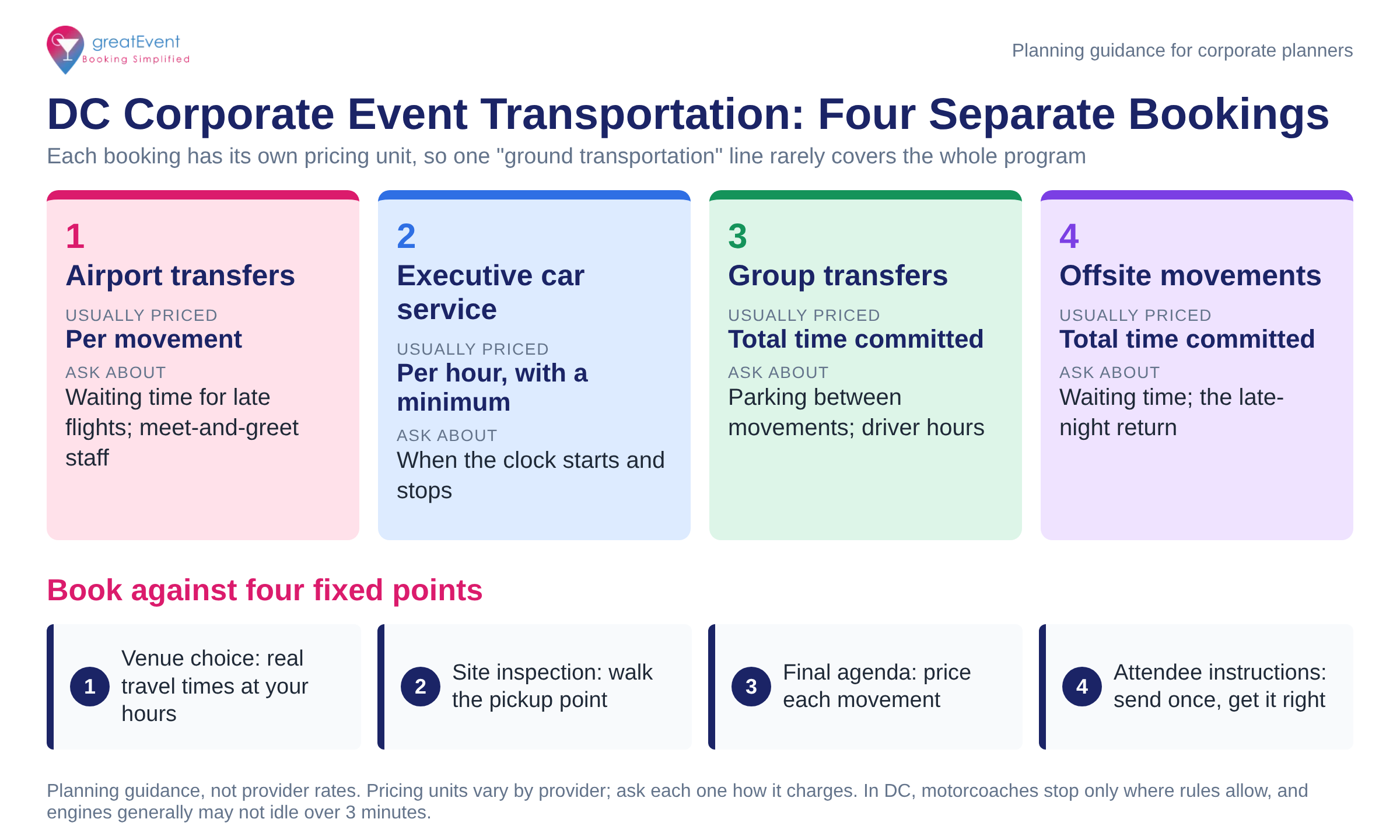
Text version of the infographic: Airport transfers are usually priced per movement; ask about waiting time for late flights and meet-and-greet staff. Executive car service is usually priced per hour with a minimum; ask when the clock starts. Group transfers are usually priced on total time committed; ask about parking and driver hours. Offsite movements are usually priced on total time committed; ask about waiting time and the late return. Fix four points before you book: venue choice, site inspection, final agenda, and attendee instructions. Planning guidance, not provider rates.
Put the total in the same comparison as the venue. A cheaper hotel farther from your offsite venues can cost more once four coach movements are priced. Our hotel proposal comparison template is where that comparison belongs, and the budget approval template covers presenting the combined figure to an approver.
Anything agreed after the contract is signed should go through a written change process, not a conversation with a driver. Our guide to controlling venue change orders applies to ground transportation as much as to the venue, and to all your vendors and suppliers.
When to book
Work backward from your fixed points, not from a generic lead time. Four of them matter.
The first is venue selection. Before you sign anything, find out the real travel time between the hotel and any likely offsite venue at the hour you will actually travel. DC traffic at 5 p.m. is a different trip from the same roads at 11 a.m. Our guide to choosing a corporate event venue near Washington, DC explains why District, Maryland, and Northern Virginia venues each change how attendees move.
Then the site inspection. Walk the pickup point and confirm it works for the vehicle class you expect to use. A site inspection that covers the meeting rooms and skips the drop-off lane has missed something that will cost you on day one.
Third, the final agenda. Movements can only be priced once session times are real. Anything booked before that is a placeholder, however firm the email sounds.
Last, before you send attendee instructions. Arrival times, pickup locations, and contact numbers reach attendees once, so they have to be right the first time. Change them later and some people will end up standing in the wrong place.
Lead times vary by provider. Arrival DC’s FAQ, for example, says 24 to 48 hours is preferred for standard reservations and recommends booking as early as possible for complex itineraries, multi-day delegations, or high-profile events. Ask each provider for its own deadlines and put them in your timeline.
Plan the ground logistics alongside the venue on greatEvent
Transportation is cheapest to solve while you are still choosing the hotel, and most expensive to solve the week before the meeting. Price the movements when you price the rooms.
On greatEvent, start your venue search with the meeting type, location, date, and attendee count. You can compare hotels and venues side by side, check real-time availability, or send one inquiry to several venues and get quotes back. Once you have a shortlist, work out what each option costs to get people in and out of, and compare the totals, not just the room rates. For DC options, see our list of corporate event venues in Washington, DC. If attendees need rooms nearby, see how to manage hotel room blocks for a conference.
There are no fees for planners. We pay you commission on any qualifying booking you make on greatEvent.
Register as a professional planner
Frequently asked questions
What does corporate event transportation include in Washington, DC?
▾
Usually four separate bookings: airport transfers, executive car service for individual VIPs, group transfers between the hotel and the venue, and offsite movements for dinners or activities. They are priced on different units, so a single quoted figure usually covers only part of the program.
How is group transportation priced?
▾
Often on the total time the vehicle is committed, not the distance driven, with a minimum hire period. A coach that waits four hours while your group has dinner is generally on hire for those four hours. Confirm when the clock starts and stops.
Where can a motorcoach stop in Washington, DC?
▾
Only where District rules allow: designated curbside locations within posted time limits, or off-street parking facilities. Passengers may not board or leave in loading zones or at Metrobus stops, and engines generally may not idle for more than three minutes.
Can a car service pick up guests at Reagan National or Dulles?
▾
Yes, if it is a sedan or limousine service the Metropolitan Washington Airports Authority permits and the pickup is prearranged. Airport regulations prohibit soliciting passengers, so give travelers the driver’s name and meeting point in advance.
How long can a bus driver work in one day?
▾
Under 49 CFR 395.5, a driver of a passenger-carrying commercial vehicle may drive up to 10 hours after 8 consecutive hours off duty and may not drive after 15 hours on duty. Exceptions exist, so ask the carrier to check your schedule.
What is a DMC, and do I need one?
▾
A destination management company provides local services such as transportation, activities, offsite venues, and on-site staff. Local agencies use different labels, so ask what each one delivers itself. Whether you need one depends on how many local moving parts you have and how much coordination you want to keep.
Who should hold the passenger manifest?
▾
Agree on it in writing before you book. Some providers offer manifest management as a service. Where they don’t, the planner holds it by default. It needs one owner, because names, times, and vehicle assignments change right up to the day of travel.
Research and sources
Sources were checked on November 10, 2026. Rules change, so confirm current requirements with the agency or airport before your program. The four-booking structure, pricing units, confirmation points, provider questions, and budgeting approach are planning guidance based on general meeting-planning practice, not published rates. The opening scenario is fictional. No prices are given because none were verified.
Arrival DC, Hospitality Partners recently signed up with greatEvent as a service provider. Its description reflects only what its own website stated on the date checked. We haven’t verified its licensing, insurance, fleet, or performance, and this article doesn’t recommend one provider over another.
- Arrival DC, Hospitality Partners: home page, with its services, about, FAQ, and contact pages, arrivaldc.com.
- Motorcoach Operations: Regulations, Requirements, and Tips, goDCgo, District Department of Transportation.
- Motorcoach Operators Guide, District Department of Transportation, 2013.
- 20 DCMR 900: Engine Idling, District of Columbia Municipal Regulations, as posted by DOEE.
- Engine Anti-Idling Law, DC Department of Energy and Environment.
- Limousine and Sedan Services, Reagan National Airport and Limousine and Sedan Services, Dulles International Airport, Metropolitan Washington Airports Authority.
- Limousine Transportation Services Permit, Metropolitan Washington Airports Authority.
- Transportation and Shuttles, BWI Thurgood Marshall Airport.
- 49 CFR 395.5: Maximum driving time for passenger-carrying vehicles, Electronic Code of Federal Regulations.
- Look Before You Book: Put Bus Safety First, Federal Motor Carrier Safety Administration.
Compare vendors for your next event
Search caterers, photographers, florists, planners, and rentals — then send one request to several vendors at once.