Quick answer: MICE stands for meetings, incentives, conferences, and exhibitions. It is the travel and hospitality industry’s shorthand for group events held for a business or professional purpose. Some sources read the C as conventions and the E as events. In North America you will also hear the same market called business events or the meetings industry. For a planner, each letter in the MICE definition points to a different venue, hotel room block, and booking window.
Example scenario (fictional): A planner at a small Chicago agency sends a hotel an inquiry for a client’s sales kickoff. The reply thanks her for the “MICE inquiry” and comes from the hotel’s MICE sales team. A week later another client asks her to price a reward trip for top sellers, and the resort she contacts routes her to its MICE team too. Both hotels file the work under the same label, but the sales kickoff and the reward trip need different rooms, contracts, and timelines.
This is for professional US event planners and agencies who plan meetings, incentive trips, conferences, and exhibitions for clients. It explains what MICE means, what each segment involves, how MICE compares with the terms business events and meetings industry, how hotels treat MICE business, and who you work with. It ends with a MICE comparison table and short answers to common questions.
In this guide:
- What MICE stands for
- Meetings
- Incentives
- Conferences
- Exhibitions
- MICE vs. business events vs. the meetings industry
- How hotels and venues treat MICE business
- Who you work with in MICE
- MICE comparison table
- FAQ
What MICE stands for
What does MICE mean? If a client asks you to define MICE, start here: the MICE acronym stands for meetings, incentives, conferences, and exhibitions. It covers group travel and events organized for work: a board meeting, a reward trip, an association’s annual conference, an industry exhibition. You will see the term on hotel sales team titles, on destination websites, in RFP tools, and in briefs from international clients.
Sources spell out the letters differently. The Society for Incentive Travel Excellence (SITE) expands MICE as meetings, incentives, conferences, events, and our incentive travel guide uses that version. A 2014 UNWTO report on the meetings industry uses meetings, incentives, conventions and exhibitions. All of these describe the same market, so when a hotel or client says MICE, ask which events they have in mind.
That same UNWTO report gives a working definition you can use. Citing a definition shared by UNWTO, Reed Travel Exhibitions, ICCA, and MPI, it describes a meeting as a gathering of 10 or more participants for a minimum of 4 hours in a contracted venue. It counts conventions, conferences, congresses, trade shows and exhibitions, incentive events, and corporate or business meetings as part of that group. Under that definition, a client dinner for six falls outside it.
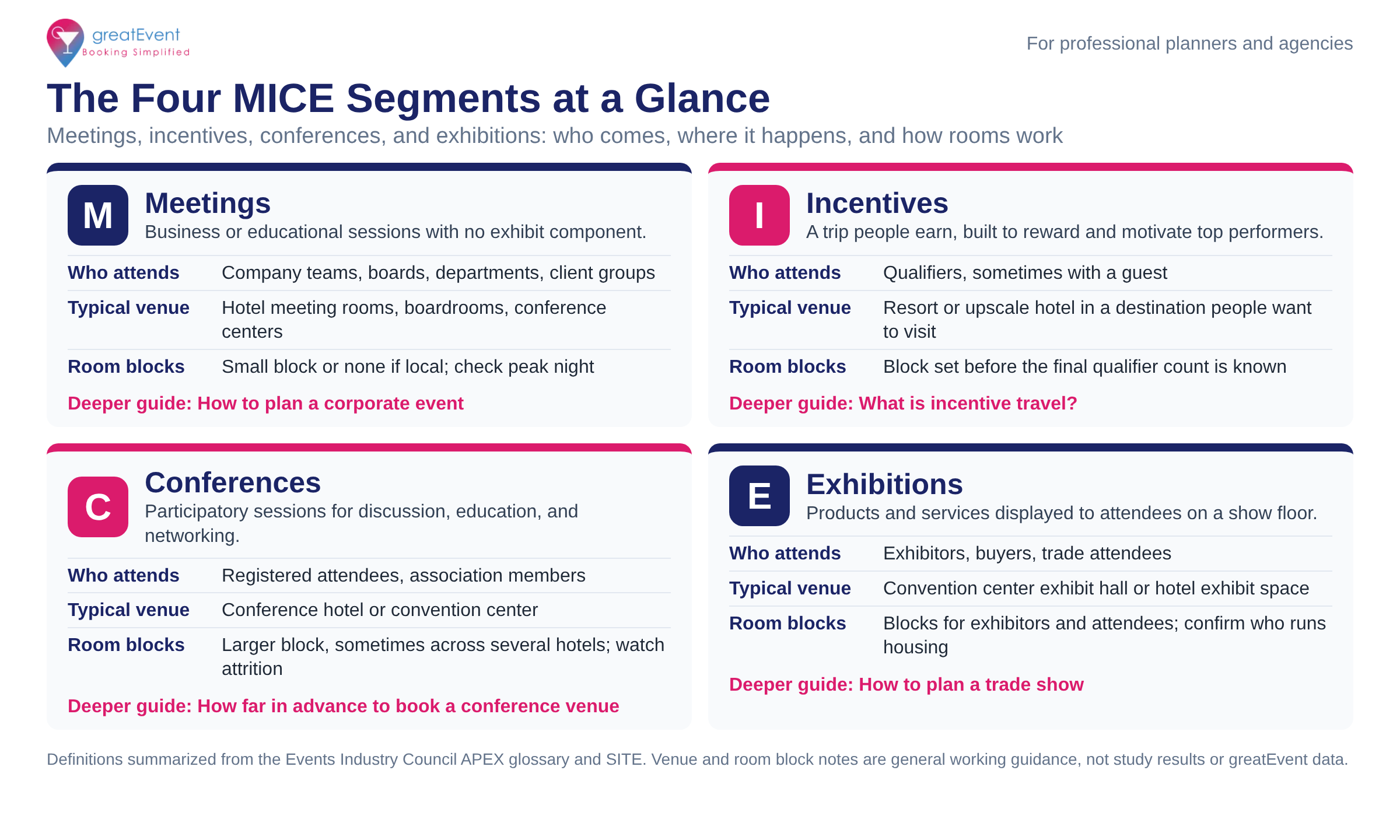
Text version of the infographic:
- M, Meetings. Business or educational sessions with no exhibit component. Who attends: Company teams, boards, departments, client groups. Typical venue: Hotel meeting rooms, boardrooms, conference centers. Room blocks: Small block or none if local; check peak night. Deeper guide: How to plan a corporate event
- I, Incentives. A trip people earn, built to reward and motivate top performers. Who attends: Qualifiers, sometimes with a guest. Typical venue: Resort or upscale hotel in a destination people want to visit. Room blocks: Block set before the final qualifier count is known. Deeper guide: What is incentive travel?
- C, Conferences. Participatory sessions for discussion, education, and networking. Who attends: Registered attendees, association members. Typical venue: Conference hotel or convention center. Room blocks: Larger block, sometimes across several hotels; watch attrition. Deeper guide: How far in advance to book a conference venue
- E, Exhibitions. Products and services displayed to attendees on a show floor. Who attends: Exhibitors, buyers, trade attendees. Typical venue: Convention center exhibit hall or hotel exhibit space. Room blocks: Blocks for exhibitors and attendees; confirm who runs housing. Deeper guide: How to plan a trade show
The venue and room block notes are general working guidance, not study results.
Meetings
The Events Industry Council’s APEX glossary defines a meeting as an event where the main activity is attending educational or business sessions, taking part in discussions and social functions, or attending other organized events, with no exhibit component. In MICE terms, the M covers corporate meetings such as board meetings, sales kickoffs, training, leadership offsites, and client meetings.
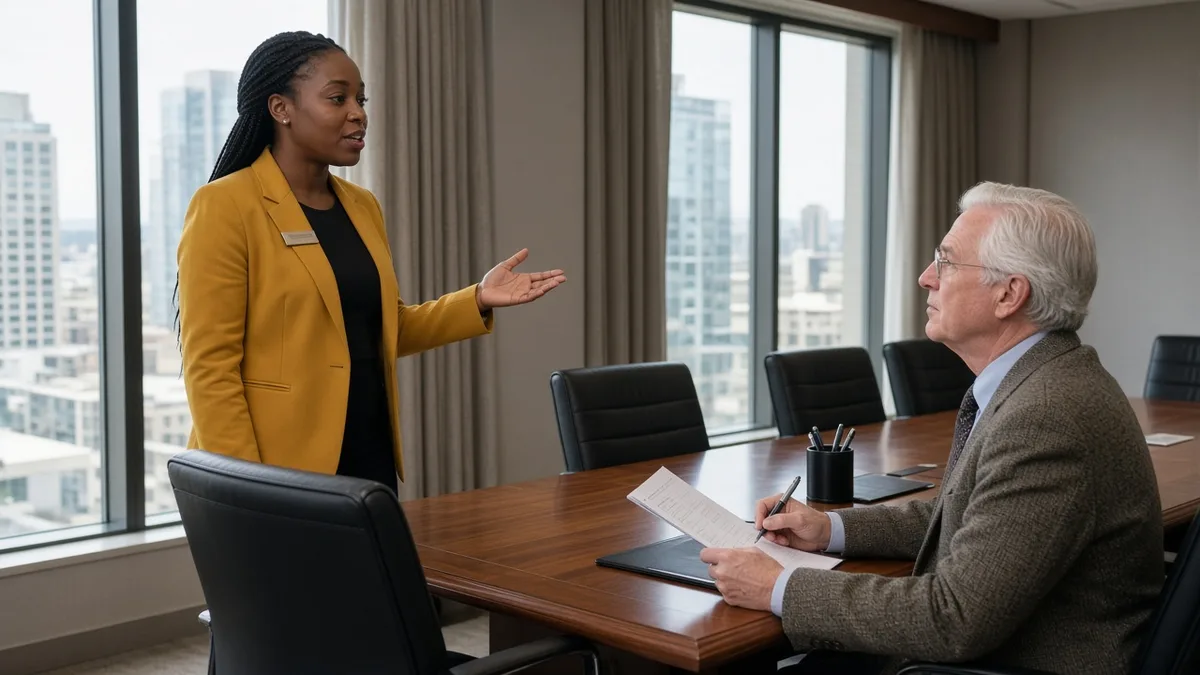
For meetings, the space comes first. You need the right rooms in the right setup, a food and beverage plan, and sometimes a small room block for attendees who travel in. A local half-day meeting may need no sleeping rooms at all. Check room sizes with our meeting room capacity chart, and use our guide on how to plan a corporate event for the full step-by-step process.
Incentives
Incentives are reward trips. MPI describes incentive travel as a rewards program that uses travel experiences to motivate performance and recognize achievement. SITE calls it the “I” in MICE and separates it from meetings this way: corporate meetings usually seek to inform or educate participants, while incentive travel seeks to motivate and inspire them.
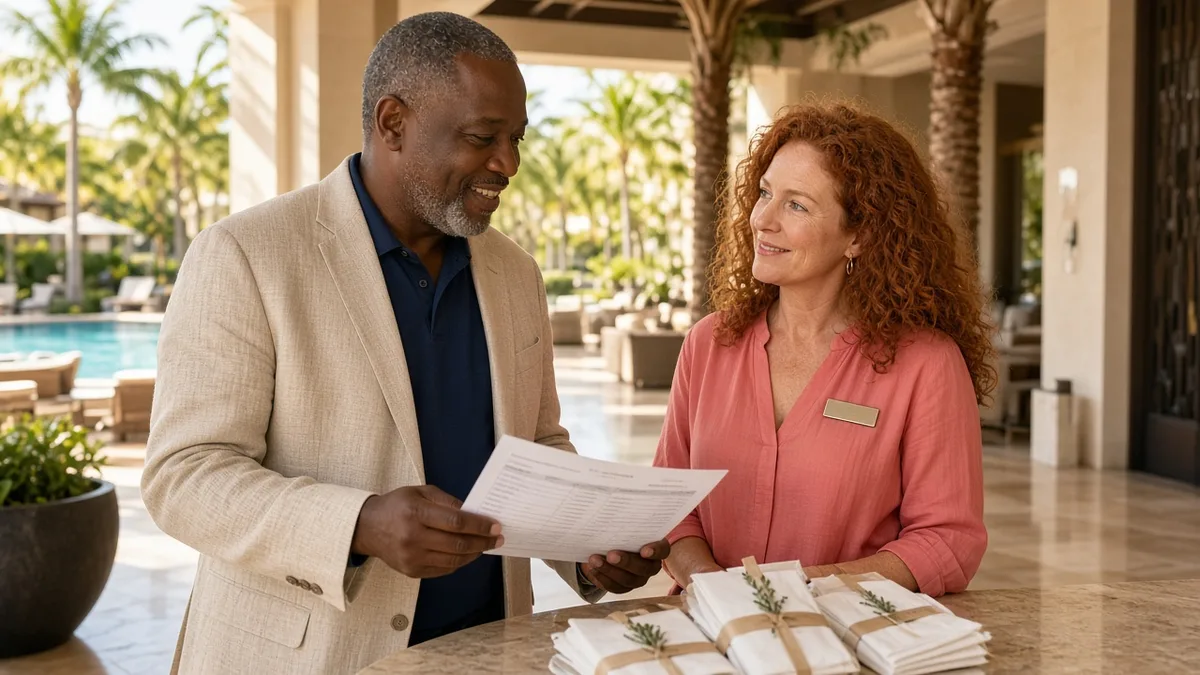
On an incentive, the destination and the hotel are part of the prize, so SITE stresses that the destination has to appeal to the people trying to qualify. Qualifiers may bring a guest, which changes your room mix. You also tend to contract the hotel before you know exactly who has qualified, so build that uncertainty into the room block size and its attrition terms. For incentive groups, greatEvent books hotel room blocks. For program design, budgets, and qualification rules, read our full guide on what incentive travel is and how companies plan it.
Conferences
APEX defines a conference as a participatory meeting designed for discussion, fact-finding, problem solving, and consultation, and notes that conferences are usually short, with specific objectives, and smaller than congresses or conventions. A convention, in APEX terms, is a gathering of delegates, representatives, and members of a membership or industry organization, with educational sessions, committee meetings, social functions, and governance business, and it typically recurs on a set schedule. Congress is the European term for a convention.
At a conference, attendees register and may book their own sleeping rooms in the block, and the organizer carries the attrition risk if those rooms go unbooked. APEX defines a group rate as the confirmed rate offered to attendees who book inside the group’s room block, and a cut-off date as the date the hotel releases unsold rooms to the public. Large conferences may need blocks at several hotels. Our guides on managing conference room blocks and room block attrition cover pickup and shortfalls. Booking windows grow with attendance, and our guide to how far in advance to book a conference venue gives ranges by size and city. You can also browse conference venues near you on greatEvent.
Exhibitions
APEX defines an exhibition as an event where products, services, or promotional materials are displayed to attendees visiting exhibits on the show floor, with a focus on business-to-business relationships. A trade show is an exhibition for members of a common or related industry and is not open to the general public. In North America, a large show is also called an exposition, or expo.
For an exhibition, you plan around hall size, the floor plan, freight, and move-in and move-out days, and you need rooms for two groups: exhibitor staff who arrive early to set up and attendees who come for the show days. Our guide on how to plan a trade show covers the timeline, venues, budget, and checklist. Convention centers and exhibit halls are bookable on greatEvent, and you can browse trade show venues near you.
MICE vs. business events vs. the meetings industry
SITE says there is no universally agreed name for this market and lists the meetings industry, MICE, business tourism, the C and I sector, business events, and the meetings and events industry as names in use. SITE also notes that MICE is widely used in Asia and Europe but often disliked in North America and Australia, where business events has gained currency, and that the UK prefers the meetings industry.
| Term | What it means | Who uses it |
|---|---|---|
| MICE | Meetings, incentives, conferences (or conventions), and exhibitions (or events) | Widely used in Asia and Europe, according to SITE; common on hotel and destination sales teams |
| Meetings industry | The same market, framed as an industry | SITE says the UK prefers it |
| Business events | MPI: meetings, conferences, conventions, exhibitions, and live experiences designed to achieve organizational or strategic objectives | SITE says it has gained currency in North America and Australia |
| Business tourism or MICE tourism | The travel side: trips taken to attend these events | SITE lists business tourism among the names in use for this market |
SITE adds that different destination marketing organizations favor different names and argue against the use of others. In practice, a US association client may say business events while a hotel brand’s international sales office says MICE, and both are describing the same work.
How hotels and venues treat MICE business
MICE in the hotel industry means group business, which hotels price and sell it differently from individual stays. STR, the hotel data firm, typically defines group rooms as 10 or more rooms per night sold under a signed agreement. HSMAI defines transient guests as those who book individually rather than with a group. Our guide to the hospitality industry for event planners explains how hotels make money on group business and who you talk to there.
When a hotel reviews your MICE inquiry, it weighs three things together:
- Sleeping rooms. APEX defines a room block as the total number of sleeping rooms used by and attributable to one event. The hotel looks at your block size, dates, rate, and pickup history.
- Meeting space. HSMAI’s space to group room ratio compares the meeting space a group needs with the sleeping rooms it books. A group that needs lots of space but few rooms is harder for a hotel to fit.
- Food and beverage. HSMAI defines a food and beverage minimum as the total catered spend a hotel requires, based on the meeting space and dates being held.
That balance explains why a meeting with a large ballroom and few rooms gets a different quote from an incentive group with many rooms and little meeting space. The contract terms to read closely are the cut-off date, attrition, and any concessions. APEX defines attrition as the difference between what the group actually uses and what it agreed to in the contract. Our guides on how to book a hotel room block and hotel contract concessions cover what to ask for.
Who you work with in MICE
| Partner | What they do for a MICE event |
|---|---|
| Hotels and resorts | Sell room blocks, meeting space, and catering through their group or event sales team |
| Venues, conference centers, and convention centers | License meeting and exhibit space and set building rules and exclusive services |
| Destination management company (DMC) | MPI describes a DMC as a local event partner that provides destination services such as transportation, offsite venues, staffing, and experiences |
| Destination marketing organization (DMO) or convention and visitors bureau (CVB) | APEX describes CVBs as nonprofit or local government bodies that promote their community through travel and tourism and help planners with information on local resources, services, and site selection |
| Event vendors | Caterers, photographers, florists, entertainment, and other services booked for the event |
A DMC can help when the program needs local services on the ground, such as an incentive trip in a city you don’t know well. Because APEX notes that CVBs help planners with site selection, a CVB is a useful call when you are comparing cities. For the full comparison, including when to call which, read our guide to DMC vs DMO vs CVB. If you want the wider view of how planners run events from brief to close-out, see what event management covers.
MICE comparison table
Use this table to explain the four segments to a client or a new team member. Group sizes and booking windows vary by city, season, and client, so treat this as working guidance.
| Segment | Main purpose | Typical group | Venue type | Room block pattern | Booking window | Deeper guide |
|---|---|---|---|---|---|---|
| Meetings | Inform, decide, or train | Company teams, boards, client groups | Hotel meeting rooms, boardrooms, conference centers | Small block or none | Varies; book once dates and headcount are firm | Corporate event planning |
| Incentives | Reward and motivate | Qualifiers, sometimes with a guest | Resort or upscale hotel | Contracted before final qualifier count | Set before the qualification period ends | Incentive travel |
| Conferences | Educate, discuss, network | Registered attendees, members | Conference hotel or convention center | Larger block, sometimes several hotels | About 6 to 18 months, by size and city, per our timeline guide | Conference booking timeline |
| Exhibitions | Show and sell products, B2B | Exhibitors and trade buyers | Convention center or exhibit hall | Exhibitor and attendee blocks | Often 12 to 24 months for larger shows, per the same guide | Trade show planning |
Find venues, vendors, and room blocks for MICE events on greatEvent
On greatEvent, you can see live inventory across hotels, convention centers, and venues, filter by event type, location, date, capacity, and distance, and compare real meeting room capacities side by side. For meetings, conferences, and exhibitions, book real-time availability instantly or send one detailed inquiry to multiple venues and get quotes back, then add vendors and a hotel room block in the same booking flow. For incentive groups, you can book the hotel room block.
There are no fees for planners. We pay you commission on any qualifying booking you make on greatEvent.
greatEvent serves all four MICE segments: meetings, incentives, conferences, and exhibitions.
Register as a professional planner
Frequently asked questions
What does MICE stand for?
▾
MICE stands for meetings, incentives, conferences, and exhibitions. Some sources use conventions for the C or events for the E. All versions describe group events held for a business or professional purpose.
What is MICE tourism?
▾
MICE tourism, also called business tourism, is travel to attend meetings, incentive trips, conferences or conventions, and exhibitions, as opposed to leisure travel.
What is the MICE industry?
▾
It is the market of venues, hotels, planners, and suppliers that serve business events. SITE notes that the UK prefers the term meetings industry and that business events has gained currency in North America.
What does MICE mean in the hotel industry?
▾
To a hotel, MICE is group business: room blocks, meeting space, and catering sold under a contract, handled by a group or event sales team and priced apart from individual stays.
What is the difference between MICE and incentive travel?
▾
Incentive travel is the I in MICE. It is the one segment built to reward and motivate people, while meetings and conferences usually aim to inform or educate.
Why do some organizations say business events instead of MICE?
▾
SITE notes that MICE is often disliked in North America and Australia, where business events has gained currency, and the UK prefers the meetings industry.
Research and sources
Sources were checked on November 3, 2026. The opening scenario is fictional. The venue, room block, and booking window notes are general working guidance, not results from a study.
- Events Industry Council, APEX glossary: meeting, conference, convention, congress, exhibition, exposition, trade show, room block, group rate, cut-off date, attrition, and convention and visitors bureau, insights.eventscouncil.org.
- Society for Incentive Travel Excellence (SITE), What is Incentive Travel, siteglobal.com.
- Meeting Professionals International (MPI), Event industry terminology and definitions (business events, incentive travel, destination management company), mpi.org.
- UNWTO, Global Report on the Meetings Industry, AM Reports Volume 7 (2014), e-unwto.org.
- STR (CoStar), STR glossary (group rooms), costar.com.
- HSMAI, Sales Acumen Glossary (transient, space to group room ratio), hsmai.org.
Compare vendors for your next event
Search caterers, photographers, florists, planners, and rentals — then send one request to several vendors at once.