Quick answer: A wedding reception timeline is the minute-by-minute schedule for the reception, from cocktail hour to the moment the last vendor leaves the building. The planner’s version is a run of show: every segment gets a start time, a length, the person who calls the cue, and what each vendor has to do. Build it backward from the venue’s hard stop, size the dinner block to the meal service style, and send each vendor the version they need.
Example scenario (fictional): A planner in Charlotte is running a Saturday reception for 160 guests at a hotel ballroom. The ceremony is in the same room, the dinner is plated, the couple wants three toasts and a sparkler send-off, and the hotel’s contract says the room must be empty by midnight. The couple’s first draft of the evening is a list of moments. The planner’s job is to turn that list into times, cue owners, and call times that the captain, the kitchen, the DJ, and the photographer all agree to before the day.
This is for professional wedding planners who run receptions for their clients. It covers the order of events, how long to plan for each segment, who owns each cue, vendor call times, the versions of the timeline each vendor needs, and a run-of-show template you can copy into your own documents.
In this guide:
- Wedding reception timeline at a glance
- Reception timeline, run of show, and BEO
- Start from the venue’s hard stop
- The reception order of events, segment by segment
- Who owns each cue
- Vendor call times
- One timeline, a version for each vendor
- Copyable reception run-of-show template
- When the timeline slips
- When to draft, send, and confirm it
- FAQ
Wedding reception timeline at a glance
The sample below is an evening reception with a plated dinner, a cocktail hour while the ceremony space is turned, and a midnight hard stop. Treat it as a starting point. The times and lengths are planning guidance for this example, not industry averages, and your own timeline should follow the venue contract, the menu, and what the couple actually wants in the evening.
| Start | Segment | Plan for | Cue owner | What the vendors need to know |
|---|---|---|---|---|
| 5:30 PM | Cocktail hour | 60 minutes | Catering captain | Bars and passed food open as the ceremony ends. The room flip happens behind closed doors. |
| 6:30 PM | Guests seated | 15 minutes | DJ or band, captain | Doors open on the planner’s call. Bars close or move inside. |
| 6:45 PM | Grand entrance and first dance | 15 minutes | DJ or band, photographer | Wedding party lined up in order by 6:40. Photographer in position before the first name is called. |
| 7:00 PM | Welcome and dinner | 75 minutes | Captain, kitchen | Welcome or blessing first, then service. Toasts start once the main course is on every table. |
| 8:15 PM | Parent dances and open dancing | 75 minutes | DJ or band | Photo and video teams eat before this block so they are back for the dances. |
| 9:30 PM | Cake and dessert | 15 minutes | Captain, photographer | Cake knife, plates, and servers staged by 9:15. Dessert goes out right after the cut. |
| 9:45 PM | Dancing | 60 minutes | DJ or band | Last-call warning to the bar 30 minutes before the bar closes. |
| 10:45 PM | Last dance and send-off | 15 minutes | Planner, photographer | Send-off items handed out during the last dance. Guests guided to the exit. |
| 11:00 PM | Load-out | 60 minutes | Planner, all vendors | Music off. Personal items, gifts, and rentals out before the midnight hard stop. |
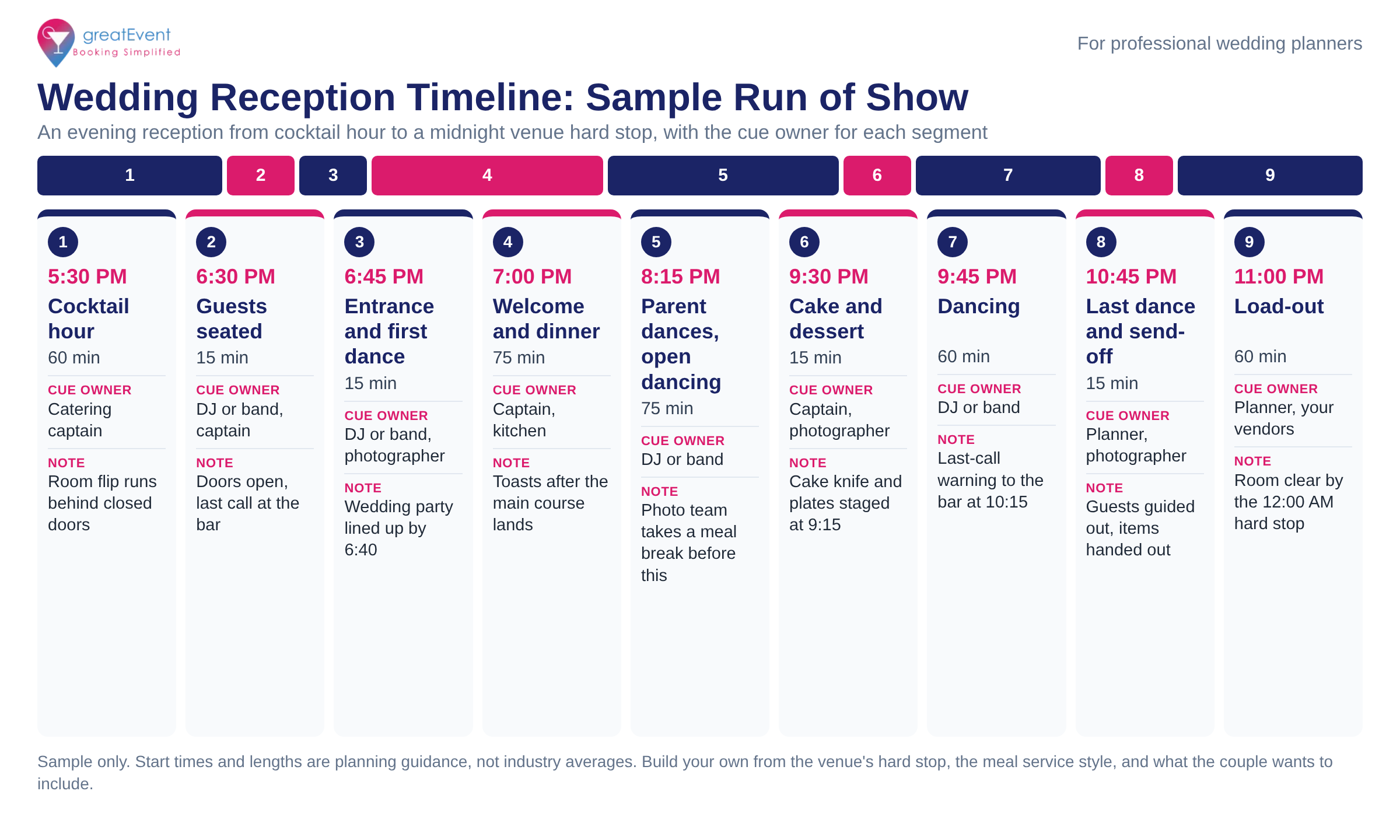
Text version of the infographic:
- 1. 5:30 PM, Cocktail hour. Plan for 60 min. Cue owner: Catering captain. Note: Room flip runs behind closed doors.
- 2. 6:30 PM, Guests seated. Plan for 15 min. Cue owner: DJ or band, captain. Note: Doors open, last call at the bar.
- 3. 6:45 PM, Entrance and first dance. Plan for 15 min. Cue owner: DJ or band, photographer. Note: Wedding party lined up by 6:40.
- 4. 7:00 PM, Welcome and dinner. Plan for 75 min. Cue owner: Captain, kitchen. Note: Toasts after the main course lands.
- 5. 8:15 PM, Parent dances, open dancing. Plan for 75 min. Cue owner: DJ or band. Note: Photo team takes a meal break before this.
- 6. 9:30 PM, Cake and dessert. Plan for 15 min. Cue owner: Captain, photographer. Note: Cake knife and plates staged at 9:15.
- 7. 9:45 PM, Dancing. Plan for 60 min. Cue owner: DJ or band. Note: Last-call warning to the bar at 10:15.
- 8. 10:45 PM, Last dance and send-off. Plan for 15 min. Cue owner: Planner, photographer. Note: Guests guided out, items handed out.
- 9. 11:00 PM, Load-out. Plan for 60 min. Cue owner: Planner, your vendors. Note: Room clear by the 12:00 AM hard stop.
Reception timeline, run of show, and BEO
Couples usually think of the reception timeline as the order of the fun parts. For you it is three documents that have to agree. The timeline is the order and timing of the evening. The run of show adds the detail behind each line: who calls the cue, who acts on it, where people stand, and what is staged. The banquet event order, or BEO, is the venue’s own record. The Events Industry Council’s APEX glossary defines a banquet event order as “a form most often used by hotels to provide details to personnel concerned with a specific food and beverage function or event room set-up.”
The BEO is where the venue writes down service times, room set, and menu, so the run of show and the BEO need the same times. If the two disagree, expect the banquet staff to work from the BEO. Our guide on what a BEO is and what goes in it covers that document in detail, and the event logistics checklist explains how a run of show and a vendor arrival schedule fit together on any event.
If the couple is still mixing up the two parts of the day, our explainer on the wedding ceremony vs. reception is a simple link to send them.
Start from the venue’s hard stop
Build the reception timeline backward from the time the venue needs the room empty. That time is in the contract, and it is the one time on the night you cannot move. Before you place a single dance, confirm these with the venue in writing:
- The contracted end time and whether it means “music off” or “room clear.”
- The last time vendors can load out, and which dock, door, or elevator they use.
- Any noise or amplified music cutoff, especially for outdoor spaces.
- When the bar must close, and whether the venue requires a last call.
- Whether another event is booked in the space that night or early the next morning.
- Overtime terms, if the couple wants to extend, and who has authority to approve them on the night.
Then work backward. Leave a load-out window after music off, put the send-off right before it, and place the cake and the last big dance set before that. Whatever time is left between the grand entrance and the cake is the room you have for dinner, toasts, and dancing. If the numbers don’t fit, you want to find that out in a planning meeting, well before 11:40 PM on the night. When you are still choosing the venue, ask for these terms up front. Our wedding venue sourcing brief template has a place for them, and the proposal comparison template lets you compare end times side by side.
The reception order of events, segment by segment
The order below is common at US receptions, but nearly every segment can move. Some couples do the first dance right after the entrance. Others save it for the start of open dancing. Wherever a segment lands, give it a time, a length, and a named owner, and keep every vendor on the same version.
Vendor arrival and setup
Setup isn’t on the guest schedule, but it belongs at the top of the run of show. List each vendor’s arrival time, load-in door, and the time they must be finished. Florists and rentals usually need the room first, the cake often arrives once the room is cool and set, and the DJ or band needs to be set and quiet before guests can walk past. Give the venue the full list so the loading dock and the service elevator are ready.
Cocktail hour and the room flip
Cocktail hour covers two jobs at once. Guests get drinks and food, and if the ceremony and reception share a room, the staff turn the room from ceremony rows to dinner tables. Plan the flip with the captain before the day: how many staff, where the ceremony chairs go, and who tells you when the room is ready. Keep the doors closed until you get that call. Photographers often use this hour for family and couple portraits, so the shot list and the cocktail hour have to fit inside the same window.
Guests seated and the grand entrance
Moving a crowd from the bar to their seats takes longer than most couples expect. Give it its own line on the timeline, and ask the DJ or band to make the call while the captain’s team opens the doors and closes or moves the bars. Line up the wedding party in entrance order a few minutes before the first name is called, and check the pronunciation of every name with the emcee in advance. The photographer needs to be at the entrance point before anyone walks in.
Welcome, blessing, and the first dance
A short welcome from a parent or the couple, and a blessing if the families want one, usually happens before the first course. Some couples move straight from the entrance into the first dance while everyone is already standing and watching. Put the song title, the start point, and the planned length on the DJ’s version of the timeline so a three-minute song doesn’t run to five.
Dinner service
Dinner is the block that most changes with the menu, so get the length from the caterer. The service style drives it. APEX describes plated service as food “arranged on individual plates in the kitchen and then served to guests seated at a table,” and family-style service as platters and bowls set on the tables for guests to pass and serve themselves. The table below is planning guidance on how each style tends to affect the timeline. Confirm the actual length with your caterer and put it on the BEO.
| Service style | How it affects the timeline (planning guidance) | Ask the caterer |
|---|---|---|
| Plated | The most predictable block. Courses go out in waves, so the toasts can be placed between courses. | How many courses, how long between them, and how many servers per table. |
| Family-style | Similar to plated, but refills and clearing take extra time. | How refills are handled and when platters are cleared. |
| Buffet | Guests release table by table, so the length grows with the guest count. | How many lines, and who releases the tables. |
| Food stations | Guests eat at different paces, so it is harder to find a moment when everyone is seated. | When the stations close, and where the toasts fit while people are still up. |
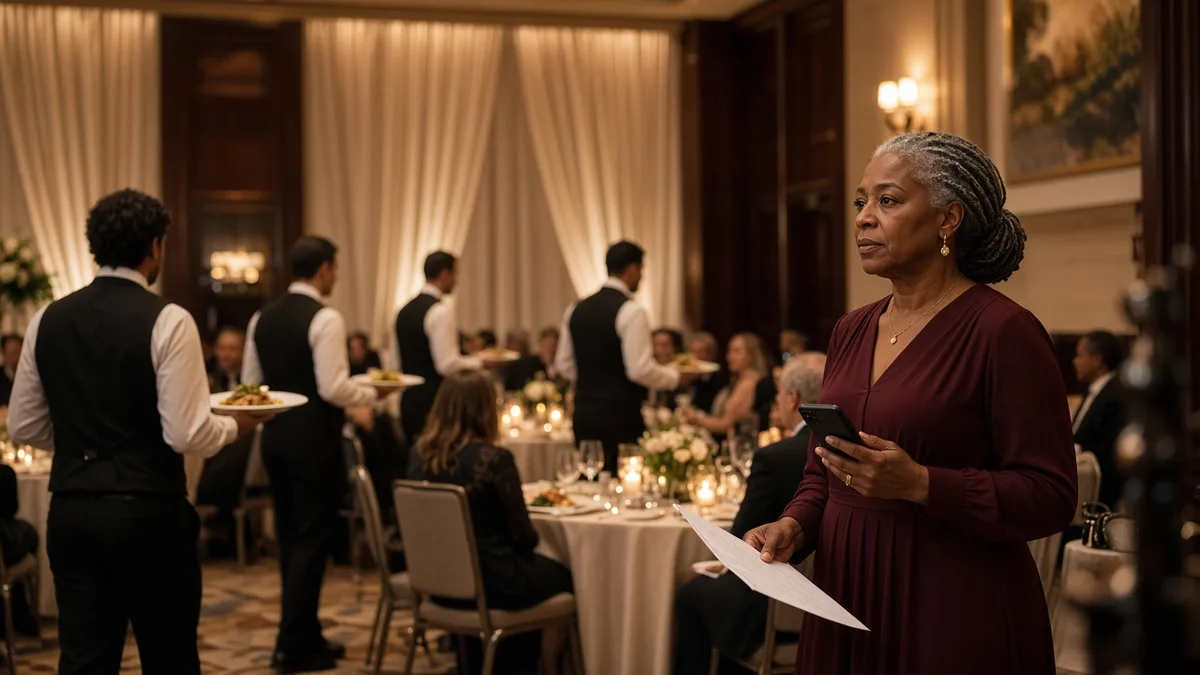
Schedule meals for your vendors too. Photographers, videographers, the DJ or band, and your own team usually eat while guests eat, so they are back at work for the toasts and the first open dance. Confirm the count of vendor meals with the caterer, and put it on the BEO.
Toasts
Toasts often run long. Agree with the couple on how many there will be, who gives them, and in what order, then tell each speaker the length you have planned. Many planners place the toasts once the main course is on every table, so guests are seated and the kitchen isn’t trying to serve over speeches. The emcee calls each speaker by name, and the captain holds service until the last toast ends. Send the best man or maid of honor our marriage toast tips along with their time limit.
Parent dances and open dancing
Parent dances often open the dance floor, with the DJ or band inviting everyone up right after. Some couples combine the parent dances into a single song to save time. Put the songs, the order, and who dances with whom on the DJ’s sheet, and give the photographer the same list. Leave the open dance blocks long and simple. They are where you recover time if dinner or the toasts run over.
Cake cutting and dessert
The cake cutting is short, but it needs staging: a cake knife and server, plates, napkins, and staff ready to take the cake to the kitchen right after the cut. Schedule it when the dance floor is busy, and you keep the energy in the room. Agree with the caterer whether dessert goes out right after the cut or as a later station, and who cuts and serves the cake.
Optional traditions
The bouquet and garter toss, an anniversary dance, a money dance, cultural traditions, or a surprise performance can all fit into the open dance blocks. List each one the couple wants with a set time, or mark it as “if time allows” so the DJ knows what to drop if the evening runs behind. If a tradition needs family members in place, name a person who brings them to the floor.
Last dance and send-off
The send-off is a timed segment with its own logistics. Confirm what the venue allows, especially for sparklers, petals, or confetti, and where the exit is. Hand out the items during the last dance, line guests up outside or along the exit, and cue the photographer before the couple walks out. If you need ideas the venue will approve, see our list of wedding send-off ideas. Some couples do a private last dance once guests leave the room. If so, put it on the timeline so the staff don’t start clearing in the middle of it.
After-party and load-out
If there’s an after-party at a hotel bar or a second space, put its start time and location on the guest-facing schedule and confirm the space with the venue. Then plan the load-out like a segment of its own. Name who collects gifts and cards, personal items, leftover cake, and any decor the couple keeps. Give each vendor a load-out time and door, and walk the room with the venue manager before you leave. Some planners also share a short guest-facing reception schedule with the wedding party so they know where the after-party is.
Who owns each cue
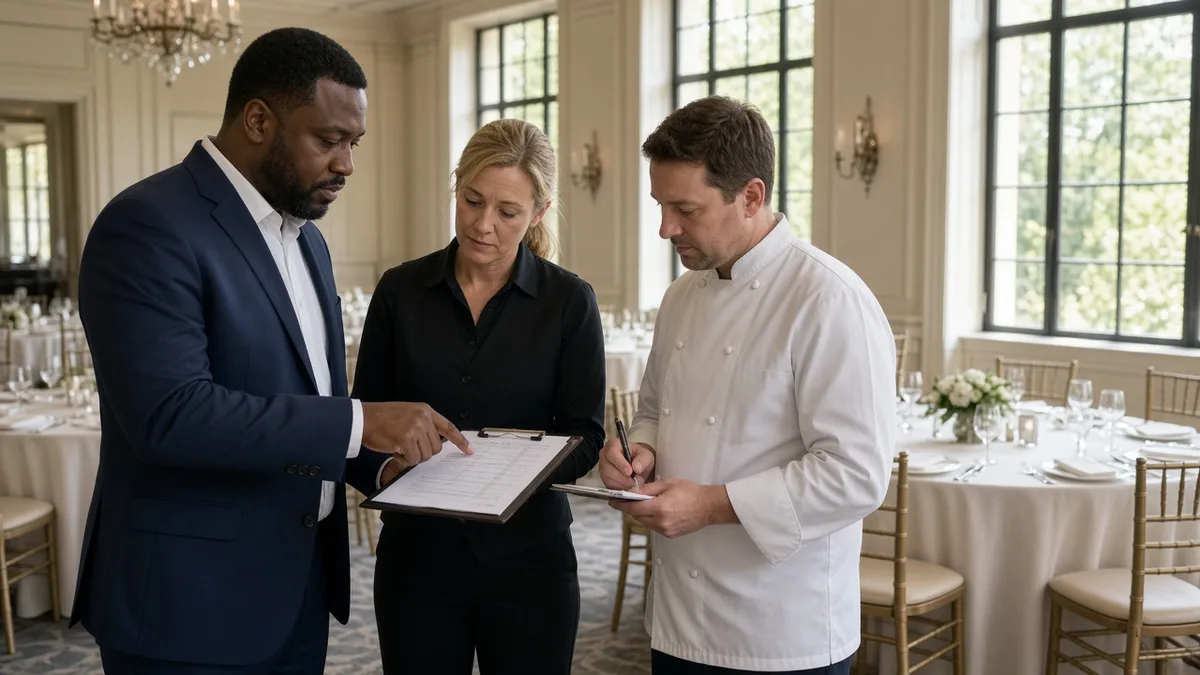
Every cue needs one person who calls it and one person who confirms it happened. When everyone assumes someone else is watching the clock, segments start late. Name the owners in the run of show and talk them through it at the vendor walkthrough.
| Cue | Called by | Acted on by | Confirms back to |
|---|---|---|---|
| Room is ready, doors open | Captain | Venue staff | Planner |
| Guests to seats | DJ or band (emcee) | Captain’s team | Planner |
| Wedding party lined up | Planner or assistant | Wedding party | DJ or band |
| Grand entrance and first dance | DJ or band (emcee) | Couple, photographer | Planner |
| Start dinner service | Planner | Captain, kitchen | Planner |
| Each toast | DJ or band (emcee) | Speaker, photographer | Captain (hold service) |
| Cake cutting | Planner | Captain, photographer, DJ | Planner |
| Last call | Captain | Bar staff | Planner, DJ |
| Send-off | Planner | Guests, photographer, DJ | Planner |
| Music off and load-out | Planner | All vendors | Venue manager |
Vendor call times
A call time is when each vendor must be on site and ready, which is usually earlier than when they start working in front of guests. Confirm load-in times with the venue, then ask each vendor how much setup time they need. The table lists what to confirm. It doesn’t give times because setup varies so much by vendor, room, and scale.
| Vendor | Confirm with them | Confirm with the venue |
|---|---|---|
| Florist and decor | Setup and strike time, items that stay or leave | Load-in door, when the room is free |
| Rentals | Delivery and pickup windows | Whether rentals can stay overnight |
| Caterer (if not the venue) | Kitchen access, staff arrival, vendor meals | Kitchen and storage rules |
| Cake | Delivery time and who sets it up | Where it is stored and displayed |
| DJ or band | Setup, quiet time before guests, song lists | Power, the music cutoff, load-out route |
| Photographer and videographer | Arrival, shot list, meal break | Where they can stand during service |
| Officiant (same-site ceremony) | Arrival and rehearsal notes | Ceremony room timing |
| Transportation | Pickup times, addresses, contact on the day | Where vehicles can wait |
One timeline, a version for each vendor
Keep one master run of show, and give everyone else a version of it. A single long document sent to everyone gets skimmed, and the line that matters to the DJ ends up buried under the florist’s load-in notes. Each version comes from the master, so if a time changes you update it once and resend.
| Version | Who gets it | What to include |
|---|---|---|
| Master run of show | You and your team | Every line: times, cues, owners, contacts, staging, and contingencies. |
| Venue and captain | Venue manager, banquet captain | Room flip, door times, service times, bar times, vendor meals, load-out, hard stop. |
| Catering | Caterer or kitchen lead | Service start, course timing, toast holds, cake cut, dessert, vendor meal count. |
| DJ or band | DJ, band leader, emcee | Every announcement with names, songs and start points, the dance order, the music cutoff. |
| Photo and video | Photographer, videographer | Must-have moments with times, family groupings, and their meal break. |
| Wedding party and family | Wedding party, parents, speakers | Where to be and when, the entrance order, and toast order and length. |
Send each vendor their version with the master attached, so they can see where their cues sit in the evening. Ask every vendor to reply with any time they can’t meet. Track the replies, because a vendor who never responded hasn’t agreed to anything. Once the run of show is final, your vendors and suppliers all work from the same times.
Copyable reception run-of-show template
Copy this into a document or spreadsheet and fill in the blanks for each wedding. The example times match the sample at the top of this guide. Replace them with your own.
RECEPTION RUN OF SHOW
Couple: ______________________   Date: ____________
Venue: ______________________   Room: ____________
Venue contact on the day: __________________   Phone: ____________
Planner on the day: __________________   Phone: ____________
Hard stop (room clear): ________   Music off: ________   Bar closes: ________
Guest count: ______   Vendor meals: ______   Service style: ______

VENDOR CALL TIMES
Vendor           | Arrive | Load-in door | Ready by | Load-out by | Contact
Florist/decor    |        |              |          |             |
Rentals          |        |              |          |             |
Caterer          |        |              |          |             |
Cake             |        |              |          |             |
DJ or band       |        |              |          |             |
Photographer     |        |              |          |             |
Videographer     |        |              |          |             |
Transportation   |        |              |          |             |

RECEPTION TIMELINE
Time     | Segment                  | Length | Called by  | Acted on by         | Notes
5:30 PM  | Cocktail hour            | 60 min | Captain    | Bar, passed food    | Room flip behind closed doors
6:30 PM  | Guests seated            | 15 min | Emcee      | Captain's team      | Bars close or move inside
6:45 PM  | Entrance and first dance | 15 min | Emcee      | Couple, photo       | Song: ________ Start: ____
7:00 PM  | Welcome and dinner       | 75 min | Planner    | Captain, kitchen    | Welcome by: ________
____     | Toasts                   | ____   | Emcee      | Speakers            | Order: ________ Length each: ____
8:15 PM  | Parent dances, dancing   | 75 min | Emcee      | DJ or band          | Songs: ________
9:30 PM  | Cake and dessert         | 15 min | Planner    | Captain, photo      | Knife, plates staged by ____
9:45 PM  | Dancing                  | 60 min | Emcee      | DJ or band          | Optional traditions: ________
10:45 PM | Last dance and send-off  | 15 min | Planner    | Guests, photo       | Items: ________ Exit: ________
11:00 PM | Music off, load-out      | 60 min | Planner    | All vendors         | Gifts, cards, personal items to: ____

IF WE RUN LATE, CUT IN THIS ORDER
1. ______________________
2. ______________________
3. ______________________

SIGN-OFF
Couple approved: ________   Venue confirmed: ________   Final sent to all vendors: ________
When the timeline slips
Receptions often run behind at some point. Decide with the couple before the day what moves and what gets cut, so you aren’t asking them to make a call in the middle of their reception.
- If portraits or the room flip make cocktail hour run long, hold the doors and shorten the first open dance block. Leave dinner service at its planned length.
- If the toasts run over, have the emcee give each speaker a quiet wrap-up signal, and take the time back from open dancing.
- If dinner runs late, check with the captain before you move the parent dances or the cake, since the kitchen’s timing comes first.
- For an outdoor cocktail hour or send-off, name the indoor backup space and the time by which you will make the weather call.
- If the couple wants to extend, you need the venue’s overtime terms and the name of whoever approves them in hand already. Tell every vendor at once if the end time moves, because their own contracts may end earlier.
Put the cut list at the bottom of the run of show, in order. If you are 20 minutes behind at 9:00 PM, everyone already knows what goes first.
When to draft, send, and confirm it
The reception timeline is one of the last documents in the planning year, but it starts early. In our 12-month wedding planning timeline, the day-of timeline is drafted a few months out and signed off with the seating chart, and the final run of show goes to every vendor the week of the wedding. A workable rhythm looks like this:
- When you book the venue, record the hard stop, load-out rules, and music cutoff.
- Once the main vendors are booked, draft the timeline and send it to them for comments.
- After the final menu and the final guest count, confirm the dinner block with the caterer and update the BEO to match.
- Walk the venue with the captain and the main vendors, and agree on cue owners.
- In the week of the wedding, send the final versions and collect a reply from every vendor.
- On the day, bring printed copies for the captain, the emcee, and your team.
If guests are traveling in, the hotel room block affects the reception too, since guests often head back to the hotel once the music stops. Our guide on how to block hotel rooms for a wedding covers the room block side. For the notes you send the couple once it’s over, see our wedding card messages for planners.
Find reception venues and vendors on greatEvent
A good reception timeline starts with a venue whose end time, load-out rules, and service style fit the evening the couple wants. On greatEvent, planners can search venues for weddings and social events and find event vendors such as caterers, photographers, videographers, DJs, florists, and cake makers. You can send one detailed inquiry to multiple venues and get quotes back, then add services and a hotel room block. Start with wedding venues near you, or read our guide to comparing wedding venues near you.
There are no fees for planners. We pay you commission on any qualifying booking you make on greatEvent.
Register as a professional planner
Frequently asked questions
What is a wedding reception timeline?
▾
It is the schedule for the reception, from cocktail hour to load-out. A planner’s version is a run of show that adds the cue owner, the vendors involved, and staging notes for each segment.
What is the usual order of events at a wedding reception?
▾
A common US order is cocktail hour, guests seated, the grand entrance, the first dance, a welcome, dinner, toasts, parent dances, open dancing, the cake cutting, the last dance, and the send-off. Most segments can move to fit the couple.
How long is a typical wedding reception?
▾
There is no fixed length. It depends on the venue contract and the couple’s plans. As planning guidance, allow about four to five hours including cocktail hour, then build backward from the venue’s hard stop and leave time for load-out.
When should toasts happen at a reception?
▾
Many planners place toasts once the main course is on every table, so guests are seated and service can pause. Agree on the number of speakers and the length of each toast in advance.
Who should get a copy of the reception timeline?
▾
Everyone working the reception: the venue manager and captain, the caterer, the DJ or band, the photographer and videographer, the wedding party, and the speakers. Give each one a version with their own cues.
When should a planner send the final reception run of show?
▾
Send the final version in the week of the wedding, after the final guest count and the venue walkthrough, and ask each vendor to confirm it in writing.
Research and sources
Sources were checked on November 3, 2026. The opening scenario is fictional. The sample times, segment lengths, and service-style notes are planning guidance for an example reception, not industry averages or study results.
- Events Industry Council, APEX glossary: banquet event order (BEO), plated service, and family-style service, insights.eventscouncil.org.
Compare vendors for your next event
Search caterers, photographers, florists, planners, and rentals — then send one request to several vendors at once.