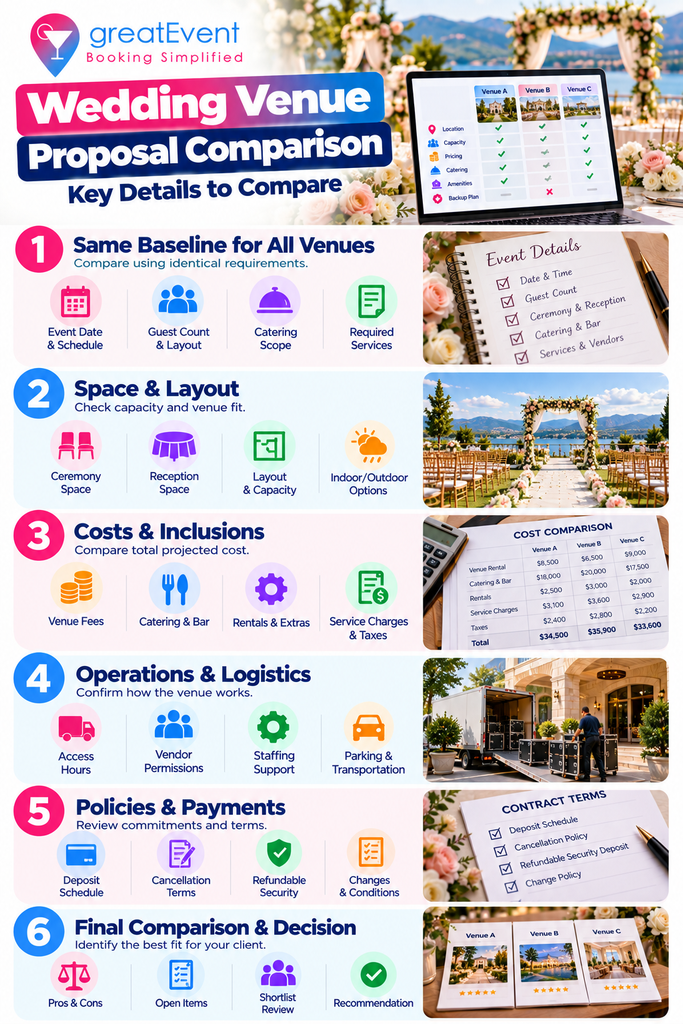
Quick answer: Price the same guest count, event schedule, spaces, catering scope and required services at every property. Then compare total projected cost, operational fit, payment commitments and unresolved conditions. Record where each answer came from before you recommend anything.
What you are producing is a recommendation your client can approve, not a spreadsheet. A lower rental fee often arrives with separate furniture, staffing or backup-space costs attached. A pricier package may include all of that and still miss a setup window your florist cannot work without.
Use this after venues have responded to your sourcing brief. It works with a written proposal, a package quote, or documented booking details. Not every booking needs a formal RFP. Every booking needs enough confirmed information to compare options fairly.
What a venue proposal comparison should include
The quoted scope, an estimate for the same requirements at each venue, the essential operational checks, payment dates, and a written recommendation. Keep the unresolved questions visible.
An empty price field means unknown. It does not mean free, and the moment anyone treats it as free your comparison is wrong.
Public venue policies show why this takes care. The Alexander in Indianapolis separates its food and beverage minimum from service charges, taxes and other fees, and its FAQ explains how a minimum-spend shortfall gets charged. [1] Those are that property’s terms. Every proposal needs its own calculation.
Start with one approved baseline
Before you fill in a single venue column, write down the assumptions every option will be measured against:
- Client or project ID, event date, adult and child guest counts, vendor meals, and the same attendance scenario for every venue
- Named ceremony, reception and backup spaces; meal and bar scope; seating layout; entertainment footprint; required accessibility arrangements
- Vendor arrival, setup, rehearsal, guest access, event end, breakdown and final pickup times
- The client-approved budget for the costs being compared, required items, optional upgrades, and who is authorized to approve a change
Label that budget precisely. A venue-and-catering comparison is not the whole wedding budget, and presenting it as one will come back at you later. Wedding venue costs and the average wedding cost for 2026 are useful for framing what sits outside this scope. Add other supplier expenses only where they fall inside the agreed scope or change because of the venue choice.
A copyable comparison template
Duplicate the venue column for each property. In every cell, record the answer, the source document or email date, and the status: confirmed, estimated, pending, or not applicable. Use exact document versions for revised quotes.
| Comparison field | Venue A | Venue B |
|---|---|---|
| Quote reference and validity | [Version; expires] | [Version; expires] |
| Date and named spaces | [Availability; hold terms] | [Availability; hold terms] |
| Layout and usable capacity | [Approved setup; count] | [Approved setup; count] |
| Access and event hours | [Setup through pickup] | [Setup through pickup] |
| Weather backup | [Space; capacity; cost] | [Space; capacity; cost] |
| Venue and ceremony fees | [$; inclusions] | [$; inclusions] |
| Catering and bar | [$; counts; service hours] | [$; counts; service hours] |
| Minimum spend and shortfall | [$; eligible spend; terms] | [$; eligible spend; terms] |
| Service charges and taxes | [Rate; base; amount] | [Rate; base; amount] |
| Rentals and required extras | [$; quantities; delivery] | [$; quantities; delivery] |
| Outside vendor permissions | [Approval; fees; restrictions] | [Approval; fees; restrictions] |
| Staffing and facility support | [Responsibilities; hours] | [Responsibilities; hours] |
| Total for the agreed scope | [$; outstanding estimates] | [$; outstanding estimates] |
| Initial payment and later dates | [$; credit; due dates] | [$; credit; due dates] |
| Refundable security deposit | [$; return conditions] | [$; return conditions] |
| Cancellation and changes | [Schedule; relevant clauses] | [Schedule; relevant clauses] |
| Essential requirements | [Pass; pending; fail] | [Pass; pending; fail] |
| Open items and owner | [Question; owner; deadline] | [Question; owner; deadline] |
Keep the supporting quotes and floor plans attached. Summarize the decision in your approval section rather than handing the client a stack of supplier documents and hoping they interpret them the way you would.
How to compare the total cost
Build an itemized total from the confirmed package or rental price, then add the required exclusions, applicable fees and taxes. Show optional upgrades separately. Where a package already covers an item, do not add its standalone price on top.
Comparable projected cost =
    venue and package charges
  + required costs outside the package
  + any contractual minimum-spend shortfall
  + applicable service charges and taxes
  - confirmed credits or discounts
Apply every percentage to its stated base. Ask the venue for an itemized calculation showing whether taxes apply to service charges, and which items count toward a minimum.
A food and beverage minimum is a spending threshold, not a line item. Adding the entire minimum on top of food you have already counted overstates the total, and it is the single most common error in these comparisons. Confirm how the property treats a shortfall. How a food and beverage minimum works against room rental covers the mechanics.
“Service charge” needs its own explanation too. Ask what it pays for, whether gratuity is inside it, and whether anything separate is expected. Keep a voluntary gratuity allowance away from mandatory venue charges.
Worked example on the same scope
Illustrative figures, not market averages or live quotes. Both options cover 150 adult guests, the same dinner and bar scope, ceremony and reception spaces, the required access hours, and a usable indoor backup. Assume every required cost has been identified.
| Cost for the agreed scope | Venue A | Venue B |
|---|---|---|
| Venue fee or package subtotal | $24,000 | $28,000 |
| Required rentals and staffing excluded above | $5,000 | $1,000 |
| Service charges and taxes confirmed by supplier | $4,800 | $4,500 |
| Comparable projected cost | $33,800 | $33,500 |
| Client budget for this scope | $35,000 | $35,000 |
| Budget remaining | $1,200 | $1,500 |
Venue B opens $4,000 higher and lands $300 lower. That is the entire argument for comparing totals rather than headline figures.
It is also only a cost comparison. The recommendation still turns on confirmed capacity, permissions, access and commercial terms, and any one of those can outrank a $300 difference.
Cost and cash required are different things
A booking payment credited against the contract total is part of that total, not an extra expense. Track its due date separately. A refundable security deposit belongs in the cash schedule: show the amount and the return conditions without carrying the whole deposit as expected final cost.
If a required price is missing, mark the total provisional. Add a documented estimate or a stated range, and name someone to chase the real number. Never rank an incomplete proposal as the cheapest because its missing lines are blank. That is how a venue wins on paper and loses in week six.
Operational differences that can change the recommendation
Check the venue can actually deliver the agreed plan before anyone assigns preference scores. A capacity figure on a sales page may describe a layout you are not using. Request a plan showing the real tables, dance floor, entertainment area and circulation.
Confirm the backup space and who resets it
Record the named backup space, its usable capacity, reservation status, activation deadline, and any reset labor or equipment cost. Identify who makes the call to move indoors and who physically carries it out.
The Alexander states that outdoor backup space must be blocked and agreed. Jacob’s Pillow describes indoor ceremony backup as included in its agreement. [1][2] Two different arrangements, both reasonable, neither safe to assume at the next property.
Price the whole access window
Compare first vendor access through final removal. A reception end time tells you nothing about how long vendors may keep working. Jacob’s Pillow lists supplementary charges for extended access and work beyond the contracted scope. [2] Ask for a schedule your production, rental, catering and transport suppliers can genuinely meet.
Check supplier permissions before assuming a choice exists
Record catering, bar, rentals, entertainment and production restrictions separately. The Henry Ford permits specified outside specialty vendors while restricting other supplied items and requiring approved access times. [3] “Outside vendors allowed” does not answer whether your client’s caterer can work there.
Record who handles room resets, furniture placement, deliveries, cleanup and facility issues. Compare that against your own planning agreement, because whatever the venue does not cover becomes staffing you need to price before the client approves anything. What event planners charge is a useful reference when that scope shifts.
How to score the proposals
Essential requirements come first: confirmed date, workable layout, required access, budget feasibility, necessary vendor permissions, and any nonnegotiable backup or accessibility arrangement. Mark each one pass, pending or fail.
An unresolved essential makes the recommendation conditional. A strong score cannot rescue a failed requirement, and presenting one that way puts your judgment on the line rather than the venue’s.
For venues that pass, an optional weighted score documents client preferences. These weights are an editorial starting point, not an industry standard. Agree them with the client before you score anything.
| Preference category | Weight | What to assess |
|---|---|---|
| Total cost and inclusion value | 35% | Value within the agreed scope |
| Operational fit | 25% | Access, layout and supplier coordination |
| Guest experience and design fit | 20% | Client priorities beyond essential needs |
| Commercial flexibility | 20% | Payments, changes and relevant terms |
Rate each category 1 to 5 with a documented reason. Multiply each rating by its weight and add the results for a score out of 5. Leave unknowns unscored until they resolve, and do not present a partial score as a final ranking.
What to send the client for approval
Give them the comparable total, the reason for your recommendation, the tradeoff that matters most, and the next payment or deadline. Attach the comparison and the exact proposal versions, so the approval is tied to the offer they actually reviewed.
Recommended venue and proposal version: [name, reference, date]
Approved scope: [spaces, date, counts, services, access hours]
Projected cost: [$], including [items]; excluding [items]
Unconfirmed estimates: [amounts and basis]
Reason for recommendation and tradeoff: [specific comparison]
Conditions to resolve before booking: [item, owner, deadline]
Initial payment and future commitments: [amounts and dates]
Quote or hold expiration: [date, time, time zone]
Client decision: [approve / approve subject to conditions /
                  request revision / decline]
Authorized approver: [name and date]
Check that the final booking documents match the approved scope and amounts. If a revision changes a material inclusion, price or obligation, update the comparison and get approval again. Your client approving your recommendation does not reserve anything.
Running the same exercise for a corporate client? The hotel proposal comparison template for corporate meetings covers the same method with meeting-specific cost categories.
Build a shortlist with greatEvent
Explore venues and service providers through greatEvent, then use this template to review the options with your client. [4] Confirm property-specific availability, inclusions and booking terms before committing. If you are earlier in the process, how to choose a wedding venue covers the broader selection stage. [5]
Research and sources
Primary sources reviewed October 8, 2026. The cited venues publish their own fee, access, supplier and backup arrangements, and no property-specific rate here is presented as a national benchmark. The template, the cost formula, the scoring weights and the approval record are editorial planning tools rather than an industry standard.
[1] The Alexander, Wedding FAQs. Minimum-spend exclusions, shortfall treatment and backup-space arrangements.
[2] Jacob’s Pillow, Hosted Event Guidelines and Policies. Extended access, additional labor and included indoor ceremony backup, used as a property-specific example.
[3] The Henry Ford, Wedding FAQs. Outside specialty vendor permissions, restricted supplied items and approved vendor access.
[4] greatEvent, How It Works. Public platform description and service limitations, and the basis for the discovery link above.
[5] greatEvent, How to Choose the Perfect Wedding Venue. The broader selection guide, used here to keep this article scoped to evaluating written offers.
Frequently Asked Questions
How many wedding venue proposals should a planner compare? ▾
Enough viable options to give the client a meaningful choice. Two or three works as a practical starting point when they all meet the brief, but there is no universal minimum. A highly specific location, date or vendor requirement can leave you with fewer genuinely suitable venues.
How do you compare an inclusive package with a venue rental? ▾
List the same required services for both, then add the missing catering, rentals, staffing and access costs to the rental option. Check quantities and service hours inside the package before you accept it as equivalent, then compare totals including applicable charges and taxes.
Should a planner recommend the venue with the lowest price? ▾
Recommend the one that best meets the approved requirements and client priorities at an acceptable total cost. A lower price only means something once the comparison covers the required scope and the venue can deliver it.
What if a venue has not confirmed a required fee? ▾
Mark it pending, name who is responsible for confirming it, and set a deadline. Show the estimate explicitly. Keep the recommendation conditional while the missing amount could still change the client’s decision.
Is a proposal the same as a confirmed booking? ▾
Check the venue’s stated booking process and documents. Record the required acceptance, agreement and payment steps, plus any hold deadline. Get written booking confirmation rather than assuming a proposal holds the space.
Compare vendors for your next event
Search caterers, photographers, florists, planners, and rentals — then send one request to several vendors at once.