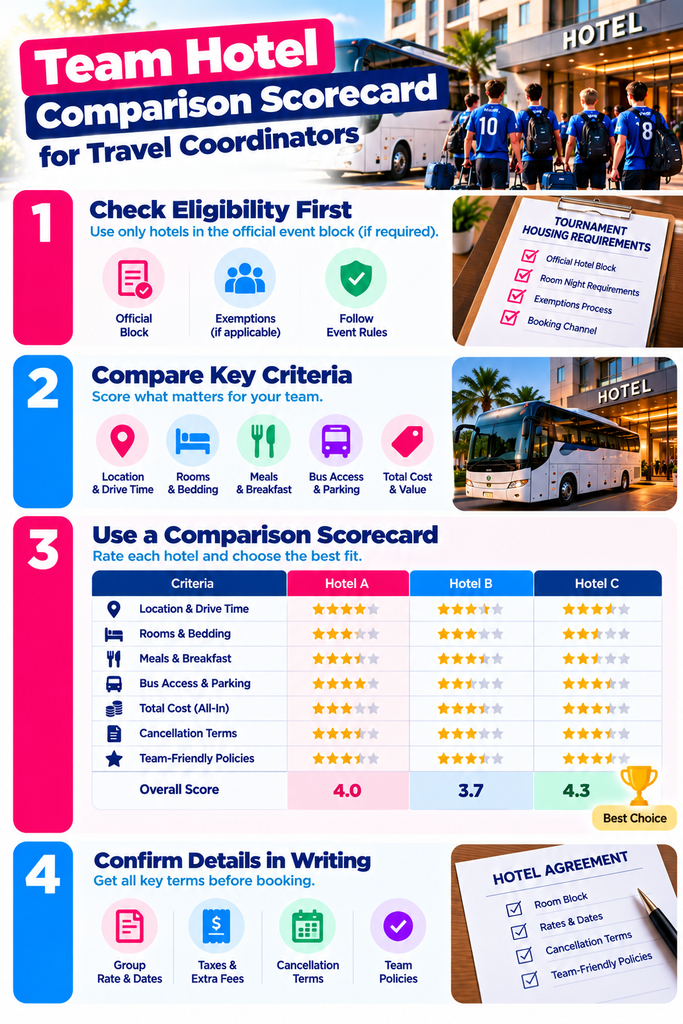
Quick answer: Check eligibility first. If the tournament requires official housing, only hotels inside the event’s designated block count, so drop everything else before you score anything. Then score the remaining hotels on weighted criteria: drive time to the venue, all-in cost, breakfast and meal timing, bedding and room mix, bus access, cancellation terms, and team-friendly policies. Get every answer in writing, then rank. The cheapest hotel may not score best.
Most hotel shortlists start as a spreadsheet sorted by nightly rate. A $20 saving per room evaporates when players are four to a room with two beds, breakfast opens after the bus has left, or the motorcoach won’t fit under the porte-cochère. A scorecard puts those trade-offs on one page, so you can defend the choice to a club director, an athletic department, or a group of parents who have opinions.
This covers the comparison step only. For the full process, see how to book hotels for a sports tournament. For contracting the block, see how to block hotel rooms for a sports team.
Why rate-only comparison fails
The nightly rate is the easiest number to compare and usually the least useful. Two quotes at the same rate can differ in every way that matters on a game day.
Location. A hotel ten minutes away at 6 a.m. can take thirty minutes in tournament traffic.
Meals. A standard breakfast window may not work for a 7:30 a.m. pool-play start.
Bedding. Two queens versus two doubles versus a king with a sofa bed changes how many athletes fit per room, which changes how many rooms you need, which changes the total you were comparing in the first place.
Transport. Bus parking, a drop-off lane, and overnight motorcoach parking are not guaranteed anywhere. The team hotel bus parking and drop-off checklist covers what to confirm.
Terms. Attrition, cutoff dates, and early-departure rules decide what you pay if the team is eliminated on day one. See what hotel terms to check when a tournament schedule changes.
Step 1: check mandatory housing eligibility
Do this before you score anything. Many US tournaments require traveling teams to book through a designated housing provider, usually called stay-to-play. Where that rule applies, a hotel outside the official block is not an option no matter how well it would have scored.
Two published examples show why you read each event’s own rules rather than last season’s:
- USA Volleyball’s 2027 Adult Open National Championship in Chicago says housing “MUST be booked within the available hotel blocks provided by our partner, Team Travel Source.” It also says room-night requirements depend on the division, and tells teams to contact the housing partner to confirm their requirement and ask about exemptions.
- Team Travel Source’s room block FAQ says each event has its own link for creating a group block, found on that event’s page.
The rules differ by event, and sometimes by division inside one event. Before building a shortlist, confirm whether official housing applies to your team, division, and travel distance; which properties are in the block and which booking channel counts toward compliance; what exemptions exist, such as local or commuting teams, and how to get one in writing; and what happens if you don’t comply.
Our explainer on the stay-to-play tournament requirement covers how these programs work, including enforcement and exemptions. Don’t try to work around an official housing rule. Where the event requires its block, your scorecard compares hotels inside that block and nothing else.
Pass/fail gates
| Gate | Pass condition |
|---|---|
| Housing eligibility | Hotel is in the official block, or the event allows open booking, or your exemption is confirmed in writing |
| Capacity | Hotel can hold your full room count for every night you need |
| Dates | Hotel covers your arrival and departure pattern, including a possible extra night |
| Accessibility | Required ADA-accessible rooms are available |
| Safety and policy | Hotel accepts minors in a group block under your organization’s supervision policy |
A hotel that fails any gate is off the list, however good its rate.
Step 2: choose criteria and weights
Once the gates are cleared, score what affects performance and budget. These are the requirements coordinators weigh most often. Adjust them for your sport, age group, and trip length.
Location and drive time, suggested weight 20%. Measure drive time to the venue at your real departure times, not distance. For multi-venue tournaments, measure to the venue where you play most. Check whether restaurants, a pharmacy, and an urgent care clinic are nearby.
All-in cost, 20%. Compare the total for your exact room-night pattern: rate × rooms × nights, plus taxes, any resort, parking or housing fees, and breakfast if it isn’t included.
Meals and breakfast timing, 15%. Ask whether breakfast opens early on game days, whether there’s private space for team meals, and whether outside catering is allowed. A free hot breakfast is worth nothing if it opens after your bus leaves.
Bedding and room mix, 15%. Confirm bed type, how many rooms of each type are guaranteed rather than requested, and whether rollaways are permitted. Bedding drives your room count, and room count drives your total.
Team transport and bus access, 10%. Bus parking, a loading zone, overnight motorcoach parking, and any shuttle the hotel runs.
Contract terms and flexibility, 10%. Attrition, cutoff date, deposits, cancellation rules, early-departure fees. Terms that fit a tournament schedule can be worth more than a lower rate, particularly in a single-elimination format. Room block attrition and shortfall charges explains how those numbers are usually calculated.
Team-friendly policies and amenities, 10%. A meeting room for film sessions, laundry, ice, a quiet floor, the curfew policy, and whether rooms cluster on one floor.
How to score: rate each criterion 1 (poor) to 5 (excellent), multiply by the weight, add the results for a total out of 5.00. Only score answers the hotel has confirmed in writing. Anything still verbal stays “TBC” until it isn’t.
Step 3: a worked example
Hotel A and Hotel B below are invented, and so is every number and rating. They demonstrate the arithmetic. They don’t describe any real property, rate, or market.
A 16U club team travels to a three-night tournament and needs 12 rooms for players, coaches, and chaperones. Both hotels sit inside the event’s official housing block, so both clear the eligibility gate.
| Criterion | Weight | Hotel A | Score | Weighted | Hotel B | Score | Weighted |
|---|---|---|---|---|---|---|---|
| Location / drive time | 20% | 28 min in game-day traffic | 2 | 0.40 | 9 min | 5 | 1.00 |
| All-in cost | 20% | Lowest total | 5 | 1.00 | About 12% higher | 3 | 0.60 |
| Meals / breakfast timing | 15% | Opens 7:00 a.m., no exceptions | 2 | 0.30 | Opens 6:00 a.m. on request; meal room | 5 | 0.75 |
| Bedding / room mix | 15% | Two doubles; mix not guaranteed | 2 | 0.30 | Two queens, guaranteed in writing | 4 | 0.60 |
| Bus access | 10% | Street parking only | 1 | 0.10 | Dedicated lot; overnight parking OK | 5 | 0.50 |
| Contract terms | 10% | 90% attrition, no early-departure waiver | 2 | 0.20 | 80% attrition, resell credit | 4 | 0.40 |
| Team-friendly policies | 10% | No meeting room | 3 | 0.30 | Meeting room, floor clustering | 4 | 0.40 |
| Total | 100% | 2.60 | 4.25 |
On rate alone, Hotel A wins. On the scorecard, Hotel B takes it 4.25 to 2.60, because it solves problems that would otherwise cost the team time, sleep, and money on game days.
The more useful outcome is what happens when the budget can’t absorb Hotel B. The scorecard shows exactly what you’re giving up, which turns a vague preference into a negotiating list. You go back to Hotel A and ask for the 6 a.m. breakfast and guaranteed bedding, because you know those two rows are worth 0.75 points of the gap.
Step 4: validate and decide
Confirm in writing. Turn every scored item into a contract term or a written confirmation from the hotel. Don’t score anything you only heard on a sales call.
Re-weight for the trip. A one-night away game weights cost more heavily. A week-long national event weights meals, laundry, and terms more heavily.
Share the scorecard. Show it to whoever approves the booking. A visible method is much easier to defend than a recommendation, especially when a parent asks why you didn’t take the cheaper hotel.
Plan the next step. Once you’ve chosen, move on to contracting and block management with the team room block guide.
Copy-ready fields for your own sheet
- Event name, dates, division
- Official housing required? Y/N, source link, exemption status
- Hotel name; in official block? Y/N
- Rooms needed per night; rooms confirmed per night
- Bed type and guaranteed room mix
- Drive time to primary venue at departure time
- All-in total: rate, taxes, fees, parking, breakfast
- Breakfast hours and early-opening option; team meal space
- Bus parking, loading zone, overnight motorcoach parking
- Attrition %, cutoff date, deposit, cancellation, and early-departure terms
- Meeting room, laundry, floor clustering
- Score 1 to 5 × weight for each criterion; total
- Status of each item: confirmed in writing / TBC / unacceptable
The status row matters most, because only items confirmed in writing should count toward a hotel’s score.
Compare team hotels with greatEvent
Where the tournament’s rules allow it, greatEvent Sports can help you explore team lodging and facilities and send one request to several properties, so you can score the replies side by side. Where an event requires official housing, book through the designated provider and use the scorecard to choose between the hotels inside that block. If you’re sizing the block before you compare anything, how many rooms a club team needs covers that step.
Research and sources
Event policies reviewed October 12, 2026. Event housing rules change by season and sometimes by division, so confirm the current requirement with your own event and its housing provider.
The gates, criteria, weights, and scoring method are editorial recommendations, not an industry standard. The Hotel A and Hotel B comparison is entirely hypothetical: every rate, drive time, attrition percentage, and rating is invented to demonstrate the arithmetic, and none of it describes a real property or market.
- USA Volleyball, 2027 Adult Open National Championship. Housing must be booked within the partner’s hotel blocks; room-night requirements depend on division; teams are directed to the housing partner for exemptions.
- Team Travel Source, Room Block FAQ. Each event has its own group-block link, located on that event’s page.
greatEvent Sports positioning is referenced for context. No automated hotel scoring or comparison capability is claimed.
Frequently Asked Questions
How should a travel coordinator compare hotels for a sports team? ▾
Start with eligibility. If the tournament requires official housing, compare only hotels in the event’s block. Then score what’s left on weighted criteria such as drive time, all-in cost, breakfast timing, bedding, bus access, contract terms, and team-friendly policies. Use only answers you have in writing, then rank by total score.
Which team hotel requirements should be deal breakers? ▾
Make these pass/fail rather than scored: compliance with the event’s housing rule, enough rooms for every night, coverage of your dates, the ADA-accessible rooms you need, and acceptance of your supervision policy for minors. A hotel failing any of them doesn’t belong on the shortlist at all.
Can I book a cheaper hotel outside the tournament block? ▾
Only where the event allows it, or you hold a written exemption. Under a stay-to-play rule, a booking outside the designated channel may not count toward compliance even at the same hotel. Check the event’s housing page and contact its housing provider. Our stay-to-play explainer has the background.
How should travel time and meal availability affect the shortlist? ▾
Measure drive time at your real game-day departure times, and check breakfast opens early enough for your schedule. A hotel that’s cheap but far away, or cheap but serving breakfast too late, usually costs the team somewhere else. The weights make that trade-off visible instead of leaving it as a feeling.
What weights should I use? ▾
The example weights (location 20%, cost 20%, meals 15%, bedding 15%, transport 10%, terms 10%, policies 10%) are only a starting point. Change them for your sport, the athletes’ ages, the length of the trip and your budget. Set them before you see any quotes, so nobody adjusts them later to favor a hotel they already like.
Compare vendors for your next event
Search caterers, photographers, florists, planners, and rentals — then send one request to several vendors at once.