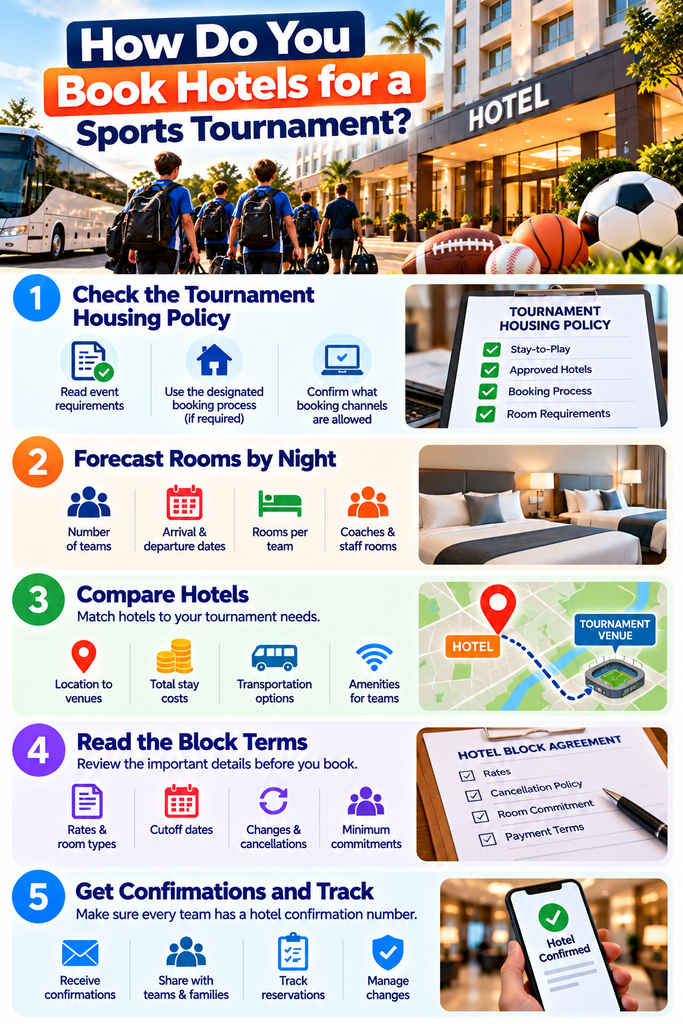
Quick answer: Check the event’s housing rules and the required booking channel first. Then forecast rooms by night, compare suitable hotels against the competition schedule, price the whole stay rather than the nightly rate, read the block terms, and track reservations until every team has a hotel confirmation number in hand.
Before any of that, settle one question: who controls the lodging. The answer changes every step that follows, and getting it wrong late is expensive.
1. Check the tournament housing policy first
Read the current event website and its housing instructions. A stay-to-play or stay-and-play policy can require participating teams to reserve through a designated provider, and the requirement often varies by division.
USA Volleyball’s 2027 Adult Open National Championship page requires housing inside Team Travel Source’s available hotel blocks, with room-night requirements that depend on the division. [1] That is one event’s rule in one season, not a national standard. Check the rules for your event, in the year you are playing.
| Your situation | Booking route |
|---|---|
| Entering an event with required housing | Use the designated housing process. Request any exemption before you book elsewhere |
| Free to arrange your own lodging | Compare suitable hotels, or a permitted group-booking service, using identical dates and room requirements |
| Organizing the tournament hotel program | Coordinate inventory, terms, booking links, reporting and responsibilities with the venues and any appointed housing provider |
Staying at an approved hotel may not be enough on its own. Plenty of policies also dictate how you reserve. Ask whether direct bookings, loyalty-point stays, or third-party sites count toward the requirement, because a team can end up at the right property and still be out of compliance. What stay-to-play actually requires covers the mechanics in more detail.
Start from the event page
Team Travel Source directs groups to the event’s own hotel link when creating a room block. [2] Use the current event and division information, because an old booking link from last season may still load and still take reservations.
2. Forecast rooms by night and room type
Collect confirmed and expected traveling teams, arrival and departure dates, room-sharing arrangements, coaches and staff, and anyone traveling separately.
Organizers should separate local teams from overnight visitors, and confirmed entries from unconfirmed demand. A single team lists each planned room with its occupants and dates.
A tournament room block calculation
Twelve visiting teams need 10 rooms each on Friday and Saturday. Four of those teams also need their 10 rooms on Thursday. Staff take 8 rooms on all three nights.
| Night | Team rooms | Staff rooms | Total rooms |
|---|---|---|---|
| Thursday | 4 x 10 = 40 | 8 | 48 |
| Friday | 12 x 10 = 120 | 8 | 128 |
| Saturday | 12 x 10 = 120 | 8 | 128 |
| Total room-nights | 280 | 24 | 304 |
That forecast is 304 room-nights with a peak of 128 rooms. The peak is the number that decides whether a hotel can host you, because the inventory has to exist on each individual night. A room-night total tells you nothing about whether Friday works.
These are illustrative figures, not a recommended rooms-per-team ratio. Build your own from registration pace and past attendance, and write the uncertainty down as a documented scenario rather than carrying it in your head. How many rooms a group block needs works through the sizing method.
Plan for the competition schedule
Check the earliest reporting time, practice and check-in requirements, playing locations, and the latest possible finish. A Sunday final may require a Sunday night for teams that advance, which means you are forecasting rooms for an outcome nobody knows yet.
Set youth rooming arrangements before calculating occupancy
Confirm the governing body’s athlete-protection policy, the required consent, the room-check procedure, and the hotel’s check-in age requirement. Where MAAPP lodging rules apply, they shape who can share a room before you calculate occupancy, not after. [3] Use the current policy from your own organization. Booking hotel rooms for youth sports teams goes further into the age and supervision side.
3. Compare hotels against the tournament schedule
A nearby hotel helps only if the team can reach the right competition site on time and use the services it needs when it needs them.
| Comparison point | What to confirm |
|---|---|
| Venue access | Travel time to each likely playing site at reporting hours, including parking and unloading |
| Room inventory | Required room types and permitted occupancy on every night; requested team proximity versus confirmed placement |
| Breakfast | Service start time, included guest count, meal options, and a confirmed early-meal arrangement where needed |
| Transportation | Bus access and parking, driver lodging if required, shuttle hours and capacity, and whether trips must be reserved |
| Team operations | Meeting space, laundry access, equipment storage, quiet hours, and the rules on outside food |
| Accessibility | The specific guest-room and route features travelers need, confirmed through the hotel’s own contact |
| Price and flexibility | Full stay price, mandatory charges, taxes, deposit schedule, cancellation deadlines, minimum stay |
One hotel or several
A single hotel simplifies communication and transportation when it has enough suitable rooms. Several hotels can cover larger nightly demand or give teams a price choice.
If you split across properties, forecast pickup and track commitments for each one separately. Strong bookings at one hotel do not offset a shortfall at another, and discovering that in week three of a four-week sell is not a good week. Blocking hotel rooms for sports teams covers the multi-property side.
4. Compare the full stay cost
Here is an illustrative comparison for 24 adult travelers using 12 rooms for three nights, with six vehicles. These are invented planning prices, not market rates.
| Cost for the same stay | Hotel A | Hotel B |
|---|---|---|
| Guest rooms | 36 room-nights x $150 = $5,400 | 36 room-nights x $165 = $5,940 |
| Breakfast | 72 meals x $12 = $864 | Included for all 24 travelers |
| Parking | 18 vehicle-nights x $15 = $270 | Included |
| Subtotal before taxes and other charges | $6,534 | $5,940 |
Hotel B costs $594 less despite charging $15 more a night. That is the whole argument for pricing the stay instead of the rate.
Before you bank it, verify that the included breakfast actually covers your occupancy and starts before departure. “Breakfast included” that serves 2 guests per room and opens at 7 a.m. is not the same offer to a team leaving at 6:30.
5. Confirm the terms before committing
Read the actual group agreement and the individual reservation policies. A room block holds inventory under agreed conditions. It does not necessarily create confirmed reservations, and the gap between those two things is where most tournament lodging disputes start.
| Term | Question to resolve |
|---|---|
| Block and hold status | Contracted rooms, a temporary team hold, or individual confirmed reservations? When does each expire? |
| Booking cutoff | When does unbooked inventory return to sale, and what happens to the group rate after that date? |
| Permitted reductions | Can the block be reduced without charge? By what dates, amounts and written process? |
| Attrition | Is there liability for a shortfall, and how is it calculated: by night, total room-nights, revenue, or another basis? |
| Payment | Who pays room charges, taxes, incidentals, deposits, housing fees and any organizer charges? |
| Cancellation and early departure | What happens if a guest cancels, a team withdraws, or a team leaves after elimination? |
| Event disruption | What remedies apply if weather, facility closure or a schedule change affects the tournament? |
| Changes and extensions | Who processes name changes and extra nights, at what price, subject to what availability? |
Release dates and liability relief are different things
A cutoff can release unbooked rooms for public sale. Whether it also reduces your financial commitment depends entirely on the agreement. Cvent’s room-block guidance treats booking terms and attrition terms as separate provisions to negotiate. [4] Room block attrition and shortfall charges explains how the calculation usually works, and reducing or canceling a block covers the deadlines that govern changes.
Appointing a housing company does not, by itself, move your financial exposure anywhere. Confirm who signs each agreement and who carries the obligation if rooms go unsold.
Check housing fees and hotel fees separately
Team Travel Source states that an applicable cancellation fee can be separate from the hotel’s own cancellation policy, with the relevant deadline set in the provider’s terms. [5] So a team can cancel inside the hotel’s free window and still owe a provider fee.
Do not assume that a canceled tournament or an early elimination produces an automatic hotel refund. If your group needs flexibility, get the specific written provision before you sign, not a verbal assurance from whoever answered the phone.
6. Complete and track the reservations
Choose one housing lead and give teams a single booking route. For an official housing program, distribute the approved link and instructions. For independent sourcing, send the hotel details and the deadline.
Send teams what they need to act
Event and division, hotel and address, required stay dates, room options, complete price information, booking deadline and time zone, payment method, and who to contact with a problem. A team that has to ask three questions before it can book is a team that books late.
Keep the records aligned
Track team name, hotel, reservation reference, guest name, arrival and departure dates, room type, booking status, and the last confirmed change. Shared rooms need the occupants linked, or two players become two rooms.
Compare booked pickup against the nightly plan on an agreed cadence, with closer reviews as hold and reduction deadlines approach. Chase the teams with missing or incomplete reservations before the deadline rather than after it.
Know which confirmation you actually have
A housing-platform reservation reference and a hotel confirmation number are different records, and they can arrive days apart. Team Travel Source notes that hotels may not be able to locate a reservation until the provider transfers it. [6]
If the hotel cannot find a booking, contact the provider with the existing reference before anyone creates a second one. Ask when the hotel receives the records and when confirmation numbers become available, then tell the teams, because a coach who cannot find their reservation at 9 p.m. will book another room.
7. Reconfirm before teams travel
| Checkpoint | Planner action |
|---|---|
| Before the applicable booking deadline | Verify every team’s reservations and resolve unmet housing requirements through the organizer |
| Before a block reduction deadline | Compare nightly pickup with commitments and request any permitted adjustment in writing |
| After hotel handoff | Check hotel confirmations, dates, room types, necessary accommodations and payment routing |
| Before arrival | Confirm breakfast and bus times, arrival instructions, equipment arrangements and the on-duty hotel contact |
| After the tournament | Reconcile actual stays and charges, resolve discrepancies, and keep aggregate pickup history for the next forecast |
Use your actual contractual dates for this schedule. A generic “30 days before arrival” checklist is not permission to miss an earlier deadline, and nothing in your inbox will warn you.
Explore sports travel options with greatEvent
greatEvent works with sports travel groups including youth clubs, collegiate programs and professional teams. [7] If your tournament permits independent sourcing, you can compare properties against the dates and room requirements you have already forecast. Where an official housing policy applies, follow it, and treat any comparison as research rather than a booking route.
Research and sources
Sources checked October 6, 2026. The sources below document specific event and provider practices at that date. The forecasts, prices, comparison checklist and planning workflow here are editorial planning material, not measured market rates or a universal industry standard.
[1] USA Volleyball, 2027 Adult Open National Championship. The housing section names the designated provider and sets room-night requirements that depend on division. Recheck the current event rules before booking.
[2] Team Travel Source, Room Block FAQs. Directs teams to their event’s hotel link to create a group block.
[3] US Center for SafeSport, Transportation and Lodging. Explains MAAPP lodging and room-check requirements, including the applicable exceptions. Use your governing organization’s current policy.
[4] Cvent, Room Block Management Guide. Supports treating booking terms and attrition terms as separate negotiable provisions. No universal discount or attrition percentage is adopted here.
[5] Team Travel Source, Booking Fee FAQs. Explains that a provider cancellation charge can be additional to the hotel’s own cancellation charge.
[6] Team Travel Source, Reservation Changes FAQs. Explains provider references, hotel handoff and pre-arrival confirmation numbers.
[7] greatEvent, Who We Serve. Supports the sports travel audience connection. The sports subdomain was discoverable in search but returned 403 to direct research access, so no live booking workflow or inventory was verified.
This article is written for US tournament organizers and team travel coordinators, and covers hotel sourcing and booking operations. Event policies, hotel contracts and athlete-protection rules vary, so confirm the current terms that apply to your event.
Frequently Asked Questions
How far in advance should you book tournament hotels? ▾
Start the lodging plan as soon as you know the event dates, locations and reservation process. For an official housing program, track when it opens and when it closes. For independent sourcing, work back from your own deadlines. There is no single lead time that fits every event.
What does stay to play mean for hotel booking? ▾
It is an event housing policy that can require teams to book designated hotels through an approved channel. Requirements and exemptions vary by tournament and sometimes by division, so read the current rules for your event rather than relying on last season’s.
Can a team book directly with an approved hotel? ▾
Only if the event rules allow that route, or the organizer grants an exception. Being at the correct property does not necessarily satisfy a requirement to book through the official housing process. Ask first and get the answer in writing.
How many hotel rooms should a tournament reserve? ▾
Build a nightly forecast from actual visiting-team needs, room sharing, staff, arrival patterns and possible extra nights. Distinguish peak rooms from total room-nights. There is no universal rooms-per-team figure that survives contact with a real registration list.
Does releasing unused rooms prevent attrition charges? ▾
Not automatically. The contract decides whether a release also reduces the financial commitment. Confirm the adjustment deadline, the permitted reduction, the calculation method and what obligation remains afterward.
Are group hotel rates always the cheapest? ▾
No. Compare identical dates, room type, occupancy, included meals, parking, fees and cancellation terms. Where an official housing policy applies, confirm whether comparison shopping is permitted at all before you spend time on it.
What if the tournament is canceled or the team leaves early? ▾
Follow the housing provider’s and the hotel’s procedures. Refunds, early-departure charges and organizer obligations all depend on the terms you agreed. Get cancellation acknowledgment in writing and check which fees survive.
What if the hotel cannot find the reservation? ▾
Check with whoever issued the booking confirmation. Some housing systems send hotel records closer to arrival. Verify the handoff timing and reference numbers before anyone creates a second booking.
Compare vendors for your next event
Search caterers, photographers, florists, planners, and rentals — then send one request to several vendors at once.