Quick answer: To book a hotel room block, start 9–18 months out. Set your dates and headcount, size the block conservatively at 50–75% of the rooms you expect to fill, then send an RFP to 3–5 hotels. Compare group rates (usually 10–25% off rack), negotiate attrition down toward 75–80%, push the cutoff date past the standard 30 days, and get a release schedule in writing before you sign.
A room block is a commitment, not a reservation. You are promising a hotel a number of room-nights, and if your guests don’t book them, you pay for the gap. That single fact should shape every decision below.
This is the general guide covering any group: weddings, sports teams, corporate meetings, conferences, family reunions. The steps are the same. Only the numbers and the guest communication change.
What is a hotel room block, and how does greatevent.com fit in?
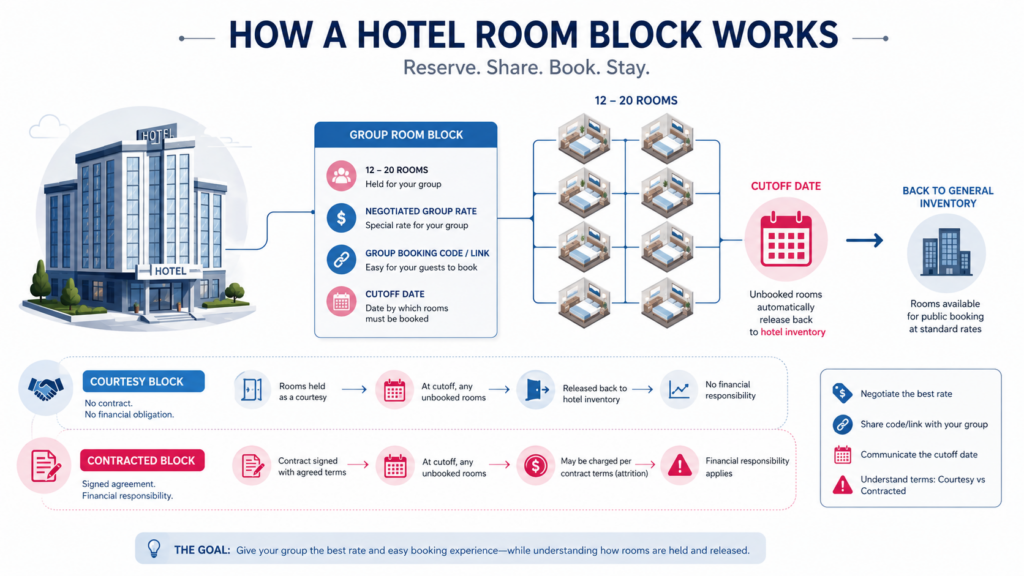
A room block is a set of rooms a hotel holds for your group at a negotiated rate, released back to general inventory on a cutoff date. Guests book under a group code or link. You sign a contract covering how many rooms, at what rate, and what happens if they go unsold.
There are two flavors:
- Courtesy block: the hotel holds rooms with no financial commitment from you. Unsold rooms simply get released. Low risk, usually offered for small blocks or as a favor.
- Contracted block: you sign for a room-night total and carry attrition liability. This is what you get once you’re asking for real volume and real discounts.
On greatevent.com, lodging sits inside the venue booking flow rather than in a separate process. The platform includes a Stay feature for group room bookings, and at checkout you can add services and a hotel room block to the same order as your venue. Hotel listings on the platform flag their own group availability directly, with notes like “14 rooms available for individual stays and discounted room blocks.” greatevent also markets itself to hotels as the first and only solution that lets customers book hotel meeting rooms online, so venue and lodging land in one place instead of two email threads. If you need a partner program or a custom tool for a very large block, confirm it with a greatevent specialist.
How do you book a hotel room block? The 6-step process
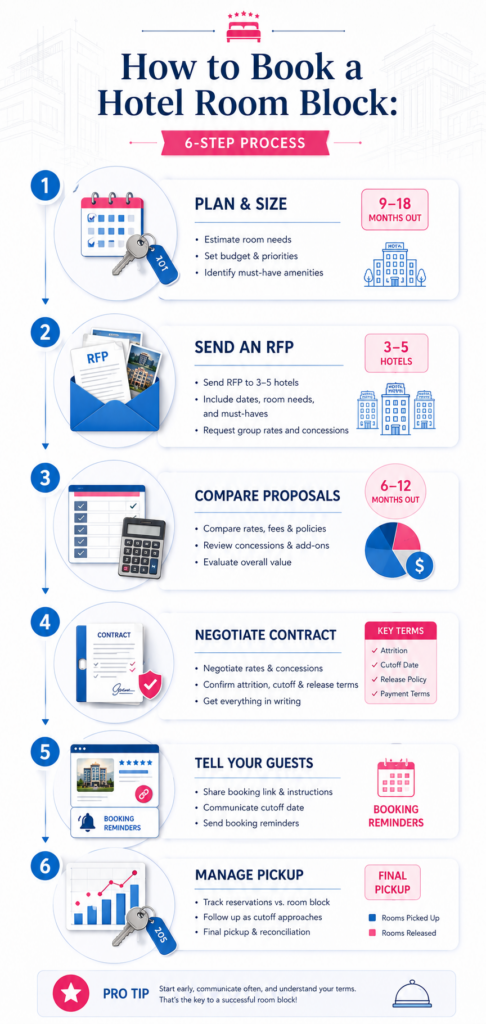
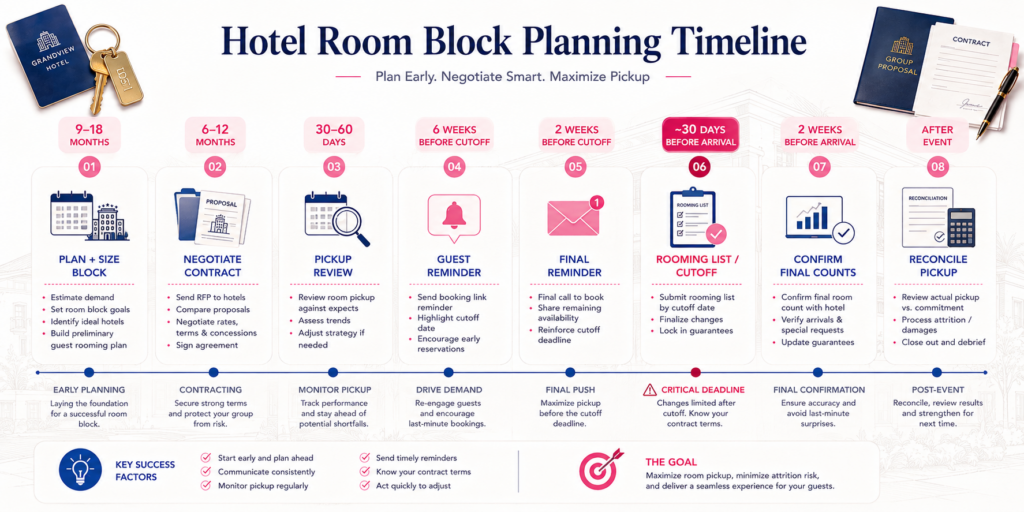
1. Plan and size the block (9–18 months out)
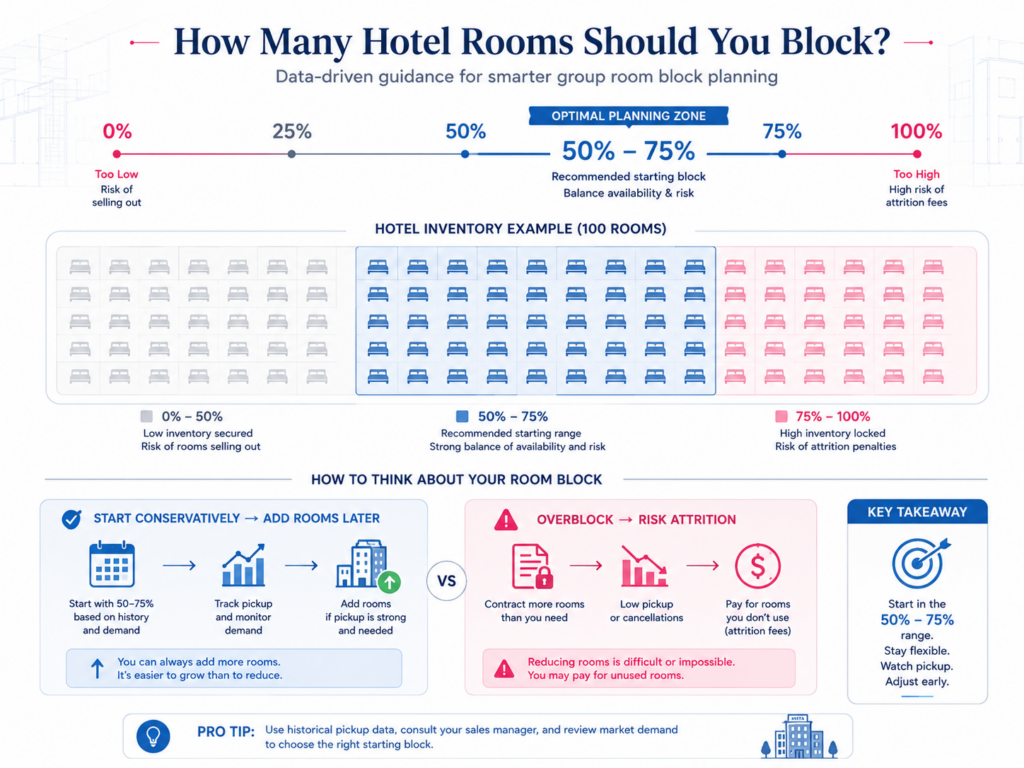
Lock your dates first, then estimate attendees, then decide how many will actually need a room. Use historical pickup if you have it. If your last event filled 62% of the block, plan around 62%, not around optimism.
Size conservatively: 50–75% of the rooms you expect to fill. You can almost always add rooms later if pickup is strong. You cannot easily drop rooms once you’ve signed for them. That asymmetry is the whole game.
In high-demand cities and seasons, move earlier. New York in May or a Coachella weekend fills up far in advance, and 12+ months of lead time is realistic. Convention towns like Las Vegas and Orlando often have several events competing for the same inventory, so secure the block early and in writing.
2. Send an RFP to 3–5 hotels
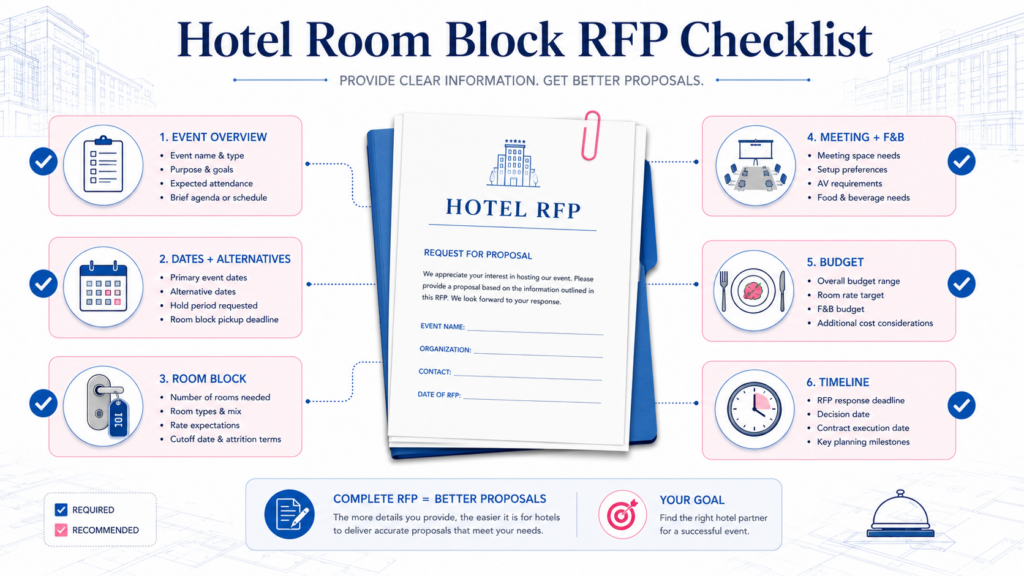
Specific RFPs get better proposals. Vague ones get ignored. Cover six things:
| RFP section | What to include |
|---|---|
| Event overview | Organization type, purpose of the event, past attendance |
| Dates | Preferred dates plus workable alternates |
| Room block | Total room-nights by date, room types, target rate range, comp-room needs |
| Meeting and F&B | Space types, setups, A/V, meal functions, ADA requirements |
| Budget | Target room rate, F&B budget, any fee ceilings |
| Timeline | Proposal due date, decision date, contact details |
Write the room block line like a buyer, not a browser: “We need 50 king room-nights and 30 doubles at roughly $150 ±$10 per night.” State your contract expectations (cutoff, attrition) up front so nobody wastes a round trip.
Send it to 3–5 well-chosen properties. Shopping at least three hotels can improve savings by roughly 15–25%. Blasting 30 hotels does the opposite: your RFP drops down every sales manager’s priority list.
3. Compare proposals apples to apples
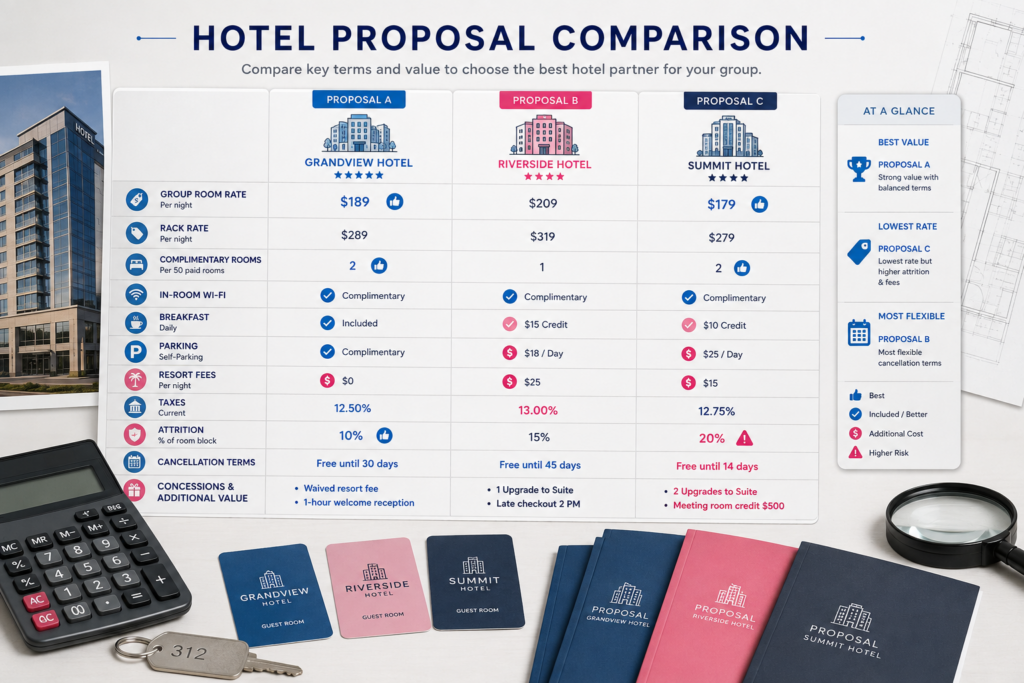
Build one comparison sheet. Group rate against the property’s comparable rack rate (a real block is usually 10–25% off). Comp rooms offered, typically one free per 20–40 rooms booked. What’s included: Wi-Fi, breakfast, parking. What’s added on top: resort fees, parking fees, taxes. Then attrition and cancellation terms, which is where the money actually lives.
Ask directly whether resort fees and parking can be waived for the group. Many properties can. Almost none volunteer. Tour your top two if the event is large or the property is unfamiliar.
4. Negotiate the contract (6–12 months out)
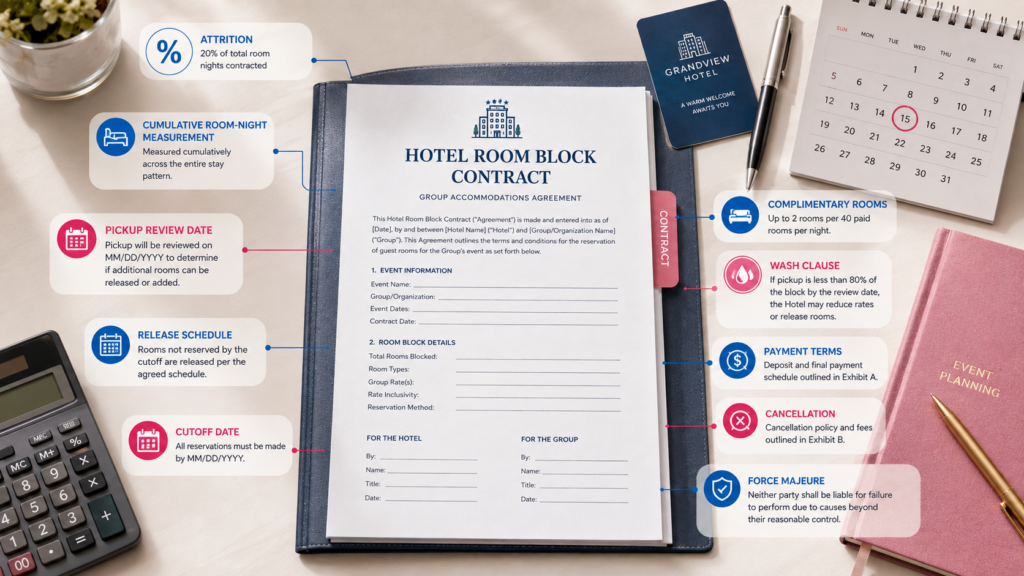
This is the step that pays for itself. Target list:
- Attrition: the standard ask is 80–90% pickup. Push toward 75–80%.
- Cumulative attrition: measure the whole block in total room-nights, not night by night. If Friday overfills and Sunday underfills, cumulative measurement nets them out.
- Pickup review clause: a checkpoint about 30–60 days before arrival where you can adjust block size.
- Release schedule: the right to trim the block without penalty on a set ladder, for example 10% at 90 days out and another 5% at 60 days out.
- Cutoff date: as late as you can get it. Later cutoffs mean better pickup.
- Concessions: comp rooms, a suite upgrade, early check-in and late checkout, free parking, comp Wi-Fi.
- Wash clause: make sure comp rooms count toward your attrition total, not against it.
- Payment terms: commonly one night’s deposit at signing, balance due at cutoff or roughly 30 days out.
- Force majeure: ask for broad language covering government mandates, natural disasters, and infectious disease, with room to postpone rather than only cancel.
Also settle one detail that gets skipped constantly: whether attrition penalties are charged against the contracted group rate or the hotel’s best available rate. Get it in the document.
5. Sign, then tell your guests
Sign, pay the deposit, and record the group code or booking link. Then publish the block immediately: event website, invitations, group emails, whatever your channel is. Lead with the cutoff date. Repeat it.
Send reminders at roughly 6 weeks and 2 weeks before the cutoff. Pickup is driven far more by reminders than by rate.
6. Manage pickup and reconcile after
Track pickup on a schedule, not on a hunch. Bookings tend to cluster late, with the curve rising slowly and then accelerating inside the final 30 days, so an alarming week-10 number is often normal.
If pickup runs hot, ask for additional rooms early while the hotel still has inventory. If it lags, use your release clause or negotiate a late release before the cutoff passes. Submit the rooming list by the hotel’s deadline (often 30 days prior), confirm final counts about two weeks out, then reconcile actual pickup and settle any shortfall after the event.
Stakeholders to keep in the loop: the planner running the RFP, the sponsoring organization approving the contract, the hotel’s sales manager, and whoever on your finance side cuts the deposit.
What does a room block actually cost?
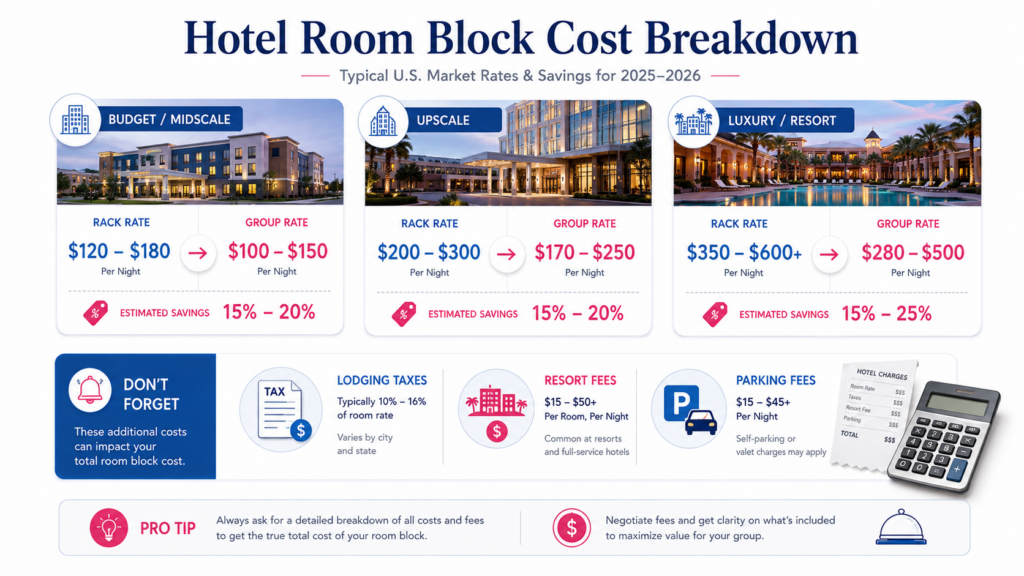
Group rates typically land 10–25% below standard rates, and larger groups in shoulder season can reach 30–40% off. Across the market, blocks generally fall in a 10–40% discount band off rack.
| Hotel category | Typical rack rate | Typical group rate | Discount |
|---|---|---|---|
| Budget / midscale (2–3 star) | $120–$180 | $100–$150 | 15–20% off |
| Upscale (4 star) | $200–$300 | $170–$250 | ~15–20% off |
| Luxury / resort (5 star) | $350–$600+ | $280–$500 | ~20–30% off |
A concrete example: a mid-range property at $160 a night might come down to $130 for a block.
Then the add-ons, which are not in that rate:
- Lodging and occupancy taxes: often 10–15% combined, varying by state and city.
- Resort fees: commonly $30–$50 per night where they apply. Negotiable.
- Parking: per night, per car, and frequently waivable for groups.
Make sure the contract states whether quoted rates are inclusive of tax or net of tax. It’s a five-figure ambiguity on a large block.
What happens if you don’t fill the block?
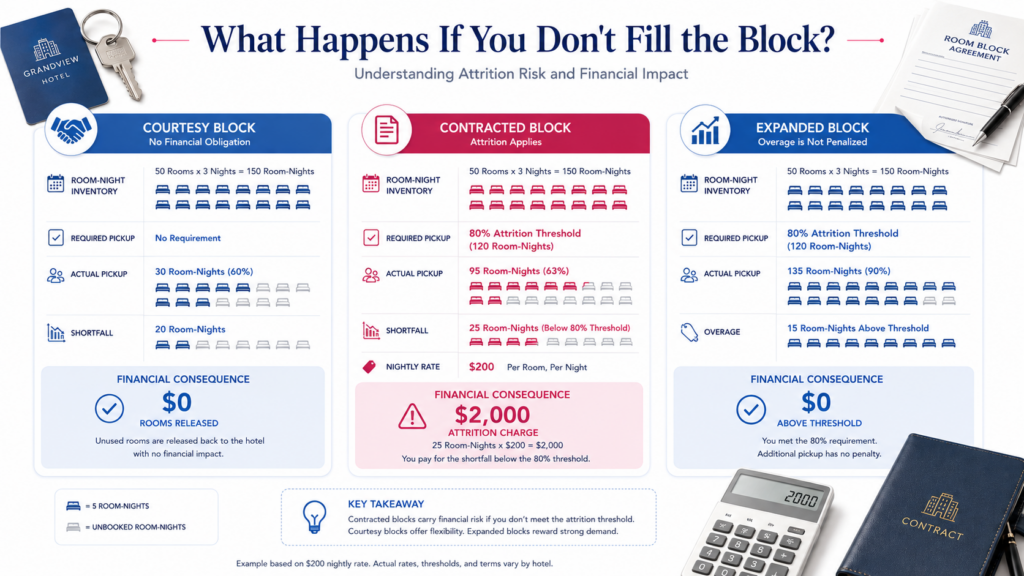
You pay for the gap. Here’s the same 20-room, two-night event under three different structures:
| Structure | Room-nights blocked | Attrition term | Picked up | Shortfall | Cost to you |
|---|---|---|---|---|---|
| Courtesy block | 20 (first night only) | None | 18 (90%) | 2 | $0 (rooms released) |
| Contracted block | 20 × 2 = 40 | 80% (32 required) | 30 (75%) | 10 room-nights | ~$2,000 at $200/night |
| Expanded block | 40 | 75% (30 required) | 35 (87.5%) | 0 | $0 (above threshold) |
Two lessons. First, a shortfall is priced in room-nights, so “5 rooms short” on a two-night event is 10 room-nights and double the pain. Second, the middle row and the bottom row are the same hotel and the same guests. The only difference is how the attrition clause was written.
Start small and expand. A block sized at 50–75% of expectation that you grow twice is cheaper than a block sized at 100% that you shrink once.
Which contract clauses matter most?
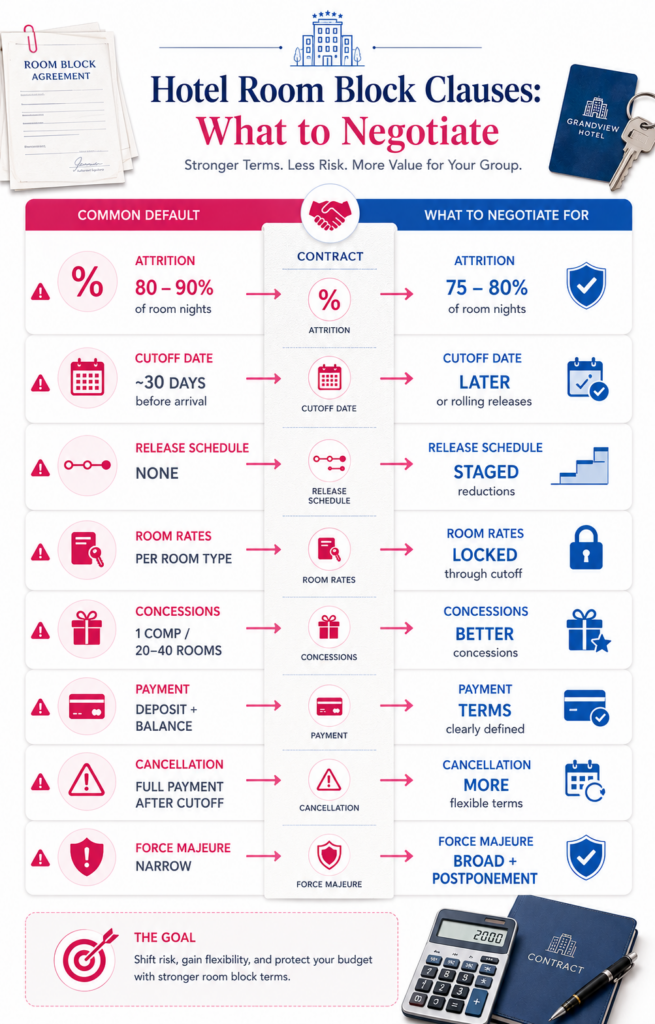
| Clause | Common default | What to negotiate for |
|---|---|---|
| Attrition | 80–90% pickup required | 75–80%, measured cumulatively across the whole block |
| Cutoff date | ~30 days before arrival | Later date, or rolling releases; group rate honored after cutoff if inventory remains |
| Release schedule | Not offered unless asked | Staged reductions without penalty, e.g. 10% at –90 days, 5% at –60 days |
| Room rates | Quoted per room type | Rate locked through cutoff; extension nights at the same rate; blackout dates named |
| Concessions | 1 comp per 20–40 rooms | Comps that wash against attrition, plus a planner suite upgrade and waived fees |
| Payment | One night’s deposit, balance at cutoff | Payment methods and any credit holds spelled out |
| Cancellation | Full payment after cutoff | Attrition waived if you cancel before cutoff; partial refund on written notice |
| Force majeure | Narrow event list | Broad list including government orders and infectious disease, with postponement rights |
Read the cancellation clause and the force majeure clause together. One decides what you owe if you walk away, the other decides whether walking away counts.
Should you book a chain or an independent hotel?
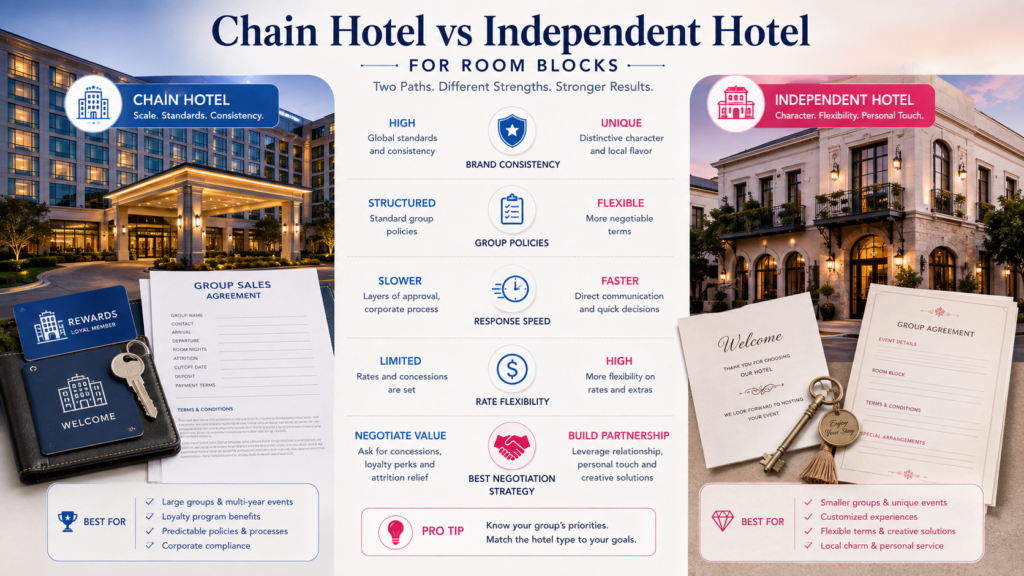
| Major chains (Marriott, Hilton, IHG) | Independent / boutique | |
|---|---|---|
| Strengths | Consistent brand standards, loyalty benefits, dedicated group sales teams | Flexibility and personalization; sharper discounts and creative perks |
| Group policies | Set and predictable (Marriott often requires 10+ rooms; Hilton runs tiered commission policies) | Case by case; more room to invent terms |
| Response speed | Slower, corporate approval layers | Usually faster, though often by phone and email rather than an RFP platform |
| Rate flexibility | Chainwide negotiated volume; resort and parking fees can be waived on request | No GDS commissions to fund, so rates can go lower |
| Best play | Cite corporate ties and volume potential; confirm comp and upgrade policy in writing | Offer committed volume or off-season dates; ask for custom add-ons like group dinners or shuttles |
Property type matters as much as brand. City-center full-service hotels carry higher base rates but handle larger blocks. Suburban and airport properties price lower, so check for a complimentary shuttle. Resorts add resort fees, which should be capped or removed. Convention hotels near a convention center expect big groups and often write stringent attrition, so read those contracts twice. University-adjacent and off-peak properties tend to be the most flexible, because they need the business.
On very small properties, price a full buyout against a block. Once you factor in amenities, a buyout occasionally wins.
Copy-paste: RFP email and phone script
Email to group sales:
Subject: Group Room Block Inquiry for [Organization], [Event Dates]
Hello [Name or Group Sales],
I’m [Name], [Title] at [Organization]. We’re planning [type of event] on [dates] near your property. We expect approximately [total] out-of-town attendees and would like to reserve [number] rooms per night (a mix of singles, doubles, and suites) from [arrival date] to [departure date].
Could you send your group rates, availability, and contract terms, including attrition and cutoff? We’re also interested in any complimentary benefits for the group, such as waived resort fees, comp rooms, or shuttle service. We plan to decide by [date].
Thank you,
[Name], [Title], [Contact info]
Phone script:
“Hi, I’m [Name], event planner with [Organization]. We’re hosting [event] on [dates], and we expect about [X] attendees from out of town. We’d like to put in a room block for roughly [Y] rooms a night. Can you tell me about your group availability and rates, and what attrition and cutoff policies you typically use?”
Follow-up after proposals arrive:
“Thanks for the proposal. A few questions. Could we negotiate the attrition down to 75% instead of 85%? Is late checkout or one additional comp room possible? And can we confirm the cutoff date at six weeks prior rather than 30 days?”
Legal and regulatory items you can’t skip
Taxes and fees. U.S. hotels add state and local lodging taxes on top of the room rate. New York State, for example, charges 4% state tax plus local occupancy taxes, and many cities layer on another 4–6%. Some jurisdictions add special hotel taxes or tourism fees; New York City also carries a hotel unit fee separate from sales tax. Ask the hotel to summarize every city-specific tax and fee in writing, and confirm who collects each one.
ADA compliance. Hotels and event venues are public accommodations under the ADA. That means accessible guest rooms, meeting rooms, entrances, parking, and restrooms, plus auxiliary aids such as sign-language interpreters on request. AHLA has been explicit that hoteliers are committed to ADA compliance, but commitment isn’t a room count. Specify accessible rooms in your RFP and your contract, and hold at least what your group needs. Failing to provide accessibility can create liability for the event sponsor, not just the hotel. On greatevent.com, hotel listings carry an Accessible section under amenities that you can check before you ever send an RFP.
Local ordinances and permits. Large gatherings can require permits or a city liaison, including noise permits and public safety review. If you’re serving alcohol, verify the hotel’s license covers your event. Respect fire code occupancy limits for meeting space, and check outdoor assembly rules for patios and pool functions. Requirements keep evolving: Philadelphia now requires event organizers to submit an Accessibility Plan for festivals, and other cities are moving the same direction.
Insurance. Liability coverage usually sits outside the hotel contract, but large events generally need it. Handle group reservation and billing data in line with privacy obligations too.
Key takeaways
- Start 9–18 months out; 12+ months in high-demand cities and peak seasons.
- Size the block at 50–75% of expected rooms. Adding rooms is easy, dropping them is not.
- RFP 3–5 hotels. Shopping at least three can improve savings by roughly 15–25%.
- Expect 10–25% off rack, up to 30–40% for large groups in shoulder season.
- Negotiate attrition to 75–80%, measured cumulatively, with a staged release schedule and a late cutoff.
- Remind guests at 6 weeks and 2 weeks before the cutoff. Pickup accelerates in the final 30 days.
Frequently Asked Questions
How far in advance should you book a hotel room block?▾
Start 9–18 months before the event for most groups. Negotiation and contracting typically happen 6–12 months out. In high-demand markets and peak weekends, 12 or more months of lead time is realistic because inventory is committed early.
How many rooms should you block?▾
Block 50–75% of the rooms you expect to fill, and use historical pickup from past events to set that number. Adding rooms later is usually straightforward if pickup is strong; removing contracted rooms is not. A conservative block is the single cheapest form of insurance against attrition.
What discount do you get on a hotel room block?▾
Group rates generally run 10–25% below standard rates, and large groups booking in shoulder season can reach 30–40% off. As a rough guide, a $160 midscale room might come down to $130 for a block. Rates quoted usually exclude lodging taxes, resort fees, and parking.
What is an attrition clause in a hotel contract?▾
Attrition sets the minimum share of your block you must fill before penalties apply, and 80–90% is the standard ask. Negotiate toward 75–80% and measure it cumulatively across total room-nights instead of night by night. Confirm whether penalties are calculated on the contracted group rate or the best available rate.
What is a hotel room block cutoff date?▾
The cutoff is the deadline for guests to book under your group rate, after which unsold rooms return to general inventory. It commonly sits around 30 days before arrival. Negotiate a later cutoff or rolling releases, and ask whether the group rate can still be honored after cutoff if rooms remain.
What happens if you don’t fill your room block?▾
You owe the shortfall in room-nights at the group rate. On a 40 room-night block with an 80% attrition clause, picking up only 30 room-nights can cost around $2,000 at a $200 nightly rate. A release schedule that lets you trim 10–20% of the block before the cutoff is the main defense.
What does a courtesy block mean?▾
A courtesy block means the hotel holds rooms for your group with no attrition liability, and unsold rooms are simply released. It’s the low-risk option for smaller groups, but it typically comes with less negotiating room on rate and concessions than a contracted block.
Should you use a chain or an independent hotel for a room block?▾
Chains offer consistent standards, loyalty benefits, and dedicated group sales teams, though corporate approval layers can slow responses. Independents tend to be faster and more flexible on rates and creative perks, since they aren’t bound by brand-wide pricing or GDS commissions. Get quotes from both before deciding.
Compare vendors for your next event
Search caterers, photographers, florists, planners, and rentals — then send one request to several vendors at once.