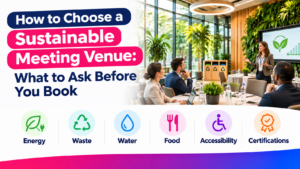
Quick answer: Ask each hotel for one comparable number: its meeting-space carbon footprint under the Hotel Carbon Measurement Initiative (HCMI), reported in kilograms of CO2e per square meter per hour. Then ask about waste, food, water and transit access, and get the answers in writing. Treat a logo or a certificate as a starting point, because it tells you about the building, not about your meeting.
Most sustainability questions in a venue RFP get answered with brochure language. “We are committed to the environment” can’t be compared across three hotels. A number per square meter per hour can.
Start with the one number hotels can actually give you
The Hotel Carbon Measurement Initiative is, in the words of the World Sustainable Hospitality Alliance, “a methodology and free tool for hotels to calculate the carbon footprint of hotel stays and meetings.” It was created in June 2012 by the alliance (then the International Tourism Partnership) and the World Travel & Tourism Council, with 23 hospitality companies. The alliance says it has been updated in 2016 and 2022 and is “already being used by over 30,000 hotels globally.”
For meetings, HCMI produces a “carbon footprint per area of meeting space on an hourly basis.” The current v3.0 process flow, last updated April 17, 2026, sets out how that number is built:
| Step | What happens |
|---|---|
| 1 | The hotel totals its annual carbon footprint from energy use and emissions factors |
| 2 | It splits that footprint between guest rooms, meeting space and the rest of the building, by square footage |
| 3 | It divides the meeting-space share by the meeting area and by hours, using either a default of 10 hours a day or the hours the space was actually used |
| 4 | The result is reported in kgCO2e per square meter per hour |
Two limits come with it, and both are stated in the document. The meeting metric covers Scope 1 and 2 emissions only, meaning the hotel’s own fuel and purchased energy. And “results are self-reported and unassured” until the alliance’s assurance system is published and in effect.
So ask for the number, and ask how it was calculated. In particular, ask whether the hotel used the 10-hour default or its actual hours. Two hotels using different methods can’t be compared directly.
How to use the number
The metric is per square meter, per hour. That means your choices change the footprint as much as the venue does.
Here is the arithmetic, using a figure invented purely to show the calculation:
| Venue A | Venue B | |
|---|---|---|
| Reported footprint (illustrative) | 0.50 kgCO2e/m²/hr | 0.30 kgCO2e/m²/hr |
| Room size you book | 200 m² | 200 m² |
| Hours you book | 8 | 8 |
| Footprint for your meeting | 800 kg CO2e | 480 kg CO2e |
Now book Venue A, but in a 120 m² room that actually fits your layout. The same eight hours comes to 480 kg, the same as Venue B in the larger room.
That’s the practical lesson. Booking the right-sized room for the hours you actually need cuts the attributed footprint directly. The meeting room capacity chart helps you size the room for your layout instead of booking the biggest one available.
The questions to send every venue
Send the same questions to each shortlisted venue, so the answers line up. These are editorial recommendations, not a published standard.
Energy and carbon
- What is your HCMI meeting-space footprint, and did you use the 10-hour default or actual hours?
- Is any of your electricity from renewable sources, and can you show how that is documented?
- Is the building certified under a recognized green building program? Which one, and what level?
Waste
- What happens to food waste: composting, donation or landfill?
- Can you serve without single-use plastic for water, coffee and breaks?
- Do you separate recycling in meeting rooms, or only back of house?
Food and beverage
- What share of the menu can be sourced locally or seasonally, and does it change the price?
- Can you plan quantities from final guarantees to reduce leftovers?
- Can you offer plant-forward menus without a surcharge?
Water and materials
- Do you provide refill stations instead of bottled water?
- Can signage be digital, or printed on reusable or recyclable stock?
Getting there
- How do attendees reach you by public transit from the airport and the main station?
- Do you offer group shuttles that replace individual car trips?
Put the answers next to the price in your proposal comparison, so sustainability is weighed against cost and capacity rather than judged on its own. If you are sending a formal brief, add these questions to the requirements in your venue RFP.
Food is where your choices count most
The venue controls its building. You control the menu, the quantities and the guarantee.
A food guarantee set too high, to stay on the safe side, is what produces most of the leftovers you can control. Set the guarantee from realistic attendance, and ask the venue how it handles surplus. If your contract has a food and beverage minimum, check whether it pushes you to order more food than the group will eat. Food and beverage minimums versus room rental explains how those minimums work.
What the greener option costs: bottled water or a water station
Replacing bottled water with a water station is on the question list above and in the contract wording. We checked three 2026 hotel banquet menus to see whether it also saves money. It usually does, but not always. The answer depends on the hotel’s price per gallon and on how much your group drinks.
| Hotel (2026 banquet menu) | Bottled water | Infused water | 100 bottles cost | Gallons that cost the same |
|---|---|---|---|---|
| Crowne Plaza Resort Chandler, Arizona | $4 each | $20 per gallon | $400 | 20 |
| Buena Vista Suites, Florida | $4.50 each | $38 per gallon | $450 | 11.8 |
| Universal Helios Grand Hotel, Orlando | $12 each | $115 per gallon | $1,200 | 10.4 |
Read the last column as a break-even point. For every 100 bottles you would have ordered, the water station is cheaper as long as the group drinks less than that many gallons.
None of the three menus states the bottle size. If they are the common 16.9-ounce bottles, 100 of them hold about 13.2 gallons. At that volume, the station wins in Chandler and costs slightly more at the other two hotels.
You may not need a full bottle’s worth per person per break. Take 8 ounces per person as a planning assumption. 100 attendees then need 6.25 gallons, which you would order as 7. That costs $140 in Chandler, $266 at Buena Vista Suites and $805 at Helios Grand, against $400, $450 and $1,200 for 100 bottles.
All three hotels add a service charge and sales tax on top of these prices: 23% plus 8.1% in Chandler, 24% plus 6.5% at Buena Vista Suites, and 27% plus 6.5% at Helios Grand. The charges apply to both options, so they don’t change which one is cheaper.
The gallon prices above are for infused water, which is the premium choice. Ask the venue three things:
- What does a plain filtered water station cost?
- Is water included with the meeting room?
- If you still need some bottles, can they be billed on consumption, so you pay only for the bottles opened?
Claims to be careful with
A withdrawn standard. The APEX/ASTM venue specification, ASTM E2774-11 (“Standard Specification for Evaluation and Selection of Venues for Environmentally Sustainable Meetings, Events, Trade Shows, and Conferences”), is listed as withdrawn in 2020. If a venue or an old RFP template cites it as current, ask what it uses now.
A certificate on the wall. A building certification describes the building. It says nothing about how your meeting is run: the menu, the materials or the waste from your event.
Self-reported numbers. HCMI results are self-reported and unassured until the alliance’s assurance system takes effect. Treat them as the hotel’s own figure, and compare like with like.
Offsets presented as reductions. Buying carbon offsets is different from using less energy. If a venue describes a meeting as carbon neutral, ask how much was reduced and how much was offset.
Absolute claims. Be wary of any venue that calls a meeting “zero impact.” Every event uses energy, food and travel. The honest goal is less, measured the same way each time.
Put the answers in the contract
A venue’s answers in an RFP are marketing until they appear in the contract. If a commitment matters to you, write it in. The wording below is an editorial starting point for your procurement or legal team to adapt, not legal language.
Sustainability commitments for [event name], [dates]

1. Venue will provide its HCMI meeting-space footprint
   (kgCO2e per m2 per hour), state whether it used the
   10-hour default or actual hours, and identify the
   reporting year.
2. Venue will serve water from refill stations or
   pitchers, not single-use bottles, in all event spaces.
3. Venue will separate recycling in event spaces and
   state how food waste is handled (compost, donation,
   landfill).
4. Venue will confirm in the banquet event order which
   menu items are locally or seasonally sourced.
5. Venue will report, within 30 days of the event, any
   measured data it collects for our event (for example,
   meals served versus guaranteed).
Keep the list short. Five commitments the venue can actually meet are worth more than twenty it will quietly ignore. Any change after signing should go through a written change order, the same as any other scope change.
Event sustainability standards
If your organization wants a formal framework for the meeting itself, rather than the venue, ISO 20121 is the international standard for event sustainability management systems. It applies to the organization running the event, not to a building. Check the current edition directly with ISO, because its page could not be verified for this article.
For most corporate meetings, a formal system is more than the job needs. A consistent set of venue questions, a right-sized room and a realistic food guarantee get most of the practical benefit.
Where planners get it wrong
Comparing brochures instead of numbers. Ask for the same metric from every venue, calculated the same way.
Booking a bigger room than the layout needs. The footprint is per square meter. A room twice the size you need roughly doubles the attributed footprint for the same meeting.
Ignoring travel. HCMI’s meeting metric covers the hotel’s own energy. Attendee flights and car trips sit outside it entirely, so a low venue number does not mean a low-footprint meeting. A venue near transit, or planned ground transportation, addresses part of that.
Asking after signing. Sustainability requirements are easier to negotiate during the site inspection and the proposal stage than once the contract is done.
Compare venues on the same questions
Sustainability is easiest to judge when every venue answers the same questions with the same kind of number. Build the questions into your shortlist, compare the answers next to price and capacity, and book the room size you need.
Start your venue search on greatEvent with the meeting type, location, date and attendee count, then send each shortlisted venue the questions above. What a meeting room costs for a full day helps you weigh any price difference that comes with the greener option.
Research and sources
Sources checked November 20, 2026. Each figure above names its source. The question list, the contract wording and the carbon worked example are editorial planning material; the footprint figures in the example are invented to show the arithmetic and are not real venue data.
World Sustainable Hospitality Alliance, “Hotel Carbon Measurement Initiative (HCMI).” Source of the HCMI description, the 2012 creation with the World Travel & Tourism Council and 23 companies, the 2016 and 2022 updates, the 30,000-hotel figure, and the meeting-space metric description.
World Sustainable Hospitality Alliance, “HCMI Methodology Standard v3.0 Process Flow,” last updated April 17, 2026. Source of the calculation steps, the kgCO2e per square meter per hour unit, the 10-hour default, the Scope 1 and 2 boundary and the “self-reported and unassured” statement. The document notes it is explanatory and that the draft methodology is the normative reference.
Hotel banquet menus, checked November 20, 2026:
- Crowne Plaza Resort Chandler, Arizona, catering menu dated February 2026: bottled waters $4 each, fresh fruit infused waters $20 per gallon, 23% taxable service charge and 8.1% sales tax.
- Buena Vista Suites, Florida, banquet menu for Summer 2025 to Fall 2026, “published pricing valid through Fall 2026”: bottled still water $4.50, fruit infused water $38 per gallon, 24% gratuity and service charge and 6.5% sales tax.
- Universal Helios Grand Hotel, a Loews hotel at Universal Orlando, 2026 banquet menu: bottled waters $12, infused filtered water $115 per gallon, 27% taxable service charge and 6.5% sales tax. The file is titled July to December 2026, while its planner guide says pricing is good through June 2026, so confirm current prices with the hotel.
The 8-ounce serving, the 16.9-ounce bottle size and the 100-attendee group are planning assumptions. None of the menus states a bottle size.
ASTM International, ASTM E2774-11, as listed by the standards distributor Nimonik. Source of the title and the “Withdrawn 2020” status.
ISO 20121 is named as the international standard for event sustainability management systems. Its current edition and scope could not be verified on iso.org for this article; confirm them directly before relying on them.
Frequently Asked Questions
How do I know if a meeting venue is sustainable?
▾
Ask for comparable evidence rather than claims. Start with the hotel’s HCMI meeting-space footprint in kgCO2e per square meter per hour, then ask about waste, food sourcing, water and transit. Get the answers in writing and compare them across venues.
What is HCMI?
▾
The Hotel Carbon Measurement Initiative is a free methodology and tool for hotels to calculate the carbon footprint of hotel stays and meetings. It was created in 2012 by the World Sustainable Hospitality Alliance and the World Travel & Tourism Council, and the alliance says over 30,000 hotels use it.
What does the HCMI meeting metric cover?
▾
The hotel’s Scope 1 and 2 emissions, meaning its own fuel and purchased energy, divided by meeting area and hours. It does not cover attendee travel. Under the current method, results are self-reported and unassured.
Is a green building certification enough?
▾
It’s a useful signal about the building. It doesn’t describe your meeting, so still ask about menus, waste handling and materials for your event.
What is the most effective thing a planner can change?
▾
Book the room size and hours you actually need, and set a realistic food guarantee. Both reduce the footprint directly, and neither depends on the venue’s claims.
Is a water station cheaper than bottled water at a hotel meeting?
▾
Usually, but check the menu. On three 2026 hotel banquet menus we checked, bottled water cost $4 to $12 each and infused water cost $20 to $115 per gallon. At 8 ounces per person, a station for 100 attendees came to $140 to $805, against $400 to $1,200 for 100 bottles. Ask for the price of a plain filtered water station, which can cost less again.
Is ASTM E2774 still the standard for sustainable venues?
▾
No. ASTM E2774-11 is listed as withdrawn in 2020. If a venue cites it, ask what framework it uses now.
Compare vendors for your next event
Search caterers, photographers, florists, planners, and rentals — then send one request to several vendors at once.