Quick answer: For a two-night weekend tournament 200 miles from home, our worked budget for a 12-player team came to $543 per player when players share rooms and carpool, and $950 per player when each family books its own room and drives its own car. The hotel and the drive are the biggest lines. Entry and referee fees added about $127 per player in our example. For comparison, the average US sports family spent $278 a year on travel and lodging for a child’s main sport in 2024, according to the Aspen Institute’s Project Play survey, so one away weekend can cost more than a typical family’s whole year of sports travel.
Every figure below names its published source, so you can swap in your own quotes line by line and keep the same arithmetic.
What families actually spend
The Aspen Institute’s Project Play surveyed 1,848 youth sports parents in late 2024, with Utah State University and Louisiana Tech University. The average family spent $1,015.64 on a child’s primary sport over the year. Travel and lodging was the largest single category, at $278.03, about 27% of the total.
| Category | Average spent on a child’s primary sport, per year |
|---|---|
| Travel and lodging | $278.03 |
| Team registrations | $196.98 |
| Lessons and instruction | $183.36 |
| Equipment and uniforms | $164.59 |
| Camps or athlete schools | $148.44 |
| Other | $42.75 |
| Total | $1,015.64 |
Travel costs climb with age and vary by sport:
- Families of 15- to 18-year-olds spent $455.89 a year on travel and lodging, against $167.18 for children aged 6 to 10.
- Baseball families spent $379.30 on travel and lodging, against $237.27 for soccer and $242.30 for basketball.
- Families earning $100,000 or more spent $429.15, and rural families spent less than urban and suburban families.
These are averages across all youth sports families, including recreational players who never travel. Travel team families can spend well above them, which is why a per-tournament budget is more useful to a team manager than a national average.
The five lines in a tournament budget
Entry and referee fees
Tournament fees are rarely one number. The Maryland State Youth Soccer Association’s 2026 cup competitions, for example, charged a $675 application fee for 12U to 19U teams, which included the first game. Each later game cost $275, and referee fees for 11U and 12U were $95 per team per game, plus a $5 processing fee. Across three games, that’s $1,525 for the team, or $127.08 per player on a 12-player roster.
Hotel rooms
CoStar’s full-year 2025 data put the average US hotel rate at $160.54 a night. Rates near the fields on a busy tournament weekend can differ, and many events require teams to book through approved hotels. The stay-to-play requirement explains how those rules work.
Driving
The IRS 2026 business mileage rate is 72.5 cents a mile, based on its annual study of the cost of running a car. It’s a fair figure for the true cost of a drive, including wear on the vehicle. A 200-mile trip each way is 400 miles, or $290 per vehicle.
Meals
The federal government’s standard meals and incidentals rate for fiscal 2026 was $68 a day. It’s set for adult business travelers, so treat it as a ceiling for players. A hotel with breakfast included, or a team meal booked in advance, brings it down. Sports team catering covers how to plan team meals with the hotel.
Coaches
Some clubs pay their coaches’ travel from the team fee, and others expect coaches to cover their own. If the team pays for the coaches’ rooms and meals, that cost is shared across the players, so decide which approach you’re using before you set the fee.
Worked budget: 12 players, two nights, 200 miles away
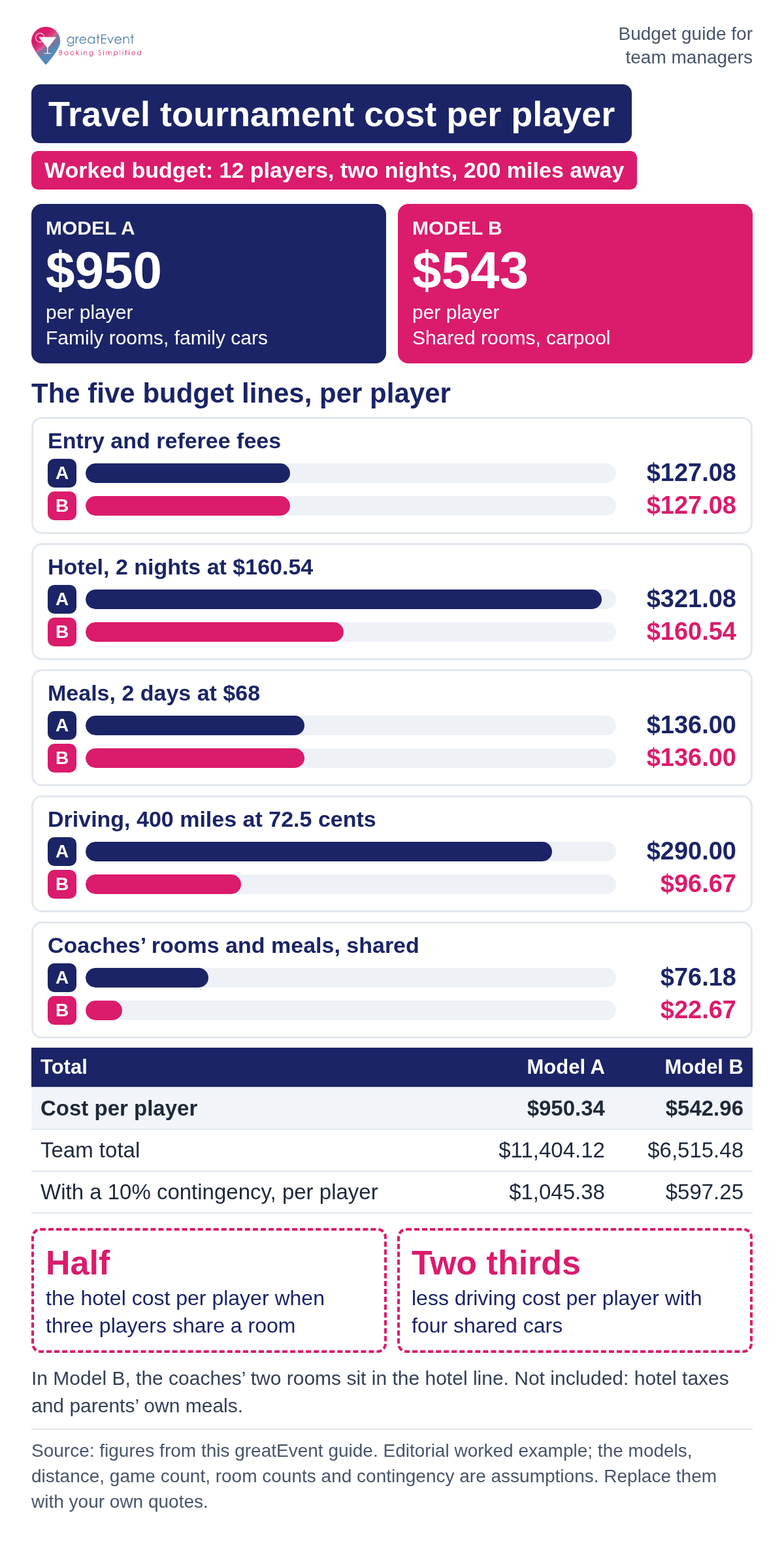
We priced the same weekend two ways. Model A is how many younger teams travel: each player stays with a parent in the family’s own room, and each family drives. Model B is how many older teams travel: players share rooms, three to a room, with two coach rooms, and the team carpools in four vehicles.
| Line, per player | Model A: family rooms, family cars | Model B: shared rooms, carpool |
|---|---|---|
| Entry and referee fees ($1,525 ÷ 12) | $127.08 | $127.08 |
| Hotel, 2 nights at $160.54 | $321.08 (one room per family) | $160.54 (6 rooms ÷ 12 players) |
| Meals, 2 days at $68 | $136.00 | $136.00 |
| Coaches’ meals, shared | included below | $22.67 |
| Driving, 400 miles at 72.5 cents | $290.00 (one car per family) | $96.67 (4 cars ÷ 12 players) |
| Coaches’ rooms and meals, shared | $76.18 | in the hotel and meals lines |
| Cost per player | $950.34 | $542.96 |
| Team total | $11,404.12 | $6,515.48 |
| With a 10% contingency | $1,045.38 per player | $597.25 per player |
In Model A, the per-player figure is really a per-family figure. Parents’ own meals are on top, and a parent’s room is the same room the player sleeps in.
The difference between the two models is almost entirely rooms and cars. Sharing rooms halved the hotel cost per player, and carpooling cut the driving cost by two thirds. Fees stayed the same, and meals rose only by the coaches’ $22.67 share.
Hotel taxes aren’t included, because they vary by city. Add your destination’s rate to the hotel line.
How to set the team fee
Most teams split the shared costs evenly across the roster. A simple way to set the fee:
- Add up the costs the team pays centrally: entry and referee fees, coaches’ rooms and meals, and any team meals.
- Divide by the number of players.
- Add a contingency. We used 10% in the example above. It covers extra games, a late checkout or a rooming change.
- Tell families separately what they pay directly, such as their own room and fuel, so nobody counts it twice.
Publish the breakdown with the fee, so families can see where the money goes before they’re asked to pay it.
How to bring the cost per player down
- Share rooms where your club’s rules allow it. In our example, three players to a room cost half as much per player as one family per room. Check the hotel’s age and supervision rules first. What hotel rules apply to youth sports teams covers them.
- Carpool. In our example, four shared vehicles instead of twelve cut driving costs by two thirds.
- Book the team block early, and compare hotels on the total cost rather than the rate alone. The team hotel comparison scorecard lists what to compare, including breakfast, parking and distance to the fields.
- Ask hotels for team perks. Marriott’s “Youth Sports Fuel the Win” promotion, for example, offers a $100 to $200 meal credit on new group contracts of 10 to 30 room nights for youth sports teams, signed by June 30, 2027, at participating US and Canadian hotels.
- Choose closer events for part of the season. Driving and hotel nights are the costs that grow with distance.
- Watch the room block terms. If fewer families book than the team committed to, the team can owe the difference. Room block attrition explains how to limit it, and tournament schedule changes covers early elimination.
Where team managers get it wrong
One mistake is quoting families only the entry fee. In our example, fees were $127 of a $543 to $950 weekend, under a quarter of the real cost.
Another is forgetting the coaches. Paying for two coaches’ rooms and meals added $76 per player in Model A.
A third is not budgeting for the room block. If the team commits to rooms and families book elsewhere, the shortfall lands on the team. Agree with families in advance that they’ll book inside the block.
Book the team hotel on greatEvent
The hotel is the biggest line in most tournament budgets, so it’s worth comparing several before you commit. Start your search on greatEvent with your tournament, dates and number of rooms. How to book hotels for a sports tournament and how many rooms a club team needs cover the rest of the booking.
There are no fees for planners. We pay you commission on any qualifying booking you make on greatEvent.
Traveling to a tournament?
Find team hotels near the fields
Compare team hotels and venues near the fields, and we’ll book the hotel room blocks your team needs.
Research and sources
Sources checked November 24, 2026. The worked budget, the two travel models, the 200-mile distance, the three-game schedule, the room counts and the 10% contingency are editorial assumptions used to show the arithmetic. Replace them with your own figures.
- Aspen Institute Project Play, “National Youth Sports Parent Survey,” with Utah State University and Louisiana Tech University, conducted online in November and December 2024 with 1,848 parents. Source of the $1,015.64 average spending, the category breakdown, and the figures by age, sport and income. Project Play’s March 2025 article “Family spending on youth sports rises 46% over five years” summarizes the findings.
- CoStar, “U.S. hotels report first full-year occupancy, RevPAR declines since 2020,” published by Hospitality Net. Source of the 2025 US average daily rate of $160.54.
- US General Services Administration, FY 2026 CONUS per diem rates, published in the Federal Register on August 19, 2025. Source of the $68 standard meals and incidentals rate.
- Internal Revenue Service, “IRS sets 2026 business standard mileage rate at 72.5 cents per mile, up 2.5 cents,” December 29, 2025. Source of the mileage rate.
- Maryland State Youth Soccer Association, 2026 State Cup and Presidents Cup application page. Source of the $675 application fee including the first game, the $275 fee per later game, and the $95 referee fee plus $5 processing fee per team per game for 11U and 12U.
- Marriott, “Youth Sports Fuel the Win Promotion Terms & Conditions.” Source of the $100 to $200 meal credit, the 10 to 30 room night eligibility and the June 30, 2027 signing date.
Frequently Asked Questions
How much does a travel tournament cost per player? ▾
For a two-night weekend 200 miles away, our worked budget for a 12-player team came to $543 per player with shared rooms and carpooling, and $950 per player when each family booked its own room and drove. Entry and referee fees were about $127 of that. Your figure depends mostly on the hotel rate, how many players share a room and how far you drive.
How much do families spend on youth sports travel a year? ▾
The average US sports family spent $278.03 on travel and lodging for a child’s primary sport in 2024, according to the Aspen Institute’s Project Play survey, out of $1,015.64 in total. Families of 15- to 18-year-olds spent $455.89 on travel and lodging, and baseball families $379.30.
Is travel baseball more expensive than travel soccer? ▾
On average, yes. In the 2024 Project Play survey, baseball families spent $1,112.50 on the sport over the year, including $379.30 on travel and lodging. Soccer families spent $910.22, including $237.27 on travel and lodging.
What is the biggest cost of a travel tournament? ▾
Usually the hotel. In our worked budget, hotel rooms were $161 to $321 per player for two nights, the largest single line in both models. Driving is next if each family takes its own car.
How much does a travel team cost per season? ▾
It depends on how many away weekends you play. Using our worked budget of $543 to $950 per player per two-night weekend, a season with six away tournaments would come to about $3,258 to $5,700 per player in travel and fees alone, before registration, uniforms and coaching. Count your own away weekends and multiply.
How do I calculate a team fee per player? ▾
Add up the costs the team pays centrally, such as entry fees, referee fees and coaches’ travel, divide by the number of players, and add a contingency of around 10%. Tell families separately which costs they pay directly, such as their own hotel room.
How can a team lower travel tournament costs? ▾
Share rooms where the hotel and club allow it, carpool, book the team block early, ask hotels for team perks such as meal credits, and choose some closer events. In our example, sharing rooms and carpooling cut the cost per player from $950 to $543.
Compare vendors for your next event
Search caterers, photographers, florists, planners, and rentals — then send one request to several vendors at once.