Quick answer: To block hotel rooms for a wedding, contact three to five hotels about 12 months out, ask each one for a courtesy block (no penalty if rooms go unsold) before you accept a contracted block, then lock the group rate, cut-off date, and attrition percentage in writing. Most chains open a block at 10 or more rooms per night. Cut-off dates run roughly 14 to 60 days before the wedding.
A room block does two things: it guarantees your out-of-town guests a room, and it holds a fixed rate so nobody pays a surprise price three weeks out. Done well, it costs you nothing but a few emails. Done badly, you sign an attrition clause and end up paying for ten empty rooms. This guide covers both sides, with the real clause names, real chain policies, and scripts you can copy.
Room blocks are also just one part of the overall wedding budget. When planning your accommodation costs alongside the venue and other major expenses, reviewing average wedding costs in 2026 can help you see where hotel rooms fit into the larger picture.
What is a wedding hotel room block?
A block is a set of rooms a hotel holds for your guests at an agreed rate until a stated cut-off date. Guests book themselves using a group code or a booking link. At the cut-off, anything unsold goes back to public inventory, usually at retail rates.
There are two kinds, and the difference is entirely about who carries the financial risk.
Courtesy block vs guaranteed block
| Courtesy (“open”) block | Guaranteed (“contracted”) block | |
| Your risk if rooms go unsold | None. Unsold rooms simply release at the cut-off | You are liable for unused rooms past the attrition threshold |
| What the hotel asks for | Often just a credit-card guarantee, no advance deposit | Deposit or credit-card guarantee, sometimes 25–50% up front |
| Typical minimum | 10 or more rooms | 10 or more rooms |
| Attrition clause | None | Yes, commonly 10–30% allowed unfilled |
| Best for | Most weddings, especially smaller blocks | Large blocks and high-demand dates where the hotel will not budge |
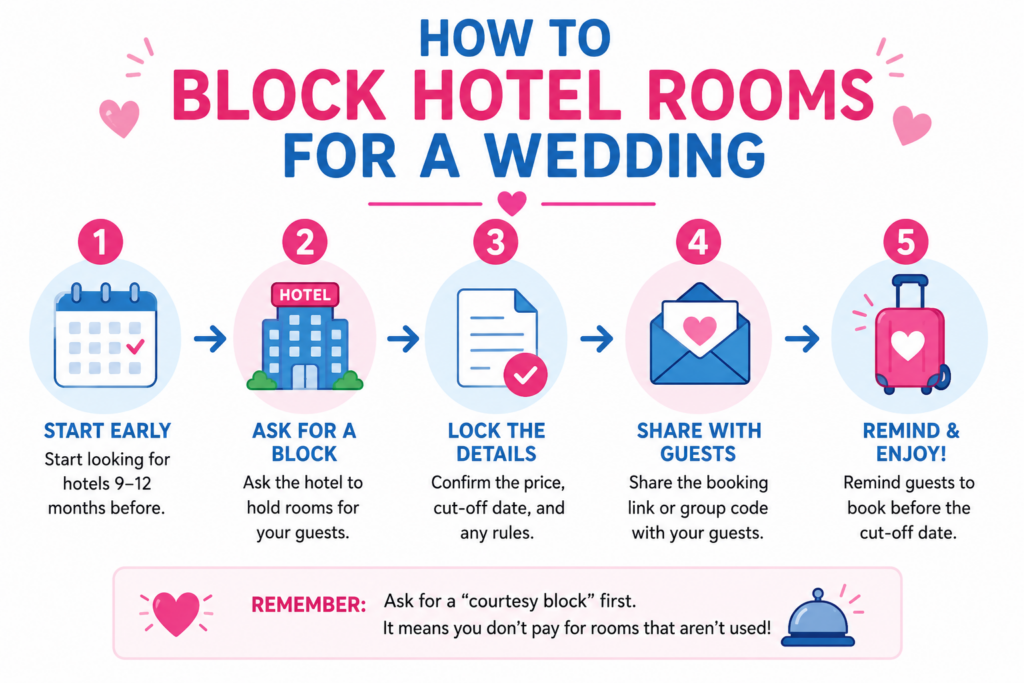
Always ask for the courtesy block first. It removes attrition risk completely, and plenty of properties will grant one for a wedding-sized group even when it is not their default. If the hotel insists on a contract, negotiate the attrition clause as light as you can get it, and aim for at least 20% washout when you are unsure how many guests will actually book.
How many rooms should you block?

Start from who is traveling, not from your total guest list. Plan on roughly 75% double occupancy, meaning about two guests per room, then round up.
Two constraints to plan around:
- Most chains treat 10 rooms as the minimum to open a group rate.
- Chain blocks often cap around 20–25 rooms per property. Need more? Ask for an additional block or split across two hotels.
Build in a cushion of about 10–15% in your lodging budget for last-minute overflow at retail rate, or for comping a room for an out-of-town VIP. It is easier to shrink a block at a review point than to find four rooms in town the week of the wedding.
When estimating the full wedding budget, remember that hotel rooms are separate from the cost of the actual event space. Comparing event space costs and party venue pricing can help you keep those two categories separate when calculating total expenses.
When should you start, and what happens when?
Start the hotel search 6–12 months out at minimum. If your date falls in a busy season or a small town, begin closer to 12 months.
| Timing | What to do |
| 12+ months | Lock the venue and date. Shortlist 3–5 hotels on proximity, price range, and shuttle access |
| 9–12 months | Request bids, negotiate terms, sign, pay any deposit, set up the group code or booking link |
| 6–9 months | Announce the block on save-the-dates and your wedding website. State the cut-off date |
| 4–2 months | Send a reminder. Confirm headcount and resize the block using your room block review clause |
| 30–14 days | Cut-off hits. Unsold rooms release to the public at best available rate |
| Under 14 days | Send the hotel your rooming list, confirm welcome bags, shuttle schedule, and signage |
| Wedding week | Onsite liaison on duty. Greet guests, handle check-ins and walk-ins |
| After the wedding | Review the master bill. Confirm comps applied correctly and holds were released |
Adjust the months to your own date. The sequence matters more than the exact numbers.
The seven-step process
- Set your date and estimate room-nights. Count out-of-town guests, assume about two per room, add your 10–15% cushion.
- Shortlist 3–5 hotels. Filter on distance to the venue, price range, and whether a shuttle is realistic.
- Send the same inquiry email to all of them. Ask about courtesy vs guaranteed blocks, the all-in group rate, minimum-night stays, parking, and check-in time. Script below.
- Compare and negotiate. Rate first, then perks. Use the best offer to push the others.
- Sign a contract that names every term. Room counts, rates, dates, attrition percentage, cut-off date and time, waived fees, shuttle provisions.
- Announce the block and monitor bookings. Share the link and code, then send a reminder roughly 60–45 days before the cut-off.
- Finalize and reconcile. Rooming list to the hotel inside 14 days, coordinate the weekend onsite, then check the master bill afterward.
A comprehensive wedding planning checklist can also help you coordinate the room block alongside venue selection, guest arrangements, and other major wedding tasks.
How do the major chains differ?
Terms vary by brand and by individual property, but the standard contract language gives you a useful baseline of what to expect and what to push on.
| Policy | Marriott (Westin, Sheraton, etc.) | Hilton (DoubleTree, Embassy, etc.) | Hyatt (Regency, Place, etc.) | IHG (Holiday Inn, Candlewood, etc.) |
| Block type | Usually contracted; courtesy blocks rare | Usually contracted | Contracted, standard attrition terms | Courtesy blocks common, no attrition penalty |
| Minimum block | ~10 rooms for a group rate | ~10 rooms | ~10 rooms | ~10 rooms |
| Cut-off | ~14 days before the event | ~21 days before the event | Unsold rooms return to inventory after cut-off; no fixed number of days noted | ~30 days before the event |
| Attrition | ~10% allowed as “wash” before penalty | Typically 20% (80% of block must be picked up) | Hotel resells unused rooms; no attrition fee if the hotel reaches full occupancy | 0% on a courtesy block |
| Cancellation | Fees apply after the agreement is signed; tied to attrition terms | 80% of the block if cancelled after cut-off | Per contract, typically similar to the attrition policy | No penalty for cancelling an entire courtesy block |
| Deposit | Often a credit-card guarantee; schedule varies by property | Often full payment on card ~24 hours before the event, negotiable | Signed contract plus deposit, often 25–50% up front; master bill around 60 days prior | Credit-card guarantee, usually no advance deposit |
| Early departure | 100% penalty for early checkout | Similar, likely 100% of remaining room nights | Likely charged as attrition | Not specified; guest cancellation fees may apply |
Two useful details buried in the fine print. IHG’s courtesy block language reduces the total rooms blocked by 25% at 60 days prior, then releases all unreserved rooms at 30 days. Hyatt commits to relocating a guest if a reserved room is not available.
Actual terms differ by property, so verify everything against the contract in front of you.
Contract clauses that cost couples money

Read the block agreement line by line. These are the ones worth an email back to the sales manager.
- Attrition. Confirm the percentage and, just as important, how it is measured: cumulative across the stay, or night by night. Ask whether rooms guests book outside your block still count toward your minimum. Nightly measurement is harsher than cumulative.
- Cut-off date and time. Get the exact wording. Marriott’s standard clause reads: “The ‘Cut-off date’ for reserving rooms in the Room Block is 5:00 p.m. local time at Hotel 14 days before the start date. After the cut-off date, it is at Hotel’s discretion whether to accept additional reservations, which will be subject to prevailing rates and availability.”
- Early departure. Many hotels charge 100% of any room a guest checks out of early. Ask for that to be waived or capped.
- Master card authority. Check whether the card on file can be charged for attrition or incidentals after the wedding. Put a limit on it.
- Hotel’s own cancellation right. Some contracts let the hotel cancel your group within 72 hours of signing with no liability. Negotiate that out.
- Force majeure. Liability usually ends if the wedding itself is cancelled, but not if individual guests cancel. Make sure the language is reasonable and that you know which scenarios release you.
- Room block review. Ask for a clause about 4–6 weeks before the cut-off that lets you resize the block without penalty. This one clause prevents most attrition bills.
- ADA rooms. Name the number of accessible rooms you need and get them held.
What will a wedding block actually cost?
Group rates typically land 10–40% below published rates, with the spread depending on city and season. For budgeting, assume 15–25% off and treat anything better as a win.
| Line item | What to expect |
| Group rate discount | 10–40% off published rate; budget 15–25% |
| Parking | $10–30 per night, often negotiable to zero |
| Resort fee | Florida resorts, for example, often add 10–20% per night |
| Incidental hold | Pre-authorization on each guest’s card, commonly $50–100 per night and up to $200+ at some properties |
| Contingency | Add 10–15% to your lodging budget for overflow and comp rooms |
Get taxes, resort fees, and service charges quoted upfront, not after you sign. A rate that looks $15 cheaper can lose to a rate with breakfast included and no parking charge.
Comparing lodging types for a 25-room block in a city, one analysis puts the hotel group rate around $150–200 per night against roughly $120–180 for Airbnb, before cleaning fees. Rural weddings, where hotel inventory is thin, tend to save more with short-term rentals.
One note for guests: incidental holds are not charges. Tell people the hold exists so nobody panics at check-in.
Negotiating: what to ask for and how
The room rate is the biggest single lever, so settle that first. Then move to guest-facing perks, because those are cheaper for the hotel to grant and more visible to your guests. Complimentary breakfast or waived parking can save each guest $20–30.
Talking points that work:
- “We’d prefer a courtesy block with no attrition if that’s possible.”
- “Can the cut-off be set 30 days before the wedding?” (Later, if they’ll go there.)
- “Could you waive parking fees and include breakfast for our block?”
- “We have a lot of out-of-town guests. Would you provide a shuttle between the hotel and the venue?”
- “If we fill over [X]% of the block, would you release us from attrition penalties or extend the cut-off?”
- “We need ADA-accessible rooms. Can you guarantee at least [Y] accessible units?”
Also ask whether unsold rooms can release gradually, in chunks between 30 and 10 days out, rather than all at once. And if the hotel charges a handling fee to drop welcome bags in rooms, ask for it to be complimentary as part of the block.
Copy-paste: initial hotel inquiry email
Subject: Wedding Room Block Inquiry for [Hotel Name]
Hello [Sales Manager],
I am planning a wedding on [date] with about [X] out-of-town guests needing rooms. We’d like to reserve roughly [number] rooms (check-in [date], check-out [date]). Could you let me know:
Do you offer a courtesy (no-penalty) block, or do we need a guaranteed block? What group rate can you offer, including all taxes and fees, and is there a minimum-night stay? What are your check-in time and parking fees, with in/out privileges? If a honeymoon suite or upgrade is available on [wedding night], what is the rate?
Thank you for your help. We look forward to working with you.
[Your name, phone, email]
Send that identical email to every hotel on your shortlist. Comparable answers make the comparison easy.
Telling your guests
Keep the announcement short and put every detail in one place.
For your convenience, a block of rooms has been reserved at [Hotel Name] at a discounted rate. You may book online via [Booking Link] or call [Hotel Phone] and reference the “[Last Name] Wedding.” The cut-off date to reserve at this rate is [Date]. Please book early to guarantee availability.
Post that on your wedding website and include it with invitations, along with the hotel address, booking link, and group code.
Two more pieces of guest communication worth building:
- RSVP wording. Ask directly whether guests need accommodations: “Will you be staying overnight? Yes, [Hotel Name] (we’ve reserved a block) / No.” That answer is what sizes your block.
- Reminder email. About 60–45 days before the cut-off: “Don’t forget to reserve your room for [Name] & [Name]’s wedding by [Cutoff Date]. After that date, rooms may not be available at our group rate.”
Wedding weekend logistics
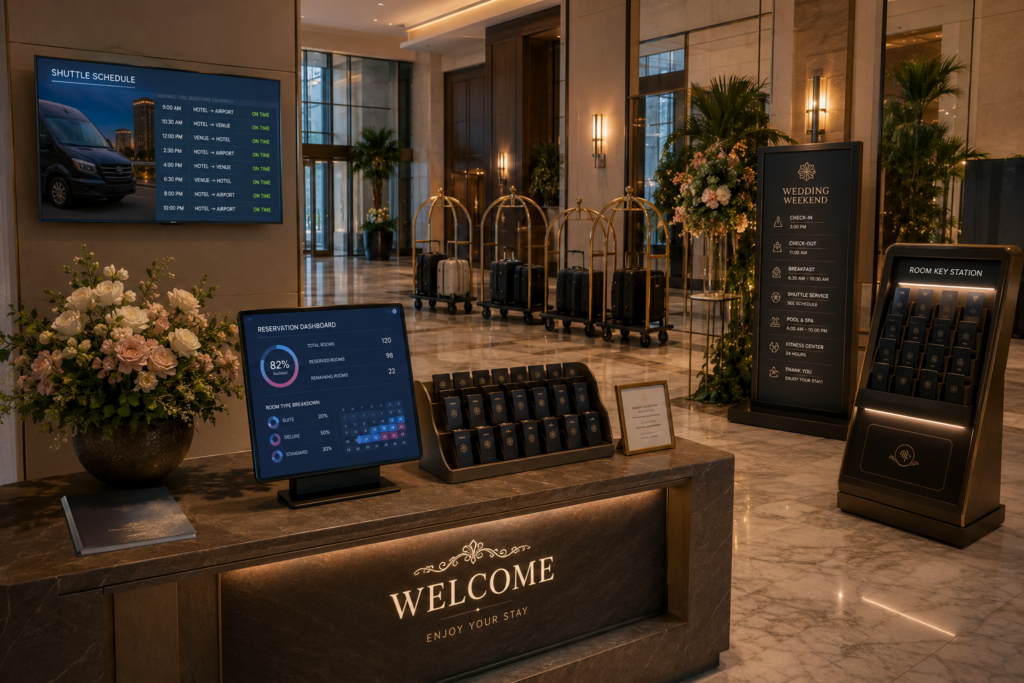
The block itself is only half the job. The weekend runs on a handful of small arrangements.
- Rooming list. Keep it current and send confirmed names to the hotel as early as they require, often around two weeks out. Finalize 1–2 weeks before check-in and flag special needs or early check-ins then.
- Check-in timing. Confirm the hotel’s check-in window, commonly 3:00–4:00 PM, and check-out, often noon. If a lot of guests land together, ask about express or dedicated check-in.
- Welcome desk. A table in the lobby with name badges, the weekend itinerary, and shuttle times answers 90% of guest questions before they get asked.
- Signage. Lobby signage or tent cards with the block name and event locations. Post the group code on any info board.
- Shuttles. Build a written schedule. Confirm pickup and dropoff points with the hotel, verify capacity if the hotel provides the vehicle, and send instructions to guests in advance.
- Onsite point person. Assign someone from the wedding party as the hotel-day contact, and make sure the hotel’s sales manager or event planner is reachable.
If your wedding is at an outdoor property or a venue where transportation and guest access require more planning, an outdoor event venue guide can provide additional context when thinking through venue logistics and guest movement.
When one hotel is not enough
- Split across hotels. Book two nearby properties, perhaps one for family and one for friends. Keep rates and amenities comparable, and route the shuttle through both. Negotiating separately also lets you use the better offer to push the second hotel.
- Third-party platforms. Services like Engine Groups and Roomblocks.com aggregate hotel options and negotiate group rates on your behalf. Engine’s wedding platform matches your requirements to hotels and handles booking logistics. Many advertise as free, so confirm whether any fees apply.
- Short-term rentals. In rural areas or fully booked markets, listing Airbnb options alongside the hotel block gives guests a choice and covers family-size needs. It complicates transportation, so group rentals into a few pickup points or offer rideshare vouchers. Keep the hotel block regardless: short-term rentals have limited ADA accessibility, and guests with mobility needs will need the hotel.
- Flexible dates. If your date can move, some hotels price Sunday check-out nights lower.
Key takeaways
- Ask for a courtesy block first. No attrition risk, no deposit, unsold rooms simply release.
- Ten rooms is the usual minimum for a group rate; chain blocks often cap around 20–25 rooms.
- Start the search 6–12 months out, and up to 12 months for busy dates or small towns.
- Cut-off dates range from ~14 days (Marriott) to ~30 days (IHG). Get the exact date and time in the contract.
- Group rates run 10–40% below published rates; budget for 15–25% plus taxes, resort fees, and parking.
- A room block review clause 4–6 weeks before cut-off is the cheapest insurance against an attrition bill.
Frequently Asked Questions
How many rooms do you need for a wedding hotel block?▾
Most U.S. chains open a group rate at 10 or more rooms. Blocks booked directly with a chain often cap around 20–25 rooms, so larger groups need a second block or a second hotel. Plan roughly 75% double occupancy, about two guests per room, when converting your guest count into a room count.
When should I book a hotel block for my wedding?▾
Start 6–12 months before the wedding, and closer to 12 months if your date is in a high-demand season or a town with limited hotel inventory. Contact 3–5 hotels at once to compare rates and perks. Sign the contract and set up your booking code around 9–12 months out.
What is a courtesy block?▾
A courtesy or open block holds rooms for your group with no financial obligation. If rooms go unsold, they release to public sale at the cut-off date and you owe nothing. IHG brands offer courtesy blocks for weddings commonly, typically with a 30-day cut-off, and any hotel is worth asking.
What is attrition on a wedding room block?▾
Attrition is the share of your block you are allowed to leave unfilled without penalty, commonly 10–30%. If a 50-room block carries an 80% pickup requirement and only 40 rooms book, you pay for the 10 empty nights. Ask how attrition is measured and whether rooms booked outside the block count toward your minimum.
What is a room block cut-off date?▾
The cut-off is the date and time the hotel releases unsold blocked rooms back to general inventory, usually at retail rates. It commonly falls around 30 days before the event, but varies by chain: roughly 14 days for Marriott, 21 for Hilton, and 30 for IHG. A later or more flexible cut-off is one of the most valuable concessions to negotiate.
How much discount do wedding room blocks get?▾
Group rates typically run 10–40% below published rates, with the range depending on city and season. Budget on 15–25%. Confirm whether taxes, resort fees, and parking are included, since a lower headline rate with a resort fee and paid parking can cost more than a slightly higher all-in rate.
Do guests pay for their own rooms in a wedding block?▾
In most wedding blocks, guests book and pay for their own rooms using the group code or booking link. Couples who want to cover rooms usually do so for specific guests via a master bill arrangement with the hotel. Either way, tell guests about incidental holds, which run roughly $50–100 per night and higher at some properties.
What happens if guests do not book enough rooms?▾
On a courtesy block, nothing: the extra rooms release at the cut-off with no charge. On a guaranteed block, you pay for unfilled rooms beyond the attrition allowance. Some chains soften this, and Hyatt waives the attrition fee if the hotel resells the rooms and reaches full occupancy.
Compare vendors for your next event
Search caterers, photographers, florists, planners, and rentals — then send one request to several vendors at once.