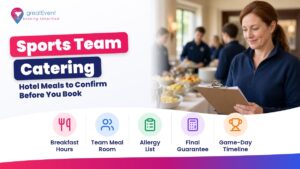
Quick answer: Sports team catering starts with the hotel. Before you sign for the room block, confirm breakfast hours against your earliest departure, boxed breakfasts for early buses, a private team meal room with its capacity and cost, and one allergy list sent ahead. Then get per-person prices, service charges, the final guarantee deadline, and outside-food rules in writing.
Example scenario (fictional): A volleyball club takes two teams to a weekend tournament: 24 athletes and 4 coaches, 28 people in all. Saturday’s first match is at 8:00 a.m., and the coaches want the bus to leave the hotel at 7:00 a.m. The hotel’s included breakfast opens at 6:30 a.m. in a lobby area with seating for about a dozen people. The club, the times, and the seating are invented, and the same numbers are used later in this post.
This is for team managers, club travel managers, athletic department operations staff, and tournament directors who book team hotels and feed traveling teams. It covers what to settle about hotel meals and catering before you sign: breakfast timing, a team meal room, allergy and dietary lists, prices and guarantees, outside caterers, and schedule changes. It ends with a meal brief you can copy and send to each hotel. Hotel terms differ by property, and your contract and banquet event orders control. This post is planning information, not legal or medical advice.
Check the housing rules before you plan meals
Some tournaments require teams to book through an official housing block, often called stay-to-play. If yours does, book through that channel first, and send your meal requests to the hotel you are assigned or choose from the event’s list. Don’t book outside the block to get a better breakfast. Our guide to stay-to-play tournament requirements explains how those rules work and who can be exempt. The rest of this guide applies either way; only the list of hotels you can ask changes.
Start from the game schedule
Write down every fixed time first: arrival, practices, match or game times, bus departures, and checkout. Then put each meal where it fits. For most tournament days that means four questions. Can everyone eat before the bus leaves? What happens in the gap between games? Where does the team eat dinner together? What do late arrivals or late games need?
| Meal | When it usually falls | What to confirm with the hotel |
|---|---|---|
| Breakfast | Before the earliest bus or first warm-up | Opening time on game days, seating for the whole group at once, and whether boxed breakfasts are possible for early departures |
| Between games | In the gap between morning and afternoon games, often at the venue | Whether the hotel or a caterer can pack lunches or snacks, pickup time, and how cold food is kept cold |
| Team dinner | Evening, after the last game and recovery | A private room or reserved area, the menu, the per-person price, and the guarantee deadline |
| Late or extra meals | After a late game, or on an extra night | Late service or a cold plate option, and how to add a meal at short notice |
In the example, the bus leaves at 7:00 a.m. and the included breakfast opens at 6:30 a.m. That leaves 30 minutes for 28 people in a space that seats about 12. The fix is a request you make before signing: an early team breakfast at 6:00 a.m. in a private room, or boxed breakfasts handed out at the bus.
Breakfast on game days
Included breakfast varies by brand and hotel. One hotel company’s team program terms, last updated September 25, 2026, list buffet or grab-and-go breakfast at its upscale brands, grab-and-go breakfast at its extended-stay brands, and a brand-standard breakfast at its midscale brands. The same terms say breakfast details are confirmed during the proposal and contract, and that program benefits vary by hotel and aren’t guaranteed. Treat any brand promise as a starting point and get your own hotel’s answer in writing.
If you are still choosing between hotels, our team hotel comparison scorecard gives breakfast timing its own weighted row. Once you’ve picked the hotel, ask these questions and keep the answers with the contract:
- What time does breakfast open on our game days, and can it open earlier for the team?
- Can the whole group sit at once, or should we use a private room?
- Can you provide boxed or grab-and-go breakfasts for departures before breakfast opens, and what goes in them?
- Is breakfast included in our group rate, and for how many people per room?
- If we add an early or private breakfast, what is the per-person price, and do a service charge and tax apply?
The team meal room
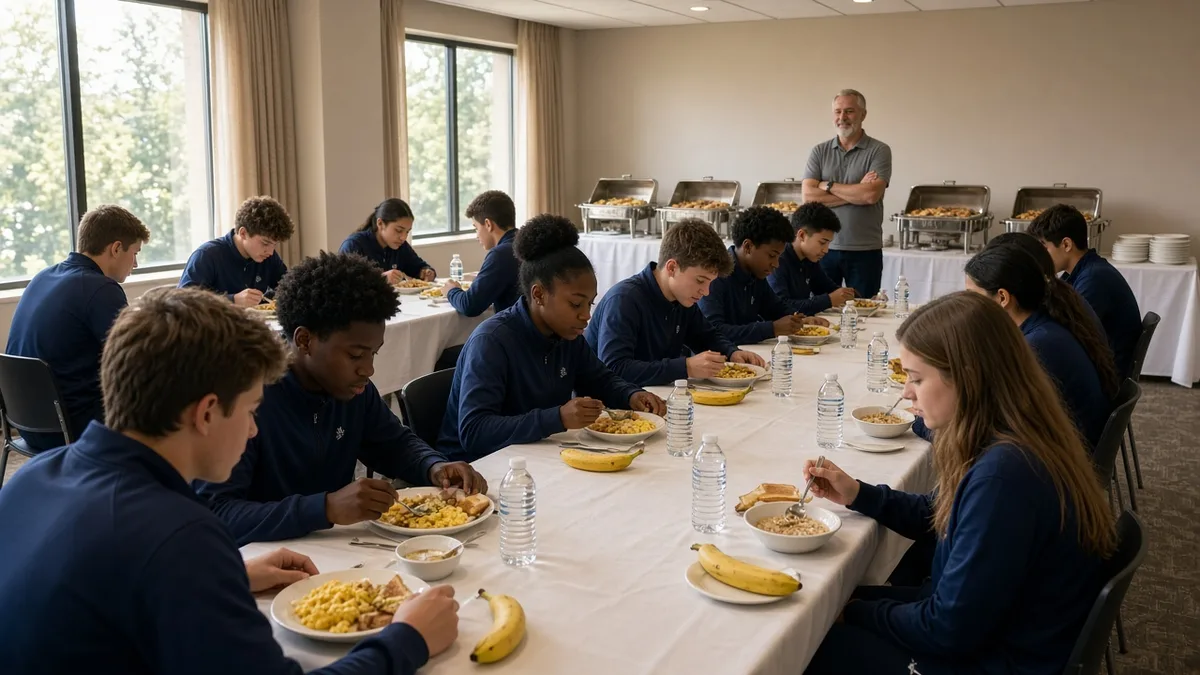
A private room gives the team one place to eat at a set time, away from other guests. Coaches can also use it for meetings or film review between meals, if the hotel agrees. Ask for the room’s capacity in your setup (long tables or rounds), the hours you can use it each day, whether it stays set between meals, and what it costs. Hotels price meeting space in different ways: a rental fee, a food and beverage minimum, or a mix. Our guide to F&B minimums vs. room rental shows how to compare the two without counting the same dollars twice.
For youth teams, decide who supervises meals and where coaches sit, and put meal times in the parent itinerary. Our guide to booking hotel rooms for youth sports teams covers supervision and rooming rules for minors.
Allergies and dietary needs: one list, sent early
Collect allergies and dietary needs once, with the travel roster, and send one list to the hotel’s catering contact and to any outside caterer. Keep allergies separate from preferences, so the kitchen can tell a medical need from a choice. The FDA lists nine major food allergens in the U.S.: milk, eggs, fish, crustacean shellfish, tree nuts, peanuts, wheat, soybeans, and sesame. Use those nine as the checklist on your form, with a line for anything else.
Your headcount comes from the same roster. Athletes, coaches, trainers, and staff may not all eat every meal, so count each meal separately. Ask the hotel how it labels buffet items and whether it can plate allergy meals separately with names on them. Keep medical plans for athletes with severe allergies with your team’s medical staff.
Prices, service charges, and the final guarantee
Ask for each meal’s per-person price, then check what is added on top: a service charge, a gratuity, or both, plus tax. Read how your hotel defines each one. One national hotel brand’s published banquet terms for its US, Canadian, and Puerto Rico hotels (last revised September 3, 2019) define a gratuity as a charge that is “fully distributed to servers,” and a service charge as one that “is not a gratuity but rather is the property of the Hotel.” Ask which one appears on your quote.
Those same terms show how the count works:
- An expected number of attendees is due by noon, hotel time, 10 business days before the event.
- The final guarantee is due by noon, hotel time, 3 business days before, and “cannot be reduced after this time.”
- The expected number can move up or down by up to 10% at the final guarantee without extra charge. A bigger reduction adds a surcharge.
- You are charged for the guarantee or the number served, whichever is greater, and the hotel prepares food only to the guaranteed number.
Applied to the fictional club: you send an expected count of 28 for Saturday’s team dinner. By our count, three business days before a Saturday is Wednesday, so the final guarantee would be due Wednesday at noon. Ask the hotel to write the exact date and time on the order. If two athletes drop out on Tuesday, a final guarantee of 26 is a cut of about 7%, inside the 10% allowance. A cut to 25 would be about 11%, which triggers the surcharge under those terms. If one more athlete is sick on Saturday, you still pay for 26. Your hotel’s numbers may be different, so read your own banquet terms.
Each meal function gets its own banquet event order (BEO) listing the time, room, menu, count, and charges. Our guide to reading a banquet event order has a checklist for reviewing each one before you sign it.
Outside food and sports team catering from your vendors
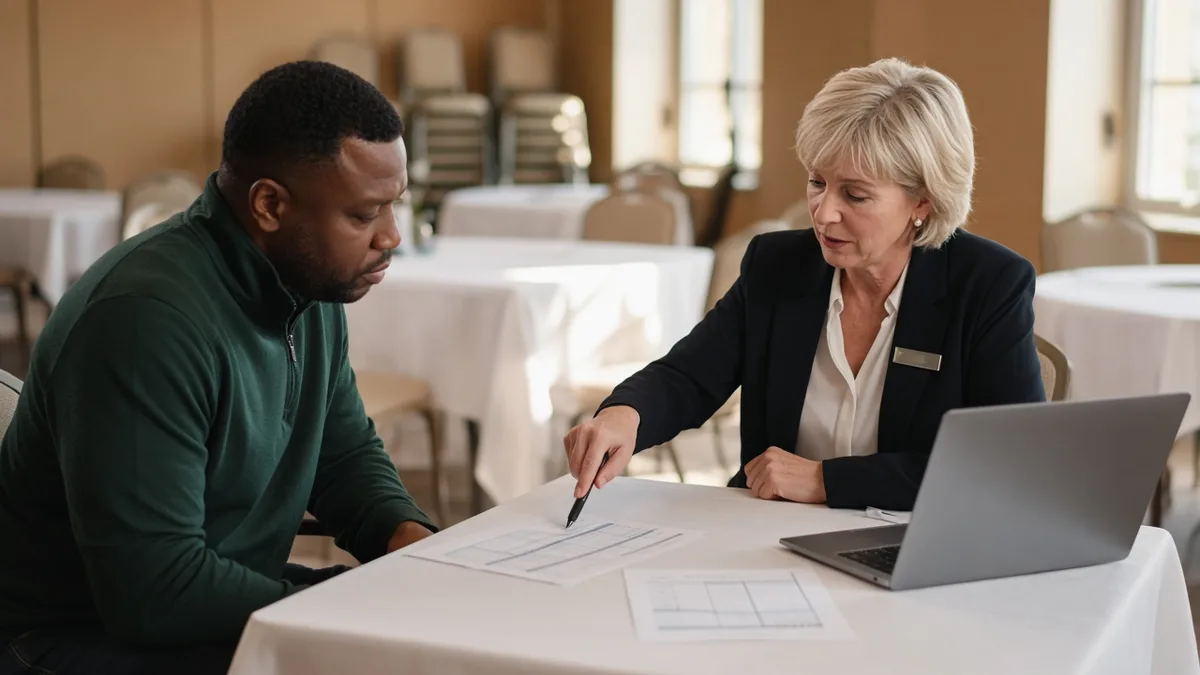
Hotels set their own rules on outside food. The national brand terms quoted above say you must get “prior approval” before bringing in food or non-alcoholic beverages, and that service fees apply to outside food served in function space, even when no hotel staff are needed. The hotel company’s team program terms go the other way for some of its brands, listing outside food and beverage at no charge as a possible benefit, again varying by hotel. Ask the question directly and get the answer in the contract.
Bringing in a caterer can make sense when the hotel has no banquet kitchen, when its breakfast is grab-and-go only, or when you need packed lunches at the venue. Treat caterers like your vendors and suppliers for any other event: send them the same schedule, headcount, and allergy list, and confirm delivery times and where food will be kept.
Packed meals between games need a food safety plan. The USDA’s Danger Zone guidance says to keep cold food at or below 40°F and hot food at or above 140°F, and not to leave food out of refrigeration for more than 2 hours, or 1 hour when it is above 90°F. Ask the caterer or hotel how lunches will stay cold until the team eats, and plan pickup times so food isn’t sitting in a hot bus or at the side of a field.
When the schedule changes
Brackets move. A team can be eliminated early, a game can be delayed, or a run to the final can add a night. Before you sign, ask how meal orders change in each case: the deadline to cancel or move a meal, what you owe after the final guarantee, and how quickly the hotel can add a late dinner or an extra breakfast. Because a final guarantee usually can’t be reduced once it’s in, send it at the deadline rather than early. For the room side of the same problem, see our guide to hotel terms when a tournament schedule changes.
A team meal brief to send each hotel
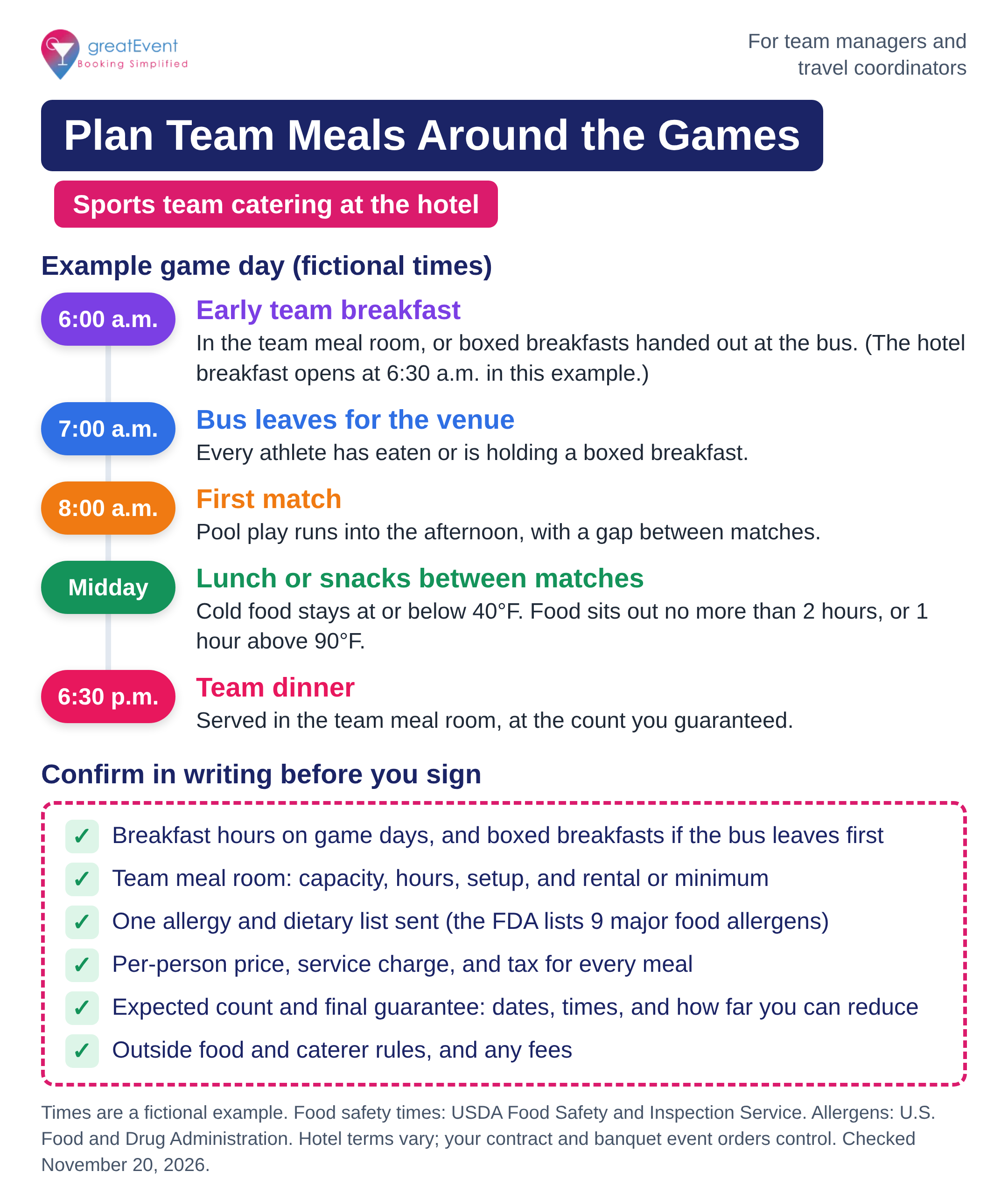
Fill this in and send it with your room block request, so every hotel answers the same questions. The infographic below shows the example game day and the six items to get in writing.
TEAM MEAL BRIEF
Team / organization: ______________   Event: ______________
Dates: ______   Group size: ___ athletes, ___ coaches/staff
Housing: official block required?  Yes / No   Assigned hotel: ______

SCHEDULE (fill in per day)
Day/date | Earliest departure | Games/practices | Return to hotel
_________ | __________________ | _______________ | _______________

MEALS REQUESTED (per day)
Breakfast:  included / early team breakfast at __:__ / boxed at __:__
Between games:  packed lunches or snacks, pickup at __:__, for ___
Team dinner:  __:__ in a private room for ___ people
Late meals:  ______________

DIETARY LIST (attached, one line per person)
Allergies (milk, eggs, fish, crustacean shellfish, tree nuts,
peanuts, wheat, soybeans, sesame, other): ___
Other dietary needs: ___

PLEASE CONFIRM IN WRITING
[ ] Breakfast opening time on our game days
[ ] Team meal room: name, capacity, setup, hours, rental or minimum
[ ] Per-person price per meal, service charge, and tax
[ ] Expected count and final guarantee deadlines (date, time, time zone)
[ ] How far we can reduce counts, and when
[ ] Outside food and caterer rules, and any fees
[ ] How meal orders change if our schedule changes
Text version of the infographic
Plan team meals around the games (sports team catering at the hotel). Example game day, with fictional times: 6:00 a.m. early team breakfast in the team meal room, or boxed breakfasts handed out at the bus (the hotel breakfast opens at 6:30 a.m. in this example). 7:00 a.m. bus leaves for the venue; every athlete has eaten or is holding a boxed breakfast. 8:00 a.m. first match; pool play runs into the afternoon, with a gap between matches. Midday, lunch or snacks between matches; cold food stays at or below 40°F, and food sits out no more than 2 hours, or 1 hour above 90°F. 6:30 p.m. team dinner in the team meal room, at the count you guaranteed.
Confirm in writing before you sign: breakfast hours on game days, and boxed breakfasts if the bus leaves first; the team meal room’s capacity, hours, setup, and rental or minimum; one allergy and dietary list sent (the FDA lists 9 major food allergens); the per-person price, service charge, and tax for every meal; the expected count and final guarantee dates, times, and how far you can reduce; and outside food and caterer rules, with any fees. Food safety times are from the USDA Food Safety and Inspection Service and allergens from the U.S. Food and Drug Administration. Hotel terms vary, and your contract and banquet event orders control.
Book team hotels and meal space on greatEvent
Where the event’s housing rules allow it, you can search hotels and venues on greatEvent and request a hotel room block for your dates. Send the team meal brief with your request so each hotel answers the same questions. For meals the hotel can’t cover, you can also find your vendors and suppliers on greatEvent, such as caterers and venues for an end-of-season team dinner. If the event requires official housing, book through that channel and use the brief with your assigned hotel.
There are no fees for planners. We pay you commission on any qualifying booking you make on greatEvent.
Register as a professional planner
Frequently asked questions
What should a sports team confirm about hotel meals before booking?
▾
Confirm breakfast hours against your earliest departure, boxed breakfasts for early buses, a private meal room with its capacity and cost, and how the hotel handles allergies. Then get per-person prices, the service charge, the final guarantee deadline, and outside-food rules in writing.
Is the hotel’s free breakfast enough for a team on game days?
▾
Only if it opens early enough and the team can sit together. If the bus leaves before breakfast opens, ask for an early team breakfast or boxed breakfasts.
Can we bring an outside caterer into the hotel?
▾
It depends on the hotel. Some require approval and charge a fee for outside food in meeting rooms, and some team programs allow it at no charge. Get the rule in your contract.
When is the final meal count due?
▾
Each hotel sets its own deadline, so check your banquet terms. Once it passes, the count may not be reducible, and some hotels bill the guarantee or the number served, whichever is higher.
How should we collect allergies for a traveling team?
▾
Collect them once with the travel roster, keep allergies separate from preferences, and send one list to the hotel and any caterer well before the trip.
What happens to meal orders if we are eliminated early?
▾
Check the cancellation and guarantee terms for each meal before you sign, and ask how much notice the hotel needs. A meal past its final guarantee deadline may still be charged.
Research and sources
Sources were checked on November 20, 2026. The opening scenario and the guarantee math are fictional: the club, headcount, times, and seating are invented to show the method. Hotel terms are quoted from published documents as examples only; your own proposal, contract, and banquet event orders control. This post is planning information, not legal or medical advice.
- U.S. Food and Drug Administration, “Food Allergies,” major food allergens section, read November 20, 2026.
- USDA Food Safety and Inspection Service, “Danger Zone (40°F – 140°F),” last updated June 28, 2023, read November 20, 2026.
- Published banquet event order additional terms and conditions of a national hotel brand for hotels in the U.S.A., Canada, and Puerto Rico, last revised September 3, 2019, definitions, guarantee of revenue, and outside food and beverage sections, read November 20, 2026.
- Published team stays program terms and conditions of a national hotel company, last updated September 25, 2026, program offerings section (breakfast by brand tier and outside food and beverage), read November 20, 2026.
Compare vendors for your next event
Search caterers, photographers, florists, planners, and rentals — then send one request to several vendors at once.