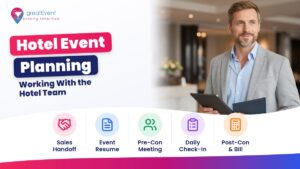
Quick answer: Hotel event planning keeps going after the contract is signed. The sales manager who sold you the program hands it to a conference or convention services manager (CSM), and from then on the event runs on documents and meetings: an event resume that the hotel turns into orders for its departments, banquet event orders you sign, a pre-con meeting just before the event, a short check-in each morning on site, and a post-con meeting where you close out the bill. Agree on contacts, signers, and change rules in the first call with your CSM, and every step after that gets easier.
Example scenario (fictional): An agency planner in Denver has just signed a three-day regional sales meeting for 180 attendees at a full-service hotel. The program has a hotel room block, a general session, six breakouts, two lunches, and an awards dinner. The planner has never worked with this hotel before. The sales manager sends a short email introducing the CSM and says the CSM will “take it from here.” The planner still needs a working rhythm with a hotel team they have never met.
This is for professional meeting and event planners and agencies who run client events at hotels. It starts where the contract ends and covers the handoff from sales, how the hotel side works, the documents the hotel works from, communication rules, the pre-con meeting with an agenda you can copy, the daily check-in on site, and the post-con meeting. If you want a refresher on job titles first, our guide to the hospitality industry for event planners has a role-by-role table.
In this guide:
- Hotel event planning at a glance
- The handoff from sales to your CSM
- How the hotel side works, and what it means for you
- The event resume and the orders the hotel works from
- Set the communication rules early
- The pre-con meeting
- Copyable pre-con meeting agenda
- On site: the daily check-in
- The post-con meeting and the final bill
- When the working relationship hits a snag
- FAQ
Hotel event planning at a glance
Once the contract is signed, a hotel event moves through six handoffs. Each one has a hotel lead, something you bring, and something you should leave with. The timing below is planning guidance. Your contract sets the real document dates, and titles vary from hotel to hotel.
| Stage | Timing (planning guidance) | Hotel lead | What you bring | What you leave with |
|---|---|---|---|---|
| Contract signed | At signing | Sales manager | Signed contract, concessions, and anything sales promised, in writing | An introduction to your CSM |
| Handoff call | Soon after signing | CSM | Your contacts, signers, and change rules | The hotel’s document dates and its contacts |
| Resume and BEOs | Weeks out, on the contract dates | CSM, catering | Event resume, function schedule, room sets | BEOs to review and sign |
| Pre-con meeting | Just before the event | CSM and department heads | Final resume, BEO packet, contact sheet, signers list | One shared plan and named contacts |
| Daily check-in | Each morning on site | CSM, banquet captain | Yesterday’s issues and today’s changes | Signed changes and checked postings |
| Post-con and final bill | Right after the event | CSM, sales, accounting | Your notes, counts, and open questions | A final bill date and the group history |
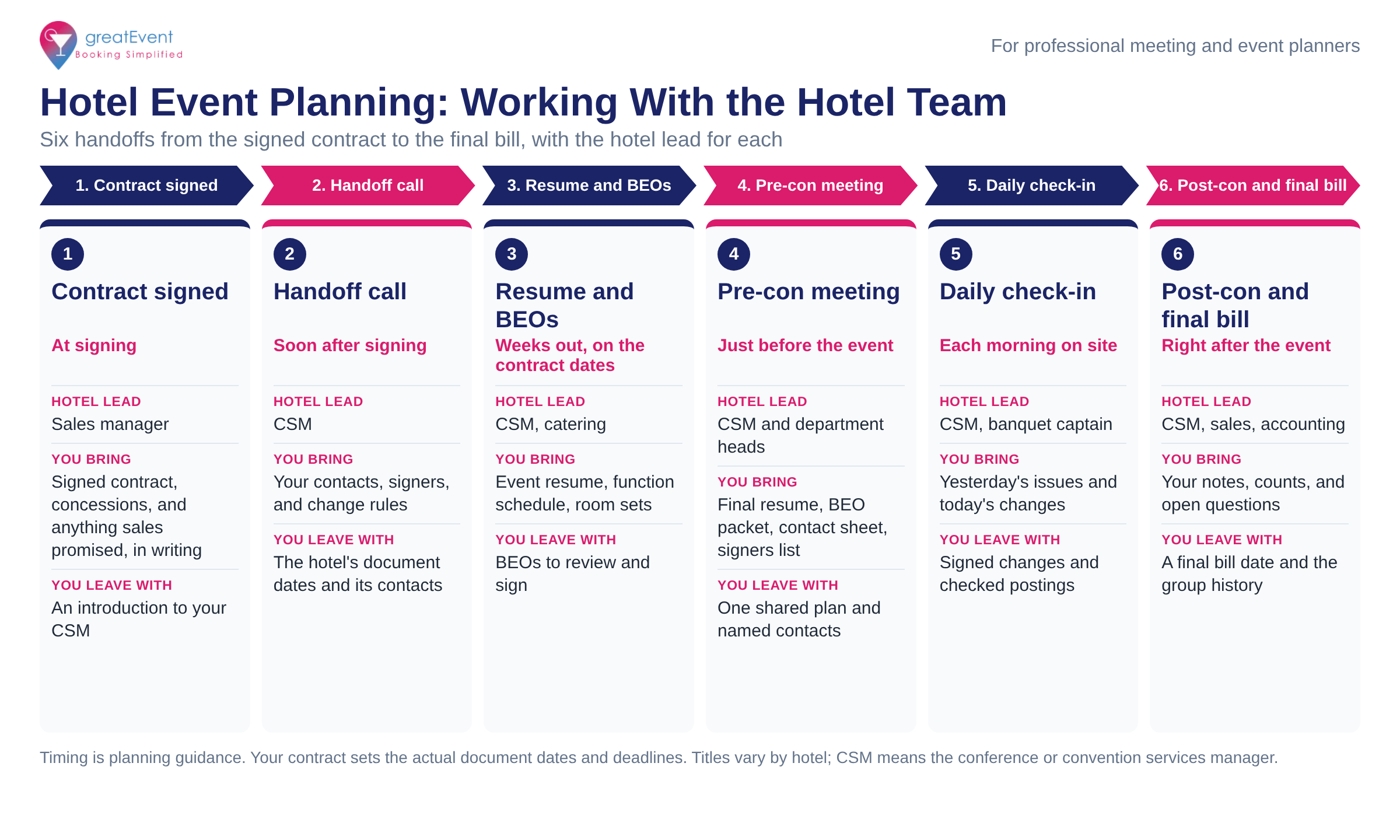
Text version of the infographic:
- 1. Contract signed. Timing: At signing. Hotel lead: Sales manager. You bring: Signed contract, concessions, and anything sales promised, in writing. You leave with: An introduction to your CSM.
- 2. Handoff call. Timing: Soon after signing. Hotel lead: CSM. You bring: Your contacts, signers, and change rules. You leave with: The hotel’s document dates and its contacts.
- 3. Resume and BEOs. Timing: Weeks out, on the contract dates. Hotel lead: CSM, catering. You bring: Event resume, function schedule, room sets. You leave with: BEOs to review and sign.
- 4. Pre-con meeting. Timing: Just before the event. Hotel lead: CSM and department heads. You bring: Final resume, BEO packet, contact sheet, signers list. You leave with: One shared plan and named contacts.
- 5. Daily check-in. Timing: Each morning on site. Hotel lead: CSM, banquet captain. You bring: Yesterday’s issues and today’s changes. You leave with: Signed changes and checked postings.
- 6. Post-con and final bill. Timing: Right after the event. Hotel lead: CSM, sales, accounting. You bring: Your notes, counts, and open questions. You leave with: A final bill date and the group history.
The handoff from sales to your CSM
At most full-service hotels, the sales manager owns the relationship until the contract is signed. After that, day-to-day planning moves to a services contact. The APEX glossary from the Events Industry Council describes the conference services manager as the “primary contact person assigned to an event” in a hotel, and notes that the same role is also called a convention services manager. Smaller hotels may give the job to an event manager or a catering manager instead. Whatever the title, find out who it is in week one.
Ask for a handoff call with the sales manager and the CSM together. Ask the sales manager to stay on long enough to walk the CSM through what was agreed. That’s when you catch the gap between what you were told and what the hotel’s services team has in its file. On that call, cover:
- The signed contract, clause by clause: room block and cutoff date, attrition, the food and beverage minimum, meeting space held, concessions, and deposit dates.
- Anything promised but not written down. If sales offered a free upgrade or a late checkout for your speakers in an email, ask for it in a contract addendum or a written confirmation from the hotel.
- The dates the hotel needs your resume, menus, rooming list, and final guarantees.
- Your CSM, their backup, and the hotel contacts for catering, front office, accounting, and security.
- How the hotel wants changes sent, and who on its side can approve them.
Send a short recap email after the call. Your CSM may not have been part of the sales conversations, so the recap becomes the shared starting point for both teams.
How the hotel side works, and what it means for you
Hotel management runs on forecasts, written orders, and set procedures. The kitchen orders food from guarantees, banquet staff are scheduled from the function schedule, and each department works from its copy of the orders. Your group may also share the building with other groups that week. That’s why your CSM asks for details early and in writing. Procedures differ by property, so confirm the specifics with your CSM.
| How the hotel works | What it means for you | What to send |
|---|---|---|
| Staff and food are scheduled from the function schedule and your guarantees. | Late changes can mean the hotel can’t staff a function, or it charges more for one. | Final counts by the contract dates, and room sets that match your diagrams. |
| Departments work from written orders, such as BEOs and the resume, not from email threads. | A request that isn’t on an order may not happen on the day. | Every request in the resume or a revised BEO, with a version date. |
| The hotel has set rules for deliveries, signage, security, and outside vendors. | Your vendors and suppliers need those rules before they arrive. | A request for the hotel’s vendor and delivery rules, forwarded to everyone who needs them. |
| Meeting space and guest rooms are sold to other groups too. | Space you don’t confirm can be reassigned, and other groups may share the foyer. | A confirmed function space schedule, including any 24-hour holds. |
| Hotels keep a record of each group’s actual rooms and spend. | That history shapes how the hotel prices your client’s next event. | A request for the post-event report of rooms picked up and spend. |
The event resume and the orders the hotel works from
The event resume is the master document for your program. APEX lists it under the event specifications guide, which it defines as a “comprehensive document that outlines the complete requirements and instructions for an event”, and notes that it is sometimes called a resume. At most hotels, the CSM uses it to write the banquet event orders and to brief the departments. Our guide to banquet event orders and their deadlines covers how BEOs are reviewed and signed.
For a hotel event, make sure the resume also covers the parts the hotel side can’t guess:
- A contact sheet with on-site cell numbers for you, your team, your client lead, and your vendors and suppliers.
- A short authorized signers list: the people who can sign BEOs, approve changes, and charge to the master account.
- Billing instructions: what goes to the master account and what attendees pay themselves. Our comparison of direct billing and credit card deposits covers how to set this up.
- VIP names, arrival times, and any requests the front office needs to know about.
- Deliveries and shipping: what is arriving, when, and who signs for it.
- How often you want room block pickup reports before the cutoff date. Our guide on managing room blocks for a conference covers what to watch in those reports.
Put a version date in the footer of the resume and of every attachment. Then, when the CSM asks which floor plan is current, you can both check the date.
Set the communication rules early
On-site mix-ups at hotel events often start before anyone arrives, when two people on your side ask the hotel for different things. Agree on a few rules during the handoff call, put them in the recap email, and repeat them at the pre-con meeting.
| Rule | Your side | Hotel side |
|---|---|---|
| Main contact | You, or one named lead on your team | The CSM |
| Backup | A named colleague who has the current resume | The CSM’s named backup or the manager on duty |
| Who approves charges | Only the people on your authorized signers list | The CSM, or the catering manager for food and beverage |
| How changes travel | In writing, against the current resume or BEO version | A revised BEO or a written confirmation back to you |
| Reply times | Agreed on the handoff call | Agreed on the handoff call |
| Escalation | Your client lead, through you | The manager the CSM names for escalations |
Ask your client not to send requests to the hotel directly. Copy them on the recap emails instead, so they see what was agreed without starting a second thread. If an executive on the client side wants something at the last minute, the request still goes through you, and you make sure it reaches the CSM in writing.
The pre-con meeting
The pre-con meeting is where the hotel team and your team go through the program together, once, before it starts. APEX describes it as a meeting at the main facility “just prior to the event beginning”, attended by the event organizer, the host organization, the facility’s department heads, other staff as needed, and contractors. As planning guidance, many planners hold it the day before the first function, or the morning of if the program starts late. Ask your CSM to book the room and invite the department heads. In the Denver example, that could be the afternoon before the general session, with the awards dinner walked through last because it has the most moving parts.
Who usually attends, and why:
| Attendee | Why they are there |
|---|---|
| You and your on-site lead | Run the meeting and walk the program day by day |
| Your client lead | Hears the plan once and meets the hotel contacts |
| CSM | Leads for the hotel and brings the department heads |
| Banquet manager or banquet captain | Owns food service and room sets. APEX calls the banquet captain the “person in charge of banquet service at food functions.” |
| Catering or catering sales manager | Confirms menus, guarantees, and dietary counts |
| Front office or rooms manager | Covers arrivals, VIPs, early check-in, and the room block |
| Accounting or credit | Confirms the master account, signers, and daily postings |
| Security and engineering | Covers access, emergency procedures, power, and room temperature |
| Your vendors and suppliers working in the hotel | Confirm load-in times, access, and the hotel’s rules |

Bring printed copies of the final resume, the signed BEO packet, the contact sheet, the authorized signers list, the latest pickup report, and the floor plans. Go through the program in time order, one day at a time, and let each department head speak to their part. Write down every change agreed in the room, then send the list to the CSM that day so the BEOs can be updated before the first function.
Copyable pre-con meeting agenda
Copy this into your own document and adjust it to your program. Everything in square brackets is a placeholder for you to fill in.
PRE-CON MEETING AGENDA
Event: [Event name]          Dates: [Dates]
Hotel: [Hotel name]          Room: [Meeting room]
Date and time: [Day, time]   Length: [planned length]
Resume version: [date]       BEO packet version: [date]

1. Introductions
   - Planner team, client lead, CSM, department heads, vendors and suppliers
   - Hand out the contact sheet with on-site cell numbers

2. Program overview
   - Purpose of the event, attendee profile, expected count
   - VIPs and speakers, arrival times, special requests

3. Rooms and arrivals
   - Latest pickup against the room block
   - Group arrival pattern, early check-ins, late checkouts
   - Rooming list changes since the last version

4. Day-by-day walkthrough (repeat for each day)
   - Each function in time order: room, set, start and end times
   - Food and beverage: guarantee, dietary counts, service timing
   - Room resets and turnover times
   - Your vendors and suppliers: load-in, access, load-out

5. Billing
   - Master account: what is charged to it, what is not
   - Authorized signers (names only)
   - Daily review of postings: who, when

6. Communication on site
   - Main contacts and backups on both sides
   - How changes are requested and confirmed
   - Daily check-in time and place

7. Safety and security
   - Emergency procedures, meeting point, first aid
   - Access, badges, after-hours rooms

8. Open questions and agreed changes
   - Read back every change agreed in this meeting
   - Owner and deadline for each one
On site: the daily check-in
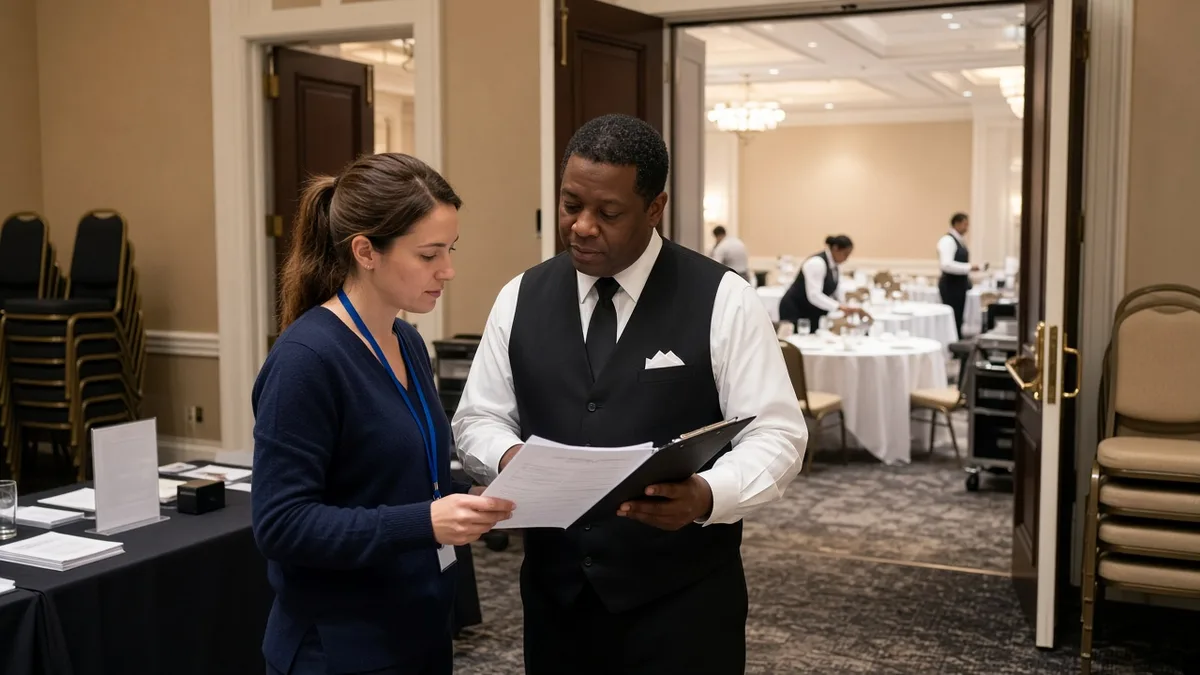
Once the event starts, set a short daily check-in with your CSM and the banquet captain or manager. As planning guidance, 15 to 20 minutes each morning before the first function is enough for most programs. Hold it in the same place every day, and keep it to three questions:
- Yesterday. What went wrong, what was fixed, and what still needs an answer. Compare the counts served with the guarantees.
- Today. Each function, its room set, and any changes. Confirm that the BEOs on the hotel side match yours.
- Tomorrow. Guarantees that are due, early setups, and departures.
Use the check-in to review the master account postings from the day before. APEX defines a master account as “a record of transactions during an event where the resulting balance is paid directly by the group”. A charge you question on day two is easier to resolve than one you find on the final bill a month later. Ask for the daily pickup or in-house count too, since late arrivals and no-shows can change your food guarantees.
When something goes wrong during the day, take it to the CSM or the banquet captain instead of asking the nearest server to fix it. Line staff may not be able to change the order, and a fix that isn’t written down can turn into a surprise charge. Agree on the fix, ask for a revised BEO if it affects cost, and sign it.
The post-con meeting and the final bill
APEX describes the post-con meeting as a meeting at the main facility “just after it has ended”, with the same kind of attendees as the pre-con. In practice it is often smaller: you, your client lead, the CSM, the sales manager, and someone from accounting. Hold it before you leave the hotel if you can, while everyone remembers the details.
A post-con agenda that works for most hotel events:
- What went well, by department, so the hotel can pass it on to its staff.
- What didn’t go well, with the time, the room, and what happened.
- Actual numbers: rooms picked up against the block, food and beverage spend against the minimum, and attendance.
- Open charges and disputed items, and who will answer each one.
- The date the hotel will send the final bill, and the date you will reply.
- What the hotel will record in your group’s history for next time.
When the bill arrives, check it against the contract, the signed BEOs, and your daily posting notes. Our guide on how to match concessions to the final bill has a line-by-line checklist for that step.
When the working relationship hits a snag
| Situation | What to do |
|---|---|
| Your CSM changes partway through planning | Ask for a handoff call with the old and new CSM if possible. Resend the recap email, the current resume, and the signed BEOs, and ask the new CSM to confirm the document dates. |
| Something sales promised is not in the contract | Raise it with the sales manager and the CSM together, and ask for it in an addendum or a written confirmation. Plan as if it won’t happen until you have it in writing. |
| The hotel misses one of its own deadlines | Send a written reminder that names the date in the contract, and copy the sales manager. Note the miss for the post-con meeting. |
| A charge you didn’t approve appears on the master account | Raise it at the next daily check-in with the posting date and the BEO it should match. Don’t wait for the final bill. |
| A department didn’t get the latest change | Fix it on the spot with the CSM, then check that the revised BEO has reached every department that uses it. |
| Your client changes the program late | Send the change in writing, ask the CSM what it costs and whether it can be staffed, and get your client’s approval before you sign the revised BEO. |
Find hotels for your next event on greatEvent
Working with the hotel team is easier when the hotel fits the program from the start. On greatEvent, planners can search venues by type, location, date, capacity, and distance, and compare meeting-room capacities side by side. You can send one detailed inquiry to multiple venues and get quotes back, then add services and a hotel room block. Start with hotels near you or conference venues near you.
There are no fees for planners. We pay you commission on any qualifying booking you make on greatEvent.
Register as a professional planner
Frequently asked questions
What does a convention services manager do at a hotel?
▾
The CSM is your main hotel contact after the contract is signed. They turn your event resume into orders for the hotel’s departments, manage your BEOs, and lead the hotel side on site.
What is a pre-con meeting?
▾
It is a meeting at the hotel just before the event starts, where you, your client, the hotel’s department heads, and your vendors go through the program together and agree on any last changes.
Who should attend a pre-con meeting?
▾
You and your on-site lead, your client lead, the CSM, the banquet and catering managers, front office, accounting, security, and the vendors working in the hotel.
What is an event resume?
▾
It is the master document for your event, listing every function, room, time, and requirement. The hotel uses it to brief its departments and write the banquet event orders.
What happens at a post-con meeting?
▾
You and the hotel review what worked and what didn’t, compare actual rooms and spend with the contract, list open charges, and agree on when the final bill will arrive.
How should planners send changes to the hotel?
▾
Send every change in writing to your CSM, against the current resume or BEO version, and wait for a revised BEO or written confirmation before you treat it as done.
Research and sources
Sources were checked on November 3, 2026. The opening scenario is fictional. Timing, attendee lists, and agenda items are planning guidance for a typical hotel event, not industry averages or study results. Hotel titles and procedures vary by property.
- Events Industry Council, APEX glossary: conference services manager (CSM), event specifications guide (ESG), pre-con meeting, post-con meeting, banquet captain, and master account, insights.eventscouncil.org.
Compare vendors for your next event
Search caterers, photographers, florists, planners, and rentals — then send one request to several vendors at once.