Quick answer: A 12-month wedding planning timeline for a professional planner runs in phases. From 12 to 10 months out, set scope and budget, sign the venue, and hold a hotel room block. From 9 to 7 months, book the vendors who take one wedding per date. From 6 to 4 months, handle guest travel, save-the-dates, secondary venues, and the tasting. At 3 to 2 months, invitations go out and you check room block pickup. The final month is for the marriage license window, the banquet event order, the final guarantee, and vendor arrival times. After the wedding, you close every account. Each phase ends with something signed or sent, so nothing slides into the next one.
Example scenario (fictional): A planner signs a new couple eleven months before an October Saturday at a lakeside venue. The couple booked the venue themselves, and it is lovely. Nobody asked the inn down the road about rooms. When the planner calls in week one, the inn has a corporate retreat on the same weekend and can offer eight rooms for 60 out-of-town guests. The next closest hotel is a 35-minute drive away, so the planner now needs a shuttle and a second block, and the save-the-dates have to wait until both are settled. One phone call at month 12 would have avoided all of it, and the countdown below is built around calls like that one.
This guide is for professional US wedding planners and agencies who run a couple’s planning year as a project: client meetings, venue and room block timing, vendor booking order, contracts and deposits, guest travel, and final confirmations with venues and event vendors. It is written to you as the planner. The timings are common planning practice, not rules, and they shift with the season, the market, and the size of the guest list. Contract points are planning information, not legal advice.
In this guide:
- How a planner’s timeline differs from a couple’s checklist
- The countdown at a glance
- 12 to 10 months out
- 9 to 7 months out
- 6 to 4 months out
- 3 to 2 months out
- The final month
- Two weeks out and the week of
- After the wedding
- Contracts and deposits tracker
- When the engagement is shorter
- Copyable countdown checklist
How a planner’s timeline differs from a couple’s checklist
A couple’s checklist lists what has to happen. Your timeline also has to say who owns each task, what gets signed, when money moves, and what a venue or vendor needs from you before they can do their part. If the couple wants their own version, our step-by-step wedding planning checklist covers the same year from their side, and the wedding planning checklist by category groups tasks by budget, venue, attire, and logistics.
Three things change when you run the year as the planner:
- You work backward from contract deadlines. The venue’s final guarantee date, the hotel’s cut-off date, and each vendor’s final payment date set the real calendar. The wedding date is only the end point.
- You manage decision speed. Many delays come from a client who takes three weeks to choose between two quotes. Agree at kickoff on who decides what and how quickly they will answer.
- You keep one source of truth. Guest count, timeline, floor plan, and vendor contacts change all year. Your vendors and suppliers should all be working from the same version.
The countdown at a glance
Use this as the spine of your project plan. The “lock” column is the test for moving on: if it isn’t signed or sent, the phase isn’t finished.
| Window | Planner focus | Lock before moving on | Client touchpoint |
|---|---|---|---|
| 12 months | Scope, budget, guest count range, date options, venue sourcing, site visits | Venue contract signed, first deposit paid, date confirmed in writing | Kickoff meeting: decision-makers and response times |
| 11 to 10 months | Hotel room block, vendor shortlists, preferred and required vendor lists from the venue | Room block agreement or written hold, with cut-off and attrition terms read | Budget check against the signed venue costs |
| 9 to 8 months | Vendors who take one wedding per date: photographer, videographer, caterer if not in-house, band or DJ, officiant | Signed contracts and deposits for each | Vendor meetings or calls |
| 7 months | Florist, rentals, hair and makeup, wedding website with room block link | Contracts signed; website live | Design meeting |
| 6 to 5 months | Save-the-dates, rehearsal dinner and welcome event venues, guest transportation, stationery order | Save-the-dates sent; secondary venue contracts signed | Midpoint budget review |
| 4 months | Menu tasting, ceremony details, first draft of the day-of timeline | Menu choices in writing; draft timeline shared with the venue | Tasting |
| 3 to 2 months | Invitations, RSVP tracking, room block pickup review, first round of vendor confirmations | Invitations mailed; pickup reviewed before any review or cut-off date | RSVP check-ins |
| 1 month | Banquet event order, marriage license window, final payment calendar, seating plan draft | BEO approved; license plan confirmed | Final planning meeting |
| 2 weeks | Final guarantee, rooming list, seating, vendor arrival schedule | Guarantee submitted by the contract deadline | Seating and timeline sign-off |
| Week of | Vendor confirmations, final walkthrough, rehearsal, payments due on the day | Run of show sent to every vendor | Rehearsal |
| After | Deposits, final invoices, room block reconciliation, reviews, debrief | Every account closed and filed | Debrief meeting |
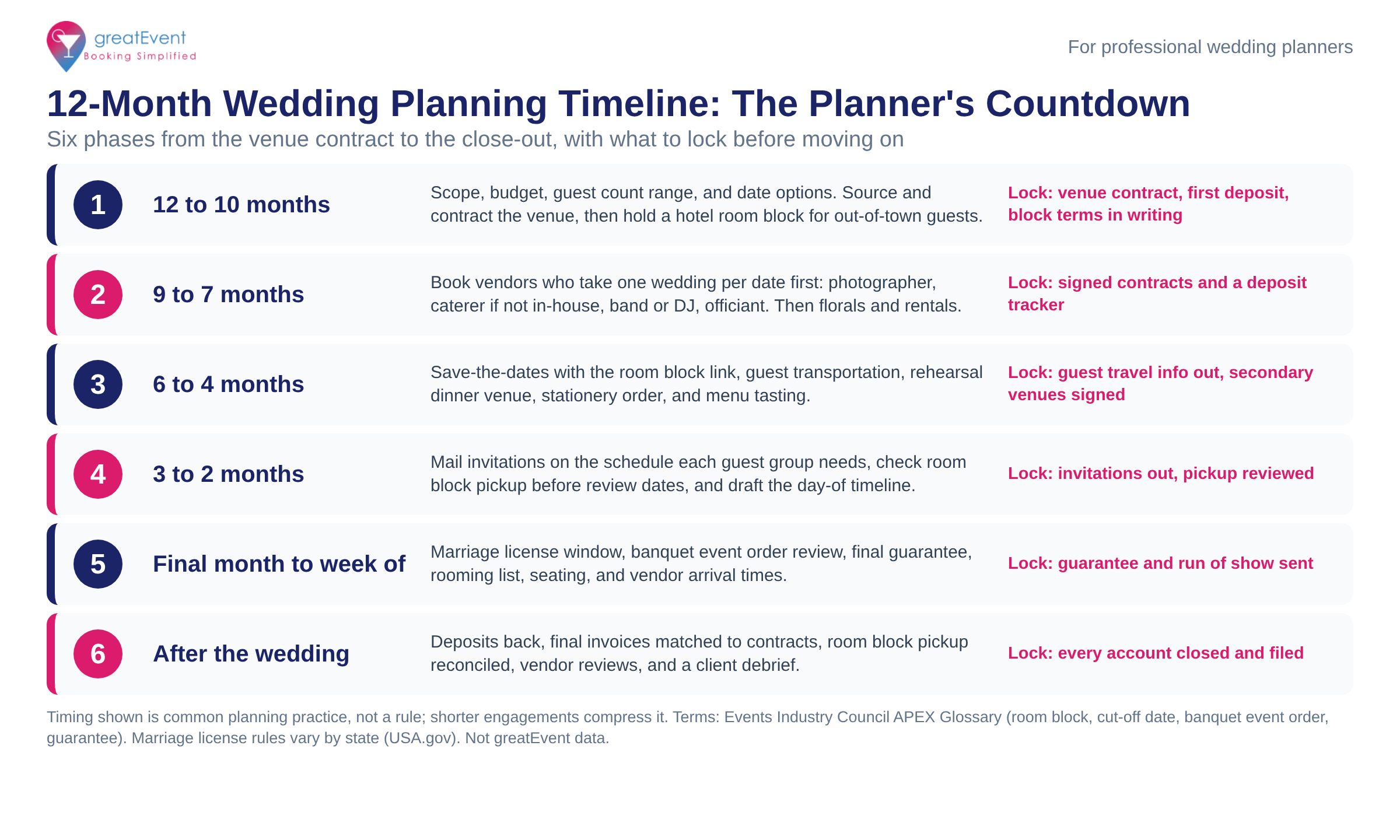
Text version of the infographic:
- 12 to 10 months: scope, budget, guest count range, and date options. Source and contract the venue, then hold a hotel room block for out-of-town guests. Lock the venue contract, the first deposit, and the block terms in writing.
- 9 to 7 months: book vendors who take one wedding per date first (photographer, caterer if not in-house, band or DJ, officiant), then florals and rentals. Lock signed contracts and a deposit tracker.
- 6 to 4 months: save-the-dates with the room block link, guest transportation, the rehearsal dinner venue, the stationery order, and the menu tasting. Lock guest travel information and secondary venue contracts.
- 3 to 2 months: mail invitations on the schedule each guest group needs, check room block pickup before review dates, and draft the day-of timeline. Lock invitations and the pickup review.
- Final month to week of: marriage license window, banquet event order review, final guarantee, rooming list, seating, and vendor arrival times. Lock the guarantee and send the run of show.
- After the wedding: deposits back, final invoices matched to contracts, room block pickup reconciled, vendor reviews, and a client debrief. Lock every account closed and filed.
12 to 10 months out: scope, venue, and the room block
Run a kickoff that sets the rules
Before you look at a single venue, get four things on paper: a guest count range, a total budget and who is paying for what, two or three date options, and the names of the people who sign off on decisions. Then agree how fast those people will answer. A two-day turnaround on vendor choices keeps the whole calendar on track. Two weeks puts it at risk.

Source and sign the venue
The venue sets the date, the capacity, the catering rules, and often the vendor list, so it comes first. Send every venue the same brief so the quotes come back in a form you can compare. Our wedding venue sourcing brief gives you a template, and our guide to what wedding venues cost in 2026 helps you check whether a quote is in range before you take it to the client.
Before the client signs, read the contract for the items that will drive the rest of your timeline:
- The deposit and payment schedule, with dates
- The final guarantee date for headcount, and whether you can go below it
- Food and beverage minimums and what counts toward them
- Required or preferred vendor lists, and any fee for bringing in an outside vendor
- Insurance certificates the venue needs from you and from each vendor
- Load-in and load-out times, end time, and noise rules
- The rain plan and the deadline for calling it
- Cancellation and date-change terms
Hold the room block early
The Events Industry Council’s APEX glossary defines a room block as the total number of sleeping rooms used by and attributed to one event. For a wedding, it is the rooms your out-of-town guests will book. Ask about rooms at the same time you contract the venue, especially on busy weekends when hotels near a venue may already have other groups. Ask how far ahead the hotel will contract a group block for your dates. If it won’t sign yet, ask for a written courtesy hold and a date when it will.
Read three terms before the client agrees to a block. The cut-off date is when the hotel releases unsold rooms to the public. Attrition is the gap between the rooms used and the number agreed in the contract, and damages can apply if pickup falls short. Ask whether a courtesy block with no attrition is possible, since wedding guests pay for their own rooms. And list the accessible rooms the group needs. The ADA regulation at 28 CFR 36.302(e) requires hotels to reserve accessible rooms on request and make sure they are “blocked and removed from all reservations systems.” If the venue has no rooms of its own, our guide to room blocks when the wedding isn’t at a hotel covers how to set one up nearby.
9 to 7 months out: book vendors in the right order
Once the date and venue are signed, book vendors in order of how hard they are to replace. A photographer or a band can only work one wedding on a given day, and the good ones fill popular dates early. A rental company can usually handle several events on the same day. The table shows one common order. Adjust it for the client’s priorities and the venue’s rules.
| Booking order | Vendors | Why this order | Confirm before signing |
|---|---|---|---|
| First | Photographer, videographer, caterer (if the venue has no in-house catering), band or DJ, officiant | One wedding per date; they are the hardest to replace | Date held, hours of coverage, overtime rate, travel fees, insurance |
| Second | Florist, rental company, hair and makeup | Often booked after the design direction is set | Delivery and pickup windows that fit the venue’s load-in times |
| Third | Cake or dessert, stationery, guest transportation | Depend on the guest count, the design, and the guest travel plan | Quantities you can change later, and the deadline for changes |
| Fourth | Rehearsal dinner and welcome event venues | Depend on where guests are staying | Capacity, minimums, and the distance from the room block hotel |
Check each vendor against the venue’s rules before the client signs. If the venue requires certificates of insurance or allows only approved caterers, a vendor who doesn’t meet those rules can’t work the event, however good the price is. Keep every quote, contract, and deposit receipt in one shared folder from the first booking on.
Seven months out, get the wedding website live with the room block link and the booking deadline on it. Guests who plan early will look for rooms as soon as they hear the date.
6 to 4 months out: guest travel, save-the-dates, and the tasting
Save-the-dates go out once the venue and room block are confirmed, because they should carry the date, the city, and where to book a room. Common practice is six to eight months before the wedding, and earlier for destination weddings. Our timeline for when to send wedding invitations covers save-the-dates and invitation timing for local, out-of-town, and destination guests.
This is also the window for the second layer of venues and services:
- Rehearsal dinner and welcome event venues, ideally close to the room block hotel
- Guest transportation between the hotel and the venue, with pickup times you can later put in the run of show
- The stationery order, with proof dates written into your calendar
- The menu tasting, once the caterer’s tasting schedule opens
By four months out, have a first draft of the day-of timeline and share it with the venue’s event manager. Their notes on setup times, kitchen timing, and room changeovers are easier to take now than in the last month.
3 to 2 months out: invitations and room block pickup
Invitations go out on the schedule each guest group needs: the guide linked above suggests six to eight weeks ahead for local guests and more lead time for guests who travel. Before you buy postage, have the stationer or the client weigh one fully assembled invitation at the post office. USPS says square, vertical, lumpy, or rigid envelopes must be hand-canceled and are charged a nonmachinable surcharge even under one ounce, and its nonmachinable criteria list the shapes and closures that trigger it, such as clasps, strings, and buttons.
Then check room block pickup. Ask the hotel for a pickup report and compare it with the guest list. If pickup is low, send a reminder with the booking link before the review or cut-off date in the contract, and ask whether the hotel will honor the group rate after cut-off for any rooms it still has. If pickup is high, ask whether it can add rooms at the same rate.
Start the first round of vendor confirmations now: date, arrival time, contact on the day, and anything still missing from their contract.
The final month: paperwork and final numbers
The venue or caterer will send a banquet event order (BEO), which APEX describes as the form hotels use to give their staff the details of a food and beverage function or room setup. Read it line by line against the contract and the tasting notes: times, menu, counts, dietary meals, linens, room layout, and the bar package. Corrections are easy now and hard on the day.
Plan the marriage license window with the couple. According to USA.gov, most marriage licenses expire within 30 days to a year, depending on the state. Some states add a waiting period. In Washington, for example, King County says a license can’t be used for three days after it is issued and is valid for 60 days after that. Pull the rules for the county where the ceremony happens, and put the earliest and latest dates to get the license in the couple’s calendar.
Also this month: draft the seating plan, put every final payment due date in one calendar, and confirm who is carrying payments due on the day.
Two weeks out and the week of
Two weeks out, the final headcount becomes a contract number. APEX defines a guarantee as a commitment to a minimum amount of rooms, food and beverage, or other revenue, usually with financial liability if it isn’t met. Send the final guarantee by the deadline in the venue and catering contracts, and keep the confirmation.
At the same time, send the hotel a rooming list if guests in the block are booked under your name or the couple’s, and confirm the rooms for the couple and the wedding party. Lock the seating plan and send every vendor their arrival time, setup window, and the name and number of the person they report to.

The week of the wedding:
- Confirm every vendor by phone or message, and log each confirmation.
- Walk the venue with the event manager, using the floor plan and the run of show.
- Send the final run of show to every vendor and the venue at the same time.
- Run the rehearsal, and confirm transportation pickup times with the driver.
- Pack the emergency kit and the envelopes for payments due on the day.
After the wedding: close every account
The project isn’t finished until the money and the paperwork are. Within the first few weeks:
- Track the return of any security or damage deposit under the venue contract.
- Match each final invoice to its contract, including overtime and added services, before the client pays.
- Ask the hotel for the final pickup report and check it against the block terms, including any attrition charge.
- Confirm that rentals were collected and counted, and that the couple’s personal items went home.
- Confirm who returned the signed marriage license to the issuing office, and by when.
- Send thank-you notes to vendors, and ask the couple for a review.
- Hold a debrief with the couple, then write your own notes on each venue and vendor for the next booking.
Contracts and deposits tracker
Build this tracker at the first booking and update it every time money moves. It is also the document you hand over if a colleague has to cover the wedding.
| Contract | Usually signed | Dates to track | Planner note |
|---|---|---|---|
| Venue | 12 months | Deposits, final guarantee, final payment, rain call deadline | Most other dates depend on this one |
| Hotel room block | 12 to 10 months | Review dates, cut-off date, rooming list, final pickup report | Ask for a courtesy block if attrition isn’t acceptable to the client |
| Caterer | 12 to 9 months | Tasting, menu deadline, final guarantee, final payment | Read the BEO against this contract |
| Photographer, videographer, music, officiant | 9 to 8 months | Deposits, final payment, timeline due date | Confirm overtime rates in writing |
| Florist, rentals, hair and makeup | 7 months | Final quantities, delivery and pickup windows | Match windows to the venue’s load-in times |
| Transportation | 6 to 5 months | Final route and pickup times, final payment | Add pickup times to the run of show |
| Rehearsal dinner and welcome event venues | 6 to 5 months | Headcount, minimums, final payment | Keep them close to the room block hotel |
When the engagement is shorter, or the wedding is a destination
The same phases apply with less time, so run them in parallel. With six months, sign the venue and the room block in the first two weeks, then book the one-wedding-per-date vendors the same month. Expect to choose from what is still available, and say so to the client at kickoff. Use the same brief for every venue so you can compare quotes in days. Our wedding venue proposal comparison template helps you lay offers side by side.
For destination weddings, move guest communication earlier. Guests need flights, time off, and sometimes passports, so save-the-dates and the room block link should reach them sooner than they would for a local wedding.
Countdown checklist (copy and edit)
Paste this into your project tool or the client’s planning document. Delete what doesn’t apply.
12-MONTH WEDDING COUNTDOWN - [Couple], [Date], [Venue]
Planner: [Name]   Guests: [range]   Decision-makers: [names]

12 MONTHS
[ ] Kickoff: budget, who pays for what, response times agreed
[ ] Venue brief sent to [__] venues; site visits [dates]
[ ] Venue contract signed; deposit 1 paid [date]
[ ] Venue terms logged: guarantee date, F&B minimum,
    vendor rules, insurance, load-in/out, rain call

11 TO 10 MONTHS
[ ] Room block: [hotel], [rooms] x [nights], courtesy or contracted
[ ] Cut-off date [__]; review dates [__]; attrition [__]
[ ] Accessible rooms requested: [number and type]

9 TO 7 MONTHS
[ ] Photographer / videographer / music / officiant signed
[ ] Caterer signed (if not in-house); tasting window [__]
[ ] Florist / rentals / hair and makeup signed
[ ] Website live with room block link and booking deadline

6 TO 4 MONTHS
[ ] Save-the-dates sent [date]
[ ] Rehearsal dinner and welcome event venues signed
[ ] Guest transportation booked; route and times drafted
[ ] Stationery ordered; proof dates [__]
[ ] Tasting done; menu choices in writing
[ ] Draft day-of timeline shared with venue

3 TO 2 MONTHS
[ ] Assembled invitation weighed; postage bought
[ ] Invitations mailed [date]; RSVP deadline [date]
[ ] Room block pickup report reviewed [date]
[ ] Vendor confirmation round 1 done

FINAL MONTH
[ ] BEO checked against contract and tasting notes
[ ] Marriage license window: [earliest] to [latest]
[ ] Final payment calendar complete

2 WEEKS / WEEK OF
[ ] Final guarantee sent [date]; confirmation saved
[ ] Rooming list sent (if needed); couple's room confirmed
[ ] Seating plan locked; vendor arrival times sent
[ ] Every vendor confirmed; final walkthrough [date]
[ ] Run of show sent to all vendors and the venue

AFTER
[ ] Security deposit returned [amount, date]
[ ] Final invoices matched to contracts
[ ] Final pickup report checked against block terms
[ ] Signed license returned by [who], [date]
[ ] Thank-yous, review request, client debrief
Source wedding venues, vendors, and room blocks on greatEvent
The first phase of the countdown moves faster when every venue answers the same brief. On greatEvent, planners can search venues for weddings and social events and find event vendors such as caterers, photographers, videographers, DJs, florists, and cake makers. You can send one detailed inquiry to multiple venues and get quotes back, then add services and a hotel room block and finalize the details with your event specialist, so your vendors and suppliers all work from the same facts.
There are no fees for planners. We pay you commission on any qualifying booking you make on greatEvent.
Register as a professional planner
Frequently asked questions
What is a 12-month wedding planning timeline?
▾
It is a month-by-month plan that runs from about a year before the wedding to the close-out after it. For a professional planner, each phase ends with something signed or sent, such as the venue contract, the room block, vendor contracts, invitations, and the final guarantee.
What should a wedding planner book first?
▾
The venue, because it sets the date, capacity, catering rules, and often the vendor list. Then the hotel room block and the vendors who can only work one wedding per date, such as the photographer, band or DJ, and officiant.
When should I set up a hotel room block for a wedding?
▾
Ask about rooms when you contract the venue, often 12 to 10 months out. If the hotel won’t contract that far ahead, ask for a written courtesy hold and a date when it will sign.
When is the final headcount due?
▾
Whenever the venue and catering contracts say. Final guarantee dates are often one to two weeks before the event. Put each one in your tracker the day the contract is signed.
What does a planner do after the wedding?
▾
Close every account: track deposit returns, match final invoices to contracts, check the hotel’s final pickup report, confirm the marriage license was returned, thank vendors, and hold a debrief with the couple.
Research and sources
Sources were checked on October 29, 2026. The timings in this guide are common planning practice, not rules or survey data. The opening scenario is fictional. Marriage license, mailing, and hotel rules vary and change, so confirm current rules with the issuing office, USPS, and each hotel. Contract points are planning information, not legal advice.
- Events Industry Council, APEX Industry Glossary, insights.eventscouncil.org: room block, cut-off date, attrition, banquet event order (BEO), guarantee, rooming list.
- U.S. Department of Justice ADA regulations, 28 CFR 36.302(e), reservations made by places of lodging, ecfr.gov.
- USAGov, How to get a copy of a marriage certificate or a marriage license, usa.gov.
- King County, Washington, Marriage licensing, kingcounty.gov.
- USPS, First-Class Mail and postage, usps.com, and Publication 25, 3-6 Nonmachinable Criteria, about.usps.com.
Compare vendors for your next event
Search caterers, photographers, florists, planners, and rentals — then send one request to several vendors at once.